They Poured Wine on the Humiliated Maid—The Mafia Boss Watching From the Shadows Risked Everything to Protect Her

## PART 1
The thing about humiliation was that it always took you by surprise even when you could see it coming.
Sera Lin had been watching Preston Holt all evening. Not because he was interesting — he was precisely as interesting as a twenty-nine-year-old who had inherited a name and confused it for a personality — but because she had learned, in eighteen months of catering work, that men like Preston were the weather. You tracked them not from curiosity but from the same instinct that made you check the sky before walking home.
His table had been loud since seven. His voice had the particular carrying quality of someone who had never been asked to keep it down. He was blond in the way that seemed to require effort, dressed in a tuxedo that fit him with the precision of custom tailoring, and he moved through the Holt ballroom with the absolute security of a man who had never needed to wonder whether he was welcome somewhere.
She had felt his eyes on her twice.
Not the way she disliked being looked at by wealthy men at these events, which was the functional invisibility of staff existing in service, the look that catalogued her as a resource. This was something else. Something with intention.
She had made a note of it and kept moving.
The ballroom was beautiful in the way of spaces built to demonstrate wealth rather than create comfort. High ceilings. Crystal chandeliers. Imported marble that caught the candlelight and sent it multiplied across every surface. The guests matched the room: diamond-studded, expensively perfumed, arranged in the strategic clusters of people who had decided which other people were worth knowing this season.
Sera moved through them with her tray and her uniform and the specific neutrality she maintained at these events, which was its own professional skill. You became slightly less than present. You operated in the margins of the gathering. You were useful without being memorable.
She was refilling champagne flutes at the west end of the room when Preston appeared in front of her.
He had a wineglass in his hand.
He was smiling.
“More of that?” he said, gesturing at her tray.
“Of course,” she said, reaching for the bottle.
She did not see it coming. That was the part she would think about later, in the specific way you thought about the moment before an accident, cataloguing your own failure to anticipate it. She should have seen it. She had been watching him all evening.
But when he tilted the glass, she was already reaching, already turned half away from him, and the cold red wine hit her head from behind like a verdict.
She felt it move through her hair and over her forehead and into her collar and down inside her uniform, the cold of it shocking even against skin she had been trying to keep neutral all night. She went still for one second before survival reflex caught up.
Laughter moved through the nearby guests with the loosening quality of something they had been waiting for. Not all of them — some held their expressions carefully — but enough of them. The people near the bar. A woman in green silk who covered her laugh with her hand without actually dampening it. A man in a blue suit who had his phone out with the camera already raised.
Preston set the glass on her tray.
“My mistake,” he said, loudly enough that the laughter could hear the invitation. “Are you all right?”
He said it like a punchline.
His mother, Helen Holt, watched from near the fireplace with the composed expression of a woman who had arranged this room and arranged the people in it and arranged the version of events that would be told about tonight. She was wearing gray silk and the kind of jewelry that had stopped being valued against money some generations back.
“Perhaps,” she said, “this will remind us all of the importance of attentiveness.”
She was not speaking to Preston.
Sera’s hands tightened around the tray.
Not from fear. From calculation. From the same instinct that said: do not throw this. Do not say what you are thinking. Do not let the two hundred people in this room have anything but your control to look at.
“My apologies,” she said. “I’ll take care of this.”
“Please do,” Helen said.
Sera knelt to the spilled glass because it was there and because kneeling was better than the alternative, which involved the tray and Preston’s face and the complete destruction of everything she had been holding together for seven months. The marble floor was cold through her uniform. She could see herself in it, refracted and diminished, the way expensive floors were designed to show you yourself in bad light.
She thought about room six. St. Catherine’s oncology ward. The letter from the insurance company explaining, in language designed to be technically accurate and emotionally unintelligible, why they would not cover the treatment. The number on the bottom of the letter.
She kept cleaning.
Across the room, a man set down an untouched drink.
He had been standing near one of the structural columns all evening, which she had noticed because he did not move the way other guests moved — circulating, performing, angling for proximity to the right cluster. He stood with the specific stillness of someone who was watching rather than participating, and she had catalogued him once at the beginning of the night and then redirected her attention to more immediate concerns.
She did not see him now.
She did not see him take out his phone.
She did not hear him say, quietly, to the person who answered: “Find out her name. Address, family, situation. Everything. Within the hour.”
At twelve-fifty, after the crowd had thinned and the chandeliers had dimmed enough to start looking like stage sets, the event coordinator found her in the service corridor.
He did not meet her eyes.
“Ms. Holt would like to see you.”
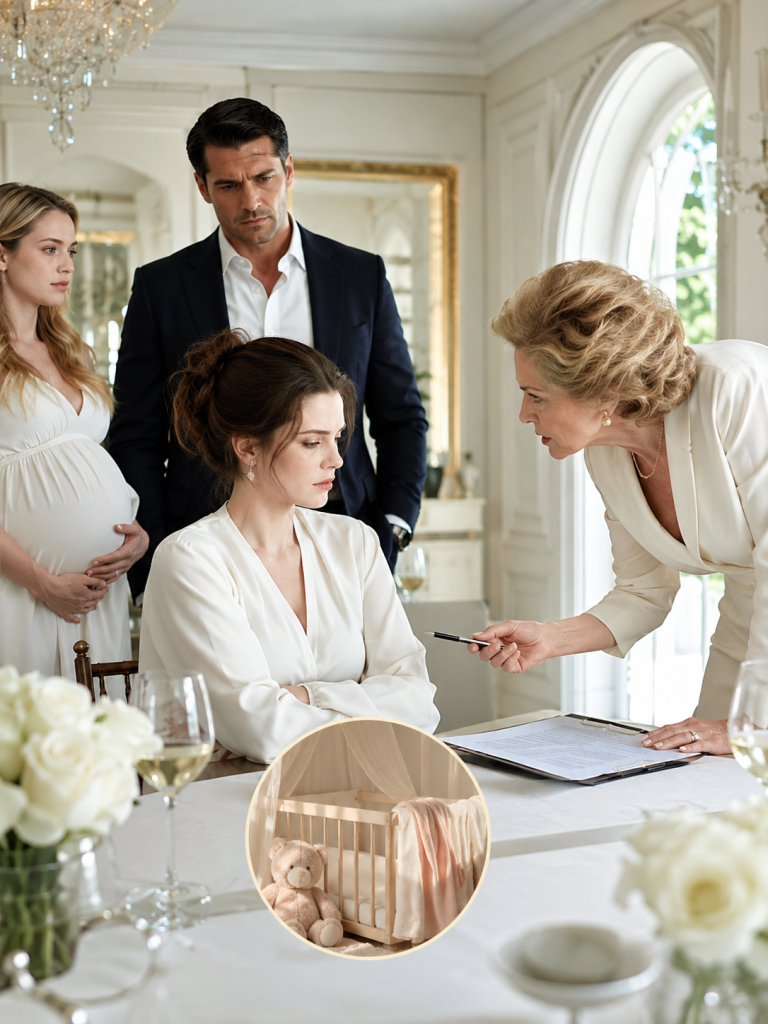
Helen Holt’s office smelled like lilies and recent decisions. She sat behind her desk in gray silk with her hands folded in the specific way of a woman who had arranged her posture as carefully as she had arranged the rest of the evening.
“Sera Lin,” she said. “We will not require your services going forward.”
The words arrived in a language Sera understood — not the words themselves, but their function, which was to finalize something that had been decided before she walked into the room.
“I see,” she said.
“The incident this evening was disruptive. Our guests were uncomfortable.”
“I understand. If I could collect my wages for the week—”
“I’m afraid that isn’t possible.” Helen’s smile was the same temperature as the office. “The cleanup. The inconvenience to our guests. Consider it applied to those expenses.”
Three hundred eighty dollars.
She thought about what three hundred eighty dollars represented in the architecture of the current month. What had been balanced against what. What moved when something was removed.
Security walked her to the door.
The October night hit her uniform where it was still damp and cold. She stood on the Holt driveway and took out her phone to check the bus schedule and understood from the numbers that she would be standing here for another three and a half hours.
She sat on the low wall near the service gate.
The hospital denial letter was still in her email. She read it again even though she knew every line because reading it was better than sitting with what it meant.
That was when the car found her.
Not a sound first — she didn’t hear it approach. Just the quality of the light changing slightly, and then headlights beside her, and then a window coming down.
“Ms. Lin,” said a male voice, calm and precise. “I’m asking you to speak with my employer.”
She stood up immediately and stepped back.
“I don’t know you.”
The door opened slowly. A man in a dark suit stepped out with his hands visible, which was a specific kind of gesture, the gesture of someone who had learned what it communicated.
“My name is Marco Ferretti. I work for Luca Ferrante of Ferrante Holdings. We were guests tonight.” He held out a card and a badge she could verify. “My employer was present in the ballroom. He asked me to find you before you left.”
“Why?”
Marco looked back toward the mansion, where music still drifted through the hedges.
“Because,” he said, “Mr. Ferrante has very specific feelings about cowards.”
The word landed differently than it should have.
She got in the car.
—
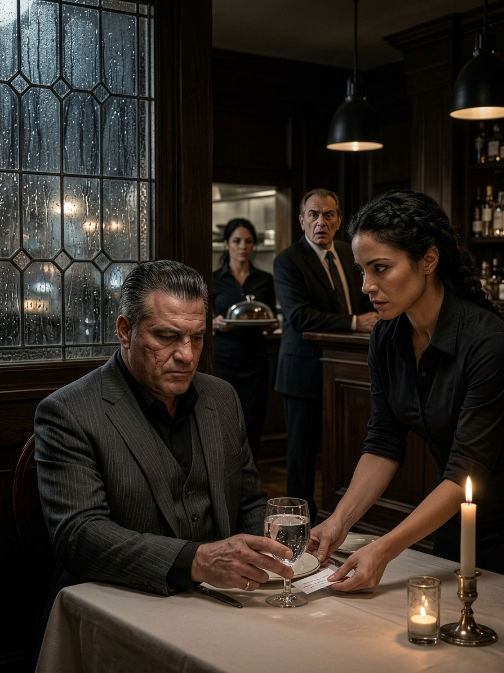
The restaurant was called Carraio, closed for the night except for a back corner where someone had arranged a table with coffee and a lamp turned low. Photographs on the brick wall — cityscapes, bridges, one large print of a harbor in what looked like Genoa.
A man rose when she entered.
Not tall in a way that announced itself. Broad-shouldered, controlled in his movement, dark hair slightly longer than professionally expected. He had a scar at his left temple that caught the lamplight and made his face look like it had been through something it had survived.
“Ms. Lin,” he said. “I’m grateful you agreed to come.”
She stayed near the door.
“Your driver said you wanted to speak about what happened.”
“I did.” He gestured to the chair across from him. “Please.”
She sat because her feet hurt and because she had not eaten since noon and because the alternative was the service gate and three hours in the cold. She sat and she watched his face the way she watched faces at these events — for the calculation underneath the surface, for what was being withheld, for what the presentation was protecting.
“What happened this evening was unacceptable,” he said.
“It happens.”
“That it happens is not an argument that it should.”
She looked at him.
“You’re going to offer me money,” she said.
Something moved at the corner of his mouth. Not quite a smile. Recognition, maybe.
“Yes,” he said. “Starting with the wages you earned tonight.”
He slid an envelope across the table. She opened it. Three hundred eighty dollars in cash, exact.
“How do you know the amount?” she asked.
“My staff research quickly.”
“And what else did your staff research?”
He looked at the table.
“Before I answer that,” he said, “I want you to know that you can leave this table at any time. Nothing is owed. Nothing is required. I saw something tonight that I found unacceptable, and I have the means to address it, and the only thing I’m asking is whether you’ll let me.”
She looked at him.
“People don’t help people like that,” she said. “There’s always something.”
“You’re right to be suspicious,” he said. “There is something. But it is not what you may fear.”
“Then what is it?”
He looked at the table again.
“I am offering you employment,” he said. “Translation work. I have contracts across four countries that require fluency in Mandarin, Cantonese, and Spanish. I have been paying brokerage fees to an agency for two years for work that could be done better in-house.” He raised his eyes. “Your CV indicates you hold all three, plus French.”
She stared at him.
“You researched me enough to find my CV.”
“Yes.”
“In the last ninety minutes.”
“My staff research quickly,” he said again, without apology.
She should have stood up. She thought about standing up. She thought about what it meant that a stranger with resources and a private driver had found out enough about her in ninety minutes to produce a figure she recognized from her own bank account.
And then he opened a folder on the table.
Inside were documents she recognized.
Not copies of her CV. Not financial records. An intake form from St. Catherine’s. An oncology report. A letter on insurance company letterhead. A number at the bottom of that letter.
Her breath left her body.
“How,” she said.
“Your mother. Margaret Lin. Ovarian cancer, stage three, Dr. Vance. Insurance denial. One hundred sixty thousand dollars.”
She was on her feet before she had made the decision.
“You had no right—”
“No,” he said quietly. “I did not.”
The admission stopped her movement before she could complete it.
He stayed in his chair. Both hands on the table, visible, the posture of a man who understood that certain kinds of transparency were load-bearing.
“You had no right,” she said again.
“Correct,” he said. “But I have it now, and I am choosing how to use it. Which is different from having taken it without using it for harm.”
She stood at the table’s edge.
“What do you want?”
“I want to tell you that I am prepared to address that letter,” he said. “Through a charitable trust, cleanly, no strings, no publicity. And I want to offer you work that is worth your actual qualifications.”
“And what do you get?”
“A translator I do not have to explain everything to twice,” he said. “And the knowledge that I did something with the advantages I have rather than nothing.”
She looked at the insurance denial letter in his folder.
Then he placed one more piece of paper on the table. He kept his hand on the corner before she could read the number.
“I will not force any part of this,” he said. “But I will say it plainly. You are carrying something that is going to break you if no one helps. I am in a position to help.”
He lifted his hand.
She looked at the number.
And before she could decide whether to take it or leave it, the restaurant door opened behind her, and the voice that entered was one she had been listening to all evening.
—
## PART 2
Preston Holt.
He was still in the tuxedo, still in the specific confidence of a man who had spent the evening performing for an audience and had not finished performing.
He had a phone in his hand.
He stopped when he saw Luca Ferrante.
The calculation on his face was visible — not fear exactly, but the rapid assessment of power ratios, which men like Preston performed automatically. He looked at Luca. At Marco near the door. At Sera, still standing at the table’s edge, still with the number under her eyes.
“Well,” Preston said. “This is interesting.”
Luca was very still.
“Interesting how,” he said.
“The server and the suit.” Preston’s smile had the quality of something stored and waiting. “I was looking for you, actually.” He raised the phone, angled toward Sera. “I uploaded a little something. Thought you might enjoy watching it with company.”
On the screen, in the bright, polished clarity of a catered event’s chandelier lighting, Sera could see herself on her knees on the marble floor. Someone had caught it in portrait. High resolution. Her face visible, her uniform dark with wine, her hands on the floor, the surrounding guests all standing above the frame.
Under it, Preston had already written a caption.
She did not read it. She did not need to.
“Posted twenty minutes ago,” Preston said. “Already doing well. The algorithm loves a uniform.”
The phone buzz in his hand was the new comment arriving.
Marco moved away from the door toward the table, not threateningly — just closer, the shift of someone repositioning to have better options.
Luca looked at the phone.
Then he looked at Sera.
“Does he need permission,” Luca asked quietly, “from you. Or should I address this directly?”
She looked at him.
She looked at Preston, who was watching this exchange with the curious expression of a man who had expected his entrance to land differently and was still waiting for the fear to arrive.
She thought about her mother.
She thought about what it cost to hold yourself together for seven months in front of people who assumed your circumstances made you more yielding, not less.
She thought about the number on the paper that was still on the table behind her.
“I would like to address it myself,” she said.
Luca looked at her.
“All right,” he said.
She turned to Preston.
“Take it down,” she said.
Preston laughed. “I don’t think—”
“You poured wine on my head because you thought I would absorb it,” she said. “Your mother took wages I earned because she thought I needed the money too badly to fight her. And now you are standing in a restaurant at one in the morning showing a room full of strangers a photograph of someone’s humiliation because you think that’s the kind of person you are allowed to be.”
Preston’s smile was still there but something in it had recalibrated.
“You don’t have leverage here,” he said.
“I don’t need leverage,” she said. “I need you to understand that what you filmed tonight is not something you are allowed to use. Because it is me. And I am telling you to delete it.”
The room was very quiet.
Preston looked at Luca.
Luca looked at Preston with the particular expression of a man who had already made a calculation and was waiting for the arithmetic to finish.
“My legal team,” Luca said, “has been monitoring the post since it went up. The image was taken at a private event at which our firm was contracted as a vendor. Ms. Lin is an employee of that firm. Her likeness was captured and disseminated without consent in a context designed to humiliate her in her professional capacity.” He picked up his own phone, glanced at it. “That’s three separate grounds. The take-down request has already been submitted to the platform. The post will come down in the next fifteen to twenty minutes regardless.” He set his phone on the table. “The question is what you do between now and then.”
Preston’s jaw tightened.
“You can’t—”
“I have,” Luca said simply. “The question is whether you delete it yourself, which costs you nothing except the performance, or whether it comes down through enforcement, which becomes part of a documented record.”
A beat.
Another beat.
Preston looked at his phone.
He looked at Sera.
She looked back at him and did not do anything with her face. Eleven years of catering work and three jobs and seven months of oncology waiting rooms had made her face very patient.
Preston deleted the post.
He left without saying anything.
Marco closed the door behind him.
Luca sat back down at the table.
Sera stood for a moment, the specific unsteadiness that followed something being released that had been held for a long time.
Then she sat down too.
“Your employer,” she said.
“The Ferrante Holdings contract, yes,” Luca said. “Real work, documented, taxed. The hospital fund is separate — a charitable entity with no connection to employment.”
“I need to see the structure of the fund.”
“I will have documents prepared.”
“And I need to understand the employment contract before I sign anything.”
“Of course.”
She looked at the number on the paper.
She looked at the hospital folder.
She thought about her mother in room six with the window that faced east and the nurse who remembered her name without looking at the chart.
“I have questions,” she said.
“Yes,” he said. “I imagine you do.”
He refilled the coffee.
—
## PART 3
Three days later, Sera met with Luca’s legal team in a glass-walled conference room on the fourteenth floor of a building in the financial district.
She brought her own legal representation — a woman named Carolyn Park who worked in employment law and who had reviewed the contract overnight and then called Sera at seven in the morning to say it was unusually clean and she should probably check for catches because unusually clean contracts were their own kind of suspicious.
There were no catches.
There was a non-disclosure clause about the terms of her compensation, which Carolyn flagged and which Sera asked to have revised to exclude any restriction on discussing the circumstances of the Holt event. The Ferrante legal team agreed to the revision in the same session.
The charitable contribution went to St. Catherine’s oncology fund in her mother’s name the following Monday.
Her mother called her on Tuesday.
She had been told by the billing office, which had received the donation, that an anonymous benefactor had contributed to her care, and that her outstanding balance had been covered, and that the treatment could proceed.
“Did you do this?” her mother asked.
“Not exactly,” Sera said.
“Who did?”
“Someone who saw something they thought was wrong,” Sera said.
A pause.
“Are you safe?” her mother asked.
“Yes,” Sera said. And because her mother asked this the way mothers asked things, which was with the full weight of their knowledge of you: “I think so. I’m making sure.”
“The translation work?”
“It’s real,” Sera said. “I’ve already started.”
The work was real.
It was also, in the mundane and slightly anticlimactic way that real work tended to be, simply work. She translated contracts, correspondence, investor materials. She worked remotely, on her own schedule, at her kitchen table with two monitors and a coffee that she made herself instead of carrying for other people. She submitted work and received feedback and occasionally had to push back on a revision request, which Luca’s team accepted without requiring her to justify herself at length.
That last part was the part she had to adjust to.
She was used to work environments where pushback required performance — where you had to be pleasant and deferential even when you were right, where the energy cost of being correct was higher than just absorbing the error. The Ferrante operation did not work that way. People said what they meant. When she was right, they said so. When she was wrong, they said so clearly and without drama and expected her to update accordingly.
It was, she thought, what competence looked like when it wasn’t also being asked to perform something else.
She saw Luca occasionally.
He was in the building most days, which was large and housed three separate enterprises, and she sometimes passed him in the corridor or encountered him in a meeting that included the translation department. He was the same person he had been in the restaurant — controlled, attentive, not particularly interested in performing warmth but genuinely interested in what was accurate.
He asked her once, about three weeks in, whether she had noticed a phrasing issue in a Spanish-language investor letter that had been reviewed by two people before reaching her.
She said she had and had flagged it in the document.
“I saw that,” he said. “I wanted to know whether you’d bring it up in conversation or just leave it in the document.”
“What was the significance?”
“People who leave things only in documents are protecting themselves,” he said. “People who also say it out loud are investing in the outcome.”
“I left it in the document,” she said.
“And now you’re saying it out loud.”
She looked at him.
“You’re running a test.”
“I run tests on everyone,” he said, without apology. “It’s how I understand how people operate.”
“And what have you determined about how I operate?”
He looked at her in the direct way that she had noticed was simply how he looked at things he was paying attention to.
“That you have been working very hard for a long time to be indispensable in situations where indispensable was not valued,” he said. “And that you are recalibrating to a context where the indispensability is the point.”
She held his gaze.
“That’s accurate,” she said.
“I know,” he said.
—
Her mother was admitted for the first treatment in November.
Sera took the day.
She sat in the waiting area outside the treatment suite and answered work emails and tried not to think about numbers, which was difficult because thinking about numbers was a coping mechanism she had developed over the seven months before the treatment became possible. When you could not affect the outcome of something, you counted. You calculated. You ran the arithmetic until it produced an answer that felt actionable even when it wasn’t.
Now the arithmetic had changed.
She was sitting with this when Luca’s name appeared on her phone.
*Not a work message. Checking in. Unnecessary.*
She looked at the message for a moment.
Then she wrote back: *She’s in the third treatment now. They say today went better than expected.*
A pause.
*Good. Take the time you need.*
She put the phone away.
The nurse came out at two-fifteen to say the treatment had gone well and her mother was resting and she could come in if she wanted.
Her mother was sitting up in the bed with a magazine she was probably not reading and the window facing east, the morning light now afternoon light coming in across the foot of the bed. She looked tired in the specific way of someone who had just been through something significant and had survived it.
“You stayed,” her mother said.
“Of course.”
“You didn’t have to.”
“Yes I did,” Sera said. “That’s not the same as having to.”
Her mother patted the bed. Sera sat.
They stayed like that for a while, without talking, which was the particular comfort of a relationship that did not require the performance of okayness.
Eventually her mother said: “The man who helped. Will you tell me about him?”
Sera thought about the restaurant. About the specific quality of the lamplight. About a man who had said *I did not have the right* without making it sound like an absolution.
“He saw something he thought was wrong,” she said. “And he had the means to do something about it.”
“And you trusted him?”
“I verified everything first,” Sera said.
Her mother laughed, which was the sound she had been trying to hear for seven months.
“That sounds like you,” her mother said.
“That is me,” Sera said.
—
The Holt family was less interesting as an ongoing story than as a closed one.
Helen Holt’s response to the events of the gala was initially nothing, and then eventually a formal cease-and-desist through her attorneys regarding the legal hold on Preston’s post, which arrived after the post had already been down for two weeks. The attorneys sent it anyway, which Luca’s team acknowledged formally and did not respond to further.
Preston’s name appeared several months later in the context of a separate matter involving his property development company, which had nothing to do with Sera and which she read about in a business news aggregate while eating lunch at her desk. She noted it and closed the tab.
She did not feel triumphant about it.
Triumph required sustained investment in the outcome, and she had redirected that investment.
What she had was the work. The mother in treatment, responding better than expected. The apartment that was the same size it had been eight months ago but which felt different now because the specific fear that had made everything smaller had been replaced by something more spacious.
She and Luca had dinner once, three months after the restaurant, at a place she chose and paid for herself, which she had told him in advance was a condition, and which he had accepted without discussion.
She told him about the catering work. Not as a grievance — as information. The specific education of years in rooms where you were required to be useful without being seen, and what you learned in those rooms about the architecture of power and who moved through it and how.
He listened the way he listened to things that were relevant.
“What did you take from it?” he asked.
“That being invisible is only an advantage if the people looking for you are the wrong people,” she said. “When the right people are looking, you want to be found.”
He looked at her.
“Is that what happened at the gala?”
“I think so,” she said. “Although I would have preferred a less theatrical method.”
The corner of his mouth moved.
“I’m sorry about the method,” he said.
“The method was Preston’s.”
“The timing was mine. I could have approached you differently.”
“You could have,” she agreed. “But you did it this way, and I said yes, and it worked out.”
“In your assessment.”
“In my assessment,” she confirmed.
He looked at the table.
“I would like to know,” he said, “in your ongoing assessment. How it’s working.”
She considered this.
“You could ask,” she said.
“I am asking.”
“Then I’ll tell you,” she said. “When it’s relevant.”
He looked at her.
“That sounds like an arrangement,” he said.
“It is,” she said.
He considered it.
“All right,” he said.
They finished dinner.
She walked home in the October cold with her coat pulled closed and the city doing what cities did at eight in the evening — generating noise and light and the specific indifferent energy of a place that continued regardless of what anyone inside it was working through.
She thought about what had changed and what hadn’t.
The money was different. The work was different. The specific weight of the month had changed its character. Her mother was in treatment and responding.
She was the same.
Not unchanged — changed, obviously, in the ways that seven months of any sustained difficulty changed you. But still herself. Still with the same opinions about contracts that she had been carrying since the first job she’d taken that didn’t match her degree. Still with the same habit of reading terms carefully. Still with the same preference for saying what was accurate over what was comfortable.
That had been her before Preston Holt poured wine on her head.
It was her after.
The wine had changed nothing about her.
It had just put her in the same room as a man who noticed, and who had the means and the inclination to do something with what he noticed.
The rest was the work.
She had always been good at the work.
—
*THE END*