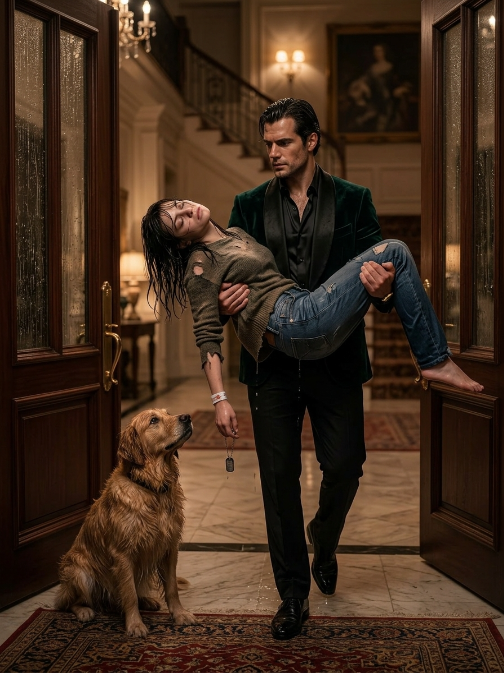
The Mafia Boss Found Her Chained in the Basement—And It Was in His Brother’s House

## PART 1
The first thing Cora Vasquez noticed when she finally stopped counting was how quiet she had become.
Not peaceful quiet. The other kind — the quiet that settles into a person when screaming has proved useless enough times that the body stops proposing it. The quiet of someone who has learned to measure time by the temperature of the room and the weight of footsteps overhead, because those were the only honest calendars left.
The basement smelled of damp concrete and rust and something organic she had stopped trying to identify in the first month. A drain in the far corner. Water she could hear but not reach. The pipe ran along the eastern wall, and the cuff at her ankle had been locked to it with the matter-of-fact cruelty of something designed rather than improvised.
Someone had prepared this room.
That thought, which had occurred to her approximately one thousand times over the weeks of her captivity, still produced the same cold drop in her chest every time she completed it.
She had been a surgical nurse at Mercy West for six years.
Her life was twelve-hour shifts and charting errors and the particular fellowship of people who stayed awake while the city slept. Her apartment was nine minutes from the hospital. She had a small collection of houseplants she was moderately successful at keeping alive. She went running on Sunday mornings before the lakefront got crowded.
She did not have a life that ended in chains.
But lives like hers ended in chains when someone decided they should.
The night the voices came, they arrived as an argument.
Not one person — several, raised above each other, competing with urgency she could feel through the floorboards. She dragged herself to the corner by habit and pulled her knees to her chest, the chain scraping as she moved. Her heart beat hard.
Then the door at the top of the stairs came open, and light hit her like something physical.
She threw her arm up.
Heavy footsteps on the stairs. One set, then another, then a third. She kept her arm over her eyes. When the spots began to clear, she made herself look.
A man stood at the base of the stairs.
He had gone completely still.
Tall, dark-suited, rain still on his shoulders from outside. He was not looking at her with the assessment she had dreaded for three months. He was looking at her the way a person looked at something that verified a worst fear.
Then he said, very quietly, to someone behind him: “Get the tools. And call Reyes. My house. Thirty minutes.”
He did not shout it.
He was the kind of man who did not need to shout.
He took three careful steps toward her, then stopped and crouched, dropping below her eye level. It was a deliberate thing to do. She noticed it even through the haze of terror.
“I’m not going to hurt you,” he said.
His voice had the controlled quality of someone managing something difficult with discipline.
“My name is Dante,” he said. “Dante Carrasco. Can you hear me?”
She nodded.
“Can you tell me your name?”
Her voice had been unreliable for weeks. “Cora,” she said. “Cora Vasquez.”
Something crossed his face.
He looked at her for one long second, then stood and typed into his phone. When he looked back, his eyes had changed.
“You’re a surgical nurse. Mercy West Hospital.”
It was not a question.
She had not told him that.
“How do you know that?” she whispered.
He did not answer immediately.
Another man appeared with bolt cutters. He stopped short when he saw her, and the expression on his face — the specific horror of a man who ran dangerous errands for a living and was not prepared for this — told her more than she wanted to know about what her appearance communicated.
“Boss,” the man said.
“Cut the chain,” Dante said. “Now.”
He crouched again before he cut it.
“This will be loud,” he said. “I want you to know before it happens.”
The crack of the metal was violent.
The sudden absence of weight from her ankle made the room tilt. She swayed, and Dante’s hands were there before she fell — one at her elbow, one at her shoulder, steady and careful, the hands of a man who had made a decision about how he was going to handle this situation and intended to honor it.
“When did you last eat?” he asked.
She tried to locate the answer.
He muttered something under his breath she did not catch.
Then he lifted her.
She wanted to resist. Her body did not have enough language left for resistance. Three months of deliberate deprivation had reduced her to the most elemental possible vocabulary: cold, dark, alive, not-alive. She had remained alive by choice, a thousand small daily choices so deep in her biology she sometimes doubted they were choices at all.
He carried her up the stairs.
The house above was the part that stayed with her longest in the weeks that followed.
It was not a warehouse. Not an abandoned property. It was a home with high ceilings and expensive art and a kitchen full of steel appliances. Men in suits moved through it with the focused efficiency of people executing a clearance operation, pulling files and drives and devices and loading them into cases.
Someone had lived here.
Above her.
Dante wrapped his jacket around her shoulders and carried her through the front door into the rain. A black car waited, engine running. He set her into the back seat with the care that comes from someone deciding something rather than simply acting.
“Where are you taking me?” she asked.
“My home,” he said. “You need a doctor and food and sleep, in that order.”
He said something in rapid Spanish to the driver, then looked back at her.
She was trying to hold the night together. Her hands were shaking against his jacket. The car was warm and that warmth was almost too much — too sudden, too real, too much the opposite of ninety days.
She said: “How did you know my name before I said it?”
Dante looked at the window.
“Cora,” he said quietly, “the person who kept you in that room is someone I know.”
She already understood, somehow.
She had understood from the moment he walked down those stairs and the horror on his face was the horror of a man who recognized the scale of a failure he had not anticipated.
“Tell me,” she said.
He turned to face her.
“His name is Cristian Carrasco,” he said. “He is my younger brother.”
The car kept moving through the rain.
Cora stared at him.
Brother.
The man who had chained her to a pipe and kept her in the dark for three months was the brother of the man who had just carried her out of it.
“I did not know,” Dante said. “No one in my organization knew. Cristian has been unstable for years but this—” His voice was controlled but something beneath it was not. “This is something I could not have predicted and did not prevent.”
“How did you find me?”
“An anonymous call to a private line. Two days ago. Someone told me to check this property.” A pause. “I expected to find contraband. Maybe evidence of one of his other schemes.”
His expression was the specific expression of a man being forced to account for every prior accommodation he had made.
“How do you know my name?” she asked again.
He looked at her directly.
“Because I have been trying to find Cristian for six weeks. Because one of the names associated with his movements over the past year was yours. A nurse who refused his advances at a hospital. A name he mentioned several times in conversations that concerned me more as the weeks passed.”
Cora felt the room restructure itself.
Not random.
Not opportunity.
He had chosen her before she knew he existed.
The Carrasco estate was behind iron gates, lit against the storm. She had heard that name — not connected to her, not in any way she had ever expected to think about it directly. Chicago names. Names that moved through the city in a register that did not require newspaper coverage.
An older woman met them at the door.
The moment she saw Cora, she stopped.
“Dios mío.”
“The blue room, Estela,” Dante said. “Water, broth, clean clothes. Dr. Reyes will be here in thirty minutes.”
“Yes, Señor Dante.”
The house smelled of lavender and something warm, and Cora’s eyes filled without her deciding to cry.
Dante carried her upstairs and set her on a bed that was larger than any room she had been in for three months. He stepped back.
His hands seemed uncertain for the first time.
“I’ll be outside,” he said. “Estela will help you. The doctor is coming.”
“Wait.”
He turned.
Cora looked at him.
“Why?” she asked. “Why does it matter to you that I’m—” She stopped. “You found me by accident. You didn’t owe me anything.”
Dante was quiet for a moment.
“My brother put you in that room,” he said. “The fact that I did not know does not change that I am connected to the reason you were there. I am responsible for the world that produced him. That connection does not become nothing because it is uncomfortable.”
He left before she could answer.
The door closed softly.
Cora lay on a bed that was real and warm and looked up at a ceiling that was not a basement.
She was alive.
She had no idea yet what that meant.
—
## PART 2
The first week was medicine.
She measured it in the way she had measured time in the basement — by hunger, by thirst, by the quality of the dark and the light. Dr. Reyes came twice a day with steady hands and a complete absence of unnecessary questions. Estela changed bandages. Food appeared in small portions, correctly calibrated, which told her that Dante had told the doctor what to expect and the doctor had communicated it to whoever was cooking.
The attention to the details of her recovery was itself a kind of information.
On the sixth morning, she felt present enough to sit at a window.
On the seventh, Dante knocked.
He waited for her to say come in.
That, too, was information.
He had coffee and had clearly not slept. He sat where she indicated, near the window, at a distance that offered no crowding.
“I have questions,” he said. “About Cristian. About what you remember. I won’t pressure you.”
“Ask.”
He asked carefully, and she answered carefully, and the exchange had the quality of two people who had both learned to manage information in difficult conditions and were now determining how much trust the situation required.
She told him about the emergency room. About the man who came in with a shoulder injury and a way of asking questions that was charming and then something else when she answered the charming questions with less than what he wanted. About the smile when she declined to give him her number. About the smile being the worst part — the specific smile of someone who had decided that what she wanted was not particularly relevant.
Dante listened without interrupting.
When she finished, he said: “My father made excuses for Cristian for twenty years. Paid for consequences. Covered over things that should not have been covered. When my father died and I took over, I stopped doing that. I told myself that refusing to enable him was enough.” He looked at his hands. “I was wrong about what enough meant.”
“Where is he now?”
“Missing. We are looking.”
Cora looked at the city outside the window. Chicago in the morning. The ordinary world doing what ordinary worlds did.
“He hunted me,” she said. “He didn’t choose me randomly after one rejection. He followed me for months before the parking lot. He knew my schedule. My building. The route I walked to my car on double-shift nights.”
Dante’s jaw tightened.
“I know,” he said. “We found records. He had help. Someone inside my organization was feeding him information.”
The words landed.
Not one person’s obsession.
A structure.
“Who?”
“We are working on that.”
“Tell me when you know.”
He looked at her.
“Yes,” he said. “I will.”
That was a promise. Not performed — just stated, with the flat certainty of someone who had decided to honor it.
“I need to tell you something difficult,” he said.
Cora waited.
“The legal record identifies you as deceased,” he said. “A memorial was held two months ago. Your colleagues at Mercy West. Your friends.”
The word *deceased* moved through her the way cold water moved.
Declared dead.
While she was underground, still making the small biological choices to continue existing, the world had filed her away.
She looked at the window.
“My plants are dead,” she said.
A silence.
“I can fix everything else,” Dante said. “The legal record. Your credentials. Your employment status. My lawyers can restore everything within weeks.”
“But not the plants.”
“No,” he said. “Not those.”
Something broke and then reformed in her chest.
She laughed once, brief and wet.
Dante looked uncertain.
“Sorry,” she said.
“Do not apologize,” he said quietly. “Ever. You have been underground for three months. You are entitled to say whatever you need to say.”
She looked at him.
“I need to work,” she said. “I need to be Nurse Vasquez again. Not right now. Not tomorrow. But soon. If I don’t, I’m afraid I’ll stop being able to remember why it matters.”
“Okay,” he said.
“Just okay?”
“Just okay. What do you need to get there and I will build it.”
She studied him.
He had the quality she was beginning to understand as native to him — not performed calm, but organized calm, the calm of someone who had trained themselves to hold difficult information without being destroyed by it.
“I need Estela to stop looking at me like I might shatter,” she said.
“I’ll talk to her.”
“And I need to stop having my meals brought to me like I’m confined.”
“The dining room is available whenever you want to use it.”
“Tonight,” she said.
“Tonight,” he agreed.
He stood to leave.
She said: “Dante.”
He turned.
“The person who called your private line,” she said. “The anonymous tip. Do you know who it was?”
His expression shifted slightly.
“No,” he said. “Not yet.”
He left.
She turned back to the window.
The tip that had sent him to that house.
The tip that had come two days before he arrived.
She thought about the timing. About what two days meant, if someone had known where she was.
Someone had known where she was and waited to make the call.
She did not know yet what that meant.
But she understood enough to know it was not finished.
—
## PART 3
Work came back in pieces.
Estela let her help with small things in the kitchen at first — not because help was needed, but because Estela understood that hands needed occupation. Cora sorted herbs and learned the names of things in Spanish and found, incrementally, that language was another form of recovery.
The medical side came next.
She set up a space off the kitchen on her own initiative. Brought it up to Dante over dinner — they had dinner together most evenings by the second week, which had begun as convenience and become something neither of them examined directly — and told him what she needed.
“Supplies,” she said. “Proper ones. Not a first-aid kit. Suture materials, antibiotics, wound care, blood pressure equipment, glucose monitors.”
“You want a clinic.”
“I want the means to do my job.”
He arranged it within forty-eight hours.
The men began appearing at her door with the tentative quality of people who had learned to ignore their own physical problems for so long they were not sure permission still applied.
A sprained knee that had been untreated for months. A shoulder injury that had developed into tendinopathy. High blood pressure caught during a routine check that Cora elevated immediately to Dante because the numbers indicated a man who was two conversations from a cardiac event.
“He’s going to fight treatment,” Dante said.
“He already has. I told him that fighting treatment would make me report to you that he could not perform his duties reliably.” She looked up. “He has an appointment with a cardiologist on Thursday.”
Dante stared at her.
“I’ve been trying to get him to see a doctor for three years.”
“You weren’t his nurse,” Cora said. “You were his boss.”
The distinction seemed to land somewhere important.
He arranged for her medical records to be restored. Her nursing license, her credentials, her professional history. She held the documents in her hands the first afternoon and felt something settle in her chest that had not been settled since the parking lot.
She was Nurse Vasquez again.
Not back to exactly who she had been — that version of her was gone, and she had no illusion about reclaiming her. But she was a nurse again. The knowledge was real and hers and no one had been able to take it out of her regardless of how dark the room was.
The nights remained difficult.
She woke three times in the first week from dreams that were not exactly memories — more like the feeling of memories, the weight and the smell and the cold of the room. The fourth night, she heard footsteps in the hallway and realized they were his.
She opened the door.
Dante was standing in the hall, not near her door — further down, near a window, one hand against the frame, looking at the courtyard.
“You don’t sleep,” she said.
“Not much.”
“Nightmares?”
He looked at her.
“No,” he said. “I keep finding things I should have caught earlier.”
She understood the sentence.
He had been retroactively examining the previous year, identifying every moment when Cristian’s behavior should have triggered a different response than the one it received. He was building a timeline that only revealed its pattern in retrospect, and the work of constructing it was keeping him awake.
“Come in,” she said.
He looked uncertain.
“I’m not going to sleep anyway,” she said. “And you can sit in the chair and look out the window and we don’t have to say anything.”
He sat in the chair.
She sat on the bed.
Outside, the city was quiet in the specific way of three in the morning.
“What was she like?” Cora asked. “When he was a child.”
“Brilliant,” Dante said. “Genuinely brilliant. He could take apart a mechanical system at eleven and rebuild it better than the original. He had a gift for reading people — for knowing what they needed to hear. My father thought it would make him a good businessman.”
“What did it make him?”
“A person who learned that needing something from someone was a problem to engineer around rather than address directly.”
The room was quiet.
“He asked you to give him your number,” Dante said. “You refused.”
“Yes.”
“He reported that to no one. Mentioned it, casually, to an associate three months later. Said a nurse had been rude to him. That was the first record I have of your name.”
“He didn’t seem upset when I said no.”
“He never does,” Dante said. “That was always the warning sign I kept misreading as a good sign. His capacity to seem unaffected by things that affected him enormously.”
“You’re reconstructing the pattern.”
“I’m trying to understand how many times I had the information and responded to the wrong thing.”
“That has its own cost,” she said. “You can reconstruct indefinitely and it won’t change what happened.”
“I know.”
“The reconstruction isn’t for you,” she said. “It’s for the people who come after me. If there are any. If you get to Cristian first.”
He looked at her.
“That is what you do,” he said. “You see the practical outcome before you get to the emotional one.”
“I’m a surgical nurse,” she said. “We are trained to see the next ten minutes before we are allowed to feel the current one.”
“Is that useful?”
“Sometimes.” She looked at the window. “Sometimes you suppress so much that the feeling backs up and becomes something else. The dreams are the backed-up feelings.”
“Then have them,” he said.
“I’m trying.”
She had not slept much that night either, but she had slept some, and Dante had still been in the chair when she woke at five-thirty, looking at the courtyard, apparently having done the same kind of work in his own way that she was doing in hers.
—
The man inside the organization was named Galvez.
He had been with the Carrasco network for eleven years, which was long enough to know schedules and patterns and the specific kind of secondary information that made it possible to track a person who did not yet know she was being tracked.
Dante brought the evidence to Cora the same morning his team confirmed it.
She looked at it.
Not because she enjoyed it. Because he had promised her no secrets, and keeping the promise meant showing her difficult things even when the instinct was to spare her.
“How did Cristian find him?” she asked.
“Family connection several steps removed. He was not recruited — he was cultivated over years. Small favors. Gradual indebtedness. Classic Cristian.”
“What happens to him?”
“Federal investigators,” Dante said. “Everything documented. Public consequences.”
She looked at him.
“Not private ones.”
“Not private ones.”
“Why?”
“Because you told me once that private justice disappears into back alleys. That what happened to you deserves a record.”
She had said that. During one of the earlier conversations, before they had the current kind of evenings. She had not expected him to hold it.
“He would have preferred private,” she said.
“I know.”
“But you’re not doing it for him.”
“No,” he said. “I’m doing it for you.”
She looked at the documents.
Eleven years of small calculations culminating in a woman’s disappearance. Eleven years of gradual drift from whatever Galvez had been before into something that had decided human beings were variables in someone else’s management problem.
“I want to testify,” she said.
“Against Galvez.”
“Against everything. Cristian. Galvez. The system that made those two possible.” She looked at Dante. “That’s going to include parts of your organization.”
“I know,” he said.
“You’re not stopping me.”
“No.”
“Your lawyers might try.”
“My lawyers work for me,” he said. “I will tell them not to.”
She looked at him for a long time.
“Why?” she said. Not for the first time. But asking it again.
“Because you were right,” he said. “About what protection without honesty becomes. I spent years keeping dangerous things private under the logic that discretion was a form of care. Cristian is the consequence of that logic carried to its natural end.” He paused. “I am not capable of becoming something entirely different from what I am. But I can stop building roofs over the problems.”
She accepted this.
Not as absolution — she had not offered absolution. As information.
The work of becoming was different from the state of having become. She understood that distinction from nursing. Every patient in recovery was in the middle of something unfinished. The question was the direction.
—
Cristian was found six weeks after Cora’s rescue, at a rented property forty minutes from the city.
He did not look like a monster.
She had been told this would be the disorienting part. He looked like a person. Tired, thinner than his photos, with the specific flatness of expression that came from extended dissolution. He sat across a table from federal investigators with his lawyer and said very little.
Dante was not in the room.
He had told her he could not trust his own reactions in that room and had asked her whether she needed him there.
“No,” she had said. “But stay where I can find you after.”
He stayed in the hallway.
She testified for two hours.
She described the parking lot, the smell of the air before the injection, the quality of the dark in the basement, the cold, the hunger, the way time stopped having the texture of time and became something else. She described the cuff around her ankle and the pipe it connected to and the marks she had scratched into the wall before she stopped counting. She described what it cost to continue existing day after day inside a room that was designed to make existing feel pointless.
She said all of it without stopping.
The federal prosecutor had told her in advance that the testimony would be difficult to hear and that she should not worry about the room’s reactions.
She was not worried about the room’s reactions.
When she came out, Dante was standing in the hallway.
He did not ask if she was all right.
He stood beside her, close enough that she could feel his presence, and waited for her to find her own breathing.
After a while she said, “I want coffee.”
“There’s a place on Randolph,” he said. “They’re open.”
“Let’s go,” she said.
They walked out together.
—
Cristian Carrasco was sentenced to twenty-two years.
Galvez received seventeen on combined charges.
The federal investigation into the Carrasco organization produced consequences that Dante did not dispute and did not hide. Three former associates faced civil liability. Two legitimate businesses under the network’s umbrella were restructured under regulatory oversight. A public record was established that connected specific events to specific decisions over fifteen years.
Dante cooperated with all of it.
He told her he had agreed to cooperation before it was required, which meant before it became the only choice. She understood the distinction.
She had given her own testimony in two separate federal proceedings.
Both times, she came out and found him in the hallway.
—
The clinic opened in the spring.
Not a large building. A renovated space in a neighborhood that had enough working families and not enough nearby medical access to make the need clear on the first afternoon.
Dante funded it entirely and did not put his name on the door.
That had been her condition, stated flatly at the beginning: not his platform, not his name, not a resource she would be asked to leverage for his reputation. A clinic. Her clinic.
He had agreed and had not referenced it again.
The staff was her choice. The intake process was her design. The services were what she had determined were most needed: primary care, wound care, chronic disease management, and a specific quiet room for patients who needed to be somewhere private before they could explain what was wrong.
She knew what that room was for.
Estela ran the front desk three days a week and told every patient what the hours were with the authority of someone who had decided the schedule was personal.
On the first day, a woman came in with two children and a month of avoided medical care she couldn’t afford.
Cora treated both children, found a community resource for the mother, and walked outside afterward and stood in the parking lot in the spring light.
Dante was waiting near the car.
“How was it?” he asked.
She looked back at the building.
“Like the thing he interrupted hadn’t ended,” she said. “Like it just went somewhere else for a while.”
He was quiet.
“I want to keep doing this,” she said.
“Then keep doing it.”
She looked at him.
Something had been building between them for months, named in small ways and then deferred, because she had enough clarity about her own psychology to understand that gratitude and safety and proximity produced something that could look like love and might not be, and she needed time to know the difference.
She had taken the time.
“I want to tell you something,” she said.
He waited.
“I’ve been watching you for six months,” she said. “The way you manage your organization. The way you talk to your men. The way you handle difficult information. The way you handle me.” She paused. “I’ve been watching to see if the restraint was performance.”
“And?”
“It isn’t,” she said. “You are genuinely trying to learn the difference between protection and control. You make mistakes and you come back and account for them. You keep the promises you make, including the ones you make when keeping them is inconvenient.” She looked at the building. “That is not a small thing.”
Dante was quiet.
“What does that mean?” he asked.
“It means I know the difference now,” she said. “Between what I felt in the first weeks, which was relief and gratitude and the disorientation of safety after a very long time without it — and what I feel now.”
He looked at her.
“I’m not saying everything is resolved,” she said. “Your world will never be entirely clean and I know that. I’m not asking you to become something you aren’t. I’m saying I see clearly what you are and what you are trying to become, and I am choosing to stand in the space of that rather than outside it.”
“That is a very careful way to say something,” he said.
“I am a careful person,” she said. “Ask anyone.”
His mouth moved.
“Cora.”
“Yes.”
“I have been waiting a long time for you to say something like that.”
“I know you have,” she said. “You were very patient.”
“I was terrified I had no right to be.”
“You didn’t,” she said. “You had the capacity. The right came from me.” She looked at him steadily. “It still does.”
He crossed the space between them.
He did not do it the way a man in a film did it, with the specific choreography of a moment designed for cameras. He did it the way he did everything: deliberately, giving her time to respond at any point, his hand at her face like something he had been careful about for six months and intended to keep being careful about.
She kissed him.
—
One year after the parking lot.
She returned to it alone first.
Stood at the far end of the staff lot at Mercy West at eight in the morning. The October air had the same cut to it. The pavement smelled of the same combination of old rain and vehicle exhaust. A nurse she didn’t know walked out carrying a coffee and didn’t look up.
Ordinary.
All of it, ordinary.
She stood there until the ordinary registered in her body as itself and not as the prelude to something terrible.
Then she walked back to the car where Dante was waiting.
She had asked him to wait.
He had waited.
“Done?” he said.
“Done,” she said.
He drove.
They went to the clinic, because she had morning hours, and he had a meeting, and the day was organizing itself around the things they did rather than the things that had been done to them.
That was not a resolution.
It was a practice.
Every morning: the choice to be present in the life that had survived everything that tried to end it. Not untouched. Not unremembered. Not pretending the basement had not happened or that it had left nothing behind. But present, and working, and choosing the next hour and the hour after that.
She had been declared dead by the world.
She had come back not as the same person but as a clearer one, which was the only kind of return actually available to her.
Cristian had wanted to make the basement the end of her.
It was not the end.
It was the place where she learned, finally and completely and without any remaining uncertainty, how much she wanted to live.
That was hers.
He had not been able to take it out of her.
And the world he thought he had taken her from had not disappeared while she was gone — it had waited, and when she returned to it, she had built it larger.
—
The night Dante asked her to marry him, he asked with the same quality of attention he brought to everything difficult: plainly, directly, without theater or performance.
They were in the garden behind the northern house. Estela had lit candles in the trees. A small circle of people stood around them: Dr. Reyes, who had calibrated her recovery in careful increments; three of her nurses from the clinic; Alejandro from the organization who had been the first to let her treat his chronic shoulder and had told everyone else she was trustworthy.
Dante held her hands.
His voice was steady.
“The night I walked down those stairs,” he said, “I came in with rage at my brother and grief at my own failure to prevent what I found. What I did not expect to find was someone who was still entirely themselves after three months designed to break them.”
Her eyes were wet.
She let them be.
“You were never broken,” he said. “You were unjustly imprisoned. Those are different things. And watching you come back — not return to who you were, because you are larger than that person, but rebuild forward — was the most accurate picture I have ever seen of what strength actually looks like.”
He opened a small box.
The ring was simple. Not excessive. Built to be worn, not displayed.
“I do not ask you to become something different to be with me,” he said. “I ask you to keep being exactly who you are, and to let me be the person who stands beside that — who chooses it, who works to deserve it, who tells you the truth when it is difficult and especially when it isn’t.”
She looked at the ring.
She looked at him.
“I have a condition,” she said.
“Name it.”
“When the organization does things I think are wrong, I say so. Directly. Without management.”
“Agreed.”
“And when you make decisions that involve my safety or my work or my life, I am part of those decisions before they are made.”
“Agreed.”
“And you never—” She stopped. “You never mistake protecting me for owning me. Not once. Not even when you are afraid.”
He held her gaze.
“That is the condition I have already been trying to meet,” he said.
“I know,” she said. “That’s why I’m here.”
She took the ring.
She put it on.
Estela cried the way people cried when something that had been long in coming finally arrived. Alejandro crossed his arms and looked at the trees and was very interested in them. Dr. Reyes raised a glass.
Cora laughed.
The sound of it surprised her still, sometimes — the ease of it, the way it came without having to be coaxed. Three months of darkness had taken many things from her, but they had not taken her laugh, which she had recovered in increments over a year in the way she had recovered everything else: by practicing it until it was natural again.
She turned to look at the garden, the lights in the trees, the faces of people who had been part of the year of her return.
Alive.
Not the paperwork version.
Not the memorial version.
Not the version the world had filed away in October.
Cora Vasquez, surgical nurse, clinic director, difficult person to manage and precise person to love.
Alive on her own terms.
That was hers.
That had always been hers.
And she had never stopped knowing it, not even in the dark.
Especially not in the dark.
—
*THE END*