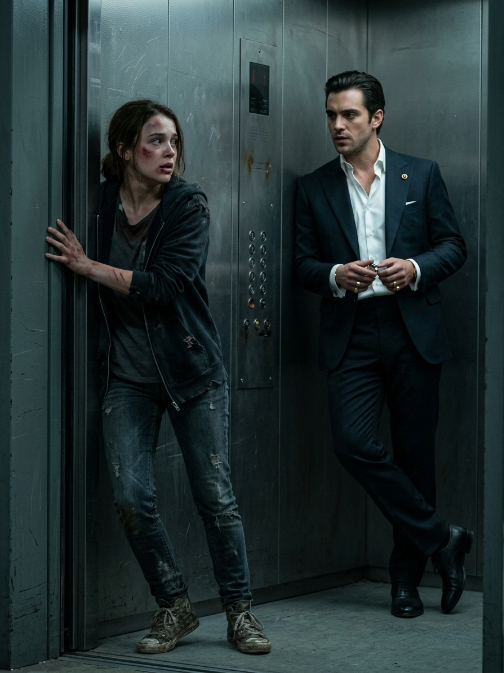
She Saved a Bleeding Mafia Boss in Secret—Then 200 Armed Men Surrounded Her Home

## PART 1
There were three categories of patients that Nadia Osei had learned, in four years of emergency nursing, to identify on sight.
The first kind arrived loudly. They announced their pain through the door, through the waiting room, through the curtain, sometimes through the parking lot. They were usually the least sick.
The second kind arrived quietly and waited to be seen and answered every question and were often the ones who had needed help the longest.
The third kind arrived as if they were doing the hospital a favor.
The man in bay seven was the third kind.
He sat on the edge of the examination bed with the specific posture of someone who had decided the examination bed was not a place he intended to stay long. His shirt was white and ruined. His hand pressed against his left side with the careful pressure of someone managing pain as a logistical problem rather than experiencing it as a feeling. He was perhaps forty, dark-haired, with a face that looked as though it had been arranged by someone who understood the utility of intimidation.
Two men stood in the space between the curtain and the bed.
They were the kind of men who stood a specific way. Nadia had learned to recognize that way. Hands loose at their sides, weight slightly forward, eyes moving in systematic patterns across the room. Security. Or whatever word you used for the same thing in a different context.
She had taken three steps inside before she processed the full picture and felt every professional instinct tell her to take three steps back.
She kept moving forward.
“The attending will be with you shortly,” she said. “While you wait, I need to assess the injury.”
The man’s eyes moved to her.
They were dark, almost black under the fluorescent light, and they stayed on her with the quality of attention she associated with either intelligence or danger. Usually both.
“I have been waiting,” he said. “I will not wait longer.”
His English was accented, Italian-inflected beneath the authority of it.
“You are bleeding,” she said. “Which means I am the relevant person in this room.”
One of the standing men shifted.
The patient raised two fingers in a gesture so small that someone not watching closely would have missed it. The man went still.
“Leave us,” the patient said.
The two men looked at each other.
“Leave us,” he said again. Same tone. Same volume.
They left.
The curtain closed.
Nadia set her tablet on the rail and pulled on gloves.
“I need to look at the wound.”
He began to unbutton his shirt with one hand, slowly, and she saw immediately that the other hand pressed against the injury was doing active work. When the fabric pulled against whatever was beneath, the muscles of his jaw went tight.
She moved his hand aside and lifted the hem herself before she had consciously decided to.
The wound was a deep laceration tracking along the lower left ribs. Not ragged — precise, the kind of cut made by someone who knew where to put a blade to cause pain without immediate fatality. Around it, older evidence: a scar she recognized as a poorly addressed exit wound. A ridge of tissue near the collarbone that had healed without proper closure.
A body that had been injured before and had not, on those occasions, gone to a hospital.
She reached for saline.
“How long ago?”
“Two hours.”
“Anything inside the wound?”
“No.”
“You are certain?”
“Yes.”
She soaked gauze and cleaned the wound margins. He watched her work with the same quality of focused attention, but there was something else in it now — not quite curiosity, not quite assessment. Something more careful.
“You are not afraid,” he said.
“I have a job to do.”
“You were afraid when you walked in.”
She did not answer that.
“The previous nurse sent for someone else,” he said.
“I noticed.” She checked the wound depth. “I need to suture this.”
“Do it.”
“I need to get an anesthetic draw.”
“No.”
She looked up.
“Without anesthetic—”
“No needles.” His voice had shifted slightly. The authority was still there, but beneath it was something she could only describe as locked. “Do it without.”
She held his gaze for a moment.
“This is going to cause significant pain.”
“Yes.”
She threaded the suture needle.
Nadia had sutured people under every variety of circumstance. She had sutured men who screamed at a 2cc injection of lidocaine. She had sutured teenagers who tried to bargain their way out of each stitch. She had sutured drunk people who didn’t feel anything and sober people who felt everything.
He sat still through all six sutures. Not rigid — the specific stillness of someone who had decided stillness was the only available form of control. Once, when she pulled a stitch slightly tighter than she intended, the breath through his nose changed for half a second. That was all.
“What is your name?” she asked, because patients talked, and because talking was data.
“Not one you need.”
“It will be on the intake form.”
“Then it will be on the intake form.”
She tied the last suture and cut the thread.
“The wound needs to stay dry for forty-eight hours. No physical exertion. If you develop fever, redness spreading beyond the margins, or increased pain, you need to return or go to a proper facility.”
“I will not return.”
“That is not a preference I can accommodate in my instructions.”
Something shifted at the corner of his mouth. Not quite amusement — the possibility of it, briefly visible.
“There is money in my coat pocket.”
She taped the dressing.
“No.”
“For your discretion.”
“My discretion is included in the service.”
His eyes moved over her face.
“Your discretion about the nature of this injury specifically,” he said.
The room changed slightly when he said that.
She understood what he was not saying: no incident report. No weapons injury notation. No police contact.
“I cannot do that,” she said.
“You already have.”
She looked at him.
He looked back.
They both knew that she had spent the last twelve minutes treating a wound she had not asked any of the required questions about, in a bay from which she had not called security, with two men standing outside the curtain who had not been asked for identification.
“The money is for your silence,” he said. “Or, if you prefer, it is for your competence. The framing is yours to choose.”
Nadia stripped off her gloves.
“Your name,” she said. “Not for the intake form. I want to know what I have gotten myself into.”
He reached for his coat.
“You have gotten yourself into nothing,” he said. “Yet.”
The word *yet* moved through the room like a weather front.
“Donatello Ferrara,” he said. “And you are Nadia Osei. Your shift ends at six. Take the bus, not the route you usually walk. Tonight, take the bus.”
He left.
The money was in her pocket before she processed the moment it had arrived there.
She stood in bay seven for a long time afterward, staring at the suture wrapper she had torn open, listening to the normal sounds of the ER resume around her like a tide filling a space she had briefly emptied.
She pulled out the folded bills.
Counted them.
Looked at the curtain where he had been.
She thought about the intake form. About the absence of his name on it. About the two men who had stood like furniture that breathed, and the way they had moved at a gesture she had nearly missed.
Then she thought about the number on the bills, and her rent, and the voicemail from her grandmother’s care facility she had listened to in the break room three nights ago.
She put the money back in her pocket.
She should have called security.
She walked to the nurses’ station instead and finished her shift.
—
By 6:20 a.m., the October sky over the city was a specific shade of gray that meant rain was committed but hadn’t arrived yet. Nadia took the bus.
She watched the street from the window. Watched the cars. Watched the particular stillness of certain vehicles that had no reason to be idling.
She saw the black SUV two blocks from her stop.
It was there when she got off. It was there when she turned onto her street. It did not approach. It did not accelerate. It simply maintained the particular distance of something that wanted her to know it was there without requiring her to confirm she’d noticed.
She got into her building without looking back.
From her fourth-floor window, she counted two.
The money from her pocket lay on the kitchen table. She counted it again.
Enough for November and December. Enough to call the care facility back with an answer rather than another delay. Enough to stop the daily mental mathematics of deciding which creditor to call back.
She left it on the table.
She did not throw it away.
She fell asleep on the couch with her coat still on and her phone face-down on the cushion beside her, and she dreamed about a man sitting perfectly still while she put thread through his skin, watching her the way you watched something that surprised you.
—
The knocking came at four in the afternoon.
Not frantic. Measured. The knock of someone who was confident about being answered.
Nadia looked through the peephole.
A man she had never seen. Dark suit. Hands visible. The same standing-a-specific-way she had recognized in the hospital.
“Miss Osei,” he said through the door. “Mr. Ferrara sent me.”
“Tell Mr. Ferrara to see an actual doctor.”
“He requires your assistance.”
“I gave him my assistance. He has sutures and discharge instructions.”
“There are complications.”
“Then he needs a hospital.”
“Miss Osei.” A pause. “He was very specific about not wanting a hospital.”
Nadia leaned her forehead against the door.
Something slid under it.
A phone.
She picked it up. Black, expensive, warm from someone’s pocket.
It rang once.
She answered because refusing felt like a choice she would regret more than answering.
“Nadia Osei.”
The voice moved through her before she identified why — because it was the same voice from the bay, but the control had developed a crack in it. Small. But there.
“Mr. Ferrara,” she said.
“The wound is infected.”
Her instincts ran the calculation automatically.
“How long has it been symptomatic?”
“Since this morning.”
“Fever?”
“My people are concerned.”
“That is not an answer to my question.”
“Yes,” he said. “Fever.”
She pressed two fingers to the bridge of her nose.
“You need IV antibiotics. You possibly need the wound reopened.”
“I have the antibiotics. I need the clinical judgment.”
“You need a physician.”
“I need someone I trust.”
“You do not trust me,” she said. “You spent money to secure my silence and had your people follow me home. That is not trust.”
A pause.
“It is the closest I come to it,” he said.
The honesty of it was strange enough to stop her.
“I know about your debt,” he said. “Your grandmother’s facility. The call you have been avoiding.”
Her grip tightened on the phone.
“I know about Daniel Akosah.”
The name hit her before she was ready.
“Do not,” she said.
“You tried to save him,” he said. “You could not. You have punished yourself for it for three years.”
“Stop.”
“I know this because I investigated you.” His voice remained level. “I investigate anyone close to me.”
“I am not close to you.”
“Not yet.”
She closed her eyes.
“If you refuse,” he said, “I understand. I will find other help.”
“Then find it.”
“I may need to involve your hospital in doing so.”
The implication arrived fully formed.
Dr. Mensah. The intake she had falsified by omission. The cameras in the corridor. The money she had taken.
If Donatello Ferrara wanted to expose her, he had everything he needed.
She understood that he was not threatening her. He was informing her of the structure of the situation. There was a difference. It was a small and insufficient difference, but it was real.
“If I come,” she said, “I am coming as a clinician. Not as whatever you think I am.”
“That is all I want.”
“I will need to bring my own supplies.”
“You will find what you need here.”
“I am not being blindfolded.”
A beat.
“That is not negotiable for security—”
“Then this conversation is over.”
Another beat. Longer.
“The route will be indirect,” he said. “You will not see the address.”
“Then I will count turns and estimate distance and have a reasonable geographic sense of where I am regardless.”
Something in his breathing changed.
“Very well,” he said. “No blindfold.”
She looked at the money on her kitchen table.
“Ten minutes,” she said.
—
## PART 2
The house was built into a hillside north of the city, which she knew because she counted seventeen minutes of ascending curves after the city gave way to tree cover. Glass and stone. A gate that opened without visible mechanism. Gardens that looked like they had been designed by someone who understood that wealth announced itself most effectively by pretending not to.
Armed men at the perimeter.
Not subtle. Not trying to be.
The room they brought her to had a fire and floor-to-ceiling windows overlooking a private lake going dark under clouds. The bed held Donatello Ferrara, shirtless, with the color wrong in his face and the bandage she had applied at the hospital stained in a pattern that told her the infection had been progressing for longer than he had admitted on the phone.
An older man stood at the bedside. Silver-haired, with the specific face of someone who had spent decades making assessments and acting on them without announcement. He looked at Nadia with the expression of someone placing her in a category.
She ignored him and moved to the bed.
The fever was worse than she had expected. The wound, when she lifted the dressing, was angry and hot and had begun the particular weeping that meant she needed to work quickly.
“Everyone out,” she said.
The older man started to speak.
Ferrara said: “Do it.”
They went.
She set up IV access and started saline with the materials arranged in a kit so well-supplied it told her exactly what kind of world this was — the kind with contingency infrastructure for events like this one.
“You should have called me earlier,” she said.
“I had business.”
“You had a knife wound.” She prepared the antibiotic line. “Business accelerated the infection.”
“It required attention.”
“You are the most consistent patient I have ever treated,” she said. “Consistently making everything worse.”
Something crossed his face. Almost a smile. She had begun to learn the geography of his almost-expressions.
“You are direct,” he said.
“You investigated me. You know I am direct.”
“I know you were third in your class at the University of Ghana School of Medicine before you transferred.”
She did not react to that.
“I know you came to this country for the residency that did not happen.”
“I came here for several reasons.”
“Daniel Akosah was one of them.”
She pressed a clean piece of gauze against the wound margin with more force than necessary.
“Do not use him as a data point,” she said.
“I am not.” His voice changed. Lower. “I am saying I know what it means to watch someone die in front of you and spend years afterwards living inside the failure of it.”
She looked at him.
He held her gaze.
“Your parents?” she asked.
“Yes.”
“Here?”
“In this house.” He looked toward the window. “I was seventeen.”
She worked in silence for a moment. Cleaned the infected margins. Removed two of the sutures she had placed the night before and repacked the wound with medicated gauze, leaving it open for drainage as the infection required.
He did not make a sound.
“I am going to leave an IV in place,” she said. “You need two more doses of antibiotics before I would be comfortable with the trajectory.”
“Then you will stay.”
“I will stay tonight.” She secured the IV line. “Tomorrow I have a shift.”
“Handled.”
Her head came up.
“What did you do.”
“You have a respiratory illness.”
“I do not.”
“According to your supervisor, you do.”
The IV bag swayed slightly from her hand releasing and gripping the stand.
“You cannot keep doing that,” she said. “You cannot reach into my professional life and move things around because it is convenient for you.”
“I can,” he said.
“That is not the same as should.”
He was quiet for a moment.
“No,” he said. “It is not.”
The acknowledgment was small. Specific. She filed it.
Later — after the antibiotics had started working, after his fever dropped half a degree, after the older man (who introduced himself simply as Corso) had brought her tea she didn’t ask for and left without explaining why — she sat in the chair beside the bed and tried to read the room she was in.
Art on the walls that she recognized from museums. Books on the shelves that looked read rather than installed. A photograph on the dresser — the only personal object visible — of a boy and two adults, taken somewhere coastal, the light the light of Southern Italy.
She was still looking at the photograph when Corso knocked and entered.
He sat across from her and said: “I have known him since his parents died.”
“You said that earlier. In the hospital.”
“I say it to anyone who needs context.”
“I am a nurse treating an infected wound. I do not need context.”
“You need exactly that.” Corso’s voice was measured. Without affect. The voice of a man who had been deciding what to say and what not to say for a very long time. “He brought you here.”
“He coerced me here.”
“He brought you *specifically*.” Corso looked at the bed. “He has a physician. He has two, in fact. He called you.”
Nadia said nothing.
“I have not seen him make that kind of choice before,” Corso said.
“What kind of choice?”
“A personal one.” Corso stood. “I am telling you because it matters for your safety. Men who want to hurt him will now see you as a route.”
She looked at him.
“You are not warning me away,” she said.
“No.” He moved toward the door. “I am warning you toward clarity.”
The lock engaged behind him.
Nadia sat in the expensive chair beside the bed of the most dangerous man she had ever met and listened to his breathing even out and thought about three things simultaneously: Daniel Akosah, the intake form she had falsified, and the specific way Donatello Ferrara had said *not yet* when she told him she was not close to him.
When she looked at her own medical bag an hour later, she found the tracker.
It was small — the size of a coin, adhered inside the front pocket of the bag. New. It had not been there yesterday.
Her blood went cold.
She carried the bag to the window and looked out at the lake.
Then she sat back down and thought very carefully.
Someone had placed it on her. Not here. She had not put the bag down in this house.
At the hospital.
The new security guard.
The bag check at the entrance.
She had thought nothing of it because it was procedure.
It had not been procedure.
—
## PART 3
She did not tell Ferrara immediately.
She told him in the morning, when his fever had broken and he was sitting upright and the color had returned to his face in the particular way that meant the antibiotics had turned a corner.
She placed the tracker on the bedside table between them.
He looked at it. His expression did not change.
“Where did you find it?”
“My bag. I think it was placed during the security check when I came on shift yesterday.”
He picked it up.
“How long has it been active?”
“I don’t know.”
He turned it in his fingers and said nothing for a moment.
“The Andrade organization,” he said. “They knew you would come to me a second time.”
“Because you had already made contact at the hospital.”
“Yes.”
“And they followed me here because—”
“Because they had no other way to find this property.” He set the tracker down. “I have been careful. You were the variable they could reach.”
The shape of it was very clean. They had watched him arrive at Mercy General. They had watched her treat him. They had planted the tracker and waited to see if she would lead them to him.
“I made you a liability,” he said.
“Yes.”
“I regret that.”
She looked at him.
“Not regret that I came to you,” he said. “Regret that it made you a target.”
“There is a difference?”
“Yes.” His eyes held hers. “There is.”
Corso entered.
The conversation that followed was in Italian, rapid and low, and Nadia did not speak Italian but she had spent enough years reading rooms to understand the gist: there was a response being planned. The nature of it was being decided.
When Corso left, she said: “What are you going to do?”
“There are options.”
“Tell me the options.”
He looked at her.
“You want to know the operational details of—”
“I want to know what kind of man I have treated for two days,” she said. “I want to know what you do when someone threatens what belongs to you.”
“You do not belong to me.”
“No. But you plan to handle this as if I do.” She kept her voice level. “So I would like to know how.”
A long silence.
“Typically,” he said carefully, “the response would be disproportionate enough to serve as a message.”
“Meaning violence.”
“Meaning the kind of resolution my world understands.”
“And in this case?”
He looked at the tracker.
“In this case,” he said slowly, “I find myself in an unfamiliar position.”
“Which is?”
“Considering what the response costs you.” He met her eyes. “Rather than only what it costs me.”
She sat with that for a moment.
“There are people I could call,” she said. “Not police. Federal investigators who have been building cases in this city for years. People who would find what you found — the tracker, the connection — very useful.”
He was very still.
“You are asking me to use a legal mechanism.”
“I am asking you to consider that you have a four-year-old nephew,” she said.
He stared at her.
“Corso mentioned it,” she said. “Briefly. And I am asking: what do you want that child to understand about how the world works? Because that is the question every decision you make right now is actually answering.”
The room was quiet for a long time.
Donatello Ferrara looked at the window.
At the lake.
At the tracker on the table.
Then at Nadia, who had come into his world through a set of curtains in an emergency room and had not, despite every opportunity, looked away.
“Give me an hour,” he said.
She gave him two.
—
The meeting with the Andrade organization’s representative happened at a location she was not told and that Ferrara returned from three hours later, pale but steady, with the specific composure of someone who had done something expensive.
“It is resolved,” he said.
“How?”
“The federal investigators you mentioned — they will find certain documentation very useful in the next forty-eight hours. The Andrade organization will find itself significantly occupied with other concerns.”
“And you?”
“A degree of cooperation with a federal investigation is sometimes the most efficient resolution available.”
She looked at him.
“That cost you something real,” she said.
“Yes.”
“Why?”
He sat down carefully on the edge of the bed, and she moved to check his wound margins without being asked, which was by now an automatic reflex.
“Because you asked the right question,” he said.
She pressed clean gauze against the wound.
“About your nephew.”
“About what I wanted him to understand.” His jaw tightened slightly as she worked. “I have spent twenty years answering that question the same way. It occurred to me that I had never considered changing the answer.”
“What made you consider it now?”
He did not answer immediately.
“You treated me the first night,” he said, “like I was a person with a wound rather than a problem with a body.”
She cut a piece of medical tape.
“You were a person with a wound,” she said.
“In my experience, the distinction is not reliably made.”
She smoothed the new dressing into place and did not move her hands away immediately. Left them where they were for a moment longer than necessary.
He noticed.
She stepped back.
“You are healing,” she said. “The wound margins look clean. The fever is gone. You need to limit movement for another four days and complete the antibiotic course.”
“You said four days.”
“Yes.”
“You will need to monitor the wound during that time.”
“I can leave you instructions.”
“Or,” he said, “you could remain.”
She looked at him.
“I cannot simply remain in your house for four days.”
“Why not?”
“Because I have a life.”
“Which your hospital has been told you will return to in four days due to a respiratory illness.”
“Which you arranged without asking me.”
“Yes.” He held her gaze. “I am asking you now.”
She folded her arms.
“You are not good at asking,” she said.
“I am learning.”
“That does not inspire immediate confidence.”
“No.” Something moved in his expression. “But it is honest.”
She looked around the room. At the art and the books and the photograph of the two adults and the boy who had become this man. At the lake through the window and the guards she knew were moving in patterns outside.
She thought about Daniel. Not with the old gutting grief, but with something softer — the way you thought about someone when you had started, finally, to understand that their death had not taken your life with it, only altered it.
She thought about the money on her kitchen table and the intake form she had falsified and the choice she had made in bay seven that had led here.
She thought about a man sitting perfectly still through six sutures, watching her face instead of the needle.
“I have questions,” she said.
“I expected that.”
“About your business.”
“I will answer what I can.”
“About what you did before this and what you are willing to stop.”
His jaw tightened.
“That is not a small question.”
“No,” she said. “It is not.”
“It may not have an answer that satisfies you.”
“I know.” She met his eyes. “I want the honest version regardless.”
He was quiet for a moment.
“Then sit down,” he said, “and I will give it to you.”
She sat.
—
She stayed four days.
Not because he had arranged her absence from the hospital, though he had. Not because leaving felt unsafe, though that was partially true. Because the conversation that started that afternoon kept going — breaking for meals, for wound checks, for the phone calls he took while she moved through the library or walked the grounds with Corso, who turned out to be a man of considerable dry wit and a twenty-year perspective on the person she was staying with.
“He does not usually explain himself,” Corso said on the third morning, handing her coffee near the garden wall.
“He does not explain himself to me either,” she said. “He just… keeps answering.”
Corso considered this.
“Yes,” he said. “That is different.”
She learned things she had not expected to learn. About the boy in the photograph who had grown up believing that the only way to protect what he loved was to make himself impossible to threaten. About the systems he had built and the people who depended on them and the degree to which dismantling what he was could not be done quickly without leaving damage in its wake. About the specific intersection of his world and the legal world — the gray territories, the enforced silences, the arrangements that kept certain neighborhoods stable and certain vulnerable people off official records.
None of it was clean.
She told him that.
“I know,” he said.
“I cannot pretend it is clean because I understand the context.”
“I am not asking you to pretend.”
“Then what are you asking?”
He was sitting in the library on the third evening, the wound healing cleanly, the fever entirely gone, his color fully returned. He looked like what he was: a man accustomed to having things his way, in the process of learning that this particular thing did not work that way.
“I am asking,” he said, “whether you are willing to know me as I am rather than as you might wish me to be.”
She looked at him across the library.
“That is a more honest question than I expected.”
“You have made honesty feel like the only available option.”
“How?”
“Because you refuse the softer version.” He tilted his head slightly. “Every time I have offered you something easier to hear, you have asked for the harder thing instead.”
She thought about Daniel. About the years she had spent carrying the full weight of that night because putting it down felt like forgetting him.
“I learned the hard way,” she said, “that easier versions have weight too. They just distribute it somewhere you can’t see.”
He held her gaze.
“Yes,” he said. “Exactly that.”
On the fourth morning she repacked her medical bag and checked the wound one final time.
Clean margins. Minimal redness. No sign of recurrence.
“You are healing well,” she said.
“I had competent care.”
“You had extremely expensive antibiotics and a body that has apparently decided infection is beneath it.”
“Also that.”
She closed the bag.
“I am going back to work today,” she said.
“I know.”
“And to my apartment.”
“I know that too.”
She looked at him.
“The men outside,” she said. “Are they there to protect me or to watch me?”
“Both,” he said. “One would be dishonest.”
“How long?”
“Until I am certain the Andrade situation is fully resolved.”
“And after that?”
He looked at her with the expression she had started to learn — the one that meant he had something to say and was deciding how much of it was safe to say.
“After that,” he said, “I would like to make you a different kind of offer.”
“What kind?”
“The kind that requires you to answer a question.”
She folded her arms.
“Ask it.”
“Do you want to know me?” he said. “Not as a patient. Not as a variable you wandered into. As a person whose life is complicated and expensive and dangerous and real.”
The room was very quiet.
She thought about the choice she had made in bay seven. About the money she had taken and the silence she had accepted and the steps that had followed from those two small decisions, leading here, to a house on a hillside and a man who had answered every hard question she had asked and whose answers had not been simple and had not been comfortable and had been, every time, honest.
“I need to go back to work,” she said.
“I know.”
“And I need to go back to my apartment and think.”
“Yes.”
“And I need you to not have your people manage my life while I am doing that.”
Something like a smile.
“Understood.”
“Including my hospital schedule.”
“That is more difficult.”
“I know. Do it anyway.”
He looked at her.
“Nadia,” he said — using her full name, with the weight he had given it the first time he said it.
“Yes.”
“The question I asked — it will still be the question when you have finished thinking.”
She picked up her bag.
“Good,” she said. “Because I want to answer it properly.”
The car was waiting in the drive. She got in without looking back.
But she noticed — because she noticed things, it was the whole of her professional survival — that there was no blindfold this time. That the route back to the city was direct. That when she reached her building, only one car remained at the corner rather than two, and it was parked far enough away that its presence was information rather than pressure.
She stood in her apartment and looked at the money still on the kitchen table.
She thought about it for a long time.
Then she picked up her phone and called the care facility and said yes. And said she would be coming on Sunday. And said her grandmother was not to be told yet, because the visit would be the news, and she wanted to deliver it herself.
She hung up.
She stood at the window.
Below, the car remained at a respectful distance. Not invisible. Not aggressive. Present in the way things were present when they were decided.
She thought about a man who had sat through six sutures without anesthesia and watched her face instead of the needle.
She thought about the file he had read, and about Daniel, and about the years she had spent inside a particular kind of grief that had quietly become the house she lived in.
She thought about being asked a question that required an honest answer.
She picked up the burner phone.
It rang once.
“Nadia.” His voice was different this time — not the controlled tone of the hospital, not the pain-managed cadence of the sick room. Just his voice, with the relief it was carrying insufficiently hidden.
“I have conditions,” she said.
“Tell me.”
“I will not give up my work. I will not be hidden. I will not pretend that what you do is acceptable because what you feel for me makes it feel different.”
“No,” he said. “I would not ask that.”
“I will ask hard questions and I will expect real answers.”
“Yes.”
“And if you manage my life without asking me—”
“I will try,” he said. “I will fail sometimes. I am trying to tell you the truth about that rather than promise something I am not certain I can deliver.”
She looked at the car below.
“That is a more useful thing to say than a promise,” she said.
“Yes,” he said. “I thought so.”
She breathed in.
“I am going to see my grandmother on Sunday,” she said.
“I know.”
“And on Monday I am going back to work.”
“Yes.”
“And sometime next week,” she said, “I am going to come to you.”
The silence that followed had a different quality from all the previous silences.
“Not because I have run out of options,” she said. “Not because you made it difficult to do otherwise. Because I want to know you the way you asked.”
“Nadia.”
“With open eyes,” she said. “All the way down.”
He said her name again.
It sounded, she thought, like a man who had stopped waiting to feel something and had started feeling it instead.
—
She went on Sunday.
Her grandmother held both her hands and said: *You look different. Like something has started moving again.*
She said: *Yes. I think that is right.*
She went to work on Monday and did her job with the same precision she had always brought to it. She stitched a man’s chin and counseled a frightened teenager and stayed an extra forty minutes for a patient nobody else had time for, and when she clocked out she felt the specific satisfaction of work done in service of something real.
The car was at the corner when she came out.
She walked to it.
The window came down.
“I thought you would make me come to you,” she said.
“I thought about it,” the driver said. He had the same specific posture as all the others. “He said to ask if you wanted a ride.”
“He said to ask?”
“Yes, miss.”
She thought about that for a moment.
“Yes,” she said. “I would like a ride.”
—
What she built with Donatello Ferrara in the following months was not simple and not safe and not the kind of love that arrived easily. It was the kind that required decision-making — not once, but repeatedly, on the mornings when she understood more clearly what his world was, and in the evenings when she watched him make choices she did not always agree with and said so, and in the specific moments when he heard her and shifted.
Not always. Not cleanly. But enough. Enough that it was real.
She kept her job. She kept her apartment for eight months before she decided to stop keeping it as a symbolic exit point and actually chose where she wanted to be. She kept her habits of asking hard questions and expecting honest answers, and he kept his habit of providing them — imperfectly, with the specific effort of someone who had lived inside a closed system for twenty years and was learning, slowly, to operate with the windows open.
Corso told her once, on a Sunday afternoon in the garden: *He is different since you came.*
She said: *I know. So am I.*
Corso considered this.
*Good*, he said. *You were both spending too much time in the same rooms.*
The nephew — whose name was Nico, and who was five years old, and who was not afraid of his uncle, which told her everything important — met her at a family dinner in December and immediately asked if she was a real doctor.
She said she was a nurse.
He said: *Is that better or worse?*
She said: *Nurses are the ones who actually stay.*
Nico considered this with the seriousness of a five-year-old doing original research.
*Okay*, he said.
Then he went back to his dinner.
Ferrara, across the table, caught her eye.
The almost-smile appeared.
She had by then learned the full geography of it. What lay beyond the almost. When it became real.
She smiled back.
Not because the world he lived in had become clean. Not because the things he had done had been erased. But because she had come, in the months since bay seven, to understand a specific truth about herself:
She had spent three years living as if Daniel’s death had used up her own courage along with his.
It had not.
She still had all of it.
She had just forgotten where she kept it.
Here, she thought. In rooms where the questions were hard. In choices made with open eyes. In work done in service of people who needed her hands.
She had found it in the last place she expected.
In a man bleeding without flinching, watching her face instead of the wound.
—
**THE END**