The Mafia Boss’s Mother Tested Five Women With the Family Ring—Only the Laundry Girl Returned It

## PART 1
The morning I found the ring, I almost kept it.
I want to say that plainly, because everything that comes after depends on you understanding who I actually am, and the honest version of who I am is a woman who stood in a basement laundry room at 4:47 a.m. with a diamond in her palm and thought: *my brother’s surgery bills. My father’s debt. One semester of tuition. An apartment with a window that gets morning light.*
That thought lasted about twelve seconds.
My name is Josie Tran. I was twenty-three years old, I had worked at Alcantara House for sixteen months, and I had learned to check every pocket before a garment went into the machine because rich people left extraordinary things in the clothes they were too busy to sort themselves.
Usually: cash, which I kept for the estate’s lost-and-found jar. Occasionally: private notes, which I folded back exactly as I found them. Once: a set of keys to what turned out to be a Maserati, which produced a very interesting morning.
But this.
This was different from all of that.
The ring was old the way certain things were old — not antique-store old, but family old, the kind of old that meant hands and history. The diamond was set low in a platinum band worn smooth at the edges from decades of use. Inside: engraved letters, worn faint, that I had to angle under the fluorescent light to read.
*R.A. to C.A. Always. 1949.*
I stood there for twelve seconds with everything it could buy laid out in my head.
Then I put it in my pocket and walked to the stairs.
The household manager, Dom, was in the service corridor when I came up from the laundry.
He was fifty-seven years old, had worked at Alcantara House longer than anyone I knew, and had the permanent expression of a man who understood things he had decided never to say aloud.
“Josie,” he said. “Where are you—”
“I found something in the north wing laundry.”
He looked at my hand. His face changed.
“Give it to me,” he said.
“I should return it directly.”
He stepped closer, dropping his voice. “Josie, listen carefully. In this house, you don’t volunteer yourself for scrutiny. I mean that kindly.”
“I didn’t steal anything.”
“It may not matter.”
“It matters to me.”
He studied me for a moment.
“Your family,” he said. “Georgia. Your brother.”
My fingers tightened around the ring. “Yes.”
“Think about them.”
“That’s exactly what I’m doing.”
He didn’t stop me after that.
I went upstairs.
Alcantara House was less a house than an institution that had forgotten it was one. White stone. Black gates. Security cameras behind the climbing roses. Gardens maintained with military discipline. And at its center, a woman named Cecilia Alcantara, who was either seventy or sixty-five depending on what mood she was in and who was asking, and who ran the household the way generals ran campaigns — with patience, intelligence, and the absolute knowledge that she would outlast everyone in the room.
The week before I found the ring, five women had arrived at the house.
Not ordinary visitors. They came in pairs of pearl earrings and family names printed on hospital wings. They walked through the estate with the deliberate ease of women who knew they were being watched and had decided to perform looking at home.
Dom told me nothing, but the staff whispered everything.
Cecilia Alcantara was choosing a wife for her son.
Rafael.
I had seen him twice in sixteen months. Both times from a distance — a dark figure crossing the east courtyard, a quiet voice behind a study door. He was thirty-four, ran his family’s various enterprises without leaving much of a footprint, and was described by the staff in the specific cautious language people used for weather: something powerful that arrived without warning and reorganized everything it touched.
None of the five women interested me.
What interested me was the ring in my pocket.
At the breakfast room door, the footman Elias nearly dropped his coffee when he saw me coming up from the staff level.
“Josie,” he whispered. “You can’t—”
I heard Cecilia Alcantara’s voice before he finished the sentence.
“Let her in.”
The breakfast room had a wall of south-facing windows that threw morning light across everything in it. Cecilia sat at the head of a long table with her coffee and her newspapers, wearing a cream silk robe, pearl earrings, and an expression of complete composure.
I crossed the room.
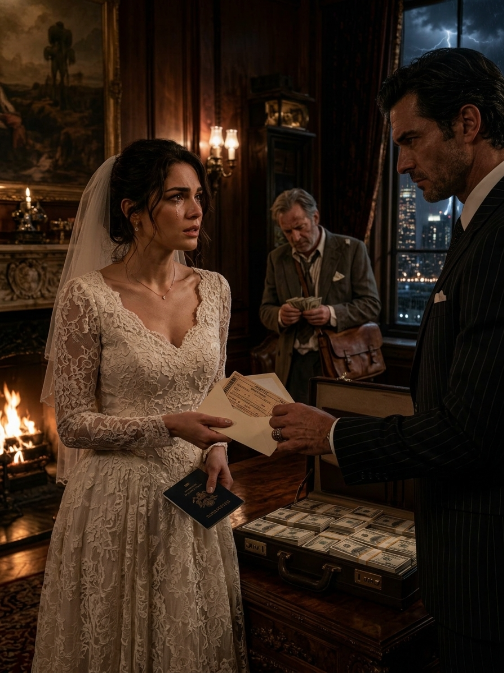
I placed the ring on the table in front of her.
“Mrs. Alcantara,” I said. “I found this in a jacket pocket from the north wing. I believe it belongs to your family.”
The room went still.
Cecilia looked at the ring for a long moment.
Then she looked at me.
Her eyes moved across my service dress, my clean hands, my face — not unkindly, but with the systematic thoroughness of someone who had spent decades reading people and did not find the exercise tedious.
She said: “What is your name?”
“Josie Tran.”
“Sit down, Josie.”
“I have the morning rounds still—”
“I know what you have.” The warmth in her voice did something complicated. “Sit down.”
I sat.
Cecilia picked up the ring.
She turned it once in the morning light.
Then she said something I would spend the next six months understanding.
“My husband gave me this ring the week before he died. I told Rafael to keep it safe.”
I said nothing.
“I did not lose it,” she said. “I placed it in the north wing jacket pocket on Tuesday.”
The word *placed* landed with the weight of something deliberate.
I thought about the five women.
I thought about the test they hadn’t known they were failing.
“Mrs. Alcantara,” I said carefully, “I would like to return to my work now.”
Her smile was the kind that had survived decades of things that should have ended it.
“I know you would,” she said. “That is exactly why you won’t.”
—
## PART 2
By noon, the whispers had reached the laundry room.
I knew because Dom came down with his face the color of old linen and his hands very still, which was the way he looked when he had decided to say something he did not want to say.
“She’s chosen you.”
“I returned a ring.”
“In this family,” he said, “that is not a small thing.”
“Dom—”
“Three of them took it. One of them hid it. One of them claimed ignorance so elaborate it was practically a confession.” He looked at me with something I read as genuine regret. “You were the only one who came upstairs.”
I stood with a silk blouse in my hands that suddenly felt like it belonged to a different world.
“She wants to see me this afternoon,” Dom continued. “East sitting room.”
“I have nothing to say to her in the east sitting room.”
“Josie.” His voice was quiet. “She pulled your file.”
“She can pull whatever she wants.”
“Your brother. The surgery. The debt.” A pause. “Your grandmother’s medication.”
The blouse went into the clean pile.
I kept my hands busy.
“She wants to offer you something,” Dom said.
“She wants to buy me.”
“She wants to offer,” he repeated carefully. “The choice is yours.”
He was not wrong about the choice being mine. He was also not wrong that my brother Minh’s remaining hospital balance was $247,000, that my father had not slept a full night in eight months, and that my grandmother had been rationing her blood pressure medication because I had not been able to send enough home two weeks in a row.
I went to the east sitting room.
Cecilia Alcantara sat beside a fireplace that was cold despite the October chill, a folder on the table in front of her. My name on the tab.
“I already know what’s in there,” I said.
“I know you do.” She slid it to the side. “That’s why I won’t insult you by reading it aloud.”
“Then say what you actually want.”
She did.
“Marry Rafael.”
I laughed. I couldn’t help it.
Cecilia waited.
“Mrs. Alcantara,” I said, when the laugh had run out. “I’m a laundry worker.”
“You were this morning.”
“That’s not something you can just—”
“The arrangement would be contractual,” she said. “Six months. Public engagement. Private agreements that protect you. Your family’s debts resolved. Your degree completed. Your grandmother’s care secured.”
“And in return, I marry a stranger because I passed a test that wasn’t my test to pass.”
“You passed it anyway.”
“That’s not a reason.”
Cecilia looked at me with the patience of someone who had been misunderstood for decades and had made her peace with it.
“The women downstairs,” she said, “came here wanting Rafael’s name, his money, or access to what he controls. You came here wanting nothing from him. That makes you the only person in the house who is not dangerous to him.”
“I could be lying.”
“Everyone can lie. You chose not to when no one was watching. That is the only vote that counts.”
I looked at my hands.
Clean from washing.
Callused from wringing.
“What does Rafael want?” I asked.
Something moved across Cecilia’s face.
“He wants to bury himself in work until he forgets he is a person,” she said. “That is not something I can fix. But it is something the right company might interrupt.”
Before I could answer, the door opened.
An estate guard stepped in, breathing hard.
He looked at Cecilia.
“The Rinaldi family sent something,” he said.
He placed a small cream envelope on the table.
I saw what was on the back before Cecilia turned it over.
A red smear across the flap.
Not lipstick.
—
## PART 3
Cecilia’s expression did not change.
That told me more than a reaction would have.
She opened the envelope with the deliberate calm of someone who had been receiving envelopes like this for decades and had decided long ago that visible fear was a resource she could not afford to spend.
Inside: a photograph. Black-and-white, printed on matte paper. A man in his early twenties stood in front of a building I did not recognize, hands in his coat pockets, looking at something off to the right. He had a wide jaw and dark eyes.
Cecilia set it face-down on the table.
“Mrs. Alcantara,” I said.
“I heard you.”
“Who is he.”
“Later.”
“You just offered me a position in your family and there is blood on an envelope in front of us. Later is not adequate.”
Her eyes came up.
For a moment she looked at me the way she had in the breakfast room — measuring, weighing, reading some quality in me that she found useful.
“His name,” she said carefully, “is Marco.”
She did not say more.
She stood, tucked the photograph inside the folder with my name on the tab, and rang a small bell on the mantelpiece.
The guard reappeared.
“Find Dom. Then find Rafael.”
The guard left.
I stayed in my chair.
Cecilia looked at the fireplace and said, not unkindly: “You asked what Rafael wants. He would tell you he wants to be left alone. That is the same answer he has given me for twelve years. What he actually wants is for the world to make sense again.”
“It did once?”
“Before his father died.” A pause. “Before Marco.”
“Who is Marco to him?”
She was quiet for long enough that the silence became its own kind of answer.
“His brother,” she said finally. “His younger brother. The family believed he died with Rafael’s father fifteen years ago.” She looked at the folded photograph. “Apparently not.”
The room seemed to change temperature.
“Then why is someone sending you his photograph now.”
“Because,” Cecilia said, “the Rinaldi family has had him for fifteen years, and they have decided it is time to use him.”
I thought about the five women. The test. The ring. The precise, patient architecture of everything Cecilia Alcantara had arranged this week.
A horrible understanding arrived.
“The engagement,” I said.
“Yes.”
“You weren’t only choosing Rafael a wife.”
“No.”
“You were creating a position that was difficult to threaten. A public one. Something that would make Rafael harder to isolate.” I looked at her. “Because you knew this was coming.”
Cecilia’s gaze met mine.
“I suspected,” she said. “I hoped to be wrong.”
The door opened.
Rafael Alcantara walked into the room.
He was taller than I had expected and carried himself with the particular economy of someone who had learned early that wasted movement invited attention. Dark suit, no tie, the collar open. His eyes took in the room — the fireplace, the folder, Cecilia, me — in a single sweep so practiced it was almost invisible.
He looked at his mother.
“What happened.”
“Come in and close the door.”
He did.
He looked at me then.
Not with hostility. Not with warmth. With the careful attentiveness of a man who had learned to read rooms before trusting them.
“This is Josie Tran,” Cecilia said.
“I know.” He paused. “You returned the ring.”
“Yes.”
His expression shifted by a small degree.
“Thank you,” he said.
“I’m not sure the thank-you is going to survive the next five minutes,” I said.
Something moved in his face. Not amusement, exactly. Something adjacent to it.
Then Cecilia placed the photograph on the table.
Rafael looked at it.
The stillness that came over him was different from his ordinary stillness. It was the kind that arrived when a person’s body understood something before their mind agreed to.
He picked up the photograph.
He turned it once.
“That’s Marco,” he said.
“Yes.”
“They said he was dead.”
“I know.”
“I watched the car.” His voice was very even. “I was nineteen. I watched the car.”
Cecilia put her hand over his briefly.
He did not move away from her touch, which told me something about what the twelve years between them had cost and built.
“How long have the Rinaldis had him,” he said.
“I don’t know.”
“They raised him.”
“Possibly.”
“Or they used him.” He set the photograph down. “What do they want.”
“I don’t know that either. Not yet.”
Rafael looked up at me.
I was not sure why. Perhaps because I was the only person in the room who had no reason to manage what I showed on my face.
“You’re going to ask me to stay,” I said.
Cecilia said nothing.
“The engagement. The public position. All of it.” I looked at the photograph of the young man with Rafael’s jaw. “Someone sends you a message with blood on it and your response is to announce a fiancée.”
“My response,” Cecilia said carefully, “is to make certain that my son is not isolated. A public engagement with a woman no one expected and no one can easily threaten gives us time. It makes the Rinaldis uncertain. They have had fifteen years to plan this. I have had this week.”
“So I’m a complication you’re introducing into their math.”
“You are a person I am asking for help.”
The honesty of that landed differently than anything else she had said.
I had spent sixteen months in this house watching people perform conversations — performing generosity, performing authority, performing concern. Cecilia Alcantara was performing nothing right now.
“I want to call my family,” I said.
“You’ll have privacy for that call.”
“Tonight.”
“Now, if you want.”
“I want to speak to Rafael alone.”
Cecilia looked at her son.
He looked at me.
She left without another word.
The room settled around us.
The fire that had been cold when I arrived was no warmer.
Rafael sat in the chair across from me. Not across the room — across the table, the folder with my name between us.
“You don’t want this,” I said.
“I don’t know you.”
“That’s not the same thing.”
“No,” he said. “It isn’t.”
I looked at the photograph on the table.
“Was he kind to you? Your brother.”
Something happened in his face.
“He was seven,” he said. “He was the kind of kind that children are when they haven’t yet learned to be afraid of it.”
“And you?”
“I was nineteen. I had already learned.”
I thought of my own brother. Minh, sixteen, recovering in a hospital bed in Georgia, doing the two-thumbs-up gesture in photos because he had decided that performing courage was better than making our father cry.
“My family needs this arrangement,” I said. “I want to say that plainly so you don’t have any illusions that I’m here out of altruism.”
Rafael looked at me.
“Good,” he said. “I have enough people performing altruism. Honesty is more useful.”
“I’m going to ask you something and I want an honest answer.”
He waited.
“If I do this. If I stand beside you in public and let your mother announce it and sit through whatever dinners and appearances this requires for six months. When it ends, am I going to leave with exactly what was agreed, or am I going to find that the agreement has become something else?”
Rafael’s eyes were steady.
“My family is not known for keeping clean agreements.”
“I know that.”
“But I am.”
“Why.”
“Because my father wasn’t. And I watched what that cost.” He set the photograph face-down. “I will write every term into a document that would survive your lawyers. And I will honor it.”
“Because your mother chose me.”
“Because you put a ring worth more than your yearly salary on a breakfast table and walked away from it.” He paused. “I have been watching people choose wealth over integrity my entire life. The ones who don’t are worth protecting.”
I looked at my hands again.
The calluses.
The clean nails.
My grandmother: *Josie, you can work in someone’s house without letting them own your soul.*
“Six months,” I said.
“Six months.”
“The terms in writing before the announcement.”
“Tonight.”
“And your brother.”
His expression tightened.
“Yes.”
“Whatever the Rinaldis want from him — it won’t be resolved in six months.”
“No.”
“So the arrangement might need to be revisited.”
He looked at me carefully.
“Or extended.”
“By mutual agreement.”
“Only by mutual agreement,” he said.
I stood.
He stood.
The photograph lay between us on the table.
“I want to know what happened to him,” I said. “Not because it’s my business. Because I think you’ve been carrying that question alone for fifteen years and it’s going to make everything harder if you’re still carrying it when the Rinaldis force the answer.”
Rafael looked at me for a long moment.
“You’ve been here sixteen months,” he said.
“Yes.”
“And you’ve been watching.”
“It’s what I was hired to do. Different department.”
His mouth moved.
That was the closest I had seen him come to an actual expression.
“Call your family,” he said. “Then come to the study. We’ll write the terms.”
He picked up the photograph of Marco.
He looked at it for a long, private moment.
Then he said, without looking at me: “He used to follow me everywhere. I used to tell him to go away.” A breath. “I have regretted that every day for fifteen years.”
I didn’t say anything.
There was nothing to say that wouldn’t make it smaller.
He folded the photograph and placed it in his jacket pocket.
“Two hours,” he said.
He left.
—
The call to Georgia lasted thirty-seven minutes.
I sat in the small sitting room off the north corridor, the door closed, the house quiet around me, and I told my father as much of the truth as made sense.
*There is a family here who needs some specific help I can provide. It pays well and it protects our family while it runs.*
My father said: *Is it safe, Josie?*
I thought about masked men in service corridors. I thought about blood on envelope flaps.
I said: *Safer than pretending we’re managing.*
He was quiet for a moment.
Then he said: *Your grandmother wants to talk to you.*
My grandmother said: *Josie, you remember what I told you.*
*I remember.*
*Then you’re already doing it right.*
*How do you know?*
*Because you called home first.*
—
The study was quieter than I expected for a room belonging to a man who ran several businesses.
Clean desk. Few papers visible. A shelf of books that looked read rather than displayed. A window overlooking the east garden, where the October light was going gold.
Dom had set a tea tray without being asked. That told me he knew how the evening had gone.
Rafael was reviewing a document when I arrived. He turned it toward me.
I read it.
Read it again.
It was precisely what he had promised. Clear terms. Specific protections. A dissolution clause that required nothing from me beyond the agreed timeline. My family’s financial obligations listed and addressed. My education funded. Housing secured.
And at the bottom, one line I had not expected.
*If this arrangement is extended beyond the original term, terms shall be renegotiated in full with equal participation from both parties.*
I looked up.
“Equal participation,” I said.
“You’re not a decoration,” he said. “If this goes longer than six months, it will be because both of us have decided it should.”
I looked at the line again.
“Your lawyers approved this?”
“My lawyers were confused by several parts of it.”
“But you kept it.”
“I drafted it.”
I picked up the pen.
I signed.
He signed below me.
Dom appeared with coffee I had not asked for and disappeared again before I could decide whether to thank him.
Rafael sat back.
“The announcement is tomorrow evening,” he said. “Public. My mother has arranged it for a dinner she was already hosting. Forty guests.”
“Are any of the Rinaldis invited.”
“No.”
“Will they find out.”
“Within hours.”
“And Marco.”
His jaw tightened.
“Possibly faster.”
I thought about the photograph. A young man with Rafael’s jaw, standing outside a building in someone else’s city, looking at something offscreen for fifteen years.
“When you find him,” I said, “you should know what to say.”
“I know what to say.”
“Do you?”
He looked at me.
“You said you’ve been regretting telling him to go away every day for fifteen years,” I said. “That means you’ve also been rehearsing the apology every day for fifteen years. But when you find him, he may not be the seven-year-old who needed you to apologize. He may need something different.”
The room was quiet.
“What might he need,” Rafael said.
“To know you looked for him. That the not-finding wasn’t not-looking.”
Something in Rafael’s face shifted.
Not dramatically.
But I had spent sixteen months learning to read this house, and I recognized the quality of a person who had just been handed language for something they had been carrying without it.
“I looked,” he said quietly.
“I believe you.”
“For three years before my father’s people convinced me it was dangerous to keep looking.”
“He should know that.”
“Yes.”
“Tell him that first. Before the apology.”
Rafael looked at me with an expression I did not have a word for yet.
Then he said: “You’re going to be difficult.”
“I’ve been told that before.”
“By whom.”
“My grandmother mostly. She means it as a compliment.”
His mouth moved.
This time it was clearly a smile.
Small, unpracticed, the kind that arrived before the person wearing it could stop it.
It lasted about three seconds.
Then his phone rang and the professional composure returned like a curtain.
He answered. Listened. Said nothing. Ended the call.
“The Rinaldis have already heard,” he said.
“How.”
“Someone in this house.”
Not Dom. I was certain enough about Dom.
But certain was not the same as sure, and I had learned in sixteen months that this house ran on layers.
“Do you know who,” I said.
“I have a strong suspicion.”
“Are you going to tell me.”
He considered that.
“Yes,” he said. “Eventually. But tonight I need you to trust that the north wing is secure and the announcement tomorrow will not be interrupted.”
“What happens after the announcement.”
“The Rinaldis will reassess. They planned on Rafael Alcantara without roots. A man in isolation is a simpler target.” He looked at the signed document between us. “They did not plan for this.”
“A laundry worker.”
“A person,” he said, with a precision that surprised me, “who cannot be threatened by social pressure because she has no social position to lose, who cannot be bought because she has already demonstrated she doesn’t take what isn’t hers, and who has no existing loyalty to any of the families involved.”
I looked at him.
“You’ve been thinking about this.”
“My mother explained her reasoning this morning.” A pause. “She was right. Which I did not say to her, because it would have been insufferable.”
I almost laughed.
“I think she heard it anyway,” I said.
“Undoubtedly.”
—
The announcement happened at a dinner table set for forty.
Cecilia wore sapphire blue and announced the news with the serene certainty of a woman who had already decided the room’s reaction was irrelevant to the outcome.
I wore a borrowed black dress and the ring, which fit as if it had been made for my hand, which I suspected it had.
Rafael stood beside me.
His hand covered mine once, briefly, at the moment his mother said the words — *my son has chosen*.
It was a considered gesture, performed correctly, meaning nothing and everything simultaneously.
I did not pull away.
The room did what rooms did: it pretended to be surprised while being exactly as calculating as it always was. I saw the assessment in each face. Staff girl. Unknown. Nobody. The relief of women who had wanted the position and could now tell themselves they had not actually wanted it. The recalculation of men who had expected this announcement to involve a different kind of alliance.
At the back of the room, a man I did not recognize watched with an expression that was not surprise.
He was older, silver-haired, and his attention moved between Rafael and me with the focused interest of someone who had been expecting this but not quite *this.*
I leaned toward Rafael.
“The man by the east window,” I said quietly. “Silver hair. He came with the Deluca family.”
Rafael did not look immediately. That restraint told me he had already noticed.
“He is not Deluca,” he said.
“Who is he.”
A pause.
“Someone I need to speak with tonight.”
“Before or after dessert.”
“Before he leaves.” He glanced at me sideways. “Good eyes.”
“I sort other people’s laundry. You learn to notice things that don’t belong.”
He was quiet for a moment.
Then: “What doesn’t belong about him.”
“He’s not watching you the way the others are. Everyone else is watching you to understand what this means for them. He’s watching you because he already knows what it means.”
Rafael turned to look at the man.
The man, as if he felt the attention, looked back.
Something passed between them.
Not recognition exactly. Something older than recognition. More like two people who have been on opposite sides of the same story for a very long time and are finally in the same room.
“Rafael.”
He looked at me.
“He has your jaw,” I said.
The room continued around us, the dinner party noise running underneath the moment like a river under ice.
Rafael looked at me for a long second.
Then he looked at the man again.
The man had not stopped watching.
“He’s older than I expected,” Rafael said, very quietly.
“Fifteen years,” I said. “People change in fifteen years.”
His hand found mine on the table.
Not for the room this time.
He gripped it with the particular intensity of a person who needs something to hold onto while the world rearranges itself.
I held back.
Because some things in this house had nothing to do with arrangements and contracts and tests, and those were the things that mattered most.
“Go talk to him,” I said.
“Now?”
“Before he decides you aren’t going to.”
Rafael looked at me with an expression I was beginning to learn.
He would not call it gratitude, because that word was too small. He would not call it trust, because it was too early for trust to mean what it should.
But he stood.
He crossed the room.
The silver-haired man watched him come.
He did not run.
He did not look away.
He stood very still, the way people stood when they had practiced this moment alone for a very long time and were terrified the practice would fail them now that it was real.
Rafael stopped in front of him.
I could not hear what was said.
But I saw the moment it landed — whatever the first word was, the first sentence — because something in the young man’s face that had been held very tight for a very long time came loose.
Just slightly.
Just enough.
Cecilia appeared at my elbow.
She was watching her sons across the room with an expression I had not seen on her before. Not strategic. Not composed. Just a mother who had outlasted an impossible loss and was watching its impossible reversal.
“How did you know to tell him to go?” she said.
“I noticed he was deciding not to.”
She was quiet.
“You observe people,” she said.
“I sort their laundry. Same skill, different application.”
She looked at me with the smile she had worn in the breakfast room — not kind, but something that cost more than kindness.
“My husband’s ring,” she said. “He told me it was too valuable to wear every day. I wore it every day anyway.”
“That sounds right.”
“He said the same thing.” She looked at the ring on my finger. “It suits you.”
“I’m keeping it only for appearances.”
“Of course you are.” The smile deepened. “That is what I said in 1952.”
I looked at her.
“Mrs. Alcantara.”
“Cecilia,” she said. “If you’re going to be difficult about my son, you should use my name.”
Across the room, Rafael said something, and the man who had spent fifteen years in someone else’s city put one hand briefly over his eyes, and his shoulders shook once with something that might have been a laugh or might have been years of something finally finding a door.
The dinner party continued around them.
Forty guests who had come to observe a transaction were witnessing something else entirely.
I thought about my grandmother, pressing both of my hands between hers at a bus station in Georgia and telling me the difference between service and ownership.
She had been right.
You could spend years in someone else’s house and still belong to yourself, if you knew where the line was and had the nerve to hold it.
I picked up my water glass.
The ring caught the chandelier light.
Behind it, my own hand. Calloused and careful and completely itself.
I drank.
—
*THE END*