The Mafia Boss Noticed Her Trembling Hands—Then His Question Changed Everything

## PART 1
The thing about being afraid for a long time is that eventually it stops feeling like fear.
It starts feeling like weather. Like the particular quality of air before a storm — tight, metallic, too still. You stop noticing it because you’ve adjusted. You’ve calibrated. You’ve learned to function inside it the way a person learns to function in a city that’s always loud.
That Tuesday afternoon, I was calibrated.
I was carrying a bowl of black bean soup to table fourteen when my hands decided to stop cooperating.
Not dramatically. Just the smallest tremor. Enough that a thin line of broth slipped over the ceramic edge and left a dark trail along my wrist, and I had to stop walking and breathe through my teeth and tell myself I was simply warm from the kitchen and not that Marco Reyes had kicked my apartment door in at seven that morning, and not that I had run down the fire escape in one shoe, and not that I had been telling myself for three weeks that this time I was really leaving.
The restaurant was loud the way Sol y Sombra was always loud at lunch — citrus and cumin in the air, the kitchen swinging open every ninety seconds, the front windows streaming afternoon light across the wooden tables. I had always loved the light here. It reached everything. I had told myself that mattered.
Monsters, I had recently learned, were unbothered by light.
They just walked through the door.
“You going to bring that, or?”
A man at table eleven.
“Coming,” I said.
I delivered the soup. I smiled. I asked about the horchata refill and wrote it down and moved away without spilling anything else, which felt like a minor victory on a day made entirely of losses.
His table I noticed the way you notice a shift in the temperature of a room.
Four men. Table five, the one near the back wall that regulars knew had the best sightline and the worst acoustics, which was precisely why certain regulars chose it. I had been working at Sol y Sombra for two years and I knew the language of that table.
The men were broad-shouldered and quiet, the kind of quiet that had weight to it. Gold at their throats. Hands that rested too still on the tablecloth, the way hands rest when they’ve been trained not to move unnecessarily.
And one man who was not like the others.
He sat with the loose, settled posture of someone who had made peace with every room he’d ever entered. Not relaxed. Something more deliberate than relaxed. His eyes moved across the restaurant in slow sweeps — door, kitchen, mirrors behind the bar, back to his table — and when they reached me, they stopped.
Not the way men sometimes stopped on me.
The way a person stopped when they noticed something that didn’t add up.
I looked away. I looked back. He was still watching.
I carried my tray to table seven and did not look again.
The mistake I made was at table five.
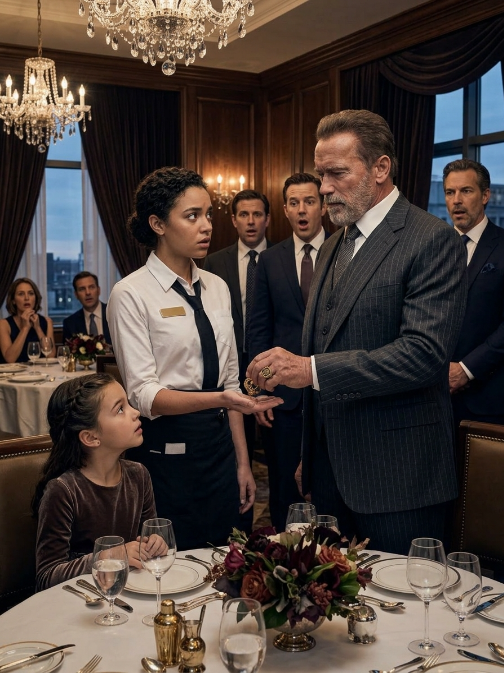
I brought their order myself because Pilar was on her break and the kitchen was insistent about the caldo going out hot. I set plates down with the professional autopilot of someone who had served hundreds of men who expected efficiency over acknowledgment. When I reached his plate, I placed it too close to his glass. He moved his hand to make room, and my wrist passed through his fingers.
Not a grab. Barely contact.
Two fingers resting on my pulse for half a second before I pulled back.
His eyes moved from my wrist to my face.
The expression on him was not curiosity.
It was recognition.
Like he knew fear from the inside and could identify it without being told.
“You’re trembling,” he said. Low, unperformed.
“Kitchen’s hot,” I said.
I turned away before he could say anything else.
My phone was in my apron. It buzzed once, then again, and I already knew without looking because I had memorized the particular rhythm of Marco’s impatience. Three weeks of leaving and coming back and leaving again, and now I was done, except that I had nowhere to go and fifty-three dollars in my checking account and a split lip that I had covered with concealer that morning.
I shoved the phone deeper into my pocket and went to check on table eleven.
When I came back through, the man from table five was watching me again.
I stopped pretending not to notice.
I met his eyes.
Something about it — the directness, the absence of judgment in his face — made my chest ache in a way I didn’t have language for yet.
Rosario appeared at my shoulder, our floor manager, twelve years at Sol y Sombra and the only person in this building who would notice if something was wrong with me before I said so.
“Table five needs refills and you need to breathe,” she said.
“I’m breathing.”
“You’re performing breathing. There’s a difference.”
I started to deny it.
Then the door opened.
The particular sound of it — the specific weight of the hinges on a hot afternoon — hit me wrong.
I turned.
Marco stood in the doorway.
He did the thing he always did in new spaces: paused just long enough to map it. His eyes moved the same way they always moved, slow and measuring, until they found me, and his mouth arranged itself into the smile I had once called handsome and now recognized as something put on over something worse.
Everything in me went cold and perfectly still.
“Rosario,” I said, very quietly. “I need one minute.”
She followed my gaze. Her face changed. “Lena—”
“One minute.”
But before I had taken a step, a chair scraped back from table five.
And the air in Sol y Sombra rearranged itself.
—
## PART 2
The man from table five stood.
He didn’t hurry. He didn’t reach for anything. He simply rose and buttoned his jacket with one hand, and the restaurant understood something I couldn’t fully articulate — that the room had just shifted its weight and everyone in it had felt it.
Marco saw him.
His smile thinned.
“I know that name,” Rosario whispered behind me. “Lena, that is—”
“I know,” I said. Because I did. Everyone in this part of the city knew.
Rafael Vega.
His name passed through neighborhoods like weather. Dry-cleaning shops and restaurant supply companies and a boxing gym in Pilsen, and beneath all of it, the kind of infrastructure that didn’t appear on any public record. Men crossed the street when his car passed. Certain judges developed selective blindness when his family’s name appeared on paperwork.
He stopped beside Rosario, not close enough to crowd me, and looked at Marco.
“You know this place?” he said.
Marco’s jaw moved. “I’m here for her.”
“She’s working.”
“She’ll leave when I say.”
Rosario stepped forward with the spine of a woman who had been running her restaurant for twelve years and had not survived that long by backing down. “You can leave a message.”
Marco looked at me over her shoulder.
The old signal. The one that said *watch what happens when you make me look small.*
I opened my mouth.
Then Rafael spoke first.
“She said no.”
Marco blinked. “Who are you?”
“Someone eating lunch.” His voice was entirely level. “Someone who noticed you followed a frightened woman to her workplace and called it love.”
Marco laughed once, ugly. “You don’t know what she’s like.”
“No,” Rafael said. “But I can read a pulse.”
The table of four behind Rafael hadn’t moved. They were watching Marco with the patient attention of men for whom calculation came before action, which was its own language and Marco clearly understood it, because for the first time all morning his certainty flickered.
“Lena.” His voice dropped to the register he reserved for private spaces. The one that meant *you’ll pay for this later.* “We’re talking.”
“She’s working,” Rafael said again. “Leave.”
Marco’s face reddened.
“You don’t own her.”
“Correct,” Rafael said. “Neither do you.”
The silence that followed was the kind that has a shape.
Marco looked at me one more time.
*This isn’t over*, his face said.
*I know where you sleep*, his eyes said.
Then he backed out through the door and disappeared into the afternoon.
The restaurant exhaled.
A child at the corner table started crying, startled by the silence, and it broke everything apart into ordinary again. Rosario turned toward me with her hands on my shoulders and said my name, and I was already shaking, not with fear this time but with something that took me a moment to identify.
Rage.
Three weeks of leaving. Three weeks of coming back. One morning of a kicked-in door and one shoe down a fire escape.
And the question I was still asking myself, the one that made the rage complicated: how had I let it go this long? What in me had been trained to stay?
Rafael touched nothing, asked nothing, stood close enough that I understood I was not alone without making me feel managed.
Then he asked the question.
“Who taught you to be this afraid?”
The words arrived like a key in a lock I had forgotten was there.
Not *why didn’t you leave.*
Not *why did you stay.*
Not *what’s wrong with you.*
Who *taught* you.
As if the fear had not grown in me naturally. As if someone had placed it there with intention.
My face crumpled before I could stop it.
Rosario made a sharp sound. Rafael took one step back, giving me room, and I understood he was not the kind of man who needed a woman’s tears to feel useful.
“There’s an office,” Rosario said.
I followed because my legs made the decision before my pride could object.
What I did not know yet — what none of us in that office would discover for another two hours — was that Marco Reyes had not come to Sol y Sombra by accident.
He had come because someone had told him exactly where I was.
And that someone had a name that was about to tear a hole through everything I thought I understood about my own life.
—
## PART 3
The office behind the kitchen was small and permanent-smelling, the kind of room that had absorbed years of receipts and coffee and difficult conversations and held them in the walls. Rosario shut the door. The restaurant noise became muffled and manageable.
Rafael stood near the window with his hands in his pockets. Not looming. Not performing concern. Just present in the specific way of men who had learned that presence itself was a form of protection.
I sat in the desk chair because my knees had stopped being reliable.
“I’m not going to ask what happened,” he said.
“Okay.”
“But I’m going to ask a different question.”
“You already did.”
He looked at me directly. “You haven’t answered.”
I laughed once, short and hollow. “My mother. My grandmother before her. A string of men who called it love and meant control.” I looked at my hands. The tremor had stopped, replaced by a stillness I didn’t entirely trust. “And Marco.”
“How long?”
“Two years.” A pause. “Three weeks since I left.”
“You left.”
“I keep leaving.”
“There’s a difference between leaving and getting out.”
I looked up.
He held the sentence without elaborating, and somehow that was worse than any explanation — that he understood the distinction well enough not to need to explain it.
“Tell me about your phone,” he said.
I reached into my apron and placed it on the desk between us.
He looked at it without touching it.
“He knows your schedule,” he said.
“Yes.”
“Your address.”
“Yes.”
“Anyone who might shelter you.”
My throat tightened. “He knows my sister is in Memphis. I haven’t told him the address, but—”
“But he doesn’t need you to tell him.”
I closed my eyes.
His voice remained even. “There’s a number on the card I’m going to leave you. It goes to a woman named Dara. She works with a legal organization that handles situations like this without requiring you to file a report that Marco might use against you before anything comes of it.”
“He has a lawyer on retainer.”
“So does the organization.”
“I have fifty-three dollars.”
“That’s not their fee structure.”
I stared at him. “Why are you doing this?”
Something moved behind his eyes. A door that opened an inch and then stopped.
“Because you can still refuse a man,” he said. “You did it in front of me, twice in ten minutes. That matters. Some women have had it taken before anyone notices.”
My throat burned.
Rosario was crying silently near the filing cabinet and pretending she wasn’t.
Rafael reached into his jacket. I tracked the movement — old habit — and he noticed and stopped.
Slowly. He withdrew a card. Set it on the desk.
Plain white. His name. A number.
“Tonight,” he said, “you don’t go back to your apartment.”
“I have nowhere—”
“There is a property. Clean. Private. No one knows the address except Dara and the person who manages the utilities.” He paused. “You take it or you don’t. That’s the whole offer.”
“What’s the rest of the offer?”
“There isn’t one.”
“Men don’t give safe houses to strangers.”
“I’m not most men.”
“That’s exactly what most men say.”
His mouth moved — not quite a smile, but adjacent to one. “Fair.”
He stood.
“The card has two numbers. Mine and Dara’s. Call either.”
He moved toward the door.
“Rafael.”
He stopped.
I looked at the card in my hand. “Marco didn’t find me by accident today.”
Something shifted in his stillness.
“Someone told him where I work,” I said. “I haven’t told anyone I was at Sol y Sombra except one person.”
“Who?”
I looked up.
“My father.”
—
Rafael left the restaurant. He did not say where he was going. But thirty minutes later, two men I didn’t recognize appeared outside on the sidewalk, and Rosario looked out the window and said, quietly, “Thank God,” and didn’t explain further.
My father’s name was Elias Moreno.
I should clarify: his name had been Elias Moreno for the last twelve years. Before that, it had been something else, which he had explained to me when I was twenty-two in the tone of a man confessing to a priest — careful, incomplete, obviously edited.
He had worked, he said, for people he no longer worked for.
He had left.
He had started over.
He had found us — my mother’s obituary had been in a local paper, and somehow he had found it, and somehow he had found me, and I had let him in because I was twenty-two and motherless and he had her eyes and her same specific way of going still when he was listening.
I had told him about Sol y Sombra three days ago.
That was the only person.
I called him from the office bathroom, hands braced on the sink, the mirror showing me a face I was still learning to read honestly.
He answered on the first ring.
“Lena—”
“Did you tell someone where I work?”
Silence.
“Papá.”
“I’m sorry,” he said.
The two words landed like a collapse.
“How long have you been in contact with Marco?”
“I haven’t—it wasn’t Marco.” His voice was rough, older than I remembered it last week. “There is a man who found me. Six weeks ago. He said he represented people who wanted to close old accounts. He asked about you.”
“And you told him.”
“He said he would protect you if I cooperated.”
The laugh that came out of me was barely sound. “He said he would *protect* me.”
“Lena—”
“He kicked in my door this morning.”
A long pause.
“I didn’t know,” he said. “I didn’t know Marco was connected.”
“What did you give them?”
Silence again. Longer.
“What did you give them?” I repeated.
“A location,” he said. “And a flash drive.”
My heart stopped.
“What flash drive?”
“Your mother kept files,” he said quietly. “Before she died. Things I sent her. Names, accounts, testimony she never filed. I told her it was insurance.”
“I’ve never seen any—”
“Loose board under the window seat in the old apartment,” he said. “Second one from the right. You moved out four years ago. But you still have a key.”
I looked at myself in the mirror.
“Who is the man who found you?”
“I don’t know his real name. He uses the name Salazar.”
I ended the call and walked back into the office.
Rosario took one look at my face.
“What happened?”
“I need to make another call,” I said.
I called Rafael’s number.
He answered on the second ring.
“Your father—” I started.
“I know,” he said. “Where are you?”
—
The apartment I had moved out of four years ago was a third-floor walkup in Bridgeport with yellow walls and a window seat I had built with my father on a Saturday afternoon when he was still someone I had just found and was still cautiously believing in.
I had loved that window seat.
I sat in it now with my hands in my lap and the loose board in front of me already removed, and what I was holding did not look like much.
A flash drive in a small plastic case. Wrapped in a piece of paper that had my mother’s handwriting on it.
*For Lena, if it comes to that.*
It had come to that.
Rafael stood near the door. One of his men was in the hallway.
“Open it later,” Rafael said. “Not here.”
“What’s on it?”
“Based on what your father told me, testimony. Account records. Names of men who moved money through a logistics network twelve years ago.” He paused. “Including a man named Salazar. Except that isn’t his real name.”
“What is?”
“I’m still verifying.”
“How close are you?”
He looked at me steadily.
“Ninety minutes,” he said.
My phone buzzed.
Unknown number.
A video call.
I looked at Rafael. He nodded.
I answered.
A man appeared on the screen.
Fifties. Silver at his temples. The particular composure of someone who had spent decades making other people nervous.
And behind him, sitting in a chair with her hands clasped in her lap, was my sister.
Valeria.
Twenty years old. Memphis. The only person in my life I had kept clean of all of this.
“Hello, Lena,” the man said. “My name is Salazar. You have something that belongs to me.”
—
That was the moment fear reached its limit in me.
Not because I became fearless — I was not fearless, my hands were shaking again and my vision had gone strange at the edges and I was aware of every exit in the apartment in the specific way of a person whose body has decided to start counting.
But there is a version of fear that transforms when it has something to protect that cannot be replaced.
Valeria was looking at the camera.
Her face was not the face of someone who had accepted what was happening. It was the face of a person thinking. Measuring. Waiting for the right moment the way I had taught her to wait for the right moment during arguments with difficult landlords and bad bosses.
*Watch for when they need something*, I had told her. *That’s when you have leverage.*
She was watching.
“Trade,” I said. “The drive for my sister. Tonight.”
Rafael made a sharp movement in my peripheral vision. I ignored it.
Salazar smiled. “Rafael Vega’s girl. I expected more nerves.”
“I have plenty of nerves,” I said. “I’m ignoring them. Where do we meet?”
—
What followed was not the version of events I would have chosen.
The location Salazar gave was a warehouse in the riverfront district, which meant waterways and multiple exits and the kind of ambient noise that made it difficult to track movement. Rafael spent forty minutes on the phone with people I couldn’t hear, and his face during those forty minutes told me nothing except that things were complicated and getting more complicated.
“You’re not going in,” he told me.
“She’s my sister.”
“The drive goes in. You don’t.”
“He’ll know.”
“He’ll find out. There’s a difference.”
I looked at the drive in my hand.
“What’s the plan?”
“You make the trade in a vehicle at the perimeter. My people take the interior positions. When Valeria comes out—”
“If.”
“When,” he said firmly. “When she comes out, you drive.”
“And Salazar?”
Rafael’s expression went carefully neutral.
“He leaves breathing if he releases her cleanly.”
“And if he doesn’t?”
“Then we improvise.”
I sat with that for a moment.
“He has my father too,” I said. “That’s what Valeria’s presence means. He found my father through me, which means he’s had my father since he called me.”
Rafael’s jaw moved once. “I know.”
“Is my father safe?”
The pause before his answer told me more than the answer would.
“We’re looking.”
I looked at the drive.
My mother’s handwriting on the wrapper.
*For Lena, if it comes to that.*
She had been preparing me for this specific night without knowing this specific night would arrive.
I folded her handwriting carefully and put it in my pocket.
Then I gave Rafael the drive.
“Don’t lose that,” I said. “Whatever happens. That goes to people who can use it.”
He looked at me.
“Agreed,” he said.
—
The warehouse was lit from inside, which meant they wanted us to see exactly what we were approaching, which meant they had considered that we would be looking for exits before we were looking for anything else.
I sat in the back of a plain gray car with a woman named Dara who turned out to be a real attorney with a very calm voice and the specific competence of someone who had done this before.
“You don’t get out,” Dara said. “The window goes down, you speak, you wait for Valeria to reach the car.”
“And if she doesn’t?”
“She will.”
“But if she doesn’t.”
Dara looked at me directly. “Rafael will make sure she does.”
I pressed my palms flat on my thighs.
The drive was gone. Rafael had it.
I had nothing to trade except my presence, which Salazar apparently still wanted, and the recording running quietly from the small device Dara had tucked into the lining of my jacket.
“Anything he says to you,” she had told me, “about your father, about the drive, about what he wanted and why — let him talk.”
“You want him to incriminate himself.”
“I want him to explain himself. Men like him can’t resist it once they believe they’ve won.”
I thought about Marco, who had spent two years explaining himself to me in the minutes after he broke something, always so certain that the explanation made the breaking acceptable.
“I know the type,” I said.
The car stopped.
The warehouse door opened.
Salazar emerged with two men and, behind them, Valeria.
She was walking. Upright. Eyes scanning the carpark with the exact expression I had described — watching, measuring, waiting.
My throat tightened.
The window went down.
“The drive,” Salazar said.
“My sister first,” I said.
“That’s not how trades work.”
“It is when you’ve already demonstrated that your word isn’t binding.” I kept my voice flat. “You told my father you would protect me. Then you directed Marco Reyes to my workplace. You have no credibility in this negotiation. Valeria walks to the car, and then we discuss the drive.”
Salazar stared at me.
Behind him, his two men shifted.
“You’re not what I expected,” he said.
“I get that a lot.”
He nodded once to the man beside Valeria.
She walked.
Not slowly. Not running. The careful, controlled pace of someone who has been told that panic will be used against her and has decided to make panic impossible.
She got into the car on the far side.
Her hand found mine immediately and held on hard.
“I have about fifty questions,” she whispered.
“I have about fifty answers,” I whispered back.
Salazar leaned toward the window. “Now.”
“There is no drive,” I said.
His expression changed.
“The drive is currently in the hands of a federal prosecutor who has been building a case against the logistics network you managed for eleven years,” I said. “Including the movement of money connected to three specific accounts that my mother documented in 2009. Including testimony from my father, who recorded four conversations with you over the past six weeks because he understood that cooperating with you was not the same as being safe from you.” I watched his face. “He just needed time to copy the drive. And someone to send it to.”
Salazar’s composure fractured.
“You’re lying.”
“I grew up with a woman who kept evidence under a window seat for twelve years,” I said. “I learned from the best.”
He reached for the door handle.
Two things happened at once.
Every exterior light in the warehouse district came on.
And Rafael’s voice came through the phone Dara held up.
“Don’t.”
Salazar looked at the light.
At the cars positioned at every exit he had mapped.
At the men who had been in the warehouse interior for forty minutes, waiting.
He looked at me.
“Your father,” he said.
“Is with law enforcement,” I said. “Voluntary. He called them two hours ago.”
That wasn’t entirely true. It was exactly true enough.
Salazar lowered his hand.
An agent appeared at his elbow before he could reconsider.
I rolled up the window.
Valeria pressed her forehead against my shoulder.
We sat in the gray car in the lit-up riverfront while the world rearranged itself outside, and I let my hands shake as hard as they needed to because there was no one to perform steadiness for anymore.
—
It took months.
Real months. The kind that contained both ordinary days and the ongoing slow machinery of federal cases, which moved without urgency or drama and required periodic phone calls with Dara and periodic appearances in rooms where I gave the same answers I had already given in writing.
My father testified.
I watched some of it.
He named names with the careful exhaustion of a man who had rehearsed this moment for twelve years and was finally allowed to actually perform it. He said my mother’s name in formal legal proceedings, which meant it was on record somewhere, which meant she existed somewhere in the permanent accounting of what had happened and who had been harmed by it.
I had not expected that to matter as much as it did.
Marco Reyes was arrested six weeks after the warehouse.
Not for what he had done to me, which took longer — the restraining order, the documentation, the patient assembly of a case that his lawyer immediately tried to dismantle. But for the things he had done for Salazar, who turned out to be a man named Guerrero who had used Marco for years as a debt collector for accounts that appeared in my mother’s files.
Marco’s lawyer was expensive.
The recordings Dara had collected were more expensive than that.
He took a plea.
I was not in the room when he did.
I was at Sol y Sombra, which Rosario had quietly returned to its Tuesday-afternoon rhythm as if Tuesday afternoons were the thing most worth preserving. I was carrying a bowl of soup to table three when Dara texted me, and I stopped walking and read it and stood very still in the middle of the restaurant for about thirty seconds before I finished delivering the soup.
The woman at table three looked up. “You okay?”
“Yes,” I said.
And it was true.
—
Valeria moved back to Chicago.
She said Memphis had been interesting but she had decided she preferred being afraid in the same city as me, which was the most Valeria way she could have phrased it.
She enrolled in nursing school and studied in the corner booth on Tuesday and Thursday mornings before I arrived and pretended she had not been there for an hour already.
My father and I had dinner once a month.
Difficult dinners. The kind where both people are trying to be honest and discovering in real time how far the gap was between what they understood about each other and what they needed to understand. He had not protected us the right way. He had not stayed. He had spent twelve years at a safe distance and called it keeping us safe, which had its own particular cruelty even when the intention behind it had been genuine.
I said that to him at dinner in February.
He nodded without defending himself.
“What do you want from me?” he asked.
“I don’t know yet,” I said. “I’ll tell you when I know.”
That was the most honest thing I had said to him, and I think it was the first thing he actually believed from me, and we ordered dessert after that and talked about Valeria’s nursing program instead, which was a different kind of honesty.
—
Rafael came to Sol y Sombra one afternoon in March.
Not the table near the back wall. He sat at table five, which was near the window and got the full afternoon light and had a clear sightline to the kitchen door and the front entrance and the mirror behind the bar.
Some habits.
I brought him coffee without being asked because I knew by then that he drank it black and that he was at his most honest in the hour after three in the afternoon, when the city had tired itself out enough to stop performing.
“You look steady,” he said.
“I am, mostly.” I sat down across from him because Rosario was managing the floor and because I had decided some months ago that my own hesitation about things I wanted was a habit left over from someone else. “Dara says the case has enough without my testimony.”
“Yes.”
“But I’m giving it anyway.”
He looked at me. “Why?”
“Because I was afraid for a long time and I want the record to say so.” I wrapped both hands around my water glass. “I want it on paper somewhere that I was afraid and I came through anyway.”
Something in his face changed.
Not dramatically. He was not a man for dramatic changes.
But the quality of his attention shifted from the steady watchfulness I had come to recognize into something less defended.
“You asked me why I did any of it,” he said. “The first night.”
“I remember.”
“I told you I noticed your hands.”
“Yes.”
He looked at the table.
“My mother,” he said. “When I was young. Different man, same architecture.” He paused. “She didn’t have anyone who noticed in time.”
I was quiet.
“That’s not a bid for your sympathy,” he said.
“I know.”
“I’m aware of what I am. I’m aware my family’s name has touched lives the way things touch lives when they’re heavy and careless.” He looked up. “I’ve spent years trying to make the carelessness deliberate. Which is not the same as undoing damage, but it is at least choosing to be responsible for what I move through.”
I thought about what it meant to be honest about the weight you carried.
I thought about my mother under a window seat, keeping evidence she hoped would never be necessary.
I thought about Valeria in a chair, watching the room, waiting for the right moment.
“You asked me who taught me to be afraid,” I said.
“Yes.”
“A lot of people did. Marco. My own habits. Men I thought were the solution to the men before them.” I looked at him directly. “But you taught me something too.”
He waited.
“That the question mattered,” I said. “Not *why didn’t you leave* or *what’s wrong with you.* But who *taught* you. As if it came from somewhere. As if it wasn’t native.”
His expression was very still.
“It didn’t come from you,” I said. “Someone planted it. And someone else helped me recognize that. That’s not nothing.”
He was quiet for a long moment.
“What do you want?” he asked.
The question surprised me by being simple.
“Right now? To sit here in the afternoon light and drink terrible coffee and not be afraid of the door.”
His mouth moved.
“That’s achievable.”
“Yes,” I said. “I’m finding that out.”
We sat for a while. The restaurant moved around us in its ordinary afternoon way — the kitchen swinging open, a child laughing at the corner table, Valeria arriving in her scrubs and sliding into the far booth with her textbook and pretending not to look our direction every forty-five seconds.
“She’s not subtle,” Rafael said.
“She’s twenty. Subtlety is a later skill.”
He almost smiled.
Almost.
I refilled his coffee.
He didn’t ask me not to.
We stayed until the afternoon light moved off table five and landed somewhere else, and neither of us explained what we were doing there or what we expected from each other, and that absence of explanation was its own kind of beginning.
—
The restaurant changed.
Not structurally. The yellow walls stayed. The same kitchen door swung open every ninety seconds. The front windows still poured light across the tables in the particular way I had always loved.
But I stopped apologizing for taking up space in it.
I started noticing which customers were performing fine and which ones were calibrated. I started doing what Rosario had done for years — appearing without announcement, asking without pressure, creating the small room where someone could tell the truth or not, without penalty either way.
One afternoon a woman sat at table fourteen with her hands wrapped around a glass of water she hadn’t touched, and I recognized the quality of her stillness in the specific way of a person who had once lived in the same quality of stillness.
I brought her water without asking.
I sat down across from her for sixty seconds, which was long enough.
“You don’t have to be okay,” I said.
She looked at me.
“I know a person,” I said. “Good person. No police forms unless you want them.”
I gave her Dara’s card.
She didn’t take it immediately.
I left it on the table and went back to work.
When I came back to clear the table, it was gone.
—
That night, after closing, I sat at table five with the lights down and a cup of terrible coffee and the particular silence of a place that held people all day and was learning to hold itself at night.
My mother’s handwriting was still in my pocket. I had not transferred it to anything else. Some things stayed in the pocket you put them in.
*For Lena, if it comes to that.*
It had come to that.
I had come through it.
Outside, the street made its ordinary sounds. A distant siren. Someone’s music two floors up. The particular way a city sounds when it has forgotten you’re in it, which used to feel like abandonment and now felt like freedom — to exist without being watched, without being tracked, without belonging to the shape someone else had cut for you.
My hands rested flat on the table.
Steady.
Not because the fear was gone.
Because I had learned the difference between fear that tells you something true and fear that was planted so long ago it had become indistinguishable from self.
One I listened to.
The other I was learning, slowly, carefully, one Tuesday afternoon at a time, to put down.
—
—