A Broke Single Mom Wanted to Share His Cafe Table—Then the Mafia Boss Saw a Child Who Looked Like His Dead Niece

## PART 1
She had forty-one dollars and no car and a five-year-old who was starting to shiver.
Those were the facts arranged in the order they mattered, which was not the order in which they had happened. The car had been towed first, while Cara Walsh was upstairs photographing the kind of corporate dinner where nobody learned anyone else’s name. Then the rain had started. Then Nadia had said, very quietly so as not to cause trouble, “Mama, my feet are wet.”
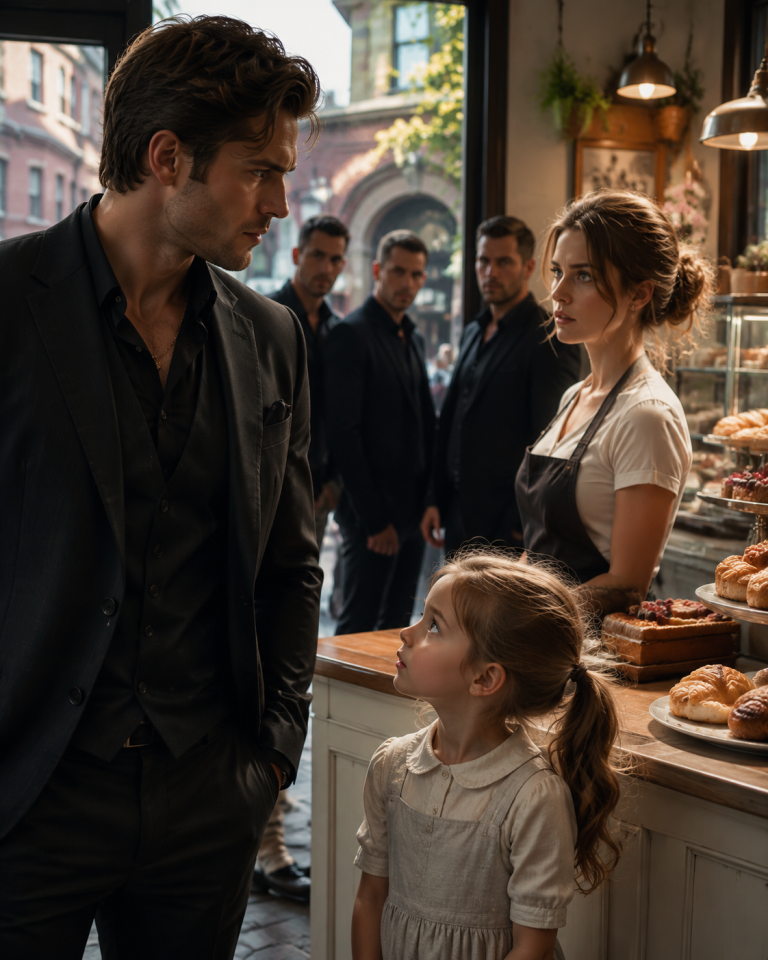
And all of it had arranged itself into this moment: Cara standing outside a cafe on West 57th, looking through the glass at warm light and empty chairs, knowing this was not a place she could afford and going inside anyway because Nadia’s lips were turning the wrong color.
—
She knew he was dangerous before the waiter reached the table.
Not because he looked it — he didn’t, quite, not in the obvious way. Dark coat, good suit, a newspaper folded with the precision of someone who had been taught to fold things precisely. One espresso. One table. The kind of stillness that came not from peace but from practice.
But then the waiter saw him.
The waiter had been moving fast the way waiters moved in packed places, weaving and apologizing and balancing three things at once. Then he saw the man at the back table and the weaving stopped. His shoulders came up, then corrected themselves down. His voice dropped a register.
“Mr. Vasari.”
Not sir. Not welcome back.
Mr. Vasari, the way you said the name of something that required care.
Cara noticed. She noticed things the way broke people notice things — not by choice but by necessity, because missing information was expensive.
She also noticed that every other table was full.
Every table except his.
She picked up Nadia, shifted her camera bag, walked to the back of the room, and hated herself the entire way there.
“I’m sorry to interrupt,” she said. “We’re not staying long. Everywhere else is taken and my daughter is cold. Would it be all right if we sat here? Just until the rain eases.”
The man looked up.
Cara had prepared to be dismissed, which was the most likely outcome and the one she had already decided she could endure.
Instead, he looked at Nadia.
At the damp curls. The blue tinge at her mouth. The careful stillness of a child who had learned not to ask for things because asking sometimes made her mother’s face do something sad.
He looked at these things, and something moved in his face that was not pity and not performance.
“Sit,” he said.
He called the waiter before they had settled. Hot chocolate with a mountain of marshmallows, a bowl of soup, bread that Nadia would later describe as the best bread she had ever eaten and would try, with adult seriousness, to explain in terms of its texture.
Cara said she could pay for her own food.
He said it was already handled.
The way he said it — not dismissive, not charitable, just certain in the way of someone for whom this particular problem had already ceased to exist — made her want to argue and made her look at Nadia’s color coming back.
“Thank you,” she said instead.
“You were working upstairs,” he said.
She looked at the camera bag.
“The Meridian dinner. Freelance.”
“I could tell.” Something at the edge of his mouth. “The way you move through a room. Always watching.”
No one had ever said that to her. The people who hired her talked about shots and angles and the guest list. They did not notice how she moved.
“Cara Walsh,” she said, because filling silence felt safer than leaving it empty. “And this is Nadia.”
“Luca Vasari.”
Said like a test.
She gave him no reaction, which seemed to interest him.
“I looked at your portfolio.” He held up a damp business card. “It was on the floor by the entrance. Your site was on the back.”
“Most people don’t look up photographers they find on the floor.”
“I am not most people.”
“I’m getting that impression.”
Something shifted — he almost smiled, which was different from smiling and somehow more significant.
“My mother’s birthday dinner,” he said. “Three weeks. Sixty guests. Full documentation.”
He named a number that made Cara’s chest tighten.
That was her car. Her February rent. Four months of Nadia’s daycare. All of it, up front.
“That’s generous for a photographer you just met.”
“I looked at the work.”
“And?”
“Sufficient to decide.”
Cara’s instincts and her bank account had a brief, furious conversation.
The instincts pointed to the waiter’s dropped shoulders and the name said like a warning.
The bank account pointed to the tow notice on her phone and the forty-one dollars in her wallet.
“I’ll need a contract,” she said.
“My assistant will send one tonight.”
“And I’d like references.”
The almost-smile again. “You negotiate well for someone who came in out of the rain.”
“Desperate people learn to be efficient.”
She waited for him to be offended by that.
He nodded once, like she had confirmed something.
By the time Nadia finished her soup, her eyes were drooping. Outside, the rain was still coming down, hard and relentless.
“My driver will take you,” Luca said.
“That’s not necessary.”
“You have no car. She is half-asleep. It is raining.” A brief pause. “These are not arguments. They are facts.”
The car was black, windowless from the outside, and smelled of leather and a cedar-based cologne that probably cost more than Cara’s camera. The driver’s name was Marco. He had the build of someone who had been given a choice between violent work and violent work and had chosen the kind that wore suits.
He was very gentle with Nadia when she nearly fell asleep climbing in.
Cara noticed that too.
Halfway to Queens, Nadia woke enough to look at Luca with the uncomplicated directness of small children.
“Do you live in a castle?” she asked.
“Something like that,” he said.
“My mama says castles are only in books now.”
“Your mother knows a great deal.” He glanced at Cara. “But occasionally reality will surprise you.”
Cara looked out the rain-blurred window and did not let herself feel anything about that sentence.
Her building appeared the way it always appeared: apologetically, in comparison. The graffiti on the lower stairwell. The broken light in the lobby. The smell of damp concrete that never fully dried. The evidence, in short, that she had been surviving rather than living for longer than she wanted to count.
Luca’s face did not change when he saw it.
That was either grace or performance. She could not tell which yet.
“Three weeks,” she said at the car door. “I’ll have the contract reviewed before I sign.”
“Goodnight, Cara.”
She went inside. Upstairs. Got Nadia into dry pajamas. Sat on the edge of her own bed with her phone and waited.
The contract arrived at 11:47 p.m.
The advance cleared at 11:52.
She stared at the confirmation for a long time.
Then she looked out her window at the rain still falling on Queens and understood, without knowing any details yet, that something had begun that would not end where she could see from here.
—
## PART 2
The Vasari estate was, in Nadia’s precise assessment, definitely a castle.
It had a curved driveway, iron gates, and a garden even in November. It had high ceilings and floors that reflected light and photographs on walls that watched you rather than decorated. It had the particular quality of buildings that had held the same family for a long time — not museums, but places where memory had a physical address.
Luca met them at the entrance and crouched to Nadia’s level to say good morning, which Cara added to the list of things she had not expected.
The sunroom was extraordinary. Three walls of glass, garden light, the kind of room that made portraits look like truth rather than photography. Cara felt her professional mind take over the moment she walked in, which was a relief.
Professional minds did not pay attention to the way a man with dangerous associations remembered how her daughter took her hot chocolate.
She was taking reference shots when she heard someone in the garden.
An older woman in cream linen was tending to roses despite the November chill, moving with the particular authority of someone who believed gardens required attendance regardless of season. Silver hair. Elegant hands. A posture that carried both warmth and weight.
The woman looked up.
She looked through the glass at Nadia.
She went entirely still.
Her hand rose slowly to her mouth.
She came inside moments later, and Luca said quietly, “Mama, this is Cara Walsh, the photographer. Her daughter Nadia.”
Renata Vasari tried to compose herself.
Her eyes kept returning to Nadia — to the dark blonde curls, the small serious face, the way she stood close to Cara’s leg with one hand wrapped in her mother’s jacket.
“Forgive me,” Renata said. “She reminds me of someone very dear.”
Luca, beside her: “My niece. Giulia. We lost her seven years ago.”
The sunroom changed.
Cara looked at Nadia through Renata’s eyes and felt the weight of it — the specific grief of people who had loved a small person and then been asked to continue living in the world without her.
“I’m very sorry,” Cara said.
Renata waved the apology aside with the motion of someone who had received many such apologies and found them both touching and inadequate.
“Long ago,” she said. “And also still.”
Then she bent toward Nadia. “Do you know how to make pasta? Real pasta. With hands.”
Nadia shook her head.
“Come,” Renata said simply. “I will show you.”
Cara stepped forward.
Luca said, quietly: “My mother would not allow harm to come to a child in her care. Of all the things you might worry about in this house, that is not one.”
Cara looked at him.
“Tell me about Giulia,” she said.
He turned to the window.
There had been a territorial dispute with a family called the Marchetti organization. Luca had refused to yield the northern port operations his father had spent thirty years building. The Marchettis had made their point at a family restaurant on a Thursday evening. Giulia had been four. Her mother — Luca’s sister-in-law, married to his brother Enzo — had survived. Giulia had not.
Enzo had not survived the aftermath, though no one had technically killed him. He had simply, over the following two years, stopped.
“I thought my name was protection enough,” Luca said. His voice carried the specific flatness of someone telling a story whose ending they are still accountable for. “I learned differently.”
“What did you learn?”
“That protection is not a name. It is a practice. It is being present and specific and constant. It is not trusting that reputation will do the work that presence requires.”
He looked at her.
“That is why Marco is here. Why the cameras are where they are. Why the gates close the way they close.”
“And your brother?” Cara asked.
“Enzo lives in Florence. He is—” A pause. “He is trying to build something that resembles a life. I don’t interfere.”
From the kitchen, the sound of Nadia laughing at something Renata had done.
Cara’s chest tightened in the way that happened when something was almost too much to hold.
“You paid me too much,” she said.
“I paid what the work is worth.”
“You paid what would make it impossible for me to say no.”
He looked at her steadily. “Would you have come otherwise?”
She considered lying.
“Probably not,” she said.
“Then I paid accurately.”
At lunch, the dining table was set for three — or four, since Renata had simply placed a fourth setting at her elbow for Nadia without discussion. The pasta Nadia had helped roll was served with a sauce that tasted like someone who understood what comfort was supposed to do.
Then the door at the far end of the room opened, and Cara understood immediately why Luca had positioned himself facing it.
The man who entered was younger than Luca, darker under the eyes, carrying his body with the careful effort of someone managing something internal. His suit was yesterday’s. His glass, which he was still carrying, was not his first of the afternoon.
He saw Nadia.
Something crossed his face that Cara could not fully name — not malice, not immediately, but something older. Something grief-shaped that had been in a dark place long enough to go wrong.
“She looks just like her,” he said.
Renata rose. “Enzo. You are not well.”
“I am perfectly clear.” His voice was not cruel. It was worse — it was accurate and broken simultaneously. “You brought a child here to make yourself feel better. Both of you. A substitute. An understudy.”
“She is not a substitute,” Renata said. “She is herself. A different child. A guest.”
“She has Giulia’s curls.”
“Many children have curls, Enzo.”
“Not like that.” He looked away, then back. “Not exactly like that.”
Luca was at the door before the sentence finished.
“Out,” he said. One word. The same quality as his name in the waiter’s mouth — not threatening, simply certain.
Enzo left, not without looking back once.
Nadia had not moved. She was still seated, watching with the particular composure of children who have learned that adults sometimes had difficult moments and the safest thing was to stay very still.
Renata smoothed her napkin and sat back down.
“More pasta, piccola?” she asked Nadia.
Nadia looked at Cara.
Cara nodded.
“Yes please,” Nadia said.
Part 2 Cliffhanger: That evening, leaving through the front gate, Cara saw a truck on the service road. Cyrillic lettering on the crates being unloaded. Armed men she did not recognize, moving with the efficiency of people who did this regularly.
She looked at Luca.
He was already looking at her.
“Import and export,” he said. “Logistics.”
“That explains everything and nothing,” she said.
“That is usually the purpose of a good answer,” he said.
She got into the car.
On the way home, Nadia fell asleep against her arm.
Cara looked at the city through the tinted glass and understood that she had just glimpsed the underside of the elegant life she was being paid to photograph, and that Luca had let her see it, and that the letting was itself a kind of decision.
The question was whether it was the right one.
She did not sleep well that night.
—
## PART 3
The birthday dinner was, professionally, the best work Cara had ever done.
Sixty people in the sunroom under string lights, the table set with the specific opulence of people who understood that beauty was not excess but attention. Renata in midnight silk at the head, receiving guests with the warmth of a woman whose authority required no announcement. Luca at her side, managing the room by being in it — his presence alone arranged everything else around it.
Through the lens, Cara did what she did: watched, waited, found the true moments inside the posed ones. A man leaning toward his wife with something he couldn’t say out loud. An old friend gripping Renata’s hands. A child who had come with her parents, bored by the grown-up table, sneaking bites of something from the dessert display when she thought no one was watching.
Cara photographed all of it.
She also photographed the things she was not supposed to see.
The men at the far wall, positioned wrong for waiters, too alert for guests. The conversations that paused when she came too close. The way certain introductions were made with specific care and certain names were not spoken in certain combinations.
She had photographed enough corporate events to understand money.
She had not, until now, photographed the kind of money that wore its silence differently.
During the main course, she heard Enzo’s voice through the adjoining door she had been told not to open.
“The Marchetti negotiation is stalled. They’re running out of patience.”
A second voice: “We can’t let them think the silence is weakness.”
“The shipment —”
“Is a separate matter.”
Cara lowered her camera.
Marchetti. The family who had been at the restaurant. The family Luca had told her about.
The words arranged themselves into a shape.
Import and export.
Logistics.
Armed men with Cyrillic crates.
Territorial dispute.
Giulia.
The shape had a name, and the name was not surprising, and it was worse than surprising because she had already known and had been letting herself not know.
A hand closed around her elbow.
Not roughly.
Carefully, almost.
She turned.
Luca.
“Walk with me,” he said.
In the library, the door closed. He did not offer her a drink this time. He sat across from her and let her reach her own position.
“I’m going to deliver the photographs,” she said. “After that, Nadia and I are done.”
“Is that what you think will happen?”
“It is what needs to happen.”
“You have been in my home twice,” he said. “You have seen my family. You have seen security, faces, positions of people who require anonymity. You have heard things through doors not by my intention but by circumstance.” He looked at her. “You are already inside this, Cara. The question is not whether. The question is what that means.”
“It means I’m a liability.”
“It means you are under my protection.”
“I don’t want your protection.”
“That changes nothing about the fact of it.”
The words had an edge without being unkind.
“What does protection mean from someone like you?”
“In practice? Marco checks the building. My lawyers become available to you if you need them. If anyone tries to use you to reach me — and they may, because people have found out I have reasons to care what happens to you and your daughter — you call me before anything else.”
“And in return?”
“You live your life. Work. Raise Nadia. The only cost is that you do not discuss what you have seen in this house.”
“Discretion.”
“Yes.”
“You mean silence.”
“Measured silence,” he said. “Which is different.”
Cara looked at him.
“The people at dinner,” she said. “The Marchetti family — the ones who—”
“Yes.”
“They are still a problem.”
“They are managed.”
“Managed is not the same as gone.”
“No,” he said. “It is not.”
He met her eyes.
“Which is why protection is not optional.”
Before she could answer, Marco appeared in the doorway.
His face said something without words.
Luca stood.
“What happened?”
Marco handed him a phone. Security footage. Enzo’s apartment building. Enzo at the door, then a second figure — someone Cara did not recognize, but Luca’s jaw tightened before the clip finished.
“When?” Luca said.
“Two hours ago.”
Luca looked at the screen, then at Cara.
“Enzo has been in contact with someone he should not have been in contact with,” he said.
“The Marchetti people.”
“Yes.”
Cara’s first thought was: Nadia. Her second thought was the same.
“Is it about me? About us?”
Luca’s silence was its own answer.
“He doesn’t hate you,” Luca said. “He hates his own grief, and sometimes you and Nadia stand in the path of it. He did not mean for this to go where it has gone. That does not change what it means.”
“What does it mean?”
“It means someone knows you’ve been here. It means someone with motivation to use that information has it.”
Cara looked at the library door.
Sixty people still eating dinner on the other side of it, and somewhere outside the gates, a calculation being made about two people who had walked into a cafe on West 57th because a five-year-old was cold.
“What do we do?” she asked.
And for the first time, she noticed she had said *we.*
Luca noticed too.
—
The letter from Nadia’s father came on a Tuesday.
Danny Walsh had been gone for three years. Not absent — present, in the specific way of men who leave and make the leaving feel like something the other person had caused. He had charm and inconsistency in roughly equal measure, and when they separated, Cara had considered herself fortunate that the inconsistency had never become something she had to document for a court.
She had been wrong to consider herself fortunate. That was the letter’s essential message.
*Out in four months. I’ve been thinking about Nadia. About my rights. I have representation now. The right kind. We should talk before this becomes official. — Danny*
Cara read the letter three times and then called a legal aid number she had kept in her phone since the separation.
The answer was what legal aid answers always were: accurate, honest, and designed for people with resources she didn’t have. A strong case. A stronger opponent if he had proper representation. A retainer of ten to fifteen thousand to do it right.
She looked at her bank account.
She looked at Danny’s letter.
She looked down the hall at Nadia’s door.
Then she called Luca.
She had not called him since the dinner. She had been managing the distance deliberately — doing the work, delivering files, keeping Nadia’s relationship with Renata to one visit per week because more felt like need and need felt like vulnerability.
He answered on the second ring.
“Cara.”
“I need help,” she said.
She had not said those three words, in that order, in a very long time. They felt like something she had built a wall around and had just knocked through.
She told him about Danny. The letter. The lawyer. The money. The three years of careful single-parenting she had done while he was absent and the fact that absence, it turned out, did not disqualify anyone from returning with documentation.
Luca listened.
When she finished, he said: “Pack a bag. For you and Nadia. Bring whatever matters. Marco will be there in thirty minutes.”
“Luca, I’m not —”
“Someone connected to the Marchetti situation knows you have access to me. Enzo has been communicating with people who see you as pressure I would respond to. This letter arriving now is not a coincidence.”
Cara’s blood went cold.
“Danny doesn’t know these people.”
“He knows people who know people who know how to find a specific kind of complication.” His voice was steady, not frightening because it was controlled rather than performed. “I am not certain. But I am certain that I will not guess incorrectly with Nadia.”
Thirty minutes later, Marco carried Nadia’s overnight bag while Nadia informed him seriously that she had packed her best butterfly headband because one had to be prepared for castles.
Marco told her this was wise.
Cara did not tell her it was a precaution.
At the estate, Renata had a room ready without being asked — which told Cara that Renata had been waiting for this moment since the dinner, since before the dinner, since the first afternoon Nadia had helped roll pasta.
“How long?” Cara asked Luca.
“Until the situation is resolved.”
“That’s not —”
“I know,” he said. “It’s the only answer I have.”
The lawyers arrived the next morning.
Not legal aid. The kind of firm that had a library on the forty-second floor and partners who billed in six-minute increments and considered twelve thousand a reasonable retainer for a case this uncomplicated.
“I cannot afford —”
“You are not paying,” Luca said.
“We had this conversation about charity.”
“And I told you it was protection.” His eyes held hers. “Danny Walsh’s family is being financed by people who want me to respond in a particular way. His custody claim is not about Nadia. It is about pressure. If I let him succeed, the message is that leverage works.” He paused. “This is not charity. This is me refusing to let Nadia be used as a mechanism.”
“And if it were just Danny? Without any of this?”
“Then it would be charity,” he said. “And I would give it anyway, if you let me. But you would not let me, so I am grateful the strategic justification exists.”
Cara looked at him.
“That is possibly the most honest sentence I have ever heard from someone explaining why they were doing something.”
“I am reliably honest,” he said. “It is not my most popular quality.”
The lawyers were efficient in the way of people paid to be.
Danny’s case began unraveling before it formally arrived. Three years of voluntary absence, documented. Zero contact attempts with Nadia, documented. A pattern of instability preceding the separation, documented. The new representation, which had appeared with unusual speed for a man who had spent three years not caring about custody arrangements, traceable to a firm with connections the lawyers described in language that would be useful later.
Enzo came to the house on a Wednesday evening.
Not drunk.
That was notable.
He stood in the entrance hall with his hands at his sides and the specific posture of someone who has decided to say something they know will cost them.
Renata came out of the sitting room.
“Enzo,” she said.
“I know what I did,” he said. “I know what I opened.”
Luca was at the bottom of the stairs.
“How much did you give them?” he said.
“Schedules. The dates she was here. The school pickup times.” His voice was flat. “I told myself it was only information. That they wanted to pressure you. That no one would — ” He stopped.
“That no one would use a child,” Cara said.
Enzo looked at her.
Something moved in his face — not defense, something rawer.
“Giulia was four,” he said. “She liked music boxes and the color orange and she refused to eat anything green. She had a laugh that started in her stomach.” He looked at the floor. “I see your daughter and I know exactly how it ends. I know what happens when people I love are used against me. And I became one of the people who does it.”
The room was quiet.
Renata said, “You are my son.”
“Mama —”
“You are my son,” she said again. “I love you. Both of those things are true, and they will remain true. But love does not prevent consequence.” She looked at him with the specific sorrow of someone who has had to hold both things at once for too long. “What you chose put a child at risk.”
“I know.”
“You will make it right,” she said. “Whatever Luca needs from you to close this — documents, testimony, names — you will provide it. Not as penance. As repair.”
“And after that,” Luca said, “there is an apartment in Lisbon. A position with the foundation’s charitable arm there. Clean work. Distance.” He looked at his brother. “Time, if you use it.”
Enzo bent for the envelope at his feet.
“You are not throwing me away,” Luca said.
“I know.”
“You are our brother. You will always be our brother.”
“I know.” A pause. “I just — I needed to see her have what Giulia didn’t. I couldn’t stand watching it from the outside.” His voice cracked slightly. “I should have. I know I should have.”
He left.
Marco escorted him out.
When the door closed, Renata sat down on the nearest chair with the particular collapse of a woman who has been strong for the exact right amount of time and has now decided to stop.
Cara sat beside her.
Renata took her hand without asking.
They sat together in the entrance hall while Nadia’s voice came from somewhere deeper in the house — she was explaining something to one of Marco’s colleagues about butterflies, with the committed earnestness of someone who believed the subject was universally interesting.
“She is a gift,” Renata said. “However she arrived here.”
“She would say the pasta was the gift,” Cara said.
Renata laughed, which was wet and real and nothing like the composed woman who had received sixty guests in this same house two weeks ago.
“Stay,” she said. “Not forever. Until it feels like choice rather than shelter. Until you wake up and think you are here because you want to be, not because there is nowhere safer.”
“That’s a different kind of invitation,” Cara said.
“Different from what?”
“From what I expected.”
Renata looked at her.
“What did you expect?”
Cara thought about the restaurant. The forty-one dollars. The tow notice. The moment she had made a calculation about danger and opportunity and the color of Nadia’s lips.
“I expected to be managed,” she said. “Moved around. Protected in the way that looks a lot like controlled.”
Renata squeezed her hand.
“That is what this house did to Giulia’s mother,” she said. “It enclosed her, with love, with every intention of safety. And she disappeared inside it.” She paused. “Luca knows this. He knows it the way people know things they failed to see until it was too late. He will try to do it differently with you.”
“He will still try to control things.”
“Yes. He is who he is.” A small smile. “Tell him when he does. He will listen. He is better at listening than most people believe, because most people never demand it of him.”
—
Three months passed with the particular quality of difficult things becoming ordinary.
Danny’s claim was dismissed without reaching a hearing. His representation withdrew once certain connections became visible in the light of the lawyers’ very deliberate disclosure. Danny himself called once, sounding less like someone who wanted custody and more like someone who had been given a script and had run out of page.
The Marchetti situation did not resolve cleanly — these things rarely did — but it receded. Luca gave no clean explanation and Cara did not ask for one. She had decided, at some point in the second month, that she would ask for honesty about the things that touched her life and accept that the things that did not were his to carry.
He was not perfect at telling her things.
She was not perfect at hearing them.
They worked at it.
Renata became the kind of presence in Nadia’s life that Nadia described, at school, as her other grandmother, which made Cara’s actual mother raise her eyebrows considerably when she heard about it, which was a separate complication.
The sunroom became Cara’s studio.
The clients came — first because Luca’s referrals opened doors she hadn’t known existed, then because the work was good and work that was good built its own momentum. She photographed families in the north light. Children with missing teeth and irreplaceable expressions. Couples who believed photographs could hold what they felt. She was a photographer, and a very good one, and that had been true before the cafe on West 57th and was still true here.
Nadia thrived in ways that had previously been impossible.
She laughed differently. Not less carefully — she had always been a careful child — but with less of the background monitoring that Cara recognized from herself. She slept without the particular silence of someone listening for disturbance. She brought home drawings from school and left them on surfaces without gathering them afterward.
This was the thing that mattered more than anything else.
One evening, Cara found Luca in the sunroom with the photograph Renata kept on her desk — Nadia in November light, face open, curls backlit, captured on the day Cara had not known what she was walking into.
He was holding it the way people held things that cost them something.
“You look at it like it still hurts,” she said.
“It does.”
“Because of Giulia?”
“Because I almost told you it was too complicated.” He set the photo down. “I almost said: take the advance, do the work, and we go our separate ways, because my world was not something I wanted you navigating.”
“Why didn’t you?”
He looked at her.
“Because Nadia asked Marco if princes had castles.”
Cara almost laughed.
“That changed your mind?”
“It reminded me what I was protecting,” he said. “Which is different from what I had been protecting.”
She looked at him.
“Say what you mean, Luca.”
He looked at the photograph.
“I was protecting the walls,” he said. “The gates. The name. The operations. The machinery I inherited from my father and believed was the thing worth guarding.” He paused. “Then a five-year-old asked about castles like the real ones might still exist. And her mother argued with me about soup and money and the difference between protection and possession.”
His eyes moved to hers.
“I love you,” he said.
No ceremony. No distance. A fact stated by someone who had carried it long enough that stating it had become necessary.
“I love Nadia. I love watching Renata become herself again because of them. I love that you argue with me consistently and are usually correct. I love that you photograph people’s truth rather than their surfaces.”
“You are not an easy man,” she said.
“No.”
“Your world is not clean.”
“No.”
“You will try to manage things without telling me.”
“I will try,” he said. “And you will tell me when I do, and I will —”
“Listen?”
“I am trying to learn,” he said. “I am better at it than I was three months ago.”
“You are,” she said. “Still not good enough.”
“I know.”
“But better.”
“Yes.”
She reached across the small space between them.
“I love you,” she said. “With all the problems attached. Which are considerable.”
“Yes.”
“But you held the table wide,” she said. “When I came in out of the rain. You let me choose whether to stay.”
His hand closed around hers.
“I am learning,” he said, “that that is what it means.”
—
The proposal happened at the cafe on West 57th.
Cara had suggested it, which was either sentimental or strategic and she could not decide which. They went on a Saturday morning, the four of them — Cara, Nadia, Luca, Renata, who had declared that she intended to be present for significant moments — and took the same back table.
The same young waiter, still reflexively formal when he saw Luca, now smiling when Nadia ordered hot chocolate with extra marshmallows with the full confidence of someone returning to a place that was hers.
Luca waited until Nadia’s mug was halfway down.
Then he looked at Nadia.
“I’d like to ask your mother something. Would that be all right?”
Nadia considered him with the seriousness she gave important questions.
“Is it about the castle?” she asked.
“In a way.”
He went to one knee beside Cara’s chair.
The cafe went quiet in the specific way of places that understand something is happening even without being told.
“I cannot offer you simple,” he said. “I cannot promise that my world will be clean or uncomplicated or free of all the things you walked into when you came in out of the rain.”
“I know,” she said.
“What I can offer is honesty. Presence. The correction — when you tell me I am crossing the line and I listen.” He opened the box. “And this, if you will take it. Which is not a claim. It is a request.”
Renata made a small sound beside him.
Nadia bounced in her seat.
“Yes,” Cara said. “You already know yes.”
He slid the ring onto her finger.
Nadia climbed into his lap from the other side of the table, which caused a brief discussion about chairs and balance that ended with everyone laughing.
The waiter started the applause.
The cafe followed.
—
People would tell the story wrong.
They would say: a broke photographer asked to share a table in the rain and ended up in a mansion.
They would say: luck. Fairy tale. Rescue.
Cara had heard that kind of story before and knew what it left out.
It left out the forty-one dollars and the car in impound and the child pressing small hands together to stay warm because she had learned not to ask for too much. It left out the legal aid numbers and the custody letters and the terrible Tuesday mornings when the bank balance and the rent and the cost of daycare produced a sum that did not add up. It left out the years of surviving before any castle appeared on any horizon.
What Luca gave her was not rescue.
It was reinforcement.
He filled the gaps that she had been covering alone. He put resources behind the fight she was already fighting. He sat across from her in a library and said: you are not a problem to be managed, you are a person under my protection, and those are not the same thing, and I am learning the difference.
And Cara, who had spent years learning to fight with what she had, found that what she had was more when someone stood beside her who understood that the point of the wall was not to contain her but to face outward.
That was the thing neither of them had expected.
That love, for people who had both learned it wrong, looked a lot like learning it right.
Together.
Slowly.
With correction, and honesty, and the willingness to be told when the other one was crossing a line.
And at a table in the back of a West 57th cafe, with hot chocolate and marshmallows and Renata Vasari crying very quietly into a good napkin, it looked a lot like choosing to stay.
Not because there was nowhere else to go.
But because here, for the first time, was somewhere worth choosing.
—