I Woke Up to a Mafia Boss in My Apartment—Then He Hissed, “Don’t Make a Sound”

## PART 1
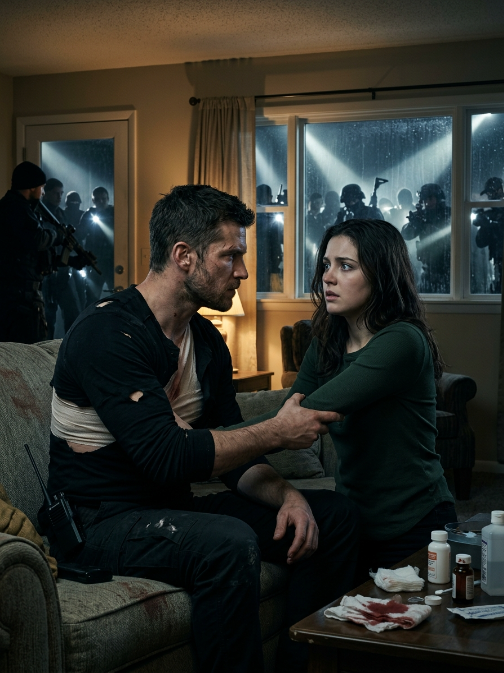
He was already inside my apartment before I heard the door.
That was the thing I kept returning to in the days that followed: not the photographs, not the threat, not even the shape of him in my window glass. It was the simple fact of a dead bolt and a security chain providing exactly the protection they promised on the packaging — which was none at all — while I sat fourteen hours into a session that had turned from professional to fatal the moment I understood what I was looking at.
The photographs were good work. That was the worst part. High resolution, correctly exposed, the kind of documentary evidence that required patience and a long lens and being in the precise wrong place. I had been shooting the intersection of Ashland and 18th for a neighborhood archive project, the kind of civic assignment that paid nothing and mattered to everyone, when my shutter caught a federal informant in a frame with a man whose name I had spent the last two weeks learning to fear.
Three weeks of verification later, I knew too much.
I also knew that Connor had been leaving me messages about strangers asking questions, and I had been too deep in my research to listen.
The coffee had gone cold again. I was about to delete the images — finally, after three weeks of telling myself I should — when hands closed on my shoulders from behind.
I did not make much sound. The palm that came over my mouth was too practiced for that.
“Do not scream,” the voice said. Italian-accented, precise. “Do not struggle. I need exactly ninety seconds of your attention.”
In my window: his reflection. Large. Controlled. The specific stillness of someone who moves through rooms like he was born to occupy them and has never needed to announce his presence.
My heart rate was trying to break something.
“The photographs on your screen,” he said. “You understand what they are.”
Not a question.
“The organization connected to that man knows you have them. They have been watching your building for three days. They have decided to act tonight.”
He stepped back enough to let me turn. I turned.
Dark eyes that processed information the way computers do — fast, exhaustive, nothing wasted on performance. A jaw that carried a scar shaped like a question mark. Expensive clothes that suggested money made through means I was currently documenting. Forty, maybe. Handsome in the way that announces itself before you can decide how you feel about it.
“Who are you?” I said.
“Someone who arrived here before they did.”
“That is not an answer.”
“It is the most relevant one.” He nodded toward the door. “You have perhaps twenty minutes. Pack nothing. Leave everything.”
“My research is on that laptop. Three weeks of—”
“Already backed up. Already secured. You touching that machine now only endangers the backup.”
The certainty of it landed before the implications could catch up.
“Dress,” he said. “Move.”
Three other men were in my apartment. I had not seen them enter either. They moved through my space with the practiced efficiency of people conducting an evacuation drill they had run many times before.
I grabbed my jacket from the chair. My hands shook through the zipper.
“Why should I trust you?” I said to his back.
“Because the alternative is waiting here.” He checked the hallway through the peephole with one smooth movement. “The people coming are not interested in negotiation.”
“And you are?”
He looked back at me then, and what I saw in his face was not reassurance. It was mathematics.
“I am interested in outcomes,” he said. “Currently, your survival is a favorable one.”
“Currently,” I repeated.
“Move,” he said again.
We went down through the service stairs. The back alley opened onto 19th Street, where a car waited with its engine running. I was in the back seat before I had finished deciding whether to resist, and by then the door was closed and the city was sliding past dark windows and I was calculating whether screaming at a stoplight was worth the calculus.
The man settled beside me. My new captor in expensive clothes.
“Nate Russo,” he said, like names were useful now.
“You own the building where—” I started.
“I own several buildings.”
“The restaurant where the photographs were taken at the adjacent property. The restaurant is yours.”
He looked at me.
“You have done your research.”
“I have been doing it for three weeks. Which you already knew.”
“Yes.”
The city lights moved past us in the particular way they do when you are leaving them.
“I am a photographer,” I said. “My work is on that laptop.”
“Your work is secured.”
“Without my permission.”
“Yes.”
Outside, Chicago became highway, became darkness, became the kind of absence that happens when cities run out of reasons to keep going.
I was crying without deciding to. Silent and inconvenient, the way grief works when it has nowhere else to be.
Nate Russo said nothing. He watched the window with the focused absence of someone giving a person their private minutes.
It was such a specific courtesy that it frightened me more than anything else he had done.
My name was Petra Hayes. I photographed things that mattered. I had a mother in a memory care facility in the city I was currently leaving at seventy miles per hour. I had a research partner named Connor who had been trying to warn me for three weeks.
And I had just been extracted by a man whose photograph was in my files under *connected to Takahashi network, identity unconfirmed.*
He was confirmed now.
Dawn was three hours away when we turned onto a private road somewhere in Michigan. A house emerged through trees: glass and clean angles, the kind of architecture that looks like a statement.
The door closed behind me.
I understood, with the complete clarity of someone who has just run out of choices, that I was inside now.
—
## PART 2
They gave me a room with a view of a lake I had not noticed arriving.
A woman named Sera appeared in the morning with espresso and a tray of things arranged like an apology: bread, butter, jam, the careful precision of someone who had been told to make this feel less like what it was. She had Italian-grandmother posture and eyes that had seen strange things and declined to editorialize.
“Ten o’clock,” she said. “The library. Mr. Russo is expecting you.”
I drank the espresso because I needed it and because paranoia about drugging requires more energy than I had left.
The library was extraordinary. Three walls of shelving, daylight doing what good light does to a room, leather and wood and a collection that told the story of its owner more honestly than any dossier. I stood in the doorway cataloguing it before anyone noticed me: first editions alongside worn paperbacks, books in four languages, margins dense with handwriting in small precise script.
I had read some of those same books. I had marked some of those same passages.
Nate Russo was there with two men — one I recognized from my building, the diplomat-faced one who managed tension with professional ease; the other built for things that required bulk and a tolerance for difficulty.
“Petra,” Nate said. Not a greeting. An acknowledgment.
He told me what I already partly knew, arranged in a sequence I had not been able to see from inside my investigation. The photographs contained two problems simultaneously: evidence of a criminal syndicate’s federal informant connections, and adjacently, evidence of Russo operations in the same geographic area. The Takahashi organization had identified me before his people had. His people had identified me second and moved first.
“You kidnapped me to protect your operations,” I said.
“I extracted you because you were twenty minutes from a conversation you would not have survived.”
“And your operations.”
“And my operations.”
He did not pretend otherwise. This was the thing I kept returning to: he did not pretend.
“Your research partner has been making noise,” said the diplomat one — I would later learn his name was Aldo. “Asking questions about a missing photographer. This created visibility.”
“Connor doesn’t know to stop,” I said. “He doesn’t know I’m gone.”
“He knows now,” Nate said. “He has been informed that you are safe and that continuing to make noise will create consequences for himself.”
The word *consequences* in that sentence meant something specific and probably irreversible.
“He has also been offered protection,” Aldo added, with the smoothness of someone accustomed to presenting the palatable face of decisions already made. “Subtle but comprehensive.”
I sat down then.
I sat down because my legs stopped cooperating, and because the room was warm, and because somewhere in the last sixty seconds I had understood the shape of my new life completely.
The door had closed behind me last night.
I was inside.
And the shape of inside, I was beginning to see, was more complicated than a cage.
—
## PART 3
### The Library and What It Contained
The restrictions were explained by Aldo with the apologetic precision of a man delivering a contract he knows is unfair but considers unavoidable.
Full access to the house. The gardens during daylight hours. The pool monitored by cameras he gestured toward with acknowledgment rather than apology. Phone calls to my mother, monitored. No contact with authorities. No contact with Connor beyond what Aldo could supervise.
“And if I refuse?” I asked.
“You return to a situation where two organizations want different kinds of access to you, neither of which involves your continued wellbeing.”
He said it without pleasure.
“I am not threatening you. I am providing information.”
The third man — the large one, introduced as Pavel — handed me a laminated card.
“Perimeter protocols,” he said. “Red zones. Safe routes. Response times. You should know the math before you make decisions.”
I looked at the card.
“Why are you telling me this?”
“Because panic kills faster than information does.” Pavel said it flatly. “And because Mr. Russo believes you are intelligent enough to use the math well.”
That night I called my mother.
The recording click at the line’s beginning was polite, almost discreet. She answered in the wandering way she answered now, her voice a weather system with its own seasons.
“Pumpkin,” she said, and I pressed my palm against my eye.
“It’s me,” I said. “You sound well today.”
“I painted something with shadows,” she said. “The teacher says I’m getting better at them. Do you think shadows are important?”
“I think they tell the truth about where the light is,” I said.
A pause. The sound of a common room somewhere.
“Are you safe?” she asked, with the clarity that arrived without warning sometimes, like a window opening briefly in a room that had been closed for months.
“Yes,” I said. And the extraordinary thing was that it was true.
She wandered away from the clarity after that. We said goodbye through the gentle negotiation of two people who have learned to love in shorter and shorter increments.
I held the phone after and acknowledged that I was crying. Not from fear. From the specific grief of someone who has learned that safety is a different shape than she expected.
—
### The Books
I found the annotations on day six.
I had been working through the library systematically, the way I approached investigations — cataloguing, cross-referencing, building a picture from the parts. Nate’s collection was not aesthetic. The books were used, which meant something. I pulled a volume of Pasolini’s poetry and found his handwriting in the margins, precise and small, in Italian I could partially follow.
The passages he had marked were the ones I had underlined in a copy I owned somewhere in Chicago, assuming Chicago still existed as a place where I kept things.
Both of us had circled the same lines about beauty ruined by people who loved it too much.
I found him in the library the next evening, working through correspondence on his laptop in the leather chair I had claimed. He did not look up immediately.
“We annotated the same Pasolini,” I said.
He set down his pen.
“Did we.”
“Page forty-seven. And again on eighty-two.”
He looked at me with the considering expression I had started to recognize as his version of genuine attention.
“What does that mean to you?” he asked.
“It means something overlapped that I wasn’t expecting.” I sat in the chair across from him. “It means you read things to understand them, not to own them.”
“Is that significant?”
“Given that you kidnapped me, yes.”
He looked back at his correspondence. Then back at me.
“The Pasolini has been on my shelf since I was nineteen,” he said. “My mother’s copy. She was a professor of literature before my father decided she should be something else instead.”
“What did he decide she should be?”
“His wife. Part of his world.”
He said it without inflection, which was the only way to carry that particular weight.
“Did she hate it?”
“She adapted.” He paused. “She was excellent at adaptation. Better than she should have had to be.”
We stayed in the library until the lights over the lake came on. He worked. I read. It was the first evening I did not consciously count the hours.
—
### The Night Silvio Almost Died
Pavel came for me on day nine with the face of someone delivering news that required a specific kind of preparedness.
Nate’s office was a room I had not found yet: glass on two sides, bookshelves that continued from the library, a desk that bore the organized disorder of someone who worked constantly. He was on the phone, his knuckles white around the receiver, speaking Italian too rapid and too low for me to follow.
His jacket was on the floor.
Not draped. On the floor.
He had not noticed.
“Silvio,” he said into the phone, then several other things I could not decode. Then simply: “Call me.”
He hung up without seeing me, running one hand through his hair in the specific way of a man whose control is holding by a thread.
“His uncle,” Pavel said quietly beside me, then withdrew.
I moved into the room. I sat down in the chair across his desk without permission or invitation, the way you sit with someone who is holding something too heavy to hold alone.
He registered my presence after a moment and said, in the voice he used when he was managing himself carefully: “You do not need to be here.”
“I know.”
“This is not relevant to your situation.”
“I know that too.”
He turned toward the window. The property was dark beyond the glass, lights coming on across the grounds in patterns I had memorized from walking the blue routes.
“He raised me,” Nate said. “My father died when I was eight. Silvio came from Genoa and stayed. He had no obligation to stay.”
“People who stay without obligation are usually the ones worth keeping.”
He glanced at me.
“That is an interesting perspective from someone being kept against her will.”
“Yes,” I said. “I noticed the irony.”
Something in his shoulders changed.
“Minor infarction,” he said. “They are saying minor. But he is seventy-three and he has been carrying this organization since before I was old enough to understand what it was.”
“Did you choose it?” I asked. “The organization.”
A long pause.
“No,” he said. “I chose the least bad option available to me when I was sixteen and out of alternatives. Which is how most people enter lives they would not have designed from scratch.”
“And if you could redesign it now?”
He looked at me directly.
“I would keep the library,” he said. “I would keep the people who stayed. I would find a way to conduct business that required less of what I am currently required to do.”
“That sounds almost like regret.”
“It is accurate accounting.”
We stayed in the office for another hour. He did not weep. He sat with the weight of it in the way of men who have been taught that public grief is a weakness and have learned to process privately. I stayed because leaving felt like a cruelty I was not willing to commit.
When Aldo appeared at midnight with confirmation that Silvio was stable, Nate exhaled.
Just that. One breath released.
“Thank you,” he said to me, which was unexpected.
“I didn’t do anything.”
“You stayed,” he said. “That is not nothing.”
—
### What the Library Taught Me About Him
By day fourteen, I understood that the library was the most honest room in the house.
His professional life was managed in the office, the conference calls and the security protocols and the business of the organization expressed through abbreviation and coded language. But the library was where he went when he needed to think something through. I had started finding him there at odd hours: three in the morning with a philosophy volume that he was clearly using as a weapon against insomnia, early evenings when he arrived before me and was already annotating something.
The annotations were the key. Reading his marginal thoughts was like reading correspondence he had never intended to send. He was engaged with questions about power and its costs, about the difference between authority earned through fear and through respect, about what happened to men who lived for long periods outside the boundaries of ordinary accountability.
He was arguing with himself about his own life, in the margins of books, for decades.
“You have been reading my notes,” he said on day fifteen.
“You left the books accessible.”
“Most people do not read what they cannot decode.”
“I have been decoding things for a living.”
He sat across from me in his chair.
“What have you decoded?”
“That you have been having the same argument with yourself since you were nineteen,” I said. “And that you haven’t resolved it. But you also haven’t stopped engaging with it, which means it still matters to you.”
He was quiet for a moment.
“And you find that meaningful?”
“I find it human,” I said. “Which is what surprises me.”
—
### The Terms
On day seventeen, I asked for a meeting.
Aldo received this request with the expression of someone slightly entertained by protocol they hadn’t established. He arranged it.
Nate was in the library. Not at his desk. In the chair across from what had become, in seventeen days, unambiguously mine.
“Terms,” I said, before I could lose the nerve. “Not leverage. Not negotiation from hostility. Language for how this works.”
He waited.
“I will not call the FBI. I will not contact Connor without your knowledge. I will not make decisions that create danger for your people without calculating the consequences first.” I exhaled. “In exchange. I am not punished for surviving. If something happens in this house that I need to respond to without your choreography, that is called survival, not disobedience. And I do not disappear from myself. The parts of me that photograph things and call my mother and read Pasolini stay. If they go, I go. Anything remaining of me would not be worth keeping.”
Nate said nothing for a long moment.
“What do you offer me in return?”
“I already said.”
“The obvious,” he confirmed. “And?”
“And I tell you when my fear is louder than my judgment,” I said. “So your math can be louder than my fear.”
He looked at me with the assessing expression that was his version of being moved.
“Done,” he said.
“Say it twice,” I said. “In Italian and in English. I’ve noticed you use Italian for things you mean completely.”
He said it twice.
Both versions landed like contracts.
—
### The Destruction
Aldo told me on day twenty-one that the photographs would be destroyed.
The neutral location. Representatives from both organizations. My presence required to demonstrate what he called *voluntary cooperation*, which we both understood was theater, but theater with life-or-death stakes.
I dressed in what Sera had found that registered as professional without performing submission. Black. Precise. Heels I could actually move in.
Nate came out of the bedroom in the Detroit apartment wearing clean clothes over evidence of a night that had evidently involved physical consequences for someone. A bruise beginning along his jaw. A shirt with a shoulder seam that had separated and been hastily repaired. He looked at me with eyes that were doing the math on everything simultaneously.
“You were hurt,” I said.
“Managed.”
“By whom?”
“Takahashi people who found the Michigan property before we finished evacuating.” He checked his phone. “The complication has been resolved.”
“Resolved meaning—”
“Meaning you are safe and the timeline for today holds.”
I did not push the rest of the sentence, because the rest of the sentence was something I could not unmake by hearing it.
The warehouse was industrial anonymity. Both organizations manifested like weather systems. I stood beside Nate while representatives arranged themselves in the geometry of mutual distrust.
The Takahashi organization sent someone I recognized from my own photographs, a man named Hideo who had the stillness of someone accustomed to rooms where everyone is pretending not to be dangerous.
“Miss Hayes.” He studied me the way you study something you might need to remember. “You understand the parameters.”
“Complete silence,” I said. “No copies. No reconstruction. No engagement with authorities regarding any aspect of this situation.”
“And you agree voluntarily.”
“I agree practically,” I said. “Which is the only kind of agreement you can trust anyway.”
Something moved in Hideo’s expression that might have been respect if I had been looking for it.
The photographs were displayed, confirmed, and systematically destroyed. My three weeks of careful documentation reduced to null values and fragments of hard drive that were then swept into a containment bag like debris.
My work. Gone.
I watched it without performing grief or compliance. I simply watched it the way you watch something necessary that cannot be undone.
On the way out, a woman in a navy suit intercepted me at the side entrance.
She did not identify herself. Her card was blank — ivory, no text.
“You are not being pursued,” she said, which was government syntax for *we know what happened and we are choosing not to proceed.* “Your partner has been advised to leave certain editorial choices on the table.”
She meant Connor.
“And if I choose to contact you?” I asked.
“That card opens a conversation,” she said. “I prefer conversations that do not require evidence.”
She looked past me at Nate, who had come to stand at my shoulder.
“Do not make me chase her,” she said to him.
“We won’t,” he said.
She left the way math leaves a room. Completely, without residue.
—
### The Pouch
I found it at the airport.
Forty-eight hours after the warehouse, I was at Detroit Metropolitan with a passport that said Harper Vance and a plane ticket to London and thirty thousand dollars in neat bundles. Aldo had arranged all of it with the efficiency of a man facilitating something he found professionally straightforward and personally complicated.
Nate had said: *You should go.* In the tone of someone who means both the thing they are saying and the opposite.
I went through security. I went to the gate. I sat among families and business travelers and students who were going to London for the ordinary reasons people go to London.
I opened my bag to find my phone.
Inside, in a sealed pouch I had never packed, were things I had not seen since the night I left Chicago.
My journals. All three of them, which had been on my desk, which should have been left behind or destroyed.
Photographs. My father young. Myself at age seven on a beach I had forgotten visiting. My grandparents at their wedding.
And at the bottom, a postcard from Porto, Portugal. My grandmother’s handwriting on the back.
*For our Petra, who finds light where it’s hiding. Come see the world. Gran.*
My hands stopped working properly.
He had kept these. Preserved them. Transported them without telling me.
Violated my privacy, yes.
But kept them like they were worth keeping.
The boarding announcement happened. First class. I had the boarding pass.
I stood at the gate and could not move.
“Miss Vance?” the attendant said.
I said: “I need to reschedule.”
—
### The Return
Matteo was in the arrivals area. He had not driven me to the airport, but he was in arrivals with the expression of someone who had been asked to wait without expectation.
“He will be surprised,” Aldo said, when I got in the car.
“Don’t tell him yet,” I said.
I found Nate in the apartment bedroom, awake, watching the window with the focused stillness of someone who has already finished grieving a departure he had decided to accept.
He turned when I came in.
I held up the pouch.
“You kept them,” I said.
He looked at the pouch.
“Yes.”
“Without permission.”
“Yes.”
“You preserved pieces of me that I had left behind.” I set the pouch on the bed between us. “That is either an extraordinary violation or an extraordinary act of care, and I am not sure I can tell the difference anymore.”
“Both,” he said simply. “It is both.”
“Why?”
He moved toward me with the contained deliberateness that characterized how he moved toward anything he had decided to approach.
“Because the night I first saw your photographs,” he said, “I understood that you were someone who looked at the world as though it deserved to be documented. Who thought truth mattered enough to risk being in the same room as it.” He stopped at the appropriate distance. “I have spent twenty years in proximity to people who would do almost anything to avoid documentation. Having someone like you in my world felt—”
He paused.
“Like being found out,” he said. “In a way I didn’t want to stop.”
“So you took my journals.”
“I took the evidence that you existed before this happened to you,” he said. “That you had a grandmother who loved you and a father who held you and a life that was yours before I arrived at it. I did not want that to be lost.”
I looked at him.
“That is an explanation,” I said. “It is not a justification.”
“No,” he agreed. “I am not asking for it to be.”
I thought about the airport. About London and an empty passport and thirty thousand dollars and a life I could build that had no Nate Russo in it.
I thought about margins annotated in two different handwritings in the same passages.
“I am staying,” I said. “Not because I am trapped. Because what you did with those photographs tells me something about how you see me. And I find I cannot walk away from being seen that way.”
“You understand what staying means.”
“You will not let me go.”
“No.”
“And I will need space, and autonomy, and the parts of myself that take photographs and call my mother and argue with you in the library.”
“Yes.”
“And I will need you to tell me when the danger changes. All of it. Not the managed version.”
“Yes.”
“And I will not stop being who I am because being who I am is inconvenient for your operations.”
“I know,” he said. “That is not something I want to stop.”
He kissed me with the precision and the care of someone who has been waiting to do something correctly for a long time.
—
### What We Built in Michigan
The new property was two hours from the old one, closer to Grand Rapids. Smaller than the architectural statement he had been using as a safe house. More like somewhere people lived rather than somewhere they were stored.
Sera came with us.
The kitchen became her domain, enforced with gentle Italian autocracy. She taught me how to make things that required patience: proper ragù, bread that needed to be felt rather than timed, coffee that made you understand why anyone invented the process. She decided that the words *surveillance*, *protocol*, and *extraction* were not permitted in her kitchen, and she was correct about this. The kitchen was where we practiced being ordinary people, which we were not, but the practice mattered.
Connor came on a Tuesday.
He stood in the Michigan garden with the expression of someone who has been writing around a person’s absence for three months and is now confronting the person herself.
“You vanished,” he said.
“I was extracted,” I said. “It’s different.”
He looked past me at Nate, who was on the house terrace with a phone and the particular expression he wore for conversations that required managing someone who did not fully understand the stakes.
“Do you love him?” Connor asked, with the directness of someone who learned early that the question is usually more useful than the answer.
“I love the version of the world where he exists,” I said. “I love that he has been having the same argument with himself in the margins of books for twenty years and he still hasn’t resolved it, which means he’s still trying. I love that he kept my grandmother’s postcard.”
Connor looked at me.
“That is a complicated yes,” he said.
“Yes,” I agreed. “It is.”
He stayed three days. By the end of the first one, he and Nate had a conversation about journalism and power that lasted four hours and ended with mutual if cautious respect. By the end of the third, Connor had been offered the kind of protection that was not confinement but was also not ignorable, and he had accepted it with the pragmatism of someone who had spent three months learning what the alternative looked like.
My mother visited in August.
We walked the property in the late summer warmth, her hand in mine, and she asked me who the man watching us from the terrace was.
“Someone who found me when I was lost,” I said.
She considered this.
“That’s the best kind,” she said, with a clarity that arrived and would leave and was perfect while it lasted.
—
### The Magazine Assignment
The magazine wanted something about a city rebuilding itself and not being certain of the grammar for it.
I drove to Detroit alone, with Pavel two cars back and a work order and the specific freedom that comes from having negotiated your own parameters.
The foundry I found had high ceilings and light that came through industrial windows at angles that told the truth about structure. I spent four hours there with two models who gave me exactly what I asked for: people who looked like they remembered when someone important put their hand on their shoulder in a noisy room.
The editor emailed at midnight.
*We didn’t know ghosts could sell denim.*
I laughed — a real one, the kind that costs nothing and means something.
I texted the nurse to ask if my mother had painted lemons again. The reply came with a photograph. Her face in the corner of the frame. The lemon with its shadow doing exactly what shadows are supposed to do.
On the drive back, Nate said nothing. He looked at the contact sheets I had made on my phone and said, quietly: “You make broken things look worth the breaking.”
He set the phone down and added, “I think that might be the only beauty I trust anymore.”
I reached for his hand.
Love is sometimes just not letting go at the red light.
—
### The Argument We Have Regularly
The argument happened in the library, which was its natural habitat.
“You interfered in Connor’s editorial decisions twice this month,” I said. “That is not oversight. That is management.”
“The article would have created direct exposure for three people under my protection.”
“Connor knows that. He has been navigating that for six months. He is not reckless. He is careful.”
“He is a journalist. Careful is relative.”
“You made a decision about someone else’s work without discussing it with me first.”
A pause.
“I did,” he said.
“That is the thing we agreed not to do.”
“Yes.”
“So what do we do about it?”
He turned away from the window and faced me with the expression that meant he was holding something he was not certain how to hand over.
“I am not practiced at being wrong about protective decisions,” he said. “I have been making them for twenty years without a counterparty who had standing to contest them.”
“I know,” I said. “That is why I am contesting them. Because I have standing. We established that.”
He looked at me for a long moment.
“I will call Connor,” he said. “I will explain the concern directly and let him decide how to navigate it.”
“That is all I asked for.”
“It is a significant concession for someone in my position.”
“Yes,” I said. “And you are making it. Which is the point.”
He made the call. Connor handled it with the grace of someone who had learned, imperfectly and slowly, that the person on the other end of the phone was not the enemy.
That evening we sat in the library in our respective chairs and both read and said very little, and the silence was the specific kind that exists between two people who have just been honest about something difficult and found themselves still in the same room afterward.
—
### December
Silvio died on a Thursday in November.
We drove to Detroit for the service. Nate’s grief was managed in public, which was expected, and genuine in private, which was the only kind that costs anything.
I did not attempt to say the right things, because there were no right things. I sat with him through the evening after the service in a small Italian restaurant where the owner refused to charge them and the other patrons left quietly when they understood who was in the room.
“He would have liked you,” Nate said, which was the only thing he said about it directly.
“What did he know?” I asked. “About us.”
“That I had kept someone in ways that were complicated,” Nate said. “That the complication was becoming something else.”
“What did he think of that?”
“He said, ‘Nate, it is about time you complicated something for the right reasons.'”
December found us at the Michigan property with snow arriving early and the lake going gray and Sera making soup that required sitting near it for warmth.
Connor’s article published to significant federal attention. Nate had not interfered with it. The article was careful in the way Connor was always careful: negative space, as he called it. The shape of what wasn’t said telling as much as what was.
I photographed the lake at night, the light from the house falling on the water in patterns that the camera understood better than I did. Nate found me there and stood beside me without trying to understand the work, which was the correct response to watching someone work.
“What happens next year?” I asked.
“The syndicate peace may not hold through spring,” he said. “Federal attention from Connor’s piece will create movement in several organizations. We will need to adapt the operational structure in three jurisdictions.”
“I mean with us.”
A pause.
“What do you want to happen?” he said.
“I want to keep photographing things that matter,” I said. “I want Connor to have access to me when he needs it. I want to visit my mother more regularly, now that the threat situation is more stable. I want to finish reading the Pasolini collection, because there are entire shelves I haven’t reached yet.”
He waited.
“And I want to be here,” I said. “Not because I have no alternatives. Because this is where I chose to be.”
He put his arm around me with the specificity of someone who has been practicing precision for twenty years and is learning to apply it toward warmth.
“Then we are agreed,” he said.
We watched the lake carry the light from the house on its surface until the cold made staying impractical.
Inside, Sera had made something that smelled like her grandmother’s kitchen.
We ate it at the table in the family room where the library was visible through the open door, my chair and his chair occupied by the books we had left there from the previous evening. Two people having the same argument in the margins of the same books, finally in the same room.
Neither of us had chosen the circumstances that made this possible.
But we had both chosen what came after.
Every morning. Deliberately.
And that choice, renewed in small ways daily, had become the only kind of freedom that felt real.
**THE END.**
—
—