“Kiss Me to Make Him Jealous”—She Didn’t Know He Was Her Fiancé, the Mafia Boss

## PART 1
She had built this room.
Not metaphorically. Literally. Every table, every flower arrangement, every carefully calibrated candleflame. The seating chart had taken four revisions. The wine selection had required a three-hour tasting she had conducted alone because Elliott said he trusted her completely, which meant he trusted her to do the work and him to receive the applause.
Celeste Ashford stood in the center of the Courtland Hotel ballroom and understood, with the quiet clarity that came from the intersection of shame and certainty, that she had spent fourteen months building a stage for someone else’s story.
Elliott Crane—her fiancé, the heir to Crane Viticulture & Trade, the man whose name would be joined to hers before winter—was supposed to be at the east arch by now. They were supposed to be receiving the Harrington family together. She had checked the schedule three times.
She checked the room instead.
He was near the east arch.
So was Lorelei.
Her sister’s lipstick was off-center. Elliott’s collar was wrong. They stood the way people stood who had just come from somewhere they should not have been, wearing the specific composed expression of people who had practiced hiding something so long they had forgotten to hide it from themselves.
Celeste’s chest cavity did something architectural.
Something that had been holding the whole structure up gave way.
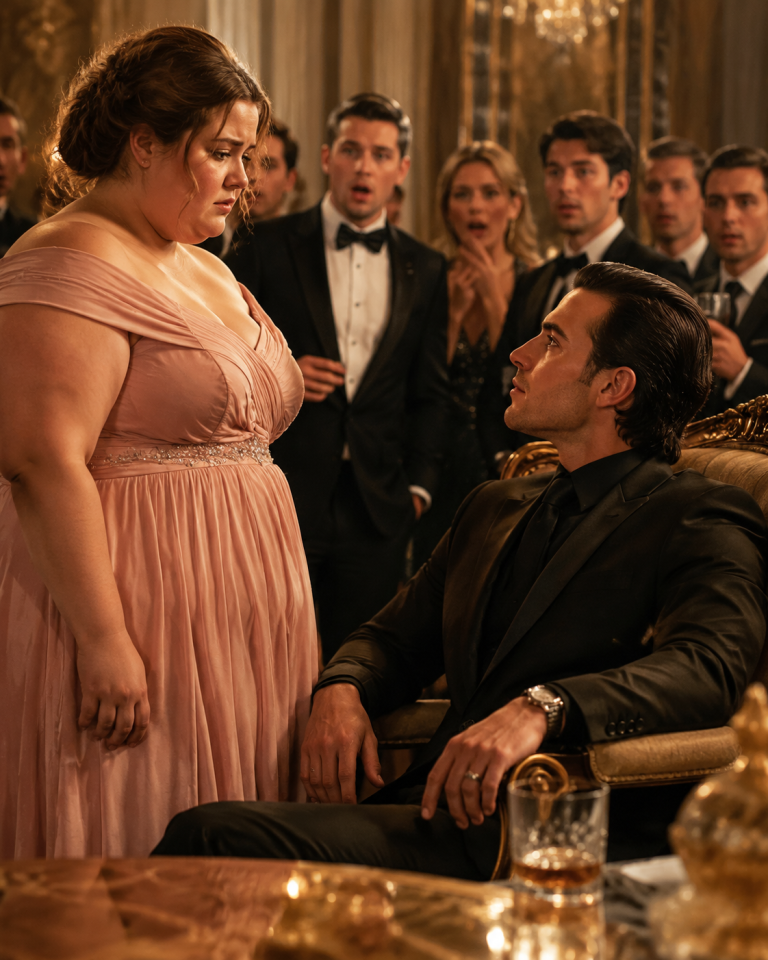
The ballroom continued: champagne towers, white orchids, two hundred people from Chicago’s financial and social top layer, all of them radiating charitable generosity toward the Ashford-Crane Foundation—her foundation, her work, her name above every door she had opened for this project.
She needed not to fall apart in this room.
She reached blindly for the nearest black suit.
“Please,” she said, before she saw the face. “I need you to kiss me. My fiancé is across the room with my sister and I need him to watch me not break.”
The man did not move.
She heard the stillness differently than she expected. Not surprise. Something else.
She looked up.
He was perhaps sixty. Silver at the temples, broad shoulders, jaw that angles tended to notice. A scar through his left eyebrow. His suit was black and precisely cut. His stillness had no social performance in it — it was the stillness of a room that had already been cleared before the arrival.
“The man near the east archway,” he said, not asking.
“Yes.”
“The woman with him is your sister.”
“Yes.”
“He noticed me before he noticed you.”
Celeste’s stomach dropped. “What?”
“He went still when I walked in.” His eyes remained past her. “That man isn’t jealous yet. He’s afraid.”
She looked at Elliott.
For the first time in the evening, he was not looking at Lorelei. He was looking at the man beside Celeste, and all his trained charisma had drained out through his shoes.
“Who are you?” she said.
The man looked down at her.
“Renato Voss,” he said.
The name moved through the room before she understood it. A man near the bar lowered his glass. Someone stopped mid-sentence. One of Elliott’s board members turned away with such speed that he nearly walked into a tray.
Celeste knew the name only the way careful people knew certain names—through rumor, through doors that closed before explanations could follow, through the specific editorial caution of newspapers that called certain men “retired businessmen” because they had lawyers who preferred that phrasing.
Renato Voss. Old money and darker money. Hotels, vineyards, private lending, and a reputation for solving problems in ways that never appeared in public records. A man whose son had died six months ago in what newspapers called a tragic accident and what people who knew the newspapers knew not to repeat.
His gaze had settled on her with the measuring quality of someone deciding whether the answer was worth giving.
He took her hand.
Not by grabbing. He simply closed his fingers around hers and folded her arm through his.
“Walk with me,” he said.
“I asked you to kiss me.”
“I heard you.”
“You haven’t answered.”
“I haven’t refused.”
He placed one hand at the small of her back. Steady, nothing more. Then he guided her directly across the ballroom toward Elliott and Lorelei.
Celeste’s heartbeat became structural.
“What are you doing?” she managed.
“Giving him something to think about besides whatever he’s planning.”
Elliott recovered his face first. He was good at that.
“Celeste,” he said, voice warm as a brand. “Where have you been?”
Where have you been. As though she were the one who had disappeared. As though she hadn’t been building this entire evening while he made it his.
She smiled. It surprised her how easy it was now.
“Greeting Mr. Voss,” she said.
Elliott’s eyes sharpened.
Renato inclined his head. “Crane.”
Not Elliott. Not Mr. Crane.
*Crane.* Flat as a sentence that has already ended.
Lorelei laughed, too brightly. “Celeste, you didn’t tell me you knew him.”
Celeste looked at her sister. Lorelei was younger by five years, beautifully composed in pale gold silk, wearing their mother’s expression for situations that required prettiness as a weapon.
“I don’t,” Celeste said. “Not yet.”
Renato’s mouth curved. “Not yet.”
Elliott stepped forward. “May I speak with my fiancée privately?”
Renato answered before she could. “No.”
The hush that followed had temperature.
Elliott’s voice cooled. “I’m speaking to my—”
“Are you?” Renato looked at Celeste’s ring.
A pulse of something dangerous moved through the air.
Nathan — Elliott — recovered quickly. “Celeste, you don’t know who you’re—”
“I know more than I did an hour ago,” she said.
“You’re making a scene.”
“I built this scene,” she said. “Every inch. Every flower. I even wrote the speech you’re delivering tonight.”
Lorelei’s carefully arranged expression faltered.
Renato spoke quietly. “Miss Lorelei. Your lipstick needs attention.”
Her hand went to her mouth.
Celeste felt something loosen in her chest. Not victory. Something older than victory. The release of a breath held too long.
“I believe Mr. Voss would like to dance,” she said.
Renato offered his hand.
She took it.
The quartet transitioned into a waltz as they stepped onto the floor. Celeste knew how to dance — Elliott had insisted, because being seen gracefully was part of the presentation he required. But dancing with Elliott had always felt like a rehearsal of approval.
Renato was different.
He did not show her off. He danced *with her*.
His frame was controlled, unhurried. He gave her exactly the space she needed and no more than what the moment required. The crowd parted and watched without him asking them to.
“He owes you money,” she said.
“Among other things.”
“You came for something.”
“Yes.”
“Tell me what.”
He guided her through a turn before answering. “There is a file. Evidence of fraud through charitable accounts. Wexler — Crane’s father’s original company — had it built into the foundation architecture before you had the foundation’s name.”
Celeste missed a half-step.
Renato adjusted without comment, making it invisible.
“He kept you in events,” Renato said. “Away from financial transfers. You were the face. He was the access.”
The words landed in exactly the right order to make her nauseous.
Elliott’s voice, months ago: *You’re better with people. I’ll manage the ugly numbers so you can remain the one everyone trusts.* She had thought it was love. She understood now it was a job description.
“How long?” she asked.
“Three years.”
“The foundation is two.”
“The accounts existed before it had a name.”
Celeste’s hand tightened in his.
The dance brought them close to Elliott again. He stood rigid, something collapsed beneath his charm. Lorelei was still touching her lip. Neither of them looked like people who had been having an affair. They looked like people who had been caught in something larger.
“Dance is ending,” Renato said.
“I know.”
“You can still leave this floor cleanly.”
Celeste looked at Elliott’s collar.
Then she reached for Nathan — Elliott’s ring finger, where her ring lived.
The diamond came off smoothly.
She held it up briefly. The chandelier caught it and burned white.
Then she dropped it into Elliott’s champagne glass.
The ring struck crystal with a sound that carried across the entire ballroom.
The silence that followed was complete.
Elliott’s face emptied.
Lorelei made a small sound.
Renato leaned to Celeste’s ear.
“Now,” he said.
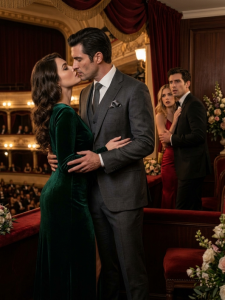
And he kissed her.
It was not the desperate, instrumental kiss she had imagined when she grabbed his sleeve. It was not a weapon. It was a man who had decided the moment deserved honesty more than theater.
His mouth touched hers with a patience that unmade her.
The room disappeared.
For one stolen second she forgot the gala, the fraud, the eight months of betrayal, and the fact that this had begun as a performance. She forgot everything except the warmth of his hand at her back and the specific quality of being kissed by someone who had no agenda except the kiss itself.
She leaned in.
When Renato lifted his head, the ballroom was still. Glass had broken somewhere.
Elliott stood five feet away, pale with a fury he was trained not to display.
“Have you,” he said, “completely lost your mind?”
Celeste touched her lips.
“No,” she said. “I think I’ve just found it.”
—
## PART 2
They left through the west corridor.
Outside the ballroom, the hotel’s skeleton showed: cream paint instead of marble, service carts instead of white orchids. Celeste’s feet ached. Her dress was ivory. Her throat felt raw.
Renato walked beside her without claiming anything.
She studied the side of his face. “You were already involved before I touched your sleeve.”
“Yes.”
“Then the timing—”
“Coincidence,” he said. “The useful kind.”
She stopped walking.
“Tell me the rest.”
He looked at her steadily.
“My name is in that file. Nathan — Elliott — borrowed from me and then buried what he borrowed beneath your foundation’s charitable accounts. When my son began investigating—” He stopped.
“Your son,” she said. “Luca. The accident.”
“Marco.” His voice did not change, which was how she knew it cost him everything. “He found the accounts. He believed someone inside the Ashford family was involved.”
Celeste went cold.
She thought of her father, Victor, who had been ill for six months. Heart trouble, doctors said. Stress, her mother said. He had withdrawn from the company. He had let Celeste handle public duties while Elliott managed the merger.
Three weeks ago he had gripped her wrist in his study, eyes unfocused but urgent: *Don’t sign anything he brings after midnight.*
She had kissed his forehead and told him to rest.
“My father?” she whispered.
Renato said nothing.
That silence was the answer.
She reached for the wall.
He stepped forward. She lifted a hand. He stopped.
That distance — offered and accepted — was the first honest thing anyone had given her all evening.
A man appeared at the corridor’s end. Forties, dark-haired, watchful in the specific way of people who had learned observation as a survival skill.
“Boss,” the man said. “I’m sorry—”
“Tomas,” Renato said. “One moment.”
Tomas’s eyes moved to Celeste, then back. “They’re moving it tonight.”
The air shifted.
Celeste looked at Renato. “What are they moving?”
Neither man answered.
“What are they moving,” she said again, and this time it wasn’t a question.
Renato looked at Tomas. “Leave us.”
Tomas went.
Celeste stepped closer. “Tell me.”
“The original ledger. Physical copies of everything. If Elliott moves it before it can be subpoenaed, the case collapses.”
“And he’s going to be blamed for everything.”
“You’re going to be blamed for everything,” Renato corrected. “Every signature you put on foundation documents. Every donor letter sent under your name. Every photograph of you receiving oversized checks.” He held her gaze. “He built you as the public face. When the inquiry begins, he steps aside. You’re the face everyone trusted.”
Celeste pressed her fingers against her sternum.
Federal inquiry. Her name. Her signatures. Her face on every single donation campaign.
And the man she had loved for fourteen months had designed it that way from the beginning.
“Why would you warn me?” she asked.
Renato was quiet.
“Because my son died chasing the truth about this,” he said. “And I would rather not see you buried trying to survive a lie.”
The ballroom doors opened behind them.
Lorelei stepped out.
She had fixed her lipstick. Her eyes had not been fixable.
Celeste folded her arms.
“Viv—Celeste,” Lorelei said softly.
“You had a year to say that.”
Lorelei flinched. “He told me you wouldn’t be hurt.”
“How considerate.”
“He said Renato Voss was the dangerous one. That his son died because he — because Renato—”
“Silenced him?” Renato asked.
Lorelei’s eyes went to him. “He said you were hunting the family. That if the file came out, people would die.”
Celeste looked at Renato.
Something moved in his face. Brief, like a light glimpsed through a closing door.
“People already have,” he said.
Lorelei looked pale. “Who?”
“Marco Voss,” Renato said. “My son. Found in his car six months ago. Police called it weather and road conditions.”
The balcony door opened again.
This time it was Tomas, breathless.
“Crane’s gone from the ballroom.”
Renato’s expression changed.
Celeste did not wait.
“The presidential suite,” she said. “Twenty-third floor. He has a private elevator key, but the service elevator is locked for renovation. Catering staff uses stairwell C to access the kitchen prep corridor on twenty-two. From there there’s a maintenance passage connecting to the suite level.” She looked at both of them. “I planned this gala. I know every route in this building.”
Renato looked at her for one long second.
“Then lead,” he said.
—
## PART 3
**The Suite and What Was Inside**
They found the suite empty.
Not undisturbed — empty. Drawers open. Papers scattered. A half-packed suitcase abandoned mid-decision. A decanter overturned on the carpet, bleeding amber.
Elliott’s cologne still in the air, which was somehow worse.
Renato crossed to the desk. Tomas cleared the rooms.
Celeste stood in the center and made herself think.
Elliott was theatrical but not careless. He had left papers visible because he wanted them to find papers. He was trusting chaos to do the work of hiding the real thing.
She looked around the suite.
White orchids on every surface. Her arrangement — she had specified white orchids throughout, nothing else.
Near the window: a vase with white orchids and two black calla lilies.
Wrong.
She had never ordered calla lilies. Elliott hated calla lilies. He said they looked like funeral hands.
Celeste crossed to the arrangement and pulled it apart.
At the base of the vase, wrapped in plastic: a small silver key.
Renato appeared at her shoulder.
She crossed to the wall safe behind a painting she recognized as a rental.
Six digits.
He would not use his birthday. Too obvious. He would not use the wedding date — too likely she’d try that. He would use something she would feel but not immediately think of.
Lorelei’s birthday.
Celeste entered it.
The safe opened.
Renato used the key.
Inside: a leather ledger, a flash drive, a stack of passports, a photograph.
Renato reached for the photograph.
Celeste reached for the ledger.
She looked up when he didn’t speak.
His face had changed.
The photograph showed a man standing outside a vineyard building, alive, holding a newspaper dated two weeks after his supposed death. Next to him stood Victor Ashford.
Celeste’s father.
Alive. Upright. Looking directly at the camera.
On the back, in her father’s handwriting: *Celeste must never marry Elliott Crane.*
The suite door opened.
Lorelei stood there, breathless, holding Elliott’s abandoned phone.
“He’s not going through the garage,” she said. “He’s going to the roof.”
Renato took the ledger. Celeste took the photograph, unable to release it.
“My father is alive,” she said.
Lorelei’s expression said she had known.
Before either of them could speak, the suite lights went out.
Emergency red bled along the walls.
From somewhere above: the unmistakable percussion of a helicopter.
Tomas appeared in the doorway. “Now.”
They moved.
—
**The Roof**
The night over Chicago was storm-edged and cold, wind that meant it.
The helicopter waited on the landing pad, blades already turning. Elliott stood beside it in his loosened tuxedo, looking like a man whose performance had finally caught up with him. Still beautiful. Ruined by it.
Near the edge of the roof, on his knees with hands bound behind him, was Victor Ashford.
Thin. Bruised at the jaw. But alive.
*Daddy.*
The word arrived in her throat before her voice found it.
Victor lifted his head. When he saw her, anguish crossed his face.
“Run,” he said.
Elliott smiled.
“Touching,” he called over the rotor. “Really. I almost hate interrupting family moments.”
Renato stepped forward. “Let him go, Crane.”
Elliott’s laugh was small and polished and completely empty. “You’re still giving commands? Dominic — Renato — please. You walked into a ballroom full of cameras, put your hands on my fiancée, kissed her in front of two hundred witnesses, and chased her upstairs.” He spread his hands. “By morning, every paper in Chicago thinks the grieving crime lord kidnapped the betrayed heiress to silence a witness. And Celeste, my love, when investigators find your signatures—”
“He said Marco’s alive,” Celeste said.
Elliott paused.
He had not expected her to know that yet.
Renato went completely still.
Elliott tilted his head. “Did you not know?”
Renato’s voice came out at a register Celeste had not yet heard from him. “Where is my son?”
Elliott looked at Victor.
Victor closed his eyes.
“Daddy,” Celeste said. “What does he mean?”
Victor swallowed. “Marco came to me with proof. Account structures. Shell charities. Names. He said if we moved too quickly, Elliott’s people would eliminate everyone connected.” He looked at Renato. “I staged the crash. I hid him.”
Renato’s jaw tightened. “You let me bury an empty coffin.”
“I saved your son.” Victor’s voice broke. “I paid for it every day after.”
Elliott clapped once. “Marvelous confession. Genuinely. But we’re out of time.”
He raised his weapon and pressed it to Victor’s skull.
Celeste screamed.
Renato stopped.
Elliott looked between them with the specific pleasure of a man who had spent fourteen months arranging exactly this moment.
“Ledger. Drive. Phone. Slide them here. Then I leave. Then everyone survives. Then you discover your inheritance and live quietly.”
Tomas’s hand moved toward his jacket.
Elliott pushed Victor closer to the edge.
“One heroic movement,” he said softly, “and Celeste watches her father fall.”
Celeste looked at Renato.
Then she stepped forward.
“Take me instead,” she said.
Elliott blinked.
“Elliott.” She kept her voice steady. “You said I was the face people trusted. Fine. Take me. I’ll say Renato forced me. I’ll say my father was confused. I’ll give you the clean exit.” She held his gaze. “But let my father go. He can barely stand. He’s useless to you now.”
Elliott studied her.
She watched the vanity in him make the calculation.
He still wanted her compliance. Still wanted to own the narrative.
His gun dropped by one inch.
That was all Lorelei needed.
From the stairwell door, with a cry that came from something deeper than fear, Lorelei threw Elliott’s phone directly at his face.
It connected.
He cursed, turning.
Tomas fired.
The bullet struck Elliott’s gun hand. The weapon skidded across the roof.
Renato moved.
Celeste ran to her father.
—
**The Rest**
What followed was less dramatic than it should have been, which was how genuine emergencies worked.
Elliott and Renato struggled near the helicopter. A man emerged from shadows in a dark coat, gaunt but unmistakably made from the same bones.
Marco Voss.
Alive.
Holding a gun.
Renato went still in the way of people who had been given something back they had already learned to live without.
“Papa,” Marco said. “Step away from him.”
Elliott looked at Marco with the expression of a man seeing arithmetic that refused to work.
“You should have confirmed the coffin,” Marco said.
Elliott ran for the helicopter.
Celeste picked up his fallen gun.
“Elliott.”
He stopped.
She stood barefoot on a storm-edged Chicago rooftop in a torn ivory dress with no ring on either hand and a gun held in both, and for the first time that evening she felt entirely herself.
“Don’t make me part of your story again,” she said.
Below them, sirens began.
Real ones.
Federal agents came through three access points simultaneously.
Elliott knelt.
Celeste did not lower the gun until his hands were cuffed.
—
**The Trial**
Nathan — Elliott — entered court with his charm thinned by six months of the actual machinery of justice.
Celeste testified with the specific composure of someone who had spent a year learning to identify everything that wasn’t.
When the defense attorney asked whether she had been manipulated by Renato Voss, Celeste glanced at the back row where Renato sat.
“Elliott Crane manipulated me,” she said. “Renato Voss underestimated me. Those are different things.”
Marco’s testimony collapsed three separate defensive strategies.
Victor’s testimony took thirty-two minutes and included a detailed account of how he had hidden a man everyone believed dead for six months because he had been afraid to trust anyone.
Celeste’s mother, Diana — indicted separately for cooperation with Elliott’s financial structures — entered court in a gray dress stripped of its armor and for the first time looked like someone who understood cost.
When Celeste’s eyes met hers, Diana looked away first.
After sentencing, Elliott stopped beside Celeste as deputies led him away.
“He’ll ruin you,” he whispered. “Men like him don’t love. They own.”
Celeste glanced toward the back row where Renato waited.
“You never understood the difference,” she said, “because no one ever wanted to own you. They only wanted to survive you.”
—
**The Vineyard**
A year later, Celeste traveled to Sicily.
The Voss vineyard lay across golden hills with the sea below it, ancient vines and stone buildings and the particular quality of light that existed nowhere else.
Renato waited at the cellar entrance. No tie. Silver hair longer than she remembered. The scar through his eyebrow looked softer in sun.
“You came,” he said.
“Marco’s letter said to.”
“I know.”
“Did you tell him to write it?”
“Yes.”
Inside the deepest part of the cellar stood an iron door. Behind it: an archive. Photographs. Ledgers. Letters. A sealed envelope with Celeste’s name on it, written in her grandmother Rose Ashford’s handwriting.
The letter told a story no one had spoken aloud: decades before the clean family portraits and the foundation galas, the Ashfords and Vosses had been wound together by blood and debt and a forbidden love. Rose Ashford had loved Renato’s older brother Emilio Voss. They had planned to run away. A feud erupted. Emilio died. Rose married into safety.
Before she died, she created a trust.
Hidden. Protected. Waiting for the right conditions.
Celeste looked up from the letter.
Victor said softly: “Your grandmother named one future heir.”
She already knew.
Renato handed her the trust document.
The Voss-Ashford Trust. Controlling shares in land, vineyards, hotels, and accounts that Elliott had spent fourteen months trying to reach through the foundation merger.
He had not wanted her name.
He had wanted her inheritance.
Renato crouched before her. “I did not know the full terms until Marco found this archive. Before you ask.”
Celeste studied him.
“I know,” she said.
“You believe me?”
“I’m learning what it looks like when you’re hiding something. This isn’t that.”
He said nothing.
“So,” she said after a moment. “I own part of your vineyard.”
“Our vineyard,” he said. “Legally.”
“And personally?”
His eyes warmed by the specific degree she had learned to track.
“That depends entirely on you.”
The sea light moved through the cellar entrance.
Celeste stood.
“I am not the woman who grabbed your sleeve at a gala,” she said.
“No,” Renato said. “That woman was breaking.”
“This one decides who gets close.”
He looked at her.
“Then ask,” she said.
He took a breath.
“May I kiss you, Celeste Ashford?”
She smiled.
“Yes.”
This time the kiss was not evidence. It was not survival. It was not even revenge.
It was a beginning.
—
**The Bride**
Two years after the gala, Chicago received an announcement that made several columnists choke on their coffee.
*Celeste Ashford requests the honor of your presence at the reopening of the Voss-Ashford Foundation for Financial Crimes Recovery, Witness Support, and Family Resources.*
No groom listed.
No engagement announcement.
Just her name, in black ink, below a crest of roses and vines.
The event was held at the Ashford Theater — a building her grandmother had quietly purchased decades earlier and which had been sitting in the trust all along, waiting for someone to notice.
Celeste stood backstage in deep emerald silk. Not ivory. Not chosen by anyone except herself.
Lorelei appeared in the doorway.
She looked different. Less polished. More real.
She worked with the foundation now, counseling women who had confused control for devotion. She was not forgiven completely. But she had stopped pretending she didn’t need to earn it.
“You look beautiful,” Lorelei said.
“Thank you.”
A pause.
“He’s in the third row,” Lorelei said.
Celeste smiled. “Renato is always somewhere.”
“Are you happy?”
Celeste turned.
For once, the question did not carry the weight of competition.
“Yes,” Celeste said. “Genuinely.”
Onstage, Celeste gave the speech herself. She talked about fraud disguised as philanthropy. About women trained to mistake endurance for grace. About public faces and invisible hands.
Then she paused.
“Finally,” she said, “I want to correct a public misunderstanding.”
The audience leaned forward.
Renato sat in the third row in black, unhurried, watching her.
“Two years ago,” Celeste said, “I grabbed a stranger’s sleeve and asked him to kiss me so my fiancé would panic.”
A laugh moved through the theater.
Renato’s mouth curved.
“I thought I was using a stranger. I was wrong.” She stepped away from the podium. “I had chosen the only man in that room who already knew how deep the lie went. He helped expose it. He annoyed me regularly. He told me truths I hated and left when he thought distance would protect me and came back when he realized I’d never asked to be protected from my own heart.”
She walked to the stage edge.
“Renato Voss,” she said. “Will you come up here?”
The theater held its breath.
Renato sat for three full seconds before Marco — his son, alive and seated beside him — laughed under his breath. “Go, Papa.”
Renato rose.
He walked onto the stage with the unhurried certainty she had recognized the first night and had spent two years learning to trust.
He stopped in front of her.
“What are you doing?” he said quietly.
Her eyes shone.
“Giving them something to remember.”
From behind the curtain, Victor Ashford emerged, carrying a small velvet box.
Renato looked from Victor to Celeste.
“No,” he said softly.
She opened the box.
Inside: a simple gold ring, warm with age.
“My grandmother’s,” Celeste said. “The one she meant to wear when she ran away with your brother.”
Renato’s expression changed in a way she had never seen from him before — not calculation, not measured warmth, but something unguarded.
“She wore that ring for thirty years before she died,” Celeste continued, “and she hid the truth in a ledger and a trust and an old iron door, hoping that someday the families would stop ruining each other and start something worth keeping.”
She took his hand.
“I don’t need rescuing,” she said. “I don’t need shelter. I don’t need anyone to make anyone else jealous.”
His fingers tightened around hers.
“But I want a partner who tells the truth even when it costs him something. I want the man who kissed me once to help me stand and again because he finally asked.” She lifted her eyes. “So I’m asking now.”
“Celeste—”
“Renato Voss,” she said clearly. “Will you marry me?”
The theater erupted.
He stared at her.
Then he laughed — a low, disbelieving sound she had heard once before, in a Sicilian cellar when she’d said she believed him — and it was the most complete sound she had ever heard from him.
“Yes,” he said. “Of course yes.”
She put the ring on his finger.
He kissed her before the applause could fully form, and it was nothing like the first kiss — not careful, not restrained, not the measured shelter of a man protecting something fragile.
This was the kiss of a man who had finally stopped treating her as something that needed protecting.
—
**The Ending**
The wedding happened six months later at the Voss vineyard in Sicily.
Victor walked Celeste down an aisle of old stone while the sea showed its blue below. Marco stood beside Renato, alive and therefore the greatest gift the ceremony contained. Lorelei cried in the second row, not prettily but honestly.
When Celeste reached Renato, he held both her hands.
“Still sure?” he murmured.
She looked at him steadily.
“Still asking permission?”
“With you,” he said, “always.”
The ceremony was brief and warm.
Afterwards, Victor found Celeste by the vineyard wall and held her for a long moment without speaking.
She held back.
Some things did not need language.
Somewhere in a federal facility, Elliott Crane watched a muted broadcast of the wedding and said nothing.
No one asked him what he thought.
When Renato kissed his wife under Sicilian light with the sea below them and the old stone surrounding them and all the complicated history of two families finally arriving at something worth keeping —
Celeste Blake Voss laughed against his mouth.
Because the kiss that had begun as a weapon had become the truest thing she had ever done.
And she had done it herself.
**THE END**
—
—