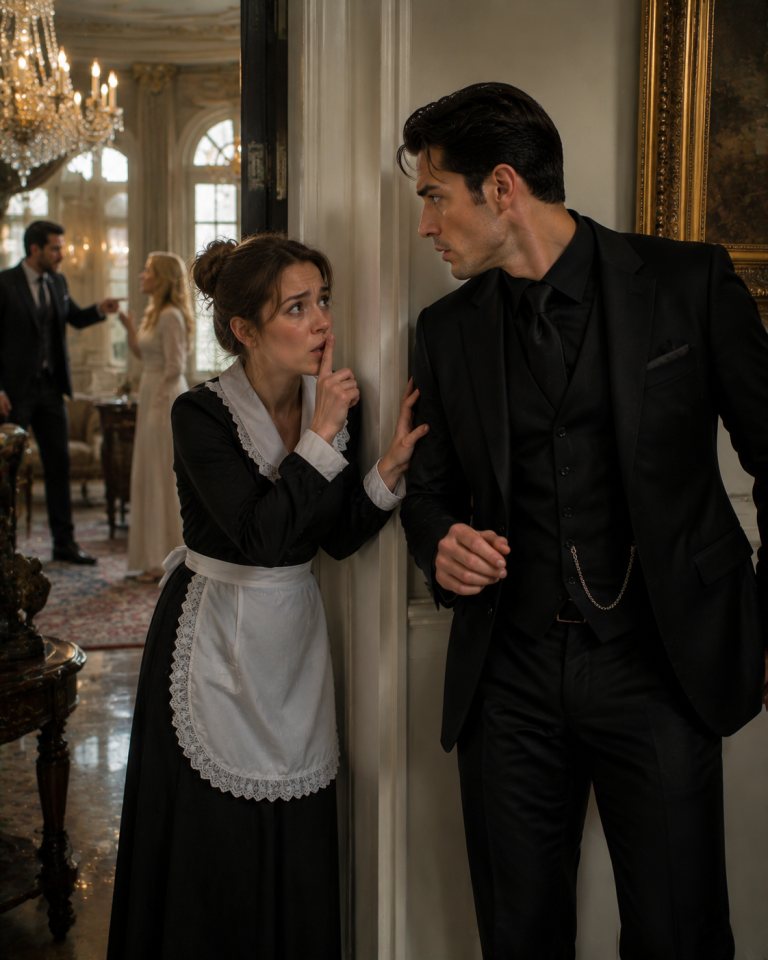
Nobody Could Tame the Mafia Boss’s Daughter—Until a Waitress Stepped In

## PART 1
The nanny was crying again.
That was the fourth one this month.
She stood in the center of the study — Italian marble, floor-to-ceiling bookshelves, the kind of room designed to communicate that the person behind the desk was not someone you disappointed — and pressed manicured hands to her face while designer heels clicked against the floor in small, helpless rhythms.
“She’s not a child,” the woman said. “She’s a force of nature. She bites. She screams. She demolished the music room. She locked me inside the linen closet for two hours and slid crackers under the door. Crackers. Like I was some kind of pet.”
Declan Cole said nothing.
He stood at the window looking down at the city he essentially owned, and he pinched the bridge of his nose and waited for the crying to end.
It didn’t end. It escalated.
“No one can handle her, Mr. Cole. I’ve worked with difficult children all over the world. I have a master’s degree. I once managed triplets through a transatlantic move.” She inhaled raggedly. “Your daughter broke my spirit in nine days.”
“Get out,” he said.
She fled.
Declan stood alone in the quiet study and thought: *there is no one left*.
He had built an empire that moved money through seventeen countries and fear through every room he entered. He could make an alderman’s career disappear with two phone calls and a coffee meeting. Men who had entire governments behind them went carefully around him.
His eight-year-old daughter had him completely defeated.
Her name was Piper.
She was brilliant, furious, grief-stricken, and destroying everything in her path with the efficiency of a small natural disaster. Her mother had been gone for two years. In that time, Piper had frightened away fourteen professionals, thrown a therapist’s notebook into a koi pond, and informed a former Navy SEAL that he was afraid of her — which he admitted, two weeks later, was accurate.
Declan did not know what to do with her.
He had never known what to do with her, even when Nora was alive. Nora had known. Nora had been the translator, the buffer, the warmth between Declan’s cold architecture and their daughter’s wild heart.
Then Nora was gone.
And Piper started burning things.
—
The restaurant was called Altavella’s, and it sat in the financial district like an open secret — no sign outside, a hostess who asked for your name before you touched the door handle, and a dining room that smelled of cedar smoke, black truffle, and discreet criminal wealth.
Sloane moved through it like weather.
She was twenty-four, bone-tired, and carrying a tray of stone bass in saffron broth on one palm while keeping her section’s wine glasses filled with her other hand, her eyes, and whatever portion of her attention wasn’t currently calculating her tip average against next month’s late notice from the collection agency.
Her mother’s medical debt had not disappeared when her mother did. Grief had that particular cruelty: the person left, the bills did not.
Three tables, two bottles of Barolo, one aggressively indecisive hedge fund manager, and she had eleven minutes before the kitchen finished the black truffle risotto for table nine.
Sloane was good at this work. Not because she loved it. Because she had learned that survival required being good at whatever was available, and available was this.
She was carrying the risotto when the front doors opened and the temperature changed.
Not the air temperature.
Something interior. The way a room rearranged itself.
Two men entered first. Their eyes moved across the space in the systematic way that security people moved when they were doing the job properly. They weren’t looking at paintings or menus. They were looking at exits.
Then Declan Cole entered.
Sloane had seen photographs. Everyone in the city had seen photographs. The kind that appeared in stories framed with words like *alleged* and *sources close to* and *no charges were filed.*
He was taller than photographs suggested, and colder, and beside him at the end of his arm was a child in a navy velvet dress who was already mid-sentence on a complaint that had clearly been building for the length of the car ride.
“I said I didn’t want to come here. I said that specifically. In the car. Twice.”
“Piper.” Low. Warning.
“I hate places like this. It smells like money and stress and everyone is pretending not to look at everyone else.”
That was, Sloane thought, a remarkably accurate review of Altavella’s.
She set the risotto down at table nine and turned.
Declan was steering the girl toward a corner booth with his hand on her shoulder. Not roughly. He was clearly attempting to be gentle, which was also clearly something he did not do naturally. The result was the awkward performance of a man trying to remember a skill from a language he had never been fluent in.
“Sit down,” he said. “Please.”
“That wasn’t a please. That was a command with the word please attached.”
Declan’s jaw jumped.
Then Piper’s arm swept sideways and a crystal water pitcher left a table with the conviction of something that had always wanted to be airborne. It struck the floor in a spectacular crash that silenced every conversation in the restaurant.
Sloane turned.
The girl was standing in the wreckage with her chest heaving, face red, eyes full of something that wasn’t anger so much as grief wearing anger as armor.
Sloane recognized that.
She had worn it herself, in a hospital corridor at 3 a.m., when being devastated felt like weakness and fury felt like something to stand on.
The bodyguards moved.
Sloane moved faster.
She stepped between them and the child with both hands open and relaxed, the way you approached something that needed to understand it wasn’t being cornered.
“Don’t,” she said.
One of the guards stared at her.
“Back up,” she said. “Give her room.”
Piper’s eyes found her.
Wild. Wet. Defiant.
“That’s a heavy face for someone your age,” Sloane said.
Piper blinked.
“What does that mean?”
“It means you’re carrying something big and you’re tired of it.” Sloane lowered herself to the floor, right there in the broken glass and spilled water. Her apron soaked through immediately. She didn’t care. “I know what that feels like.”
The room held its breath.
Piper was still holding herself like something coiled, but the coil had loosened by a degree.
Declan said, “Get up.”
“Not to you,” Sloane said, without looking at him.
His silence had a specific quality. She had been in rooms with dangerous people before — her mother’s hospital had been full of people who were fighting for their lives and sometimes took it out on the nearest available person — and she had learned to read the weight of a silence.
This one was dangerous.
It was also, underneath, surprised.
Sloane looked at Piper.
“Do you want to sit down here?” She patted the floor beside her. “The view is bad and it’s uncomfortable, but nobody’s trying to manage you from this altitude.”
Piper looked at the floor.
Then at Sloane.
Then, slowly, she sat.
Not next to her. A few feet away, cross-legged, facing her.
“He doesn’t know what to do with me,” Piper said.
“I noticed.”
“Everyone quits.”
“I noticed that too.”
Piper’s lip trembled.
She was fighting it hard.
Sloane recognized that fight.
“My mom died,” Piper said. “He told me she left. He didn’t tell me the truth.”
From the corner of her eye, Sloane saw Declan go very still.
“That must have made everything worse,” Sloane said.
“Everything.” Piper’s voice cracked once. “Every time I find out something true, there’s another lie behind it.”
Sloane nodded.
The restaurant remained frozen.
“What’s your name?” Sloane asked.
“Piper.”
“I’m Sloane.” She gestured at the broken crystal around them. “We should probably not be sitting in this.”
Piper looked down, noticed the glass, and shifted sideways toward a clear patch.
Sloane moved with her.
Behind them, Declan watched his daughter navigate ten inches of practical safety precaution with a stranger on a restaurant floor, and something in his face moved in a way his face was not accustomed to moving.
—
Later — after Piper had been moved to the back room, after she’d finally cried the kind of crying that required support rather than space, after the restaurant manager had been quietly compensated and asked to forget the evening — Declan found Sloane in the hallway outside the kitchen.
“You should have let my people handle it,” he said.
“Your people were going to make it worse.”
“You don’t know that.”
“She would have gone for another table when she felt cornered. More glass. Possibly someone gets hurt.”
He stared at her.
“You read that in nine seconds?”
“I read it in three.”
A pause.
“Who are you?”
“Sloane Merritt. I work here.”
“Before here.”
She looked at him. “Waitressing. Before that, my mother was dying. Before that, other things.”
He was quiet for a moment.
“She hasn’t talked to anyone in eight months,” he said. “Not a therapist. Not a teacher. Not me.” He looked toward the back room. “She just spoke to you for twenty minutes.”
“She spoke to someone who sat down in the glass with her.”
“No one else did that.”
“No one else thought of it as a reasonable option.”
Declan reached into his jacket and produced a card.
“Come work for me.”
Sloane looked at the card.
“I’m not a nanny.”
“I’m not offering nanny work.”
“What are you offering?”
He hesitated. This was not a man who usually hesitated.
“I don’t know,” he said. “Something like what you just did.”
Sloane thought about the collection agency. About the final notice. About the hospital bracelet still in her bedside drawer that she couldn’t bring herself to throw away.
She thought about Piper sitting cross-legged on a restaurant floor, saying *he told me she left.*
“I’ll come see the situation,” she said. “I’m not promising anything.”
He nodded once.
“That’s more than fourteen people managed.”
—
## PART 2
The Cole estate was not a home.
It was a system.
Security at the gate. Security at the door. Motion sensors she spotted in the hedges and the garden planters and probably inside the marble angel that watched the driveway from a stone alcove. Cameras in the corridors calibrated to subtle angles.
Sloane noted all of it and said nothing, because people who built systems like this had usually had very good reasons.
Piper met her at the foot of the stairs with the specific energy of a child who had decided to be suspicious but was fighting curiosity about whether the suspicion would hold.
“You came,” Piper said.
“I said I would.”
“Most people say they will.”
“I noticed you kept track of that.”
Piper looked at her father over her shoulder. “Is she staying?”
“That’s being discussed.”
“It should be discussed with me.”
Sloane crouched so she was at eye level with the girl. “Then let’s discuss it. What would make this work or not work for you?”
Piper stared at her.
Nobody had asked her that. The look on her face said so clearly.
“I don’t want someone who’s afraid of me,” she said.
“Reasonable.”
“I don’t want someone who reports everything to him.”
Sloane glanced up at Declan, who was watching this exchange with the expression of a man taking notes on something he had never previously understood was a subject.
“Some things would need to be shared,” Sloane said. “Safety things. Nothing else without your say-so.”
Piper considered this with the seriousness of an eight-year-old conducting a personnel evaluation.
“Okay,” she said.
She walked upstairs.
Declan looked at Sloane.
“That took twenty seconds,” he said.
“She just needed to be consulted.”
“She locked my last employee in a closet.”
“Was that employee consulting her or managing her?”
He opened his mouth.
Closed it.
“Come inside,” he said instead.
—
In his study — which smelled of cedar and old paper and the specific tension of a room where difficult decisions were made — Declan sat across from Sloane and looked at her the way he looked at documents he was trying to locate the vulnerability in.
“You’re not a child specialist,” he said.
“No.”
“Not a therapist.”
“Definitely not.”
“Not trained in security.”
“Also no.”
“Then what qualifies you?”
Sloane thought about this.
“I spent three years watching my mother die,” she said. “Slowly. In stages. I learned what it looks like when someone needs someone to just be there instead of fixing. And I learned what it costs to pretend you’re fine when you’re not.” She held his gaze. “Piper isn’t broken. She’s bereaved. Those require completely different responses and everyone in her life keeps giving her the wrong one.”
Declan was silent.
“Also,” Sloane added, “I’ve dealt with angry people in a professional capacity for four years. Your daughter is angry but she’s not dangerous. She’s loud. There’s a difference.”
Something in his expression shifted by a degree.
“What do you want?” he asked. “Salary. Accommodation. Terms.”
“Tell me about her mother first.”
The shift reversed.
His face closed.
“That has nothing to do with—”
“It has everything to do with it,” Sloane said quietly. “Piper knows she’s been lied to. She doesn’t know what the truth is. That gap is where all the rage lives.”
Declan looked toward the window.
Rain had started again, soft and persistent.
“Her name was Nora,” he said.
He said it the way people said names that had become both ordinary and enormous through repetition and absence.
“She disappeared two years ago. From our home. She was—” He stopped. “She was taken.”
“By who?”
“Enemies.”
“Did you find out who?”
“I know who claimed responsibility.” His jaw tightened. “I know who I believed afterward.”
“But not who actually did it.”
“No.”
“And Piper heard something she wasn’t supposed to hear.”
His eyes returned to hers.
“How do you know that?”
“Because she said everything she believes is a lie. That kind of certainty comes from overhearing something specific.”
For a moment, the study held the kind of silence that meant someone was deciding how much truth was useful.
Then his phone buzzed.
He looked at the screen.
His expression changed.
“You should see this,” he said, and handed her the phone.
On the screen was a message from an internal security address.
*We found a note in Piper’s room. She didn’t write it.*
Sloane felt the cold arrive before she finished reading.
*It says: give them what they want or they take the girl next.*
She looked up.
Declan’s face was the face of a man who had just understood that the threat he had believed was contained was not contained.
“Who would leave that in her room?” Sloane asked.
“Someone inside this house,” he said.
And the two of them looked at each other across the desk with the shared understanding that this had just become a different kind of problem.
—
## PART 3
**What Piper Was Carrying**
Sloane found her in the library at ten o’clock at night, kneeling on the floor in front of a locked cabinet with a hairpin.
“Stop,” Sloane said from the doorway.
Piper flinched.
“I wasn’t—”
“You were picking the lock.”
“I was practicing an important life skill.”
“On your father’s locked cabinet.”
Piper sat back on her heels and looked caught and stubborn in equal measure.
Sloane crossed the room and crouched beside her.
“What’s in there?”
“Mom’s things.”
Sloane looked at the cabinet. Then at Piper.
“Does your father know you’ve been trying to get in?”
“No.”
“Does he know this is where her things are?”
“Yes. He put them there.” Piper’s voice thinned. “And then he locked the door and we never talked about her again.”
Sloane understood something about grief then — not anything new, but something confirmed. Locked doors were not protection. They were just grief with a padlock on it, and everyone inside the house could smell what was behind them.
“Try the hairpin on the left side of the keyhole,” Sloane said.
Piper stared at her.
“I’m not teaching you to break into things,” Sloane said. “I’m teaching you that some things are locked poorly and deserve to be opened.”
The lock gave in eight minutes.
Inside were objects that smelled faintly of something floral — a perfume that had outlasted the person wearing it. A silk scarf. A small photograph album. A stack of correspondence tied with a navy ribbon.
And at the very bottom of the cabinet, an envelope.
Addressed to Sloane.
Her full name. Sloane Merritt.
Piper saw it first.
“Why does it say your name?”
Sloane’s hands were not entirely steady as she opened it.
Inside, one line in handwriting she had never seen before:
*If my daughter finds you, you were always meant to be found.*
Behind her, a board creaked.
Declan stood in the doorway with the expression of a man who had just seen something he could not immediately explain and had not yet decided whether to be afraid of it.
“What is that?” he asked.
Sloane turned, holding the envelope.
“Something your wife left.”
His face went through several things in rapid succession.
“That’s not possible. Those were sealed two years ago.”
“She knew my name.”
“How?”
“I don’t know.”
The three of them stood in the library while the rain outside intensified and the question moved through the room like smoke.
Then the alarm system detonated.
—
**The Brother**
Declan moved the way people moved when violence was their native language and they were returning to it involuntarily — fast, precise, no wasted motion. He had Piper behind him before the second alarm cycle completed.
Sloane grabbed Piper’s other hand and they moved through the library’s service passage into the secure corridor.
Three guards converged.
“East wing,” one said. “Two men. Armed. They came through the kitchen entrance.”
“Staffing?” Declan said.
“Two unaccounted for.”
“Find them.”
They were in the panic room in under ninety seconds — a reinforced space that looked less like a bunker than a well-appointed waiting room, with monitors showing feeds from every part of the property.
Piper was rigid against Sloane’s side, shaking with the specific shaking of someone who had been afraid before and knew how long fear could last.
“Look at me,” Sloane said.
Piper looked at her.
“Tell me five things you can see in this room.”
Piper blinked.
“What?”
“Five things. Go.”
Piper’s eyes moved. “The monitor. The table. Your hands. The water bottles. The light on the ceiling.”
“Good. Four things you can feel.”
“My feet on the floor. Your hand. My own heartbeat. The cold air.”
“Three you can hear.”
“The alarms. Your breathing. My breathing.”
“Two things you know for certain.”
Piper thought.
“I’m here. You’re here.”
“One thing that’s true no matter what happens.”
Piper met her eyes.
“My mom loved me,” she said.
Something cracked open in Sloane’s chest.
“Yes,” she said. “She did.”
Declan watched this from across the room and said nothing.
On the monitors, his guards were moving through the east wing. One screen showed a figure running toward the service exit.
Declan’s eyes narrowed.
“That’s Marcus,” he said.
Marcus Dole. His head of internal security for six years.
He reached for his radio.
But Piper said, “I knew it was him.”
Everyone turned.
Piper pulled her hand free from Sloane’s and reached into the lining of her dress. Her fingers found something small and silver — a key on a thin chain.
“Mom gave this to me,” she said. “The last time I saw her. She told me never to let the men in the house find it.”
She held it out.
The key was small, ornate. Not a house key. Something older.
“She said if I ever felt in danger I should give it to someone I trusted.”
She looked at Sloane.
“I trust you.”
Sloane took the key.
Declan stared at his daughter.
“How long have you been carrying that?”
“Two years.”
“Piper—”
“I couldn’t tell you.” Her voice was fierce. “Mom said not to. She said if the men in the house found out about the key, we’d both be in danger.” She swallowed. “She said there were people watching who weren’t working for us.”
Declan sat down.
That was not something people in rooms like this normally did.
“What does the key open?” Sloane asked.
Piper looked uncertain.
“She said it was for a truth box.”
“A safety deposit box?” Sloane said.
“Maybe. She described it as something that held the truth until the right person was ready to carry it.”
On the monitor, Marcus had been intercepted near the gate.
Declan stood again.
“Stay here,” he said.
“We’re coming,” Sloane said.
“This is not your—”
“You’re going to interrogate your head of security and your daughter is sitting in this room with whatever information he came here to find,” Sloane said. “I’m not leaving her.”
He looked at her for one beat.
“Stay behind my people,” he said.
“Obviously.”
He almost said something else.
Didn’t.
Left.
—
**The Lake House**
Marcus was not talking.
That became clear within the first few minutes on the footage from the security room where Declan’s people were having the conversation. Sloane and Piper watched on a monitor in the adjacent office.
Piper leaned forward.
“His brother works for Uncle Raffaele,” she said.
Sloane turned.
“Who is Uncle Raffaele?”
“My dad’s brother. He comes for dinner sometimes.” Piper’s voice was careful. “I don’t like how he looks at things.”
“What do you mean?”
“He looks at things like he’s counting them.”
Sloane thought about that.
“What does he count?”
“Mom used to say he counted what should be his.” Piper’s voice went flat in the way children’s voices went flat when they were reporting something they had absorbed but not fully understood. “She said he was building patience like a house.”
Sloane looked at the monitor.
Declan had just said something that made Marcus flinch.
“Piper,” Sloane said. “What did you overhear the night your mother disappeared?”
The girl went very still.
“You heard something, didn’t you? The thing that made you believe everyone was lying.”
Piper’s hands tightened in her lap.
“Dad and Mom were arguing. In the study. He didn’t know I was in the hall.” Her voice was barely above a whisper. “He said something about the accounts. About money that had gone somewhere wrong. And Mom said, ‘It was Raffaele. I can prove it. I have the records.'”
Sloane’s pulse changed.
“And then?”
“And then Dad left. He had a call. He was angry and he left.” Piper looked at her hands. “And when he came back Mom was gone.”
“What did he tell you?”
“That she had to go away.” Piper’s jaw worked. “And when I got older I heard one of the guards say she had been taken. And Raffaele told me Dad was the reason she died.” Her voice cracked once and held. “And I didn’t know who to believe.”
Sloane looked at the monitor.
On the screen, Declan had his hand on the table and his head bowed.
He knew.
He had just figured out what his daughter had been carrying alone for two years.
She watched him stand, and even through the static of a security camera she could see the specific grief of a man who had failed to understand what his child needed to tell him.
He looked directly at the camera.
Not at Marcus.
At the camera.
At Piper.
Then he left the room.
—
He came to the office and stopped in the doorway.
Piper looked at him.
“You didn’t do it,” she said. Not a question. She had made her own assessment in the interval.
“No,” he said.
“Raffaele.”
“Yes.”
“Mom knew.”
“She was gathering proof. She had been for months.” He came into the room and sat beside Piper, which was not something he did naturally — sitting beside rather than across from. “She didn’t tell me because she was afraid I wouldn’t believe her. Raffaele and I were—” He stopped. “He had been with me from the beginning.”
Piper’s eyes were wet.
“She was right that she had to hide it,” she said.
“Yes.”
“Marcus was watching her.”
“For Raffaele. Yes.”
“And the key?”
Declan looked at the silver key still in Sloane’s hand.
“Your mother had a safety deposit box at a private institution I have no access to. I didn’t know it existed.” He paused. “She didn’t trust me with it.”
That sentence cost him something.
Piper heard what it cost.
“She loved you,” Piper said. “She just couldn’t trust everyone around you.”
He closed his eyes.
He was quiet for a long time.
Then Piper leaned against him.
Not dramatically. Not the way it happened in the emotional peaks of stories. Just — leaned. The way a tired child leaned on the nearest solid thing.
Declan’s arm came around her.
Stiffly.
Learning.
Sloane set the key on the table between them.
“Whenever you’re ready,” she said.
—
**The Box**
The safety deposit institution was in a building that looked like a private members’ club and operated like a very serious secret. Nora Cole had opened the account eight months before she disappeared, under a name that was her mother’s maiden name, with a key she had given her daughter and a corresponding access card she had mailed to an attorney with instructions to hold it for a period of two years before attempting delivery.
The attorney had attempted delivery the previous week.
The delivery address had been Altavella’s restaurant.
Sloane received that information in a car on the way to the institution and sat with it until she understood it.
Nora had not known Sloane.
She had known someone at the restaurant.
She had known that whatever was in that box needed to reach her daughter through someone outside the family, outside the threat, outside the reach of the men Raffaele had placed inside her husband’s house.
She had trusted the accident of it.
*If my daughter finds you, you were always meant to be found.*
Not fate, exactly. Something more practical: a mother who understood that the right person might not be chosen in advance, but would be recognizable by what they did when it mattered.
Sloane sat with that in the car.
The box contained three things.
Financial records tracing fifteen months of transfers from Declan’s accounts to entities controlled by Raffaele. Clean documentation, organized by someone who had understood numbers and known how to preserve evidence.
A recorded conversation between Raffaele and Marcus discussing what would happen to Nora when she could no longer be managed.
And a letter addressed to Piper, in the clean handwriting Sloane had last seen on an envelope in a locked cabinet.
Sloane stepped aside while Declan read the records.
She sat with Piper on a bench in the institution’s waiting area while the girl opened the letter.
Piper read it silently.
Her face went through everything.
Then she folded it carefully and put it in her coat pocket.
“She said she was proud of me,” Piper said.
“Of course she was.”
“She said she knew I was carrying something heavy and that she was sorry it took so long for someone to help me put it down.”
Sloane said nothing.
“She said”—Piper’s voice wavered—”that the girl who sat on the restaurant floor with me was someone who had also lost a mother, and that she hoped we would help each other.”
Sloane looked at the wall.
Her throat was tight in the specific way of something true arriving without warning.
“She was good at reading people,” Piper said.
“Yes,” Sloane said. “She was.”
Piper leaned against her.
“I’m still angry sometimes,” Piper said.
“You’re allowed.”
“About all of it.”
“Yes.”
“But I’m less—” She paused. “Less alone in it.”
“That’s what the heavy things need,” Sloane said. “Not to be fixed. Just carried by more than one person.”
Piper was quiet.
Then: “Are you staying?”
Sloane thought about the collection notices. About the hospital bracelet. About the particular arithmetic of survival and the unexpected way it sometimes opened into something other than survival.
“I don’t know what I’m doing,” she said honestly. “But I’m not leaving today.”
“That’s the most honest answer I’ve gotten from an adult in two years,” Piper said.
“I’ll try to keep the average up.”
—
**After**
Raffaele Cole was arrested on a Tuesday, in a meeting at his own office, by federal agents who had been building a case for eleven months and who had been given the final piece of evidence by an attorney following instructions left by a woman who had understood that even the best-laid plans might need to wait for the right moment.
Marcus Dole cooperated in exchange for a reduced sentence.
The men he had placed inside Declan’s organization were removed over the following three weeks with the quiet efficiency of someone who had been building a list for a long time.
Declan testified before a closed federal proceeding for two days. He emerged from it looking like a man who had traded something that could not be recovered for something that could not be taken away.
Piper did not destroy anything for twenty-seven days.
On the twenty-eighth day, she broke a window.
Not in rage.
She was practicing a throwing technique and misjudged the angle.
Declan came out to the garden and looked at the broken glass and looked at Piper, who was waiting for the consequence with her chin up and her hands clasped.
He said: “Good arm.”
Piper stared.
“We’ll work on the trajectory,” he said.
And walked back inside.
That was the first time Piper laughed for no reason that could be attributed to anything specific — it just escaped her, in the garden among the broken glass, a laugh that was surprised to find itself there.
Sloane heard it from the kitchen.
She stayed for another month.
Then two more.
By the time she stopped counting, she had stopped counting because counting felt wrong — it felt like planning an exit from something she had stopped planning to exit.
Nora’s debt to the collection agency had been handled, quietly, in the way that things in Declan’s world were handled — without ceremony and with the assumption that it simply needed doing. Sloane had not asked him to. He had not asked her permission.
She had looked at him across the kitchen table and said, “You should have asked first.”
He had said, “You’re right.”
That had been its own kind of progress.
The letter from Nora stayed in Piper’s coat pocket until the pocket wore out. Then she moved it to a small wooden box on her dresser — the kind of box you kept things in that you wanted to be able to find.
The key went on a chain around Piper’s neck.
Not as armor.
As memory.
One evening, near the end of the year, Sloane found Declan in the kitchen making espresso with the focused inefficiency of a man who had decided to learn something domestic and was approaching it as he approached everything: with too much seriousness and not enough awareness that some things were allowed to be easy.
“You’re doing it wrong,” she said.
“I’m doing it methodically.”
“Those are different things.”
He looked up.
The kitchen light was warm in the specific way of winter evenings, and the house beyond the kitchen smelled of something Piper had been baking in a mood of experimental ambition, and somewhere above them Piper was playing music too loud for one of the tutors who had not yet quit.
“Thank you,” Declan said.
“For what?”
“For sitting in the glass.”
Sloane took the espresso portafilter from his hand and tamped it correctly.
“You would have figured it out,” she said.
“I wouldn’t have.”
“Eventually.”
“No.” He said it without self-pity, as a fact. “I needed to see someone do it first.”
She handed the portafilter back.
He looked at her.
“Are you staying?” he asked.
It was the same question Piper had asked.
It deserved the same honest answer.
“I’m not leaving today,” she said.
His mouth did something that was not quite a smile but was the shape where a smile would eventually be.
“That’s a start,” he said.
“Most things are.”
Upstairs, the music changed.
Piper was singing along with it now, badly and completely without self-consciousness, the way children sang when they believed no one could hear.
The espresso machine made its sound.
The kitchen was warm.
And Declan Cole, who had paid fourteen nannies and gotten none of them to stay, looked at the woman standing in his kitchen and understood that the person his daughter had needed was not someone hired to handle her.
It was someone willing to sit in the broken glass and wait.
**THE END**
—
—