The Mafia Boss Stormed Into the Hospital Ready to Kill — Then a Bleeding Cleaning Lady Raised a Broken Mop to Protect the Child He Thought Was Lost

## PART 1
I have put men in the ground before their families knew they were missing.
I have walked into rooms where deals were struck in whispers and left behind nothing but the kind of fear that soaks through walls and never fully dries. I have given orders that rewrote people’s futures without blinking, without sleeping badly, without losing a single night.
None of that prepared me for the woman with the broken mop handle.
My name is Marco Ferrante. And the night everything I built began to fall, the city smelled like rain, exhaust, and whatever it is that three in the morning smells like when something is about to go wrong in a way you cannot shoot your way out of.
I was sitting across from two men who had recently made the mistake of forgetting who I was. The restaurant was quiet, which is how I prefer rooms to be when important things are being decided. Dante Ricci, my security chief, stood near the door with both hands visible and both eyes dangerous.
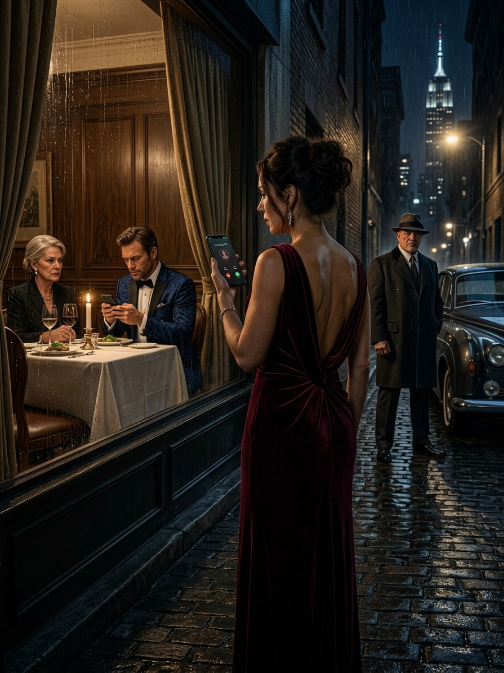
Then my private phone lit up.
Clara’s name.
Only four people had that number. My consigliere. My lawyer. My underboss. And Clara — the woman who had raised Leo since the week he came into my life wrapped in a blue blanket and accompanied by no paperwork worth trusting.
Clara never called late.
I answered before the second ring.
“Mr. Ferrante.” Her voice was broken glass. “It’s Leo. He collapsed. He couldn’t breathe. The paramedics said his heart—”
The whiskey glass in my other hand hit the floor without my deciding to drop it.
Everything after that moved on instinct.
Leo was six years old. He had a heart condition the cardiologists called *minor* with the comfortable detachment of people who would never have to watch him monitored. I had wrapped rings of protection around that boy — private physicians, a rotating security detail, a nanny who had once chased a photographer off my front step with a serving ladle. I had ensured that nothing in this city breathed near him without my knowledge.
And still, he was in an ambulance.
Dante had the armored car waiting before I reached the sidewalk. As we cut through Manhattan traffic in the rain, I did what I always do when fear becomes useless: I turned it into something colder. More precise. More useful.
“Lock down the pediatric floor,” I said. “Anyone not on the approved list gets removed immediately.”
“Already done,” Dante said.
Enemies don’t come at men like me directly anymore. They learned not to. Instead they come at what we love — and everything I loved lived in that boy.
By the time we reached Lenox Hill, I was not a father rushing to a sick child. I was a loaded weapon looking for something to point itself at.
The nurse at triage began explaining visitor restrictions until I placed a card on the counter. Matte black. No logo. She understood.
“Fourth floor. Room 412.”
I took the stairs.
The pediatric wing was wrong the moment I stepped onto it. Too quiet. Then I saw one of my own men slumped against the nurses’ station, breathing but unconscious. Another lay near a doorframe with one hand pressed against his ribs.
Not a medical crisis.
An attack.
“Seal the stairwells,” I said quietly to Dante. “Anyone running comes to me alive.”
I reached Room 412 and kicked the door in.
Gun raised. Eyes scanning low to high.
A woman screamed — not in panic, in warning.
“Back up. I will use this.”
She stood between the door and the hospital bed, both feet planted, gripping the splintered handle of a broken mop like something she had already swung tonight. Blue cleaning uniform torn at the shoulder and soaked dark. Blood running from a cut above her eyebrow in a slow, deliberate line down the side of her face.
Her eyes went to mine, not to the gun.
That told me something.
“Two men tried to kill him,” she said. Her voice trembled — not with fear but with the specific vibration of someone running on adrenaline after a fight they’d already won. “Ten minutes ago. I walked in. I stopped them.”
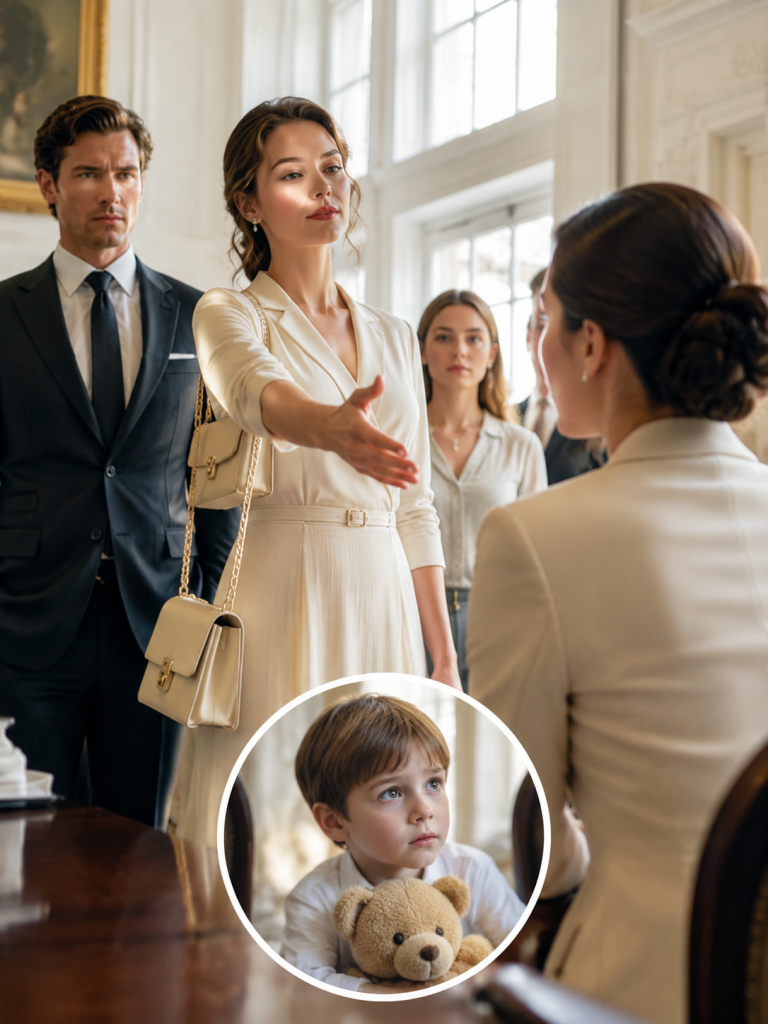
Behind her, in the blue glow of a cardiac monitor, Leo lay under a white blanket. Small. Still. Tubes taped to his face.
I lowered the gun one inch.
“Who are you?”
“Rosa Vega.” She didn’t shift her weight off that back foot. “I clean this floor. I saw what they were doing to his IV line. I hit the panic alarm. Police are coming.”
Dante moved in behind me.
Then Leo’s monitor changed its rhythm.
Not stopped. Changed. A sharp, erratic stutter that made the green line across the screen jump like something trapped.
Rosa’s eyes snapped toward it, and the hardness left her face for one raw second, replaced by something almost like guilt.
“His IV,” she said quietly. “One of them had a syringe. He got something into the line before I could stop him. I thought I was fast enough.”
I crossed the room in three strides and examined the bag above Leo’s bed. Clear fluid. Hospital label. And somewhere inside it, something that was slowly pulling my son apart.
“Get a doctor,” I said to Dante. “Now.”
Rosa was already clamping the line, already pressing the nurse’s call button with the heel of her hand, already doing the next necessary thing while I stood frozen beside my son’s bed like all my power had shorted out.
The doctor arrived at a run. Pale. Young. Dante had him by the collar.
“Treat him,” Dante said.
“I need to know what he was given—”
Rosa thrust the disconnected IV line at him. “Cardiac interference. They injected something before I stopped them. Treat for arrhythmia and work backwards.”
The doctor’s fear sharpened into training. He moved.
And then Leo’s monitor stopped stuttering and went flat.
One long, unbroken tone.
The doctor shouted “Charging!” and climbed onto the bed rail.
The defibrillator whined as it built power.
I have never in my life been unable to move. Not in war. Not under fire. Not in rooms where the odds ran entirely against me.
I could not move.
Rosa stepped in front of me.
“Protect the door,” she said. Low and direct. “That’s what you can do. Go.”
The first shock hit Leo’s chest.
Nothing.
“Again!”
The second shock.
One thin beep answered.
Then another.
The doctor exhaled like a man surfacing from water. “We have him. Weak pulse. He needs ICU.”
Rosa covered her mouth with both hands.
I leaned one arm against the wall and breathed.
Then Dante stepped in from the corridor. His face was the specific expression of someone delivering news that makes everything worse.
“We found a third man,” he said. “Pharmacy scrubs. He was standing outside the door when we grabbed him. Marco — he’s smiling.”
The prisoner, when we cornered him against the hallway wall, did not beg.
He smiled.
And his eyes moved past me. Past Dante. Past the gun at his throat.
They found Rosa.
“You look familiar,” he said to her.
Rosa shook her head. “I don’t know you.”
“No. But you knew your brother.”
The corridor went silent.
Somewhere down the hallway, three rapid gunshots exploded in quick succession.
And when I turned back, Rosa was staring at the prisoner with an expression that made the back of my neck go cold — not confusion, not fear, but the slow dawning of someone who has just heard the shape of a thing they’ve been circling for years.
—
## PART 2
Moving Leo to the cardiac ICU required a service corridor, a broken elevator code, and Rosa Vega leading the way through the hospital’s hidden skeleton like someone who had memorized it for reasons none of us had thought to question.
She knew which cameras were dead. Which routes bypassed the locked fire doors. Which linen cart left the clearest path. You only learn a building that way when you’ve been inside it long enough for people to stop looking at you.
Dante walked beside me. Voice flat. “She knows his medication schedule. His room rotation. His shift timing.”
“I know.”
“That’s not a coincidence.”
“I know.”
I watched Rosa push through a service door ahead of us and understood, somewhere beneath the night’s chaos, that she had not stumbled into Room 412 by accident. She had been in that building, on that floor, for a reason. What I did not yet understand was whether that reason had saved my son’s life — or set up the conditions to end it.
We reached the sixth floor. The ICU doors took Leo, and I was left on the other side of the glass like all my money and fear amounted to nothing in the face of a sliding door and a doctor who had not yet decided what he thought of me.
Rosa stood against the wall.
The adrenaline was leaving her now. I could see it in the careful way she held herself upright — the body beginning to log everything it had absorbed. Split eyebrow. Bruised jaw. Shoulder wound gone stiff. The broken mop handle still in her right hand out of what seemed like pure reflex.
“Your brother,” I said. “Tell me.”
She didn’t answer immediately. When she did, her voice had the flatness of a story rehearsed so many times it had worn smooth.
“Diego was sixteen. He ran errands for men he thought were businessmen. He saw something he wasn’t supposed to see. He was found in the East River.” A beat. “The police called it a robbery.”
Dante went very still beside me.
I kept my face neutral.
Because I knew that name.
I had known it for years.
“Did you kill him?” Rosa asked.
“No.”
“Did you protect the man who did?”
The ICU glass reflected both of us back at ourselves — a woman who had bled for my son and a man with too many answers he had never chosen to give.
Before I could speak, the service elevator at the end of the corridor opened by itself.
Every gun in the hallway came up.
Inside: a burner phone. Black. Old. Taped to the back wall.
Ringing.
I stepped in and picked it up.
The voice on the other end was quiet. Unhurried. Intimately familiar in the way only the dead can be familiar, because you carry them in a part of your memory that doesn’t update.
“Hello, Marco.”
My sister Bianca had died eight years ago in a car explosion outside Atlantic City. I had identified what remained of her by a ring and a dental record and a grief so total it had nearly swallowed me whole.
“Bianca,” I said.
Dante’s face changed entirely.
Rosa stared between us.
My dead sister breathed against the phone.
“You look pale,” she said. “Even from here.”
“You’re dead.”
“I renovated,” she said. “It took time.”
The elevator began to move upward on its own.
I put the call on speaker.
Bianca’s voice filled the small space.
“There is something you need to understand about the woman standing next to you, Marco. Something about her brother, about Leo, and about a truth you have been living inside without knowing it.”
Rosa’s eyes locked on the phone.
“Diego Vega was not killed for knowing too much,” Bianca said. “He was killed because of what his sister carried. And what his sister carried is the reason Leo is alive tonight — and the reason he was never, in any way that matters, yours.”
Rosa went white.
I stopped breathing.
The elevator opened on six.
Bianca’s voice dropped to something almost gentle.
“Leo is not your son, Marco. He never was.”
The corridor outside was empty and humming under fluorescent lights.
Behind the ICU glass, Leo lay surrounded by machines.
As if he heard something through all that distance and glass and disbelief, he turned his head.
Not toward me.
Toward Rosa.
And through the oxygen mask, with tubes taped to his pale face, my son — the boy I had raised and loved for six years — mouthed one word.
*Mom?*
—
## PART 3
The word hit Rosa like something physical. She took one step backward and pressed her hand flat against the glass, and Leo — weak, barely awake, barely holding on — lifted two fingers toward her from the other side.
The cardiac monitor steadied.
Dante looked at me.
I had no answer for him.
The cardiologist came out a few minutes later, exhausted and careful.
“He’s asking for the woman,” she said. “Whatever keeps him calm, we want it.”
Rosa walked in.
She approached Leo’s bed like every step crossed a distance she hadn’t been told she was allowed to cross. She touched the bed rail first, not him. Then Leo’s fingers found hers and curled around one of them, and the monitor drew its cleanest line of the night, and a nurse whispered, “His rate is improving.”
Rosa bent close to him.
“I’m here,” she said.
From the doorway I watched my son hold a stranger’s hand like she was the only solid thing in the room. And something I had built carefully over years — the certainty of what I was to him, the architecture of that love — developed a crack I couldn’t see the bottom of.
Dante stepped next to me. “You need to go down.”
“I know.”
“Bianca has Clara in the garage. She said ten minutes on the oxygen in that room.”
“I know.”
He looked at Rosa through the glass. “She hates you.”
“She should.”
That silenced him.
—
The basement garage smelled of everything that happens when history tries to quietly disappear: cold concrete, old oil, the specific silence of a city that keeps moving while something permanent occurs beneath it.
Emergency lights pulsed red across the parked ambulances. I moved between the pillars alone.
Then Clara’s voice, hoarse and trembling: “Mr. Ferrante?”
I found her in a storage room near the ambulance bay, wrists raw, gray hair matted against her face. She wept when she saw me, but not for herself.
“Is Leo alive?”
“Yes.”
Her whole body loosened.
I cut the ropes.
“Lucia?” she said.
“Bianca,” I said. “Where?”
“Behind you.”
I turned.
My sister stood beneath a broken fluorescent light. Thinner than memory. A scar curved from her left ear down her jaw — the signature of an explosion that hadn’t finished what it started. Silver threaded through hair she’d once kept black. Her pistol was lowered.
That was what frightened me most. Bianca never lowered a weapon by accident.
“You sent men to suffocate a child,” I said.
“I sent men to create a crisis that would get you into that hospital before Caltieri’s people finished the job.” She held my eyes. “There is a difference.”
“To Leo there wasn’t.”
She flinched. The first honest thing her face had done.
“Tell me,” I said.
She told me.
Rosa Vega had been seventeen years old during a winter storm in Queens. Her brother Diego was already dead. She had no one. There were complications — fever, blood loss. She nearly died. When she woke in the clinic, a nurse she didn’t recognize told her that both babies had not survived.
“Both,” I said.
“She was carrying twins.”
The garage tilted.
“A boy,” Bianca said. “And a girl.”
I stared at my sister.
“The boy was Leo. A man named Bruno Caltieri had paid the clinic nurse to falsify the records. He took both children as leverage — tools to be sold or used when the time was useful. I discovered what he was doing. I got to Leo first. I took him back.” Her voice didn’t waver, but something behind it did. “I had no safe place. You had the only fortress in New York that no one could reach. So I gave him to you and told you he was mine.”
“And then you died.”
“And then I let you believe I had.”
Clara pressed her eyes shut behind me.
“The girl,” I said.
“Sold through Bruno’s private adoption network to a family in Brooklyn. I spent years trying to trace the records. They had been purged.” Bianca reached into her coat and held up a photograph. “Her name is Mia. She is six years old. She lives in Brooklyn Heights and has a field trip at seven this morning.”
A little girl. Dark curls. Gap-toothed smile. Leo’s mouth. Rosa’s cheekbones.
“Caltieri’s remaining network found her,” Bianca said. “The attack on Leo tonight was a distraction and a warning. They are going to take Mia before dawn.”
My phone rang. Dante.
“Boss.” His voice was careful in the way that means everything is about to become worse. “Rosa heard Leo say a name.”
“What name?”
Pause.
“Mia.”
A beat.
“She’s gone.”
—
We found Rosa in Brooklyn twenty minutes later — not at the school, but across the street from the apartment building listed on Mia’s emergency contact record. She stood under a dead awning in the rain, soaked through, watching the warm light of a third-floor window with the particular stillness of someone afraid that moving might make it disappear.
I got out of the car alone.
“I woke up in that clinic,” she said, without looking at me. “A nurse I didn’t know. She told me both babies were gone. No bodies. No certificates. Just — gone.” Her voice was steady in the way things are when they’ve been shaking long enough to forget how. “I spent years thinking I had done something that made God decide I didn’t deserve them.”
I stood beside her in the rain.
“I’m sorry,” I said.
She laughed — one short, empty sound.
“You raised my son in a protected house while I scrubbed blood off hospital floors to be near him.”
Nothing to hide behind.
“Yes.”
She turned then, and what I saw in her face wasn’t hatred. It was a reckoning — careful and absolute and made by someone who had not run out of clarity.
“When this is over,” she said, “I want the truth. All of it.”
“You’ll have it.”
Across the street, a black van rolled past the building. Too slowly. Too deliberately. Dante’s voice crackled in my earpiece: *We see it.*
Rosa saw it too.
She was already running before I could speak.
Two men out of the van. One toward the building. One raising a weapon at Rosa.
I fired from across the street. His shoulder. He spun into a parked car.
A third man came around the van and grabbed Rosa from behind. She drove her elbow back into his throat. He staggered. She slammed his head into the van door until the window cracked, took his weapon, and kept moving.
From the building above: a child screaming.
We went in.
Third floor hallway. A masked figure dragging a small girl toward the stairwell — pink backpack, dark curls, kicking with everything she had.
Rosa raised the stolen gun with both hands.
The man pulled Mia closer. “Drop it.”
Rosa didn’t move.
Mia stopped struggling.
She looked at Rosa.
Something passed between them that had nothing to do with logic — a recognition without introduction, a turning toward that was older than memory. Mia didn’t know this woman. She had never seen her face. And yet her body understood something her mind had no words for yet.
Mia bit the man’s hand to the bone.
He screamed.
I fired once — his knee — and he released her.
Mia ran straight into Rosa’s arms.
No hesitation. No question. As if she’d simply been waiting for the right address.
Rosa caught her and made a sound that wasn’t a word — it was six years of grief tearing open. Every morning she had spent believing both her children were in the ground, coming apart all at once.
“My baby,” Rosa sobbed. “My baby, my baby—”
Mia held on with the unconscious certainty of someone who doesn’t yet understand what they’ve found but knows absolutely that they are not letting go.
Then a woman appeared from the apartment at the end of the hall. Sarah Brennan. Mia’s adoptive mother. Pajamas and white face and eyes that went from the armed men to Rosa to her daughter wrapped around a stranger’s body.
Both sets of arms were real. That was what made the hallway unbearable.
Mia, still crying, reached one hand back toward Sarah.
“Mommy—”
Rosa flinched as if something had entered her through the ribs.
Sarah began to cry. “Please. She’s my daughter.”
Rosa held Mia for one more second. Then, slowly, she lowered her to the floor and kept both hands on her small shoulders.
“I’m not here to take you,” she whispered.
Mia stared at her. “Who are you?”
Rosa pressed her lips together hard.
“I don’t have the right word yet,” she said. “But I think I’ve been missing you since before I knew your name.”
Then Dante shouted: *Down.*
Bullets tore through the hallway walls.
—
We held the apartment through four minutes of gunfire, got everyone out the fire escape, into the car, and followed Bianca’s directions to a shuttered church in Queens whose basement had been fortified decades ago by men who believed every institution should have somewhere to disappear.
Leo was already there — Clara had moved him under Bianca’s coordination, portable monitor, private doctor. When Rosa came through the door, he was awake. When he saw Mia, he tried to sit up.
Mia crossed the basement without asking permission and placed her palm against Leo’s hand.
“You’re real,” Leo said.
“So are you,” Mia said.
The monitor settled into the cleanest rhythm of the entire night.
Rosa knelt between both children and cried without sound. Sarah stood back and let her. I remained at the room’s edge — outside the circle of light, which is where I had always stood when it came to anything that mattered.
Leo looked at me.
“Dad?”
Rosa stiffened.
I walked to his bedside and took his hand, and Rosa — who had every right to stop me — didn’t.
That mercy cut deeper than any of the night’s wounds.
“Don’t fight,” Leo whispered.
I looked around the room. At Mia and Rosa and Sarah and Clara and Bianca and Dante near the door.
“I’m trying not to,” I said.
—
Bianca handed me the flash drive before dawn.
“Everything is here. Birth records. Clinic payments. Bruno Caltieri’s network. The truth about Diego. The truth about both children.”
“Why give it to me?”
“Because it ends one of two ways. You protect yourself. Or you protect them.”
The church doors above us blew inward before I could answer.
Smoke rolled down the stairs.
My father’s voice preceded him.
Aldo Ferrante. Whose funeral I had attended eighteen months ago. Whose estate I had inherited. Whose sins I had, apparently, misunderstood the total extent of.
He came down the stairs slowly — a cane, a charcoal coat, armed men at his shoulders, and the same black-nail eyes that had impressed my entire childhood flat.
He saw Leo and Mia.
“Remarkable,” he said. “Both survived.”
Rosa stood. She picked up an iron candlestick from the wall.
I stepped between them — not to protect him, but to keep her from being shot.
Aldo smiled. “Give me the drive, Marco. We close tonight. Leo stays yours. The women disappear. Your sister disappears properly.” He extended his hand. “You remain king.”
He was offering me everything I had built my life around wanting.
Control. Position. The comfortable lie restored.
Leo watched me with wet eyes.
Rosa didn’t plead.
Dante stood near the door with the expression of a man deciding whether the last door inside him was still open.
I set my gun on the floor.
Aldo’s smile widened.
I took the flash drive from my pocket, held it up —
And dropped to one knee.
Not to my father.
To Leo. To Mia. To Diego Vega’s name. To every life that had been traded for my convenience.
Dante understood immediately. His phone was in his hand before I drew a breath. Recording.
I looked at my father.
“My name is Marco Ferrante,” I said.
And then I confessed.
Names. Dates. Orders given and orders allowed. The men I buried and the men I protected because the math of building an empire demands that you pay in things you tell yourself you can afford. I named Bruno Caltieri. I named the clinic. I named the bribes. I named the silence I had traded for power.
Aldo lunged for me with his cane.
Federal agents came through the ceiling.
Bianca had not brought us to a hiding place.
She had spent eight years building this exact room, with this exact evidence, waiting for the moment I would choose to be useful.
In the chaos — smoke, shouting, Dante tackling a gunman, Sarah pulling Mia flat, Rosa shielding Leo — my father reached into his cane and drew a blade and drove it toward Dante’s back.
I moved without deciding to.
The knife entered my side.
Rosa shouted my name.
I went down.
The last thing I saw before the world faded: Leo reaching for me through Clara’s arms.
*”Dad!”*
—
I woke to gold light.
Real sunlight. Warm across my face. The kind that has no agenda.
Leo’s voice: “You’re breathing weird.”
I opened my eyes.
He sat beside the bed in dinosaur pajamas, still pale but present, watching me with the careful attention of someone who had been waiting a long time for me to come back. Mia sat next to him swinging her feet, already studying me with the solemn assessment of a child who forms her own conclusions.
Rosa stood behind them.
Arms folded. Eyes slightly red. Pretending otherwise.
“You got stabbed by your undead father,” she said. “Doctors don’t love that.”
Leo smiled. “She makes jokes now.”
Mia leaned forward. “Are you still a crime boss?”
The room went quiet.
I thought about deflecting. Then I looked at Leo.
“No,” I said. “I’m not.”
Mia nodded, satisfied. “That’s probably better. It sounds like a lot.”
Rosa turned toward the window, but I caught the edge of a smile before she managed to hide it.
—
The case detonated New York over the following months.
Aldo Ferrante lived long enough to watch his empire seized, his accounts frozen, his protections stripped away by the documentation Bianca had spent eight years assembling. Bruno Caltieri’s trafficking network collapsed under testimony and files and the particular determination of people who had been waiting a very long time to be believed. Children were found. Records were opened. Mothers got lawyers.
I did not walk free.
I did not disappear into a cell forever either.
What I gave was testimony, money redirected from things that ended lives toward things that protected them, and the particular usefulness of a man who knows exactly where every body is buried — including the ones buried as records, as bribes, as convenient silence.
Leo’s birth certificate was restored. Mia’s too.
Leo Cruz-Ferrante.
Mia Cruz-Brennan.
No court could untangle love cleanly. No one tried. Sarah remained Mia’s mother. Rosa became hers too. I remained Leo’s father. Rosa became his mother — not because blood required it, but because Leo did.
The first time all of them sat together in Central Park — Leo and Mia chasing pigeons with the confidence of small royalty, Rosa and Sarah on a bench working through the awkward-becoming-comfortable rhythm of two women who had found unexpected territory in each other — I stood twenty feet away.
“Are you going to lurk there forever?” Rosa called.
Dante answered for me. “Yes.”
Rosa rolled her eyes. “Come here, Ferrante.”
I did.
Not as a king. Not as a threat. Just as a man who had finally run out of reasons to stand at the edge of things.
Leo climbed carefully into my lap. Mia leaned against Rosa. Sarah took photographs. Dante pretended not to smile near a hot dog cart. Bianca watched from under a tree, alive and inexplicable, drinking espresso.
The night before Leo’s cardiac surgery — same hospital, same floor, different world — Rosa found me outside his room.
“You’re pacing,” she said.
“I don’t pace.”
She stood beside me.
A long silence.
“You didn’t steal him on purpose,” she said eventually.
“No.”
“But you kept a world where someone could.”
That sentence landed quietly and did not leave.
“Yes,” I said.
She breathed out slowly.
“Then help me build one where they can’t.”
So I did.
When the surgeon came out smiling the following morning, Rosa collapsed into Sarah’s arms. Clara sobbed loudly enough that Dante sat down. Bianca said something to God that sounded more like a negotiation than a prayer.
I went in to Leo’s recovery room.
He opened his eyes.
“Dad?”
“Here.”
“Rosa?”
“Here.”
“Mia?”
“Here.”
He settled back with the quiet satisfaction of a child who has taken attendance and found everyone present.
“Good,” he said. “Everybody stayed.”
—
People still tell the story wrong.
They say the most feared man in New York stormed into a hospital looking for assassins and found a bleeding cleaning woman holding a broken mop handle — and froze.
True.
They say she saved the boy.
Also true.
But the whole truth is stranger and better.
Rosa Vega saved two children she didn’t yet know were hers, broke a network that had stolen them, faced a king without stepping back, and turned a hospital corridor at three in the morning into the first page of something no one could have written on purpose.
One spring afternoon: Leo and Mia chasing bubbles through Central Park, arguing about which pigeons had criminal energy. Clara and Bianca walking behind them, debating what dead people should be allowed to order at cafes. Dante and his father at a food cart, both men pretending the wind was responsible for their eyes. Sarah a few steps away, photographing everything.
Rosa sat beside me on a bench.
She handed me half her coffee.
I stared at it.
“What is this?”
“Peace offering.”
“Is it poisoned?”
“Not today.”
I took it.
She smiled.
Not forgiveness. Not love.
Something more durable than both.
A beginning.
Leo turned back from the pigeons and shouted: “Dad! Mom! Mia says pigeons are just tiny gangsters!”
Rosa and I both answered at the same moment.
“What?”
The children burst into laughter.
And under the bright, impossible New York sun — with all our ghosts standing a respectful distance behind us and two living miracles making a mess of the city ahead — I understood the only truth none of my enemies had ever been able to prepare me for:
The most dangerous thing I ever did was not the killing.
It was the staying.
**THE END**