He Ordered a Plain Bride for His Lonely Ranch—Then a Stunning Woman Arrived Carrying a Dangerous Secret

PART 1
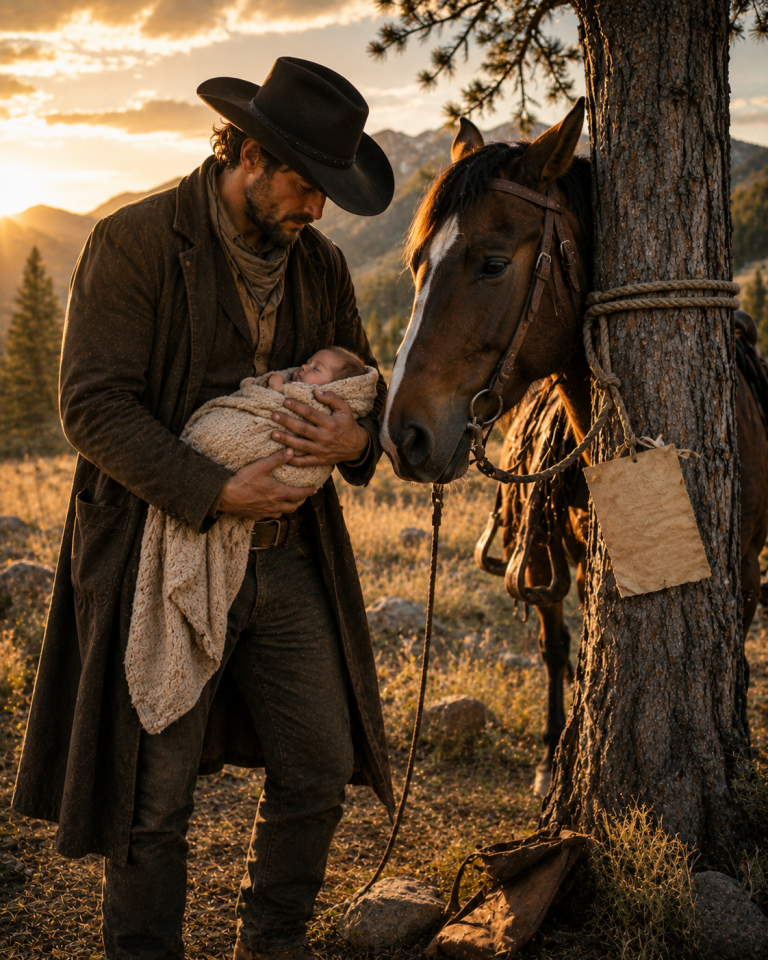
Everett Hail had asked for plain.
Ten weeks ago he’d placed an advertisement in three territorial newspapers. Rancher seeks wife. No frills. Must be practical, willing to work. Romance not required. Companionship sufficient. He’d gotten three replies full of dime-novel nonsense about destiny and the frontier spirit, and one that wasn’t. I can cook, manage accounts, and mend what’s broken, it said. I don’t need poetry. I need distance. No name. Just initials — LV.
He’d written back with a date and a town. She’d confirmed. That had been eight weeks ago, and now the stagecoach was finally rolling into Holtz Crossing three days late, dust rising behind it like a signal fire.
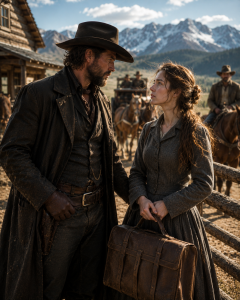
Everett stood outside the general store with his hat pulled low, watching the road the way a man watches something that owes him money. A traveling salesman climbed down first, nodded to no one, and went looking for the hotel. Then she stepped out.
He’d asked for plain. What he got was something else. Her face was angular, sharp at the cheekbones, mouth set in a line that made no promises. Dark hair pulled back tight enough to hurt. A traveling dress the color of old charcoal, dusty but well-made. And eyes the color of rain clouds, moving across the street with the slow, deliberate sweep of someone cataloging exits.
“Everett Hail?” Not a question. A confirmation.
“That’s me.”
She walked toward him with steps too measured to be casual, one small trunk in hand, a leather satchel held close against her side like it carried something worth more than gold — or more dangerous. Up close he saw the exhaustion carved into the fine lines around her eyes.
“Lydia Vance,” she said. No handshake offered. “The ranch is far?”
“Couple hours.”
“Good.” She was already turning toward his wagon.
The ride out was quiet in a way Everett wasn’t used to. Lydia sat with her hands folded, eyes tracking the horizon like she expected trouble to come from it. When he asked where she’d traveled from, she said, “East,” and nothing more. He’d asked for no complications. Apparently that included no history.
The ranch came into view as the sun started down — six hundred acres of decent grazing, a house his father had built forty years back, a barn needing new shingles. Nothing that would impress a woman who’d grown up with money. But Lydia looked at it the way someone looks at a fortress.
“How many hands do you keep?”
“Just me.”
“How much of the land can’t be seen from the house?”
Strange question. He didn’t ask why she wanted to know.
Inside, the house still carried the hollow feel of a place where one man had lived too long alone. Two bedrooms. His, on the left. The one on the right had stayed shut for three years.
“I’ll take the spare room,” Lydia said, already moving toward the closed door.
“That room’s not —” He stopped himself. “Let me go in first.”
It was exactly as Rachel had left it. Clothes in the wardrobe. A quilt folded at the foot of the bed. Three years of dust over everything like a shroud.
“Someone died here,” Lydia said, without expression, when she saw it.
“My wife. Three years back.”
“I’m sorry.” She said it like she meant it — the kind of sorry that carries its own private griefs. “I can’t sleep in a shrine, Mr. Hail. Neither can you keep one forever. We’ll deal with it now, or I’ll find somewhere else to stay.”
He should have been furious. Instead, something in her directness cut straight through the impulse to defend himself. They cleared the room together until the light failed — packed Rachel’s things into a trunk, beat the dust from the mattress, wiped down the window that looked west toward the mountains. By the time they finished, it was just a room again. Four walls. No ghosts.
Over beans and cornbread, Lydia informed him she’d be handling meals starting tomorrow. Over breakfast the next morning, she informed him his account books were a disaster and someone had likely been stealing from him for months.
She wasn’t wrong. A trip into town confirmed it — the feed supplier’s son had been skimming small amounts for half a year, confident no one would notice. Lydia noticed. She laid the evidence on the counter in a voice that never rose and never needed to, and walked out four hundred dollars richer and considerably more feared.
“You enjoyed that,” Everett said on the ride back.
“I did. No shame in it. Just fact.”
They stopped for supplies on the way home. Everett waited by the wagon while Lydia went inside — and that was when he noticed the man standing outside the hotel. Tall. Well-dressed for a town like this. Watching the street with the same careful attention Lydia had shown the moment she stepped off the stage.
The man’s eyes found Everett’s wagon. And stayed there.
He started walking over, unhurried, deliberate — the kind of casual that isn’t casual at all.
“Afternoon,” the stranger said. “Fine day. I’m looking for someone. Woman, late twenties, dark hair. Might’ve arrived on the stage a day or two back. Seen anyone like that?”
Everett’s hand tightened on the reins.
“Lots of women have dark hair.”
“This one might’ve seemed like she was running from something.” The man’s smile widened, patient as a held breath. “I’d pay fifty dollars to whoever points me in the right direction.”
He’d already checked the stage line’s passenger manifests in three towns, he added, almost as an afterthought — easy enough when the man paying your wages owns half the freight contracts on this route. Everett filed that away. A man who could read stage manifests like a book had resources that went well past a father’s worry.
That was when Lydia stepped out of the store, arms full of packages — and every line of her body went rigid.
The stranger’s expression shifted. Satisfaction, laced with something colder.
“Well now,” he said softly.
PART 2
Everett was down off the wagon before he’d decided to move, putting himself between Lydia and the man before either of them could think better of it.
“Lydia Vance,” the stranger said, tipping his hat like they were old acquaintances. “Been looking for you.”
“You need to leave,” Everett said, voice flat.
“This doesn’t concern you, friend. This is between —”
“She’s my wife. That makes it my concern.”
The man’s eyes flicked between them, recalculating. “Your wife. That’s interesting. Does her father know about this arrangement?”
“Doesn’t matter what he knows.”
“Oh, I think it matters quite a bit.” The stranger’s smile didn’t waver. “Mr. Vance sent me to bring his daughter home. He’s very concerned about her welfare.”
“I’m not going back.” Lydia’s voice was quiet, steady, and absolutely final. “Tell him I’m not going back.”
“That’s not really an option, Miss Vance.”
“It’s Mrs. Hail,” Everett said. “And you can tell her father she’s staying here.”
The man studied him a long moment — the way a gambler studies an opponent’s hand. “You know what you’re getting into, Mr. Hail?”
“I know she’s my wife. That’s all I need to know.”
“Then you’re a fool.” He tipped his hat again, unhurried, and walked back toward the hotel. “I’ll be in town a few more days, in case either of you change your minds.”
Lydia didn’t move until the man disappeared inside. Then she sagged against the wagon like every string holding her upright had been cut at once.
“That was Calder,” she whispered. “My father’s man. He won’t stop. He’ll come to the ranch.”
“Let him come.”
“You don’t understand. My father —”
“I understand a man sent someone to drag you back against your will. That’s all I need to understand.”
She looked at him then — really looked, searching for something. Truth, maybe. Or the shape of a commitment neither of them had signed up for.
“Why?” she asked. “Why would you do this? You don’t know me. You don’t owe me anything.”
He didn’t have a clean answer. Didn’t know why he’d claimed her as his wife to a stranger’s face before the paperwork was even filed. Didn’t know why standing between her and whatever her father might send felt more urgent than anything had felt to him in three years.
“Because you’re here,” he said finally. “On my land. Under my roof. That means something.”
That night, over coffee gone cold, Lydia told him everything — the father who saw her as leverage rather than a daughter, the senator’s son thirty years her senior he’d tried to force on her, the locked door and posted guards after her third refusal, the stolen jewelry that bought her passage west, the four false names it took to cross six states unfollowed.
“I should leave,” she said. “Go further west. Canada, maybe.”
“No.” Everett met her eyes across the table. “We file the papers tomorrow. Make it legal. Once you’re my wife on paper, your father’s got no clean claim.”
“That won’t stop him. He doesn’t care about legality. He cares about control.”
“Then we’ll deal with that when it comes. But you’re not running again unless you choose to. Not because you’re scared.”
She was quiet a long time, this quiet rancher who’d asked for simple and gotten her instead — complicated, dangerous, dragging trouble behind her like tin cans tied to a rope.
“You’d do this? Actually marry me? Face down whatever my father sends?”
“I’m tired of living like a ghost,” he said. “And I think maybe you are too.”
Something shifted in her expression. Not quite a smile. Close enough.
“All right,” she said. “We’ll file the papers tomorrow.”
They did. The county clerk issued the license that morning — no waiting period required out here, so long as both parties appeared and signed — and by afternoon Judge Morrison performed the ceremony in his office above the general store, his wife and the store clerk standing as witnesses. Ten minutes once the license was in hand, signatures entered in the registry, and it was done — legal, recorded, and utterly unromantic. Walking back to the wagon, Lydia touched the plain gold band on her finger.
“Strangest wedding I’ve ever been to,” she said.
“You’ve been to many?”
“Fair point.”
They were halfway home when they saw the dust on the road behind them. Three riders, coming fast. Everett pulled the wagon into a grove of cottonwoods, and they waited, low and silent, while the riders passed without slowing — heading toward town. Away from the ranch.
“He’s looking for you in the wrong places,” Everett said. “For now.”
That night neither of them slept. Everett kept his boots on. Lydia sat with her door cracked and her father’s face fresh in her mind, the leather satchel open on her lap — a pistol, a stack of old letters, a photograph of a woman who might have been her mother. Everything she’d managed to save when she ran.
Dawn came quiet. No riders. No trouble.
But six days later, a lawyer named Victor Ashworth arrived in a polished black buggy that had no business on ranch land — carrying a petition to have Lydia declared mentally incompetent, a lawsuit to annul the marriage, and an envelope with five thousand dollars in it for Everett’s signature.
What Everett didn’t yet know was that Jonathan Vance wasn’t finished. He hadn’t even really started. And the question that would decide everything wasn’t whether Lydia was competent to make her own choices.
It was whether a judge in Denver — a judge who’d known Jonathan Vance for twenty years — would ever agree to let her.
Denver, Ashworth had explained coldly, because Lydia had never formally established residence anywhere else — her legal domicile, under the law, was still her father’s house, the one she’d fled. A competency petition, he said, belonged wherever the ward was domiciled, not wherever she happened to be standing when she signed a marriage certificate. It meant Vance got to choose the courthouse, the judge, and the twenty years of history between them. It also meant the marriage itself wasn’t being tried in Montana, where it was performed and recorded, but in the one city where Jonathan Vance’s name still opened every door.
PART 3
Everett stood in the yard with a post-hole digger still in his hands, watching Ashworth’s buggy roll away, and understood with total clarity that he’d just made things exponentially worse.
“How much did he offer you?” Lydia asked, meeting him halfway to the house.
“Five thousand.”
She went pale. “That’s a fortune for a ranch this size.”
“It is.”
“Why didn’t you take it?”
“Because you’re not for sale.”
“Everett, that money could change everything for you. The ranch. Your future.”
“I don’t want a future that comes from selling you out.” He shook his head at the look on her face. “This isn’t romantic nobility. It’s practical insanity, and I know it. Your father’s going to have judges, expert witnesses, doctors who’ll say whatever he pays them to say. Maybe stubbornness is all I’ve got. But I’ll lose standing up before I lie down.”
Ashworth had made that plain before he’d left, almost as a courtesy. Vance’s rail company ran the freight contracts for half the merchants in three territories, he’d said — Carson’s Feed included. It would be a shame if certain suppliers found their shipments delayed for months at a time over paperwork irregularities. He hadn’t needed to finish the thought.
That night they counted the ranch’s savings twice, hoping the number would improve. It didn’t. Three hundred and forty dollars — nowhere near enough for a real lawyer against six of Jonathan Vance’s. Lydia wrote to an old acquaintance from her former life, a woman named Margaret Chen who’d fought her way through law school specifically to spite men like her father, but a letter to San Francisco wouldn’t bring help in time even if Margaret agreed.
Two weeks after Ashworth’s visit, Calder returned with worse news — the hearing had been moved up. One week, not three. Just enough time to make sure they couldn’t properly prepare.
“They moved it to catch us off guard,” Lydia said, hands shaking. “We won’t have a lawyer. Jacob Morrison does property disputes and wills. He’s never handled anything like this.”
They asked him anyway. Morrison listened, alarmed, and admitted honestly he wasn’t qualified — but he gave them a name. Martin Cross, in Cheyenne. Three days’ travel. Less than a week before the hearing.
Neighbor Tom Fletcher — a man who’d feuded with Everett over a property line for five years — showed up at sunset with his hat in his hands. “Heard you might need someone to watch the place while you’re gone,” he said. “What Vance is doing, trying to drag his daughter back like she’s property — that ain’t right. I got daughters of my own.”
They left for Cheyenne at dawn.
Martin Cross was shorter than Everett expected, stocky, gray-haired, tired-eyed, and not taking new clients. He listened anyway, at his wife’s urging, to the whole story — the advertisement, the marriage, Calder’s visits, Ashworth’s bribe.
“This is a disaster of a case,” he said when they’d finished.
Lydia’s face fell. “So you won’t take it?”
“I didn’t say that. I said it’s a disaster.” He leaned back, studying them. “Vance has money, connections, and time to prepare. You have none of those things. But we don’t play his game. We play ours. We don’t argue your competency — we argue his authority. We make him the one on trial.”
His fee, normally, would have run two thousand dollars plus expenses. They had three hundred.
“Give me that,” Cross said. “We’ll call the rest a loan. Pay it back when you’re able.” When Everett asked why, Cross’s expression hardened. “Twenty years ago, Jonathan Vance destroyed a friend of mine over a stretch of land for his railroad. Bought off the assessor, buried him in litigation, took the land anyway, and drove him to drink himself to death waiting on an appeal that never came. I’ve been waiting twenty years for a chance to make that man answer for something. This might be it.”
They spent three days preparing — Cross interviewing them separately and together, pulling apart every inconsistency Vance’s lawyers might exploit, pushing Lydia to say out loud things she’d kept buried.
“Why did you run?” he asked her.
“Because my father gave me no choice.”
“Not enough. Why that decision, specifically?”
Her hands clenched. “Because I’d tried reasoning. Three times I refused the engagement. Three times he ignored me. He locked me in my room, posted guards, told me I’d come around or he’d make me come around.”
“Good,” Cross said. “We’ll use that. Show the pattern. Running wasn’t irrational. It was survival.”
Denver was bigger than anything Lydia had seen since she’d fled it. The hearing convened the next morning in a courthouse built to intimidate — stone and columns, echoing halls. Jonathan Vance sat at the front table with six lawyers in expensive suits, the expression of a man who considered the outcome already settled.
His lead attorney, a silver-haired man named Whitmore, opened with the story he’d clearly told a hundred times before: a concerned father, a troubled daughter, medical evaluations from three physicians documenting her erratic behavior — the theft of jewelry, the flight across state lines under false names, the hasty marriage to a man who’d advertised for a wife who wouldn’t ask questions.
“This is not the behavior of a rational, competent adult,” Whitmore said. “This is the behavior of someone in crisis.”
Cross rose, calm where Whitmore was theatrical. “The real question before this court isn’t whether Mrs. Hail is competent. It’s whether her father has the right to control her life simply because he disagrees with her choices.” He walked the judge through it — Lydia’s education, her head for numbers, her negotiations with suppliers before she ever left her father’s house. “The only thing that changed is that she refused to marry the man he chose for her. Running from that wasn’t irrational. It was self-preservation.”
Judge Henderson allowed Lydia to testify. She took the stand with steady hands and told it plainly — the guard rotation she’d learned, the two-hour window on changeover nights, the jewelry sold through a housemaid, the four names across six states.
“That sounds like careful planning,” Cross said. “Rational thought.”
“It was necessary.”
Cross wasn’t finished with testimony alone. Two nights before the hearing, one of his contacts in Denver had turned up a housemaid — the same one who’d helped Lydia slip out the window, since let go from the Vance estate and willing, for the first time, to swear to what she’d seen. And buried in a stack of correspondence Cross had subpoenaed from the Hartford family’s attorney was a letter in Jonathan Vance’s own hand, proposing the marriage not as a father’s hope for his daughter’s happiness but as a condition of the senator’s continued support for a rail line Vance’s company needed pushed through the legislature. Cross entered both into the record before Whitmore could object to their relevance. A father’s love, written down, priced against a stretch of track.
Whitmore’s cross-examination came at her sideways and then head-on — the sold jewelry recast as theft, the quick marriage recast as desperation, the advertisement itself twisted into evidence that Everett had gone looking for someone vulnerable enough to exploit.
“I wasn’t desperate,” Lydia said, jaw tight. “I was deliberate.”
“Deliberate enough to investigate whether Mr. Hail was suitable, based on what — one conversation?”
“I trusted my judgment.”
“Those aren’t the actions of a rational, stable person,” Whitmore pressed. “Those are the actions of someone escaping —”
“Abuse,” Lydia said, before he could finish it for her. The word landed hard in the courtroom. Whitmore recalibrated, needled her about physical violence she couldn’t claim, tried to recast her father’s control as ordinary parental guidance. Lydia held the line. “It’s control. It’s treating me like property to be traded for political favor. I was leverage. That’s all I ever was to him.”
When Everett took the stand, Whitmore came at him just as hard — the advertisement for someone who “wouldn’t ask questions” twisted into predatory intent, the marriage’s speed recast as a scheme to secure Lydia’s bookkeeping skills and her father’s money in one convenient package.
“That’s a damn lie,” Everett said, before he could stop himself, and Henderson banged the gavel and warned him once, sharply, about contempt.
The first day ended with doubt hanging thick in the room. Back at the hotel, Lydia said what neither of them wanted to say out loud. “We’re going to lose.”
“Then we go down swinging,” Everett told her. “We don’t surrender. Not while we’re still standing.”
The second day brought Tom Fletcher to the stand, plain-spoken and impossible to shake, describing Lydia as sharper than most men in Holtz Crossing and Everett as too honest for his own good. It brought Jonathan Vance himself, testifying with practiced warmth about a daughter he loved and only ever wanted to protect — until Cross’s cross-examination stripped the warmth away, question by question, until Vance was left admitting, under oath, that “protective oversight” meant she couldn’t leave her room without supervision, couldn’t go outside alone, couldn’t see anyone he hadn’t approved.
“So she couldn’t leave freely, couldn’t go outside alone, couldn’t see people without your approval,” Cross said. “Most people would call that confinement, Mr. Vance. What would you call it?”
“Protection.”
“From what?”
“Her own choices.”
“Like refusing to marry the man you’d already chosen for her?”
By the time closing arguments came, Cross’s final words hung over the room like a held breath: “We’re saying that a woman’s choices only matter if a man approves of them. That’s not justice. That’s control. And it’s exactly what Mrs. Hail was running from.”
Henderson took the ruling under advisement overnight. Neither Everett nor Lydia slept.
The next morning, the judge’s verdict came in careful, deliberate sentences — the medical evaluations dismissed as unreliable secondhand opinion, the marriage found to be the product of strategic thinking rather than impaired judgment, and finally, the words that mattered: the petition to declare Lydia Hail incompetent was denied. The petition for annulment was denied. The marriage stood, legal and unbroken.
Vance rose without looking at his daughter, said something clipped to Whitmore, and walked to the door. There he stopped, turned, and said the only thing that would prove true. “This isn’t over, Lydia.” Then he was gone.
They went home. Calder never came back. No new lawsuits arrived. Months passed, and the fear that had lived in Lydia’s shoulders for so long began, slowly, to go quiet — though Everett noticed she still checked the horizon when riders approached, still kept a hand near the desk drawer where she stored her pistol.
What grew in that quiet was something neither of them had planned for. A marriage of convenience became, without either of them quite marking the day it happened, something real. Standing in Rachel’s old room one evening, Lydia finally asked the question that had been sitting unspoken between them for months.
“What do you want us to be?”
“Something real,” Everett said. “Not just a legal arrangement. Not just a business partnership.”
“I’m scared,” she admitted. “Scared this will fall apart. Scared I don’t actually know how to be a real wife instead of just a convenient one.”
“I’m scared too. I’d rather be scared with you than alone.”
That night he finally moved Rachel’s packed trunk out of his room for good, donated her clothes to the church, kept only a few things that mattered. The room felt different after — still his, but with space for a future instead of only a past. Weeks later, a letter arrived from Lydia’s estranged Aunt Catherine in Chicago, who’d read about the hearing in the newspapers and wanted, after years of silence, to rebuild what Jonathan Vance had deliberately severed.
Three months after the verdict, a telegram brought different news. Jonathan Vance had suffered a stroke — alive, but paralyzed down one side, barely able to speak, asking for his daughter.
“Part of me wants to ignore this,” Lydia said. “Let him die without seeing me. That would be justice, wouldn’t it?”
“Would it make you feel better?”
“I don’t know. Maybe. Or maybe I’d spend the rest of my life wondering what he wanted to say.”
They traveled to Chicago together. In a bedroom larger than their entire house, Jonathan Vance struggled to form words with half his face gone slack, finally managing, with enormous effort, two of them: You right.
Lydia went very still. “That doesn’t fix anything,” she said quietly. “It doesn’t undo what you did. But I’ll accept it.” She stood to leave, her father’s working hand grasping uselessly at the air behind her. “I hope you have years to think about the daughter you drove away. But I won’t be coming back. This is goodbye.”
In the carriage afterward, she cried the kind of grief that has nothing to do with missing someone and everything to do with never having had them to miss. “I’m not sad about what I just said to him,” she told Everett later, back at the ranch, in the room that used to be a shrine and was now simply hers. “I’m sad I never had a father worth missing.”
She asked for a real wedding after that — not the ten-minute courthouse arrangement that had started as an escape plan, but a beginning chosen freely, with people who mattered gathered in front of the house. It happened on a clear April Saturday, thirty guests in borrowed chairs facing west toward the mountains: Tom Fletcher’s family, half of Holtz Crossing, Jacob Morrison officiating in his good suit, Martin Cross making the trip from Cheyenne because, he said, he wanted to see how the story ended.
“Is it a happy ending?” Everett asked him.
“Seems like it to me. You got the girl. She got her freedom. What else do you call it?”
“Complicated.”
“The best stories usually are.”
Two weeks before that wedding, another telegram had arrived — shorter this time. Jonathan Vance had died. Lydia read it, set it down, and went back to chopping vegetables for dinner, needing no performance of grief for a man who’d earned none.
“I’m not sad he’s dead,” she said quietly, later that night. “I thought I would be, even a little. I’m not. I’m just sad I never had a father worth missing.”
The evening of the wedding, after most of the guests had gone, she found Everett by the barn and told him she was pregnant. Fear and joy arrived in him at once, tangled together the way they always seemed to be with her.
“Are you happy?” she asked.
“Terrified. But yeah. Happy.”
“Good. Because I’m terrified too. We’ll figure it out like we figured out everything else. Together.”
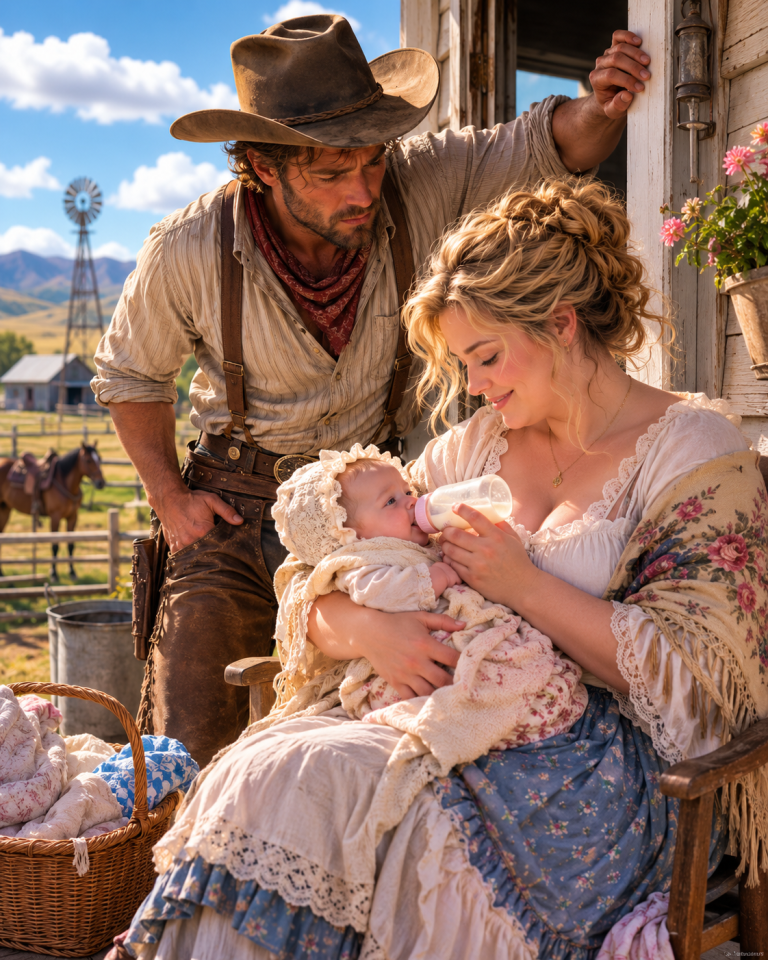
Catherine Hail was born on a cold October morning after fourteen hours of labor, small and red-faced and, in her father’s careful first words to her, welcomed to the mess. She grew loud, opinionated, and completely uninterested in being told what to do — which suited both her parents just fine.
Years later, on a warm summer evening, Everett and Lydia stood on the porch and watched their daughter chase chickens across the yard, laughing every time they scattered and immediately trying again.
“You ever think about how we got here?” Lydia asked.
“Sometimes. It started with fear. With running. With desperation.”
“It did. But it became something else. Something better than either of us planned.”
Everett had placed an advertisement wanting simple — no complications, no history, no one who’d ask questions or demand too much. He’d gotten Lydia instead: complicated, demanding, full of questions, trailing danger behind her like tin cans on a rope. Best mistake he ever made.
Lydia had answered that advertisement wanting only distance, a place to hide from a father who’d never once seen her as anything but leverage. She’d found instead a home she’d chosen, a partner who let her be exactly and difficultly herself, and a daughter she intended to raise knowing she was never, ever property.
“She’s going to be a handful,” Lydia said, watching Catherine let a chicken go the moment it pecked her, then chase it right back down.
“She already is.”
“Good. Let her be difficult. Let her ask questions and make demands and refuse to be simple. The world will try to make her smaller.”
“We won’t,” Everett said, and pulled her against him as the sun went down behind the mountains, painting the sky the color of something finally, fully earned.
THE END