He slapped his wife to defend his mistress — then discovered she owned the company behind his fortune

PART 1
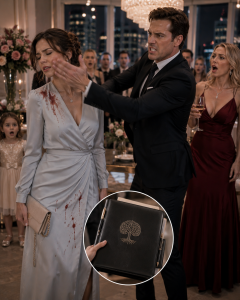
The slap landed before Serena Vale could explain. Her five-year-old daughter Lily froze beside the cake table in a white tulle dress, both hands pressed to her chest. “Mommy,” the child whispered. Serena did not fall. She did not scream. She set one hand on the edge of the table, steadied herself, and lifted her eyes.
Across from her, Chloe Bennett stood in a ruined white couture gown, red punch spreading across the skirt like a theatrical wound. Her lips trembled. Her eyes were wet but watchful. “I am so sorry,” Chloe said, voice breaking beautifully. “I never wanted this to become a scene.” It was already a scene.
It was Lily’s birthday party at the Plaza Meridian Hotel, and Serena had spent three days planning it because Julian had promised, for once, to be present. Julian’s jaw was tight. He wore a dark navy suit, the kind that made him look calm even when his eyes were cruel. “Apologize,” he said. Serena slowly lowered the napkin. “For what?”
Thirty minutes earlier, Chloe had entered the children’s craft lounge wearing that white gown as though a five-year-old’s birthday were a red carpet, bent toward Lily with a smile too bright to be kind, and asked whether the child wanted to help carry a tray of drinks. Serena had been across the room with the event manager. When she turned back, Lily stood near Chloe with shaking hands, red punch splashed across the gown. Chloe cried instantly. Julian arrived at exactly the right moment. Too right.
“Lily did not do it on purpose,” Serena said. “So you admit she did it.” “I admit she was standing near Chloe when it happened.” Julian’s laugh was short and ugly. “You always speak like a lawyer when you know you are guilty.” Lily burst into tears. “I didn’t mean to. Miss Chloe moved the tray. I tried to catch it.” Chloe covered her mouth. “Sweetheart, you do not have to lie for your mother.” The child’s face crumpled.
Something cold moved through Serena. “Check the hotel footage.” Julian’s eyes narrowed. “Do not make this worse.” “There are cameras in the craft lounge corridor. There are servers. There were other parents nearby.” “Enough.” “No. Not enough. You hit me before asking one question.”
A murmur passed through the room. Julian noticed it, and though his public image mattered to him more than truth, his pride mattered more than caution. He stepped closer, lowering his voice in a way that still carried. “You have embarrassed me for the last time.” Serena felt the sting in her cheek pulse with each heartbeat. She saw Lily trembling beside the cake, saw Chloe’s fingers press delicately into the stained silk, saw Julian’s attention flick toward the photographer who had stopped shooting but hadn’t lowered the camera.
For six years, Serena had protected Julian’s rooms — smiled through his corrections, softened his coldness into charm, hosted his investors, stayed quiet when he described her as “not interested in business,” let people believe she was only the beautiful wife of a rising CEO because she thought love didn’t need to win every room. Tonight he had slapped her in their daughter’s birthday ballroom. And he had done it for a woman wearing a dress bought with money from a company whose entire future depended on Serena’s signature.
Serena bent down and lifted Lily into her arms. The child clung to her neck, sobbing into her shoulder. Julian’s mouth tightened. “Where do you think you are going?” “Away from this room.” “Not until you apologize.” Serena looked at him over Lily’s shaking back, her cheek red, her lip bleeding, her voice quiet enough that guests had to lean in to hear it. “Remember this slap, Julian.” His expression flickered. “Next week, when you stand onstage and ask investors to trust your judgment, remember that this is the judgment you chose.”
Then Serena turned and walked out of the ballroom, carrying her daughter past the ruined cake, past the silent guests, past hotel staff who stepped aside without being told. At the door, she stopped only once — not to look back, but to tell the event manager, “Preserve every camera angle from the craft lounge, the corridor, and this ballroom. No one deletes anything.” He blinked. “Mrs. Vance?” Serena looked at him. “My name is Serena Vale.”
PART 2
Julian believed his wife had nowhere to go. It was there in the way he corrected her in public, made decisions about Lily’s schooling without asking, described Serena’s family as “old money with old grudges.” He was wrong about many things, but that one would be the most expensive.
Serena left through the service elevator, Lily hiccupping herself toward exhausted sleep against her shoulder, one small ballet flat missing. The event manager, a pale man named Owen, followed at a respectful distance. “Ms. Vale, I’ve instructed security to preserve the footage.” “Send the preservation confirmation to Margaret Sloan.” Owen’s face changed — everyone in Manhattan hospitality with sense knew that name, counsel to the Vale Trust. Serena noticed the shift in his posture, the moment he stopped seeing a slapped wife and started seeing a woman connected to an old family office that owned more quiet pieces of the city than most people could name. She hated that the difference mattered. Tonight, she would use it.
A black sedan pulled up before she could call anyone. Margaret Sloan stepped out — sixty-one, silver-haired, built like a verdict, charcoal coat, no jewelry except a watch. Her eyes went to Lily, then to Serena’s face. “Who hit you?” “Julian.” “In front of witnesses?” “Yes.” “Cameras?” “Preserved.” “Good.” That was Margaret — outrage would come later, if useful. First came structure.
Inside the warm car, Margaret listened without interrupting as Serena recounted everything: the gown, the punch tray, Chloe’s tears, the slap, the demand for an apology, Lily’s terror. Only once did Margaret’s hand tighten around her bag handle. Then she opened a tablet. “The timing matters. Vance Enterprises begins its IPO roadshow in six days. Julian hosts the pre-IPO investor gala at the Meridian next Friday, and plans to announce the anchor investor then.” “He does not know who the anchor investor is,” Serena said. “No,” Margaret agreed. “He thinks the commitment comes from Northbridge Capital.” “Northbridge is only the front vehicle. The underlying commitment requires approval from the Vale Trust. Your approval.”
Serena closed her eyes. Her father had structured it that way before he died — not because he disliked Julian, though he had. Harrison Vale distrusted any man who needed his wife to shrink so he could feel tall. He hadn’t forbidden the marriage. He’d simply made sure her inheritance and voting power could never be touched by it. At the time, Serena had resented him for that. Now she felt the old ache of gratitude. “Has the final subscription agreement been signed?” “No. Julian’s team expects signature after the gala. They believe public confidence will pressure the final approval.” Serena almost smiled. Julian had always loved a stage. He thought applause could become leverage.
Margaret watched her. “What do you want to do?” For a few seconds, Serena said nothing. She looked at Lily, asleep now, one hand curled against her collarbone, a faint red mark on the child’s wrist where Julian had grabbed her too hard pulling her from the cake table. The anger that moved through Serena then was not loud. It clarified her.
“First, Lily sees Dr. Harlow tonight, privately. Second, Owen sends the footage to you and a forensic video consultant — clean chain of custody. Third, we review every payment Julian made to Chloe through Vance Enterprises.” Margaret’s eyes sharpened. “You suspect company funds?” “I suspect Julian mistakes his desire for business necessity.” “Fourth,” Serena said, looking back at the window, “do not stop the gala.” Margaret was quiet a moment. “You want him onstage.” “I want him where he chose to be.” “And Chloe?” Serena’s fingers tightened around the cold pack against her cheek.
“She wanted an audience for my humiliation. She can have one for the truth.”
PART 3
What Serena didn’t yet know that night was how far back the lie went. Five years earlier, Julian’s car had struck a guardrail during a storm on the West Side Highway, his door pinned, smoke filling the cabin. Chloe — then a twenty-four-year-old event assistant — later gave tearful interviews claiming she’d dragged him from the wreck, holding up a silver pendant she said had fallen from her own neck during the rescue. The pendant wasn’t hers. Serena had been following Julian’s car after an argument that night; she was the one who kicked off her heels and climbed through broken glass to pull him free, the one whose shoulder took a burning strip of upholstery, whose pendant chain snapped as she rolled down the embankment with his weight against her. She’d passed out before the ambulance came. Chloe found the pendant by the road and understood opportunity when it glittered. When Serena tried to explain, Julian laughed — believing her would have meant seeing the woman in his house as more than convenient. “You are jealous of a woman who saved my life,” he told her. She never mentioned it again. That silence became one of the marriage’s hidden graves, and over the years Julian turned Chloe into a sacred debt — consulting contracts, apartments, jewelry, access to events where Serena was told to remain graceful.
At Margaret’s private clinic, Dr. Harlow found no fracture, no concussion in Lily — only bruising, shock, and a fear that didn’t show on X-rays. “Miss Chloe asked me to bring punch,” Lily told them, unprompted. “She said Mommy was busy and I was a big girl. Then she moved her dress in front of the tray. I tried to stop it. Daddy yelled. He hit Mommy.” Later, Margaret handed Serena a tablet with the preserved footage. It was clear: Chloe checking the corridor, calling Lily over, guiding the child’s hands to the tray, then stepping directly into its path and hooking one finger under the edge. Almost graceful. She’d also messaged the front desk to notify her the moment Julian entered the hotel — and messaged his chief of staff ten minutes before the incident. The machinery around Julian had helped prepare the scene. And the gown he’d accused Serena of ruining had been paid for through Vance Enterprises as a corporate image-consulting expense.
“We can send legal notice tonight,” Margaret said. “Not yet,” Serena told her. “You want the pattern, not the incident. One slap is a scandal. A pattern is a governance problem.” Margaret’s mouth curved. “Your father used to say that.” “Then he was right.”
Julian didn’t call until noon the next day — a husband who loved his wife would have called before sunrise; a father who understood what he’d done would have asked about his daughter. His message read: *You made a public scene at Lily’s party. We need to talk before this affects next week.* Not before this affects Lily. Before this affects next week.
Serena spent the morning at the Vale Trust office with Margaret, forensic accountant Elise Porter, and Northbridge’s managing partner Malcolm Reid, who had spent months praising Julian’s leadership while unknowingly negotiating with Serena’s trust vehicle. Elise’s preliminary report found red flags across Vance Enterprises’ discretionary budgets — Chloe paid through direct consulting fees, apartment reimbursement filed as client hospitality, wardrobe expenses filed as executive branding. “If the CEO is using company resources for an undisclosed intimate partner while presenting clean governance to public investors, underwriters will care,” Elise said. Margaret pulled the old accident records too: the first emergency call had come from Serena’s old phone, not Chloe’s; hospital intake noted smoke inhalation and a shoulder burn for an unidentified woman who left before registration; Chloe’s own treatment records showed only minor abrasions, no burn trauma. And a photo of a scorched silver pendant engraved *S V* — proof Chloe had used as her own for five years.
“This is not a marital issue,” Malcolm said slowly. “No,” Serena said. “It is a character issue attached to a public offering.” That sentence changed his posture — men like him could ignore a woman’s humiliation if they called it personal. They couldn’t ignore risk attached to a public offering. “What do you want Northbridge to do?” “Nothing yet. Continue preparing for the gala. Let Julian believe the roadshow remains intact. But we do not sign the subscription agreement. We prepare withdrawal language, a governance review request, and a clean path for Vance Enterprises to survive without Julian if the board chooses to remove him.” “You do not want to destroy the company.” “The employees did not slap me,” Serena said. “The engineers did not frame my daughter. Julian can meet the consequences of his own choices.”
For five days, Chloe acted like a woman who’d already won — no photos from the party, but enough hints in her private circle to seed gossip through three wealthy wives’ chat groups and a columnist who specialized in making cruelty sound like lifestyle reporting. Serena gave her silence — not helpless silence, working silence — while Margaret’s team built the file: chain-of-custody footage, traced payments, a former assistant confirming Chloe held a company card despite no formal role, staff tablet records proving she’d timed the spill. On Tuesday, Julian messaged again: *You owe Chloe a private apology before Friday. If you refuse, do not attend the gala.* Serena replied, for the first time: *I will attend.* “He still thinks the scene was mine,” she told Margaret. “That will make Friday easier.”
By Friday, a new place card sat at the principal table — arranged quietly through the hotel, whose management group carried loans placed through a bank where the Vale family held influence, and whose gala contract required accurate listing of controlling capital representatives. *Serena Vale, Controlling Approval, Vale Trust.* No one told Julian.
Serena arrived ten minutes after speeches began, in a simple black gown, the fading bruise on her cheek left uncovered. Julian was mid-speech — “Trust is the foundation of every great company” — when he saw her and stalled. Chloe sat at the principal table in a pale gold replacement gown, a diamond bracelet on her wrist; her smile froze the moment she recognized Serena walking the center aisle. Owen pulled out the chair beside the Northbridge placard, where the new card already sat. Julian’s face lost color. “Serena,” he said into the microphone, warmth stretched over panic. “I did not realize you were joining us tonight.” “Clearly.”
He stepped down, lowering his voice. “What are you doing?” “Listening.” “This is not your event.” “That is the problem.” He had no choice but to return to the stage and finish praising governance, disciplined capital, and Chloe for “standing by Vance Enterprises through difficult moments.” Then he announced Northbridge as cornerstone investor. The room applauded. Malcolm did not. Serena did not.
Malcolm rose before the next slide. “Before any investment announcement proceeds, Northbridge needs to clarify that no final subscription agreement has been executed.” The applause died in pieces. “Our commitment remains subject to final approval by the underlying capital authority.” Julian’s eyes found Serena — the first true understanding, not yet complete but beginning. Margaret stood. “The Vale Trust controls the approval rights behind the Northbridge commitment. Ms. Serena Vale is the controlling trustee.” Julian laughed once. “This is absurd. Serena has no involvement in Vance Enterprises.” “She does now,” Margaret said, “because your offering documents rely on a capital commitment that requires her signature.” The board chair’s face darkened. “Julian, did you know this?” He didn’t answer fast enough.
Chloe stood abruptly, her chair scraping. “This is about the birthday party. She is doing this because I was humiliated.” Serena turned to her. For five days Chloe had lived inside a story where she was the wounded woman; the costume no longer fit the room. Margaret gestured to Owen, and the screen changed — the craft lounge footage, silent, unmistakable. Chloe’s face drained of color. Then came the text messages, the invoice for the gown filed as executive branding, the consulting contract, the apartment reimbursement. “Preliminary review suggests company funds may have been used for personal benefits connected to an undisclosed intimate relationship,” Elise said, plain and clear. “This is a personal attack,” Julian said, gripping the podium. Serena stood. “A personal attack is slapping your wife in front of your daughter because another woman cried over a dress. This is a governance review.”
The board chair tried to pause the meeting. “No,” Serena said. “This meeting continues. Your CEO just announced a cornerstone investment that has not been approved. The room deserves correction.” Margaret placed the withholding notice on the table. Julian stepped down, voice low and dangerous. “Serena, you are destroying me over a slap.” She let him see the full coldness in her eyes. “No, Julian. The slap only made me stop protecting you.”
*
The gala became a board crisis within fifteen minutes — underwriters requesting private calls, Northbridge withdrawing its name from materials, independent directors demanding emergency counsel. Serena requested three things from the board: a formal independent investigation before the IPO could proceed, immediate suspension of any benefit connected to Chloe, and a leadership contingency plan protecting employees and legitimate investors. “You are not asking us to kill the offering outright?” counsel asked. “I am asking you not to sell public investors a company whose governance you have not examined.” Revenge would have been easy — she could have burned it all down by dawn. But she thought of the engineers, the accountants, the warehouse staff whose options depended on leaders they hadn’t chosen, and understood the difference between power and tantrum. At midnight, the board voted to delay the roadshow thirty days, suspend Julian from offering communications, and freeze Chloe’s contracts.
Chloe fled the hotel before dawn with two suitcases and a driver paid in cash. By afternoon, investigators tracing her Park Avenue apartment — leased through a Vance Enterprises subsidiary — found, among the garment bags, a small scorched silver pendant engraved with Serena’s initials. Serena’s hand went cold holding it in an evidence envelope; she had worn it the night she saved Julian’s life, and Chloe had built five years of borrowed heroism around its theft. The recovery connected Chloe not only to the birthday setup but to the original accident lie, corroborated by a retired paramedic’s sworn statement and a recovered cloud message Chloe had sent a friend days after the crash: *He thinks I pulled him out. I did not correct him.*
Cornered days later, Chloe made her own mistake — contacting Julian not to apologize, but to threaten him with recordings unless he kept paying her, referencing the old fire and how easily she’d fooled him. Julian, furious, forwarded the messages to his lawyer as proof of extortion; they reached the board, then investigators, then Margaret. He read them alone, then asked to see the accident file, the pendant photo, the paramedic statement. That night he called Serena’s phone four times. She didn’t answer. She forwarded the voicemail to Margaret, who summarized it in one sentence the next morning: “He knows.”
He came to the Vale Trust office two days later, uninvited, visibly shaken in a way his tailor couldn’t fix. “I saw the file,” he said. “The accident. The pendant. The dispatcher record. Why didn’t you make me listen?” “I tried,” Serena said. “Once.” “Once should have been enough for the truth.” She made him say the sentence himself: “I slapped my wife in front of my daughter because Chloe staged an accident with a dress purchased through company funds.” He offered to do whatever she wanted. “What I want,” she said, “is not for you to perform remorse because your offering is collapsing.” “I loved you.” “You loved the version of me that made your life easier. Why did you never ask why my shoulder hurt when it rained? Why did you believe Chloe’s tears faster than Lily’s voice?” He had no answer. Margaret slid a folder across the table. “All communication regarding the marriage, custody, and financial matters will proceed through counsel.” “Custody?” “You put your hands on me in front of Lily. You grabbed her hard enough to bruise her wrist. Yes. Custody.”
*
The board removed Julian from the CEO role before the month ended, calling it a leadership transition. Vance Enterprises did not collapse — the independent review found real governance failures, but also a viable business worth saving. Serena approved a revised path only with conditions: Julian removed from offering communications, Chloe’s expenses clawed back, board oversight strengthened, employee protections written into policy. “You took everything,” Julian’s one message read, through counsel. Serena did not reply.
That night, Serena took Lily to the old Vale house in Hudson Valley — a stone estate her father had loved for its privacy, not its grandeur, though Julian used to call it a castle whenever he wanted her to feel embarrassed by where she came from. Lily stopped beneath the portrait of Harrison Vale in the library. “Is that Grandpa?” “Yes.” “He looks serious.” “He was.” “Was he nice?” “Sometimes by accident.” “Did he like Daddy?” The question found a tender place. “He wanted me to be safe,” Serena said. “Daddy did not make you safe,” Lily said, with the clean cruelty only children manage. “No,” Serena agreed. “He did not.” “Are we safe now?” Serena looked out at the dark trees. Safety, she’d come to understand, wasn’t a place someone gave you — it was a practice, a lock, a lawyer, a boundary, a willingness to leave, a refusal to let love excuse harm. “We are becoming safe,” she said, and Lily accepted that.
The custody process moved slower than anger wanted, and Serena learned to respect it. Courts didn’t exist to deliver emotional symmetry — they needed records, evaluations, sworn statements, time. Lily’s therapist documented nightmares and confusion around apologies; Dr. Harlow provided medical notes; the Plaza Meridian submitted its preserved footage; the family center logged every supervised visit. At the second custody hearing, Serena wore gray and her mother’s pendant; Julian arrived thinner, carrying a folder of program attendance certificates, and didn’t approach her in the hallway — a restraint the evaluator noted, and Serena noticed too. Inside, the birthday footage was summarized rather than replayed in full, a mercy meant for Lily, not for him. The evaluator recommended continued supervised visitation and no overnight time until Lily’s therapist confirmed she felt secure; Julian’s attorney asked for faster expansion, and the judge declined. Serena felt relief and grief at once — relief that Lily remained protected, grief that a child’s relationship with her father now had to be measured in professional reports. Afterward, Julian stood near the elevator, hands at his sides, looking like a man who wanted to speak and knew he shouldn’t. Serena appreciated the second part more than the first. For years he’d demanded immediate access to every room of her life — her attention, her forgiveness, her silence after insults. Now a court order and his own shame had taught him to wait in a hallway. Not redemption. A beginning of consequence.
Chloe’s case ended in settlement and a narrow but serious plea — false statements tied to the accident claim, misuse of funds, obstruction — after her attorney’s negotiations met Margaret’s refusal to accept vague language. In court, Chloe admitted staging the incident but framed it as emotional pressure and confusion; not redemption, strategy, though it helped protect Lily by keeping the footage from being played in full. Afterward, in the courthouse hallway, the two women looked at each other without Julian between them for the first time — Chloe smaller than the woman who’d stood in white silk at Lily’s birthday, stripped of the borrowed power she’d worn like perfume. Serena felt an unexpected, colder sadness: not pity strong enough to erase accountability, just the recognition of how many lives could be damaged by the hunger to be chosen. Chloe took one step forward, then stopped, and let her attorney lead her away. Only Lily, Serena thought, had ever wanted something simple — a birthday where the adults behaved.
Julian entered mandatory parenting and anger-management programs, first as humiliation, later as the only path to seeing his daughter. Supervised visits began at a neutral family center. “Daddy cried,” Lily reported after the first one. “How did that make you feel?” “Sad. But I was still mad.” “You can be both.” “He said sorry.” “Do I have to say it’s okay?” Serena held her daughter’s hands. “No. An apology does not make you responsible for fixing the person who hurt you.” “Can I say maybe later?” “Yes.” Serena wrote the phrase in her journal that night and began using it for herself — with reporters, with old friends, with Julian’s letters. *Maybe later.* Healing did not have to perform on anyone else’s schedule.
Inside Vance Enterprises, the mood after the board’s decision was more complicated than the headlines suggested. Employees were frightened — some had joined for the logistics platform, some had stock options that suddenly felt fragile, some had seen Julian’s temper before and were privately relieved, others worried Serena would punish the whole company for its founder’s cruelty. She understood the fear; powerful families often spoke about principle while ordinary workers paid the bill, and she refused to repeat that pattern. Through the board, she requested an employee town hall, led by the interim CEO with outside counsel present, held not on a stage but at floor level in the company’s largest training room, under flat ceiling lights, engineers beside warehouse managers, finance staff along the wall holding paper cups of bad coffee. She kept her sentences short: the review would focus on executive conduct and use of company resources, not legitimate work; employees who cooperated would be protected; no one should alter, delete, or hide records for any executive, current or former. Short sentences were easier to believe.
Afterward, a young finance analyst waited near the door — barely twenty-five, tired-eyed, a folder clutched to her chest. She told Serena she’d flagged Chloe’s invoices six months earlier and been told by Julian’s chief of staff to stop being difficult. Serena didn’t ask why she’d stayed silent afterward; she already knew — rent, health insurance, student loans, the fear of being labeled dramatic, the fear of being right and still losing. The folder held emails and approval screenshots that weren’t enough to build the case alone, but strengthened the pattern considerably. Serena thanked her and made sure counsel recorded her name for whistleblower protection. That evening, alone in her father’s study, Serena found she was thinking about the analyst more than Julian. The slap had opened the door. But behind it sat a whole system of people trained to look away because one man’s pride paid their salaries — and for the first time she understood her return to power couldn’t be only personal. If she used the Vale Trust only to avenge herself, she’d stay trapped inside Julian’s story. If she used it to build cleaner rooms, she could finally leave him behind.
Three months after the gala, Serena returned to Wall Street as herself, hosting a private investment summit on ethical capital structures and governance before public offerings. She no longer arranged herself to make powerful men comfortable, and people noticed. She built a governance fund through the Vale Trust for whistleblower protection and family-controlled capital ethics — the same analyst’s folder still sitting, in spirit, behind every clause. Margaret’s only note on the first draft of the initiative read: *This is no longer about Julian.* Serena stared at it a long time, then smiled.
The revised financing closed in winter with no bell-ringing ceremony — just lawyers, restated controls, and an interim CEO who understood survival wasn’t the same as victory. Julian’s founder portrait came down from the lobby wall. Julian was not invited to the closing dinner; a business-press paragraph noted his separation from the company without photograph or quote, which for a man who’d lived on centrality was its own punishment. His final letter to her, unlike the others, didn’t ask to come home — it said he’d watched the birthday footage again in therapy, that Lily’s face after the slap would remain the worst memory of his life, that he understood now Serena’s silence had never been consent. She filed it under *Custody Correspondence.* Not marriage. Not apology.
*
Julian saw Serena one last time before the divorce finalized, in a mediation office with beige walls and no chandeliers, no investors, no cameras — just lawyers, water glasses, and the tired machinery of ending what should never have become so cruel. He had improved enough to be almost painful to look at, not because he deserved sympathy, but because he looked like a man who’d finally found the door to a room after setting the house on fire. He accepted every supervised custody term, every financial boundary, and gave up any claim that Serena had damaged him unlawfully by withholding investment approval. Near the end, he asked for five minutes to speak with her through counsel; Margaret advised against anything private, so Serena agreed to hear him with everyone present. He said he’d spent months trying to locate the exact moment he lost his family — first he thought it was the gala, then the birthday party, then the accident five years earlier. Now he believed it had happened in smaller moments long before any of those: every time he chose a flattering lie over an uncomfortable truth, every time he let her become smaller so he could feel larger, every time he called her calmness weakness. His words weren’t worthless. They were simply late. “I hope you never again doubt what you saw,” he told her, and that last sentence found its mark — because his greatest damage had never been the affair or even the public slap. It had been the slow erosion of her trust in her own perception, every concern turned into jealousy, every question into drama. She told him only one thing: Lily’s safety would matter more than his remorse. He nodded. No argument.
The divorce finalized two weeks later. Serena didn’t throw a party or burn photographs. She took Lily to the park, bought two cups of hot chocolate, and watched her climb a rope tower with careful determination while other parents talked about school forms, none of them knowing a marriage had legally ended that morning. Some freedoms didn’t need witnesses.
A year after the birthday party, Serena stood in the same hotel’s different ballroom — she’d requested that — at a charity gala for legal aid supporting women and children leaving unsafe homes, wearing her mother’s repaired pendant with one edge left deliberately, visibly scorched. “Not every scar needs to disappear to become beautiful,” she told Margaret. Lily, six now, tugged her hand and asked, with the clean logic only children have, “If someone spills juice, nobody gets yelled at?” “Nobody gets hurt for an accident,” Serena said, and meant it as a description of the whole life she’d rebuilt.
She spoke for two minutes that night about emergency legal filings and believing children when they describe what happened, and closed with the only line she needed: dignity isn’t restored by applause — it’s restored by choices that make safety real. She kept building doors for exactly the rooms her name could reach: a governance fund, a rapid-response legal clinic, a townhouse near Lily’s school with low shelves and a dining table built to survive spilled juice without anyone flinching.
The second anniversary of the party passed with no ceremony at all — Serena noticed the date only on a calendar reminder for the annual fundraiser, and realized it no longer belonged to Julian’s hand or Chloe’s dress. It belonged to everything built after. That evening, Lily spilled blue paint across the kitchen table making a school project, looked up guilty for half a breath, then remembered nothing bad happened here because of stains, and kept working. Serena handed her a cloth, took one for herself, and they cleaned the table together while dinner warmed on the stove.
The house was ordinary. It was safe. It was enough.
THE END