“Bring her home,” my husband sneered — then he found me marrying the man who destroyed his pride

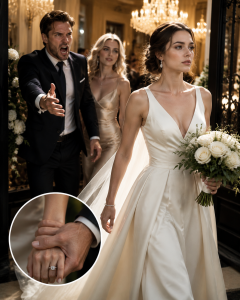
—
## PART 1
Celeste Ardan came home three months before her wedding to find a pair of cream satin heels sitting under the foyer bench. Half a size too large. Too shiny. Too eager to be seen.
Not hers.
Martin, the house manager, appeared in the hallway and went pale. “Miss Ardan,” he said, then corrected himself a beat too late. “Celeste. You’re back early.”
For two years he’d called her Miss Ardan with the warmth reserved for the woman everyone assumed would become Mrs. Osborne. Now he said her first name like a warning.
She didn’t ask questions. Questions were for people who still needed confirmation. She walked upstairs, her suitcase wheels clicking against each step like a countdown.
At the end of the hall, the master bedroom door stood slightly open. Laughter drifted through the gap — a woman’s voice, sweet and theatrical. *”Everett, do you like this one? Ivory looks expensive without trying too hard.”*
Celeste stopped at the crack in the door. Marabel Lane stood beside the bed in a silk slip, holding a nightgown against her body, auburn hair falling in deliberate waves. Her open suitcase spilled lingerie and perfume across the rug. A pale pink robe lay draped over the chair like a flag planted on conquered land.
Everett sat on the edge of the bed, sleeves rolled up, smiling at her.
That was what hurt first. Not the slip. Not the suitcase. The smile — the unguarded softness Celeste hadn’t seen on his face in months.
She looked at the room carefully, the way she read a risk report. New sheets. Their engagement photo gone from the nightstand. Her cashmere throw moved off the chair. The little jewelry tray she’d bought in Venice now held Marabel’s earrings.
He hadn’t merely betrayed her. He’d redecorated around it.
Celeste turned before either of them saw her and walked to the guest suite. Everything there was untouched — her spare clothes still hanging, her backup laptop in the drawer, an old business phone only three people knew about, charging behind a stack of books.
She locked the door, set the suitcase on the bed, and removed her engagement ring — five carats, emerald cut, photographed for society pages under a headline about old-money elegance. She placed it on the desk. The indentation on her finger looked more intimate than the diamond ever had.
People who didn’t know Celeste well assumed she was decorative, because she dressed like someone who understood presentation. Thirty years old, pale blonde, posture trained by ballet and boardrooms. What they missed was the decade she’d spent building her own wealth as a crisis strategist for private equity acquisitions — the person companies called when a deal looked clean in public and rotten underneath. She read risk reports the way surgeons read scans. She knew exactly which missing footnote could sink a nine-figure project.
Everett had known that once. Then he’d started treating her competence like a charming hobby — preferring the version of her who hosted dinners, wore diamonds, and made his reckless decisions look intentional after the fact. That version had just quietly died in the guest suite.
Her old phone buzzed. One message: *Julian Vale. The penthouse is ready. If you need it, the key’s with the concierge.*
Julian had been her rival in graduate school, her silent ally in three deals, and the only man who’d ever noticed what she left unsaid. He ran Veil Capital now — a firm Everett both envied and needed. Eight months earlier, over a work dinner that had run too long, he’d told her plainly that he intended to marry her one day, engagement or not, and that he wasn’t in a hurry — only in earnest. She’d told him just as plainly that she was already promised elsewhere, and he’d let the subject close without pressing it. It had stayed between them since, unspoken but not forgotten, the way a standing offer waits without needing to be repeated.
She typed, *I may need 24 hours.* His reply came in seconds: *Take the whole building if you want.*
A knock at the door. “Celeste.” Everett’s voice.
She glanced at the ring on the desk. “One second.”
She opened the door. Everett stood in the hallway, handsome in the way that got forgiven by people who valued symmetry over character. Behind him, Marabel hovered in a robe that wasn’t Celeste’s but looked entirely too at home in Celeste’s house.
“You came back early,” he said.
“I did.”
“Why didn’t you call?”
Her gaze slid past him to Marabel. “I didn’t realize appointments were required to enter my own home.”
“Celeste, this must look strange,” Marabel offered, delicate.
“No,” Celeste said. “It looks very clear.”
Everett rubbed the bridge of his nose. “Marabel’s going through a difficult time. She needed somewhere private. You were away — the room was lonely.”
“He’s right,” Celeste said, when Marabel touched his arm and murmured that she’d told him this was awkward but he’d insisted, said Celeste was *practical.*
He blinked. He’d prepared for tears, for a scene. Not for her calm.
“I have a project downtown,” she said. “I’ll stay there for a while.”
“What project?”
“A private one.”
“For how long?”
“Until it’s finished.”
Marabel smiled, gentle and already victorious. “Don’t worry about the house. I can help Everett with anything he needs.”
Celeste looked at the hallway — the art she’d chosen, the runner she’d restored, the sconces shipped from Paris. “How generous,” she said, and turned to leave.
Everett reached for her wrist. She moved before he touched her. “Celeste.” She stopped. For two seconds he looked close to saying something real. Something like *I’m sorry.* Something like *this isn’t what it looks like* — though even that would have been better than what came.
“Be careful on the road,” he said instead.
She nodded once. “I always am.”
—
## PART 2
At two in the morning, Celeste left the ring on the guest suite desk beside a printed note, and walked out through the garage with two suitcases, three hard drives, and the keys to a car she’d bought with her own money. The note said only: *You may keep the room, but not the woman who paid attention in it.*
By eight the next morning, Everett found it. By then, Celeste was sitting in the lobby of City Hall beside Julian Vale, a charcoal suit without a tie, black hair damp from rain, looking less polished than in board meetings and more dangerous because of it.
“You slept?” he asked.
“Four hours. Enough for legal paperwork.”
He held out a small velvet box. Inside were two plain platinum bands, each engraved with a single letter. *C. J.*
“You brought rings.”
“I assumed you’d refuse diamonds today.”
That almost broke her — not because it was romantic, though perhaps it was, but because it was accurate.
“You said eight months ago you weren’t in a hurry.”
“I wasn’t lying. I also wasn’t going to let the offer expire the morning you finally needed it.” He said it without triumph — a man collecting on patience, not on opportunity.
“This is not a rescue,” she said.
“I know.”
“I’m not marrying you because I need a roof.”
“I know. And if you ever move another woman into my bedroom, I’ll take more than the bedroom when I leave.”
His mouth curved. “That sounds fair.”
The clerk called their names. Celeste Ardan and Julian Vale married in a municipal room with beige walls and fluorescent lights, in front of a judge who’d seen enough impulsive weddings to know the difference between panic and decision. No flowers. No photographer. No seven-tier cake. Just the closing of a question that had already been answered months before either of them said it out loud.
Julian walked her to the car. “My attorney will send Everett formal notice by noon,” he said.
“Of the marriage?”
“Of several things.”
“Southport,” she said, “among other disasters.”
His expression stayed calm, but his eyes carried the controlled fury she recognized from hostile negotiations. “He moved another woman into your bedroom while using your analysis to keep his company upright. I’m not sentimental enough to ignore that.”
Her personal phone rang. Everett. She let it go twice, then answered.
“Where are you?” he demanded.
“Good morning to you too. Did you take off the ring?”
“Yes.”
“That ring cost four hundred thousand dollars.”
“Then keep it for Marabel. Her shoes already moved in.” Something shattered in the background. “Celeste, come home.”
“I am home.”
“Where?”
She looked at Julian, standing by the car in the rain, one hand on the open door, entirely unbothered by the storm. “With my husband.”
Silence. Then Everett laughed once, harsh and disbelieving. “Do not play games with me.”
“I’m not. I got married this morning.”
“To whom?”
Julian leaned toward the phone. “To me,” he said.
Everett stopped breathing. The line went dead.
—
## PART 3
For two days, Everett tore through the city looking for her — airlines, hotels, her assistant, his assistant, the florist for the canceled wedding, the jeweler. His messages moved from command to persuasion to disbelief. Celeste answered none of them.
She stayed in Julian’s Tribeca penthouse, floor-to-ceiling windows, dark wood floors, a kitchen already stocked with the exact tea she drank when she was furious. Her clothes arrived before noon — not purchased hastily, but chosen correctly, her size, her colors, her preferred designers. In the master bedroom sat a framed photograph: Celeste and Julian at a business school gala, four years earlier. She wasn’t posing. She was looking toward a window, holding champagne. He stood half a step behind her, speaking to someone off-camera, but his attention was on her.
She hadn’t known he’d kept it.
That afternoon, Julian’s chief analyst delivered a file titled *Osborne Group Exposure Map.* Celeste opened it on the sofa. Southport waterfront — Everett’s crown jewel, the luxury project he’d bragged about for months, using her market notes in his investor decks without credit. The file said something else entirely: soil instability, transit easements, pending municipal review, debt maturity stacked within nine months. A geological survey delivered to Everett’s office eleven weeks earlier — and never opened.
She remembered that day. March 12th, a Monday. Seven urgent folders in his signature tray. The survey was the third. At 1:40, Marabel called from a boutique, said she felt dizzy. Everett left after signing only the first two folders. That evening, Marabel posted nine photos — in the fifth, she stood by a fountain while his reflection appeared behind her in the glass.
Celeste had noticed then. She simply hadn’t decided what to do with it yet.
On the third day, an invitation arrived. *The Harrington Foundation Winter Gala. Everett Osborne, co-sponsor, guest Marabel Lane. Celeste Vale, guest of Julian Vale.*
“You arranged this,” she said.
Julian didn’t look up from his documents. “The gala happens every year. I arranged the guest list.”
“Why?”
“Because men like Everett only understand loss when it has an audience.”
“And me?”
“You only need to go if you want him to see what he failed to keep.”
She thought of the satin heels by the door, the slip, *be careful on the road,* Marabel calling it *the house.*
“I want him to see,” she said.
—
The night of the gala, Celeste wore black — not mourning black, not revenge black, something quieter and sharper, a column gown with a low back, her hair pinned to reveal the long line of her neck. Julian fastened a sapphire necklace around her throat before they left, the stone deep and dark, ringed with diamonds like captured ice.
“Too much?” she asked.
“For anyone else.” At the ballroom entrance, cameras swung to Julian, then to her. The murmurs moved fast — *wasn’t she engaged to Everett Osborne? Did they get married?*
Across the room, Everett’s champagne glass tilted, a drop spilling onto his cuff. Marabel, beside him in a silver gown too bridal for the room, followed his gaze and went rigid.
Celeste didn’t look away. Julian’s hand found the small of her back — not pushing, not claiming, just there.
Everett’s face moved through confusion, shock, possessiveness, rage, before he remembered he was being watched. Marabel recovered first, leaning close to smile at him, her eyes flat.
“That was faster than expected,” Julian murmured. “He hates being last to know.”
Through dinner, Celeste spoke to donors and investors while two women pretended not to stare at her ring. Julian introduced her as his wife without emphasis — the elegant cruelty of not needing to announce a victory when the fact alone was enough.
Everett came to the table without asking permission. “Celeste.”
Julian set down his glass. “Mr. Osborne, you’re interrupting my wife’s dinner.”
“This is between me and Celeste.”
“There is no you and Celeste.”
Marabel hurried over, smiling too brightly. “Congratulations,” she said. “I didn’t realize you found a replacement so quickly.”
Celeste dabbed her lips and stood. The table went quiet. “Replacement?”
Marabel lifted her chin. “If the word fits.”
Celeste smiled, small and dangerous. “The slippers you wore were mine. The sheets you slept in, the vanity you filled with your bottles, the art on the walls, the house manager who calls me by my first name because you frightened him into uncertainty — all mine. Even the man you’re clinging to is something I left behind.”
A soft ripple moved through the nearby tables. Marabel’s face flushed. “You arrogant—”
“Careful,” Julian said, without raising his voice.
“You married him to punish me,” Everett said.
“No. I left you to protect myself. I married him because he knew the difference. You were engaged to me three days ago, and entertaining a woman in my bedroom the same week.”
“She stayed because she had nowhere else to go,” Everett said.
“She had a suitcase, skincare, lingerie, and enough confidence to call my home hers. Don’t insult both of us by calling it charity.”
Everett glanced around, suddenly aware of the room. “Five minutes,” he said. “Outside.”
Julian stood. Celeste touched his sleeve. “I can handle five minutes.”
—
In the corridor, Everett rounded on her. “What the hell do you think you’re doing?”
“Attending a gala with my husband.”
He flinched at the word. “Do you understand what you’ve done? You made me look like a fool.”
“No, Everett. I stopped helping you look like a man worth marrying.”
His face went pale. “I made one mistake.”
“You moved her in. You changed the bedroom. You submitted a revised wedding vendor form with her name on it.”
He froze. “How do you know that?”
“Marabel posted a story from the bridal salon. You were reflected in the mirror, holding the folder. The planner confirmed the change after I canceled my payment authorization.”
“You canceled everything tied to my accounts.”
“The florist, the deposit, the quartet, the honeymoon suite — my money, my cancellations. That wedding was ours until you tried to put her name where mine was.”
He stepped back like she’d struck him. “Celeste,” he said, softer now. “Come home. We can fix this.”
“Which home? The one where she lives?”
“I’ll send her away.”
“How generous.”
“I mean it.”
“So did I. When I signed the marriage certificate.” He grabbed her wrist — not hard enough to bruise, hard enough to remind her who he thought still had claim. She looked down at his hand. “Remove it.”
He didn’t. Julian appeared at the end of the corridor and said one word. “Everett.”
Everett let go. Julian walked toward them slowly, calm, nothing gentle in it. “Touch my wife again,” he said, “and your company’s collapse will become the second-worst thing that happens to you this month.”
“What did you say?”
Julian handed him a black folder. “You should read faster than you sign.”
Everett opened it. His anger drained into confusion, then alarm. *Veil Capital — conditional acquisition offer. Southport waterfront debt exposure. New Jersey logistics center, controlling interest. Offer price: sixty-two cents on the dollar.*
“You’re trying to buy my project.”
“I’m offering oxygen to a drowning company at a price that reflects how long it’s been underwater,” Julian said. “Go to hell eventually. But not before your board meeting tomorrow.”
Everett turned to Celeste. “You gave him this.”
“You gave me the data for two years. Every time you asked me to clean up your investor decks or rewrite your lender memos, pretending I was only making them sound nicer. I used my own work product. The disaster is still sitting unread in your office.”
“What disaster?” Julian’s expression sharpened. “You truly don’t know.”
The ballroom doors opened. Peter Osborne stepped out — Everett’s father, chairman of Osborne Group, the same blue eyes, less vanity, more survival.
“Everett,” he said. The corridor chilled.
“Dad.”
Peter held up a report. “Eleven weeks ago, the Metropolitan Transit Authority sent a geological and easement survey on Southport. It says the transit hub intersects our foundation zone. Why did I learn this from Julian Vale’s offer packet?”
“I never received that.”
“You did,” Celeste said, before Julian could answer. Every head turned. She kept her voice even. “March 12th. Seven folders in your signature tray. The survey was the third. You signed the first two, then Marabel called and you left for Fifth Avenue and never came back to the office. That Friday, I flagged the missing survey reference in your investor deck comments. You marked it resolved without opening the attachment.”
Silence. Peter looked at his son. “Is that true?”
No answer came. Marabel, who’d followed them out, stood pale near the doors, one hand at her throat.
Peter lowered the report. “The board meets at eight. Be there sober, silent, and ready to explain why your affair cost us two hundred million dollars.” He walked away.
Everett looked as if the floor had moved. Then he turned on Celeste. “You set this up.”
“No. I remembered it.”
“You ruined me.”
“I noticed you ruining yourself.” Julian stepped beside her. “We’re leaving.”
“Celeste—” His voice broke, finally, the tone he should have used in his own hallway before she left. The first real sound of fear.
“Too late,” she said. “Good night, Everett.”
—
By the next morning, Osborne Group’s board removed Everett as acting chief executive pending emergency restructuring. By noon, his father voted with the majority — and voted, too, to accept Veil Capital’s revised offer rather than gamble the company’s survival on a project no lender would touch. The debt facility and controlling interest in Southport closed to Veil Capital within the week, at the lowered price Julian had named in the corridor. By five, Marabel’s social media had gone private. By six, Everett was back in the townhouse that had looked grand when Celeste first moved in and looked absurd now that the woman who’d made it intelligent was gone.
The cream satin heels still sat under the bench, one tipped sideways, as if even the shoes had lost confidence.
“Where is she?” Everett asked Martin, who knew exactly which woman he meant. That was its own indictment.
“Miss Lane is upstairs, sir. Packing.”
In the master bedroom, Marabel stood over an open suitcase, phone at her ear, face red with panic. “I cannot post a statement. If I post anything, it looks like I knew.” She hung up when she saw him.
“You said she was overreacting,” Marabel said.
“That’s your concern? My name is everywhere. My company is bleeding because I left that report unread to come running when you called.”
“I didn’t force you to leave,” Marabel snapped. “I said I felt faint. You decided to come shopping.”
The truth belonged to both of them equally. He’d wanted to be needed by someone who performed helplessness beautifully. She’d wanted a man powerful enough to make another woman’s house feel like a prize. Neither had considered the prize was built on that woman’s intelligence.
“I’m not staying here while everyone calls me a liability,” Marabel said, zipping the case.
“With what money?” She froze. The card he’d given her ran through a discretionary account now under board review; her modeling contracts had slowed since she’d become publicly attached to scandal.
“You really thought I’d pay for everything forever,” he said.
“You thought Celeste would too,” she snapped back, and dragged the suitcase to the door. At the threshold she turned. “You know what the worst part is? She didn’t even fight me. She looked at me like I was furniture someone had put in the wrong room.” Then she left.
The engagement ring still sat in its velvet box on the nightstand, where he’d placed it after finding Celeste’s note, as if returning it to a proper place could undo the fact she’d removed it. He picked it up. Four hundred thousand dollars. Five carats. Perfect clarity. Completely useless. He threw it across the room; it struck the wall and fell into the carpet without making nearly enough sound.
—
Celeste heard about each development from Julian’s study, barefoot on the couch in one of his shirts, reviewing the updated debt stack — a spreadsheet, not romance, open across her lap.
“Peter accepted a meeting,” Julian said, by the window.
“Of course he did.”
“Marabel left the townhouse.”
“Already,” Celeste said. “Apparently the house felt hostile.”
“It was never hers.” His mouth curved faintly. “Do you want it back?”
She thought of the bedroom, the shoes by the door, Everett’s smile. “No.”
“Good. I hated that house.”
“You visited twice.”
“Enough.”
They worked in silence for a while — strangely peaceful. No performance. No man insisting he loved her while resenting the way she saw. That evening he set a cup of tea beside her. “Caramel.”
“How do you know?”
“You drank it after the Winslow deal collapsed. You said peppermint was for people pretending to be calm.”
She wrapped her hands around the mug. “Why did you wait?”
“For you.”
“That’s not an answer.”
“Because you were engaged.”
“That stopped you? It should stop everyone.”
The answer was so simple it hurt. Everett had treated an engagement like an obstacle to manage. Julian had treated it like a boundary.
“I’m not ready to be a love story,” she said.
“Then be a person in my house,” he said. “The rest can earn itself.”
In the weeks that followed, he kept that promise in ways too quiet for gossip to notice. No parading her through restaurants to prove possession. No photographers. A second desk appeared in the study, across from the window where morning light fell cleanest. Her tea moved into the cabinet at eye level. One Tuesday she came home from a hostile lender meeting to find him in the kitchen with flour on one sleeve and a recipe open on his phone.
“What happened?”
“I attempted pasta.”
“Attempted?”
“The verb is intentional.” On the counter sat a bowl of dough with the texture of wet cement. She laughed until she had to lean against the island — the first time in days she’d gone that long without feeling watched for emotional evidence. That was how safety began: not with fireworks, with the absence of strategy in another person’s kindness.
He wasn’t without edges. A week after the gala, she found him quietly instructing his general counsel to draft a non-disparagement clause aimed at Marabel, as though a legal document could out-argue gossip. “You can’t leverage her into silence,” Celeste told him, sliding the draft back across the table. “That’s the same move Everett would make, just better funded.” Julian looked at the page a long moment, then at her, and didn’t defend it. “You’re right,” he said, and told his counsel to shelve it. It cost him something to admit — she could see that — but he did it without making her ask twice, which was, she was starting to learn, the closest thing to an apology he offered.
One evening she found a sealed envelope on her desk — a revised post-nuptial agreement, drafted by his attorney. No traps. Her premarital assets stayed hers, her future earnings stayed hers, any joint property required both signatures. A short note was attached: *You should never have to trust me because the paperwork leaves you no choice.*
She read it three times, then walked into the library. “You’re either the most romantic man alive,” she said, holding it up, “or the least.”
“Both, hopefully. Most men would find this insulting.”
“Most men overestimate how much trust they deserve.”
Everett had wanted trust as tribute. Julian offered structure so trust would never have to be blind. “Thank you,” she said. He nodded once, as if she’d thanked him for passing the salt.
—
Two months later they held a reception, not a wedding — the legal marriage was already done, and Celeste refused to perform bridal innocence after everything that had happened. Julian’s family estate in the Hudson Valley filled with investors and people whose invitations had rearranged entire social circles’ assumptions.
She wore ivory, a simple silk gown with an open back, no veil. On her wrist sat a jade bracelet Julian had bought at auction after overhearing her mention her grandmother’s lost heirloom exactly once.
Before the reception, his mother, Beatrice Vale — silver-haired, elegant, terrifying in the way of women who’d survived old money and kept the furniture — found her near the library.
“You look like yourself,” Beatrice said.
“Is that approval?”
“It’s better.” She adjusted Celeste’s sleeve. “Julian kept a photograph of you on his desk for four years. I told him once, if he admired you that much, he should say something. He said you belonged to yourself first and to another man second, and he had no interest in stealing what hadn’t chosen him.” She looked toward the windows, where Julian stood, ears faintly red, as if he knew his mother was betraying him. “My son is many things. A fool in love, occasionally. A thief, never.”
Then the gates called. A security guard spoke to the estate manager, who looked at Julian, who looked at Celeste. She already knew.
Everett appeared at the end of the gravel drive — thinner, unshaven, holding an envelope, nothing left of the man who once commanded ballrooms with a glance. Security stopped him near the fountain. Celeste walked out alone; Julian followed at a distance, close enough to intervene, far enough to let her decide.
“You weren’t invited,” she said.
“I know. I bought it back.” He held out the envelope. “Southport. The stake, the debt. I sold the Newport house, the Aspen place, everything, and paid Veil Capital three times the offer to unwind the acquisition. I fixed it.”
“You think that was the problem?”
“I—” He swallowed. “I know I hurt you.”
“You humiliated me in my own home. You replaced me before I left.”
“I was confused.”
“You ignored a report that nearly destroyed your company because your mistress wanted attention. And now you’re standing at my husband’s gate with a cashier’s check, like I’m another distressed asset you can repurchase.”
His face crumpled. “I love you.”
The words arrived and landed nowhere. Once they would have destroyed her. Now they were only words from a man who understood value after loss, not love before damage.
“Do you know the difference between you and Julian?” she asked. He looked past her toward the house, something between hatred and exhaustion crossing his face. “He has more money,” he said.
“No. When you found me in pain, you told me to be careful on the road. When Julian found me leaving, he told me I already had a home. You gave me a warning. He gave me shelter.”
The wind moved through the trees, lifting the hem of her gown. Everett dropped to his knees on the gravel, the envelope crushed in his hands. “Please. Just give me one chance to prove I understand.”
She looked down at him and felt something clean and sad — not longing, not weakness. Sadness for the life she’d almost entered, the years she might have spent mistaking endurance for devotion.
“Not everyone who leaves is waiting to be followed,” she said, and turned back toward the house.
Julian met her halfway. He didn’t ask if she was all right — he knew she wasn’t fragile, and knew *all right* was too simple a question. He held out his hand. She took it.
—
During dinner, Julian stood to speak, his hand tightening once around his glass before he began. “Celeste once told me the most dangerous mistake in business is confusing possession with value. Some people do it with love, too — they think because something is near them, it belongs to them. She’s taught me it’s the other way around. Love is knowing when to stand beside someone without blocking the door.”
The room quieted. Celeste looked down at the jade bracelet on her wrist and said nothing, which was its own kind of answer.
Later, after the guests had gone and the estate had fallen silent, she stood on the balcony over the dark garden. Julian came out with two cups of tea.
“No champagne?” she asked.
“You barely drank yours. You noticed.”
“I do that.”
She took the tea. Somewhere beyond the trees, the road curved into darkness — somewhere out there, Everett would eventually stop kneeling and go home to what was left of his company. She felt no urge to look back.
“Do you regret marrying me so quickly?” she asked.
He leaned beside her on the railing. “No. You should at least pretend to think about it.”
“I did. For four years.” She turned her face away, smiling despite herself.
In another life she might have married Everett and spent years translating his neglect into excuses. Instead, life had given her a brutal gift: the truth early enough to escape. She had simply left, and in leaving learned the thing Everett never understood — a woman’s silence isn’t always heartbreak. Sometimes it’s the sound of a door closing so softly the man on the other side doesn’t realize he’s lost the whole house until the lights go out.
**THE END.**