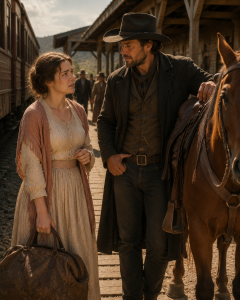
A MAIL-ORDER BRIDE WAS ABANDONED IN A BLIZZARD MILES FROM HER GROOM — THEN SHE LEARNED WHAT KIND OF MAN WAS WAITING FOR HER

—
PART 1
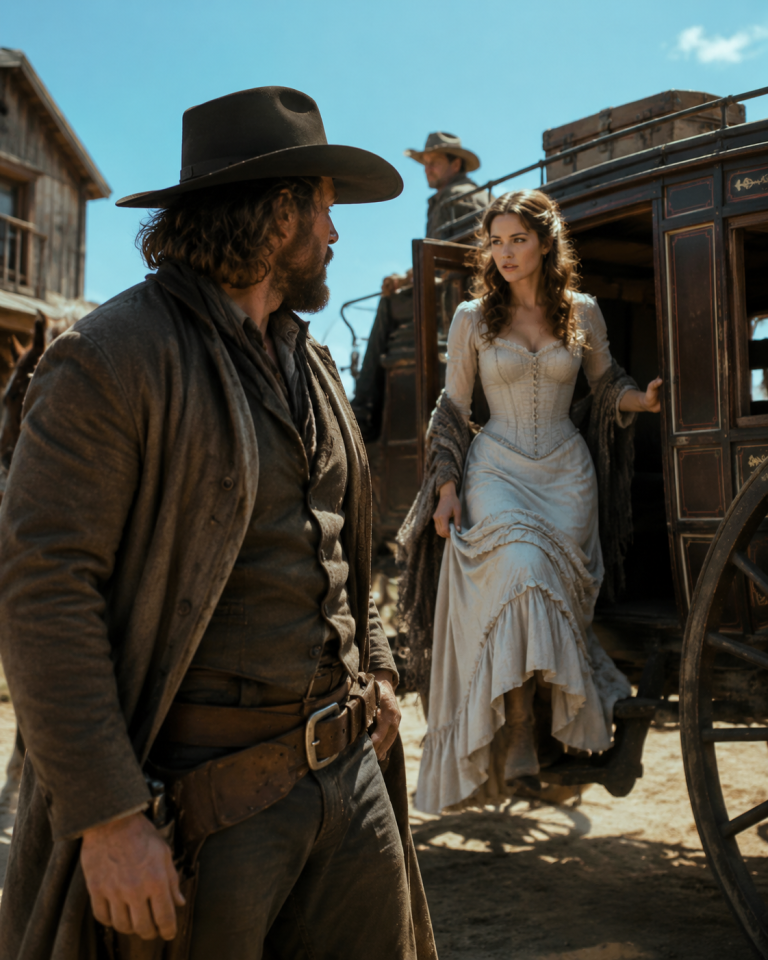
The stagecoach hit another rut, and Clara Bennett’s head slammed against the wooden wall hard enough to blur her vision.
She’d stopped trying to brace herself hours ago. Her hands were too cold to grip anything properly, and exhaustion had settled into her bones like an infection.
“How much farther?” she called through the panel separating her from the driver.
No answer. Just the howl of wind and the labored breathing of horses being pushed too hard through a storm that should have grounded them two days ago.
She pressed her face to the gap in the leather curtain. Nothing but white. The world had disappeared into snow so thick she couldn’t see the horses pulling the coach.
*Samuel Whitmore. Landowner, age 42, seeking companion for ranch in Helena Valley.*
She’d memorized every word of his letter. Three pages describing a prosperous cattle operation, a comfortable house, a life far from her aunt’s tenement, where she’d been worked like a servant since her parents died when she was fourteen. It wasn’t a love match. But it was a future that belonged to her.
The coach lurched, then stopped completely.
Boots crunched through snow. The door jerked open, and a blast of freezing air hit her like a fist. Hutchkins, the driver, stood there, ice crusted in his beard.
“End of the line.”
“What?”
“Horses are done. Storm’s getting worse. There’s a settlement half a mile that way.” He jerked his thumb over his shoulder. “Wait it out there.”
“You’re leaving me *here*?”
“Got no choice.” He hauled her trunk out into the snow. “Move, or I leave your things too.”
Clara scrambled after him, boots sinking to her knees, wind trying to knock her sideways. “Wait — how do I—”
“Follow the road. Marker’s a quarter mile. Turn north. You’ll see lights.”
He snapped the reins before she could answer. Within seconds, the coach had vanished into the white.
Clara stood alone, staring at the empty space where her future had just driven away.
**
The trunk was too heavy to drag through drifts this deep. With shaking fingers, she opened it and made her choices fast — two dresses, left behind; books, left behind; the photograph of her parents, shoved inside her coat; the money Samuel had sent, sewn into her bodice, torn free and stuffed in her pocket alongside his letter — proof of who she was and where she was supposed to be.
Then she closed the trunk on everything else and started walking.
She lost feeling in her feet after ten minutes. After twenty, she couldn’t tell if she was still on the road.
When the first building materialized out of the snow — a trading post, light glowing in its windows — she stumbled toward it like a moth and pounded on the door with fists she could barely feel.
A big, bearded man answered, shotgun raised. “We’re closed.”
“Please — I’ll freeze—”
“Not my problem.”
“I have money. I can pay.”
That got his attention. He looked at the bills in her trembling hand, then at her face, and stepped back to let her in.
“Name’s Garrett,” he said, setting the shotgun aside. “This is my trading post. Where were you headed?”
“Helena.”
“Helena’s sixty miles southeast of here. Whatever fool was driving that coach dumped you way off course.”
Sixty miles.
“We’ve been cut off since December,” Garrett went on. “Mining company blew the south bridge trying to keep competitors out. Territorial government hasn’t bothered fixing it. You want Helena, you’re either walking through the mountains, or waiting till spring.”
“I can’t wait until spring. I’m supposed to marry a man who’s never met me, and if I don’t show up, I have nothing.”
Garrett’s wife emerged from the back room — small, dark-haired, wary. “Who’s this?”
“Says she’s got money.”
“How much?”
“Enough,” Clara said, meeting the woman’s eyes. She’d dealt with hostile landlords her whole life. She knew how this worked. “I can pay three dollars a week.”
“Three?” Margaret laughed, sharp. Then, after a look passed between her and Garrett: “Five. You get a corner of the storage room, one meal a day, and access to the stove. Understood?”
It was highway robbery. Clara had no leverage. “Understood.”
**
Three days later, the storm still hadn’t broken. Clara had made herself useful sweeping floors and organizing shelves, anything to justify her presence. On the fourth morning, she found Margaret mending a shirt in the back room.
“I need work,” Clara said. “My money’s running out.”
Margaret studied her. “You really a mail-order bride?”
“Supposed to be.”
“Girl, you got dumped in the worst possible place at the worst possible time.” She sketched a crude map. “There’s a woman up the valley runs a boarding house — Ruth Callaway. Needs help with her books.” She paused, pulling out a small knife in a leather sheath and pressing it into Clara’s hand. “Keep it hidden, keep it close. And when you talk to Ruth — don’t mention you’re trying to marry Sam Whitmore. There’s history there. None of it good.”
Clara’s stomach turned cold. “What kind of history?”
Margaret only shook her head and turned back to her mending.
—
PART 2
Ruth Callaway’s boarding house was two stories of peeling paint and a leaning porch post, but smoke rose from the chimney and curtains hung in the windows — signs of life that felt almost welcoming.
Clara proved herself with the ledgers in under an hour — nine years managing her aunt’s accounts, three businesses, two rental properties. Ruth hired her on the spot. Room and board, no wage yet.
Then Clara made the mistake Margaret had warned her against.
“I was supposed to marry a man in Helena,” she admitted. “Samuel Whitmore.”
Something dark flickered across Ruth’s face. “Sam Whitmore.” Her voice went flat. “He owned this boarding house once. Sold it to my husband for twice what it was worth, then made sure the bank gave us terrible terms. Tried to take it back when we couldn’t keep up.” She set down her mending. “You know what happened to his first wife? Died in childbirth. Second one ran off with a surveyor after six months. Word is he made her life so miserable she’d rather risk the wilderness than spend another day under his roof.”
Clara’s mouth went dry. “I don’t know if I want to marry him anymore.”
“Well, you’ve got time to figure it out.”
She had more than time. Bloodstone Valley, it turned out, was under siege in a much larger sense.
The mining company — Blackthorn — had spent months systematically pushing families off their land. Burned barns. Poisoned wells. A sheriff on their payroll who called every act of arson a “chimney fire.” Two weeks after Clara’s arrival, the first ranch burned — the Morrisons, a family of six, who arrived at Ruth’s door in their nightclothes having refused to sell.
At the center of the resistance stood a rancher named Cole Mercer — hard-eyed, methodical, a man who’d lost his wife and daughter to raiders five years back and had never let anyone close since. He organized the valley’s families into documenting every threat, every burned barn, every act of violence, building a case to send to the territorial governor.
Clara, with her ledgers and her patient, exacting hand, became the one who turned scattered testimony into an airtight brief. Fifty pages. Names, dates, witness statements.
“You’re thorough,” Cole told her, reading it over.
“I learned that if you’re going to accuse someone powerful, you’d better have perfect records.”
He decided to ride the documents north through the mountains himself — a two-week journey through unmapped wilderness in February, the only way to reach the territorial capital before the roads blocked by Blackthorn’s sabotage could be cleared.
“That’s suicide,” Clara said.
“Sitting here waiting for them to burn us out one family at a time is definitely suicide.”
He left at dawn three days later, the documents sealed in a waterproof case, duplicates hidden along the route in case he didn’t make it.
Five days after that, Clara heard horses in the street — a dozen riders, and in the middle of them, a man in an expensive suit.
Victor Hail.
“I understand,” he said, stepping into Ruth’s parlor with the casual confidence of a man who owned the room, “you’ve been harboring some interesting documents.”
Two of his men had already kicked in the door. His men tore the boarding house apart and found all three copies.
“We caught Mr. Mercer trying to cross Devil’s Pass three days ago,” Hail said, watching Clara’s face carefully. “He’s currently enjoying our hospitality. Unharmed. For now.”
He handed the documents to one of his men.
“Burn these.”
—
PART 3
“You have twenty-four hours,” Hail said, tipping his hat to Ruth as if this had been a pleasant social call, “to convince everyone in this valley to cooperate. After that, people start getting hurt.”
Then he was gone, taking the ashes of a month’s work with him.
The boarding house dissolved into chaos — the Morrison children crying, Mrs. Morrison having what looked like a panic attack, Clara sitting frozen in a chair with her arm throbbing where a guard had wrenched it.
“We have to get him out,” she said, the moment the shaking would let her speak.
“Clara, they have twenty armed men at the mine headquarters,” Ruth said. “What are we supposed to do — storm the place?”
“They’re expecting us to roll over. That’s their whole strategy. Terrorize people until they’re too scared to fight back.” Clara stood, ignoring the pain in her shoulder. “If we rescue Cole, and get new documents to the governor, we prove it doesn’t work.”
“You’ve changed since you got here.”
“I had to.” Something hard and cold had settled in Clara’s chest. “I spent my whole life keeping my head down because I thought that’s how you survive. Out here, it just makes you an easier target.”
**
The plan came together over twelve hours around Ruth’s kitchen table, drawn from a hand-sketched map and whatever courage six farmers, a bookkeeper, and one determined young man named Thomas could scrape together.
“You’re talking about attacking a fortified position with six farmers and a bookkeeper,” Patterson said.
“I’m talking about getting one man out before Hail makes good on his threat.” Clara kept her voice level. “If anyone has a better idea, I’m listening.”
Nobody did.
Ruth knew a root cellar with an exterior door on the mine headquarters’ north side — a way in that didn’t involve a frontal assault. Clara would go, because she knew what Cole looked like and was small enough to fit through spaces the others couldn’t. Thomas would go with her. Ruth would set a diversion in town. The rest would hold a perimeter in the trees.
“You don’t have to do this,” Ruth told her that night.
“Yes, I do.”
“Why?”
“Because I’m more afraid of being the person who could have helped and chose not to.”
**
At midnight, an explosion lit the southern sky — Ruth’s diversion, right on time. Clara and Thomas slipped through the root cellar door, picked a latch with Margaret’s knife, and found a hallway of offices. The third door had a padlock and no window.
“Cole,” Clara whispered against the wood.
A pause. Then, rough with disuse: “Clara.”
Relief flooded through her so hard she nearly dropped the lantern. “We’re getting you out.”
“Storage shed,” he said. “Third building. They keep keys on a hook. Clara — there are at least six men upstairs. You need to leave before they realize you’re here.”
“Not without you.”
Thomas came back with the keys just as gunfire erupted outside — not the distant diversion, but close, right outside the building.
“They know,” Thomas said.
They found Cole against the far wall, bruised, blood dried on one side of his face, a rib that clearly wasn’t just “maybe” cracked. They half-carried him through the service exit into a yard full of Hail’s men.
“Drop your weapons,” Patterson shouted from the treeline, rifles raised.
Someone fired. The world exploded into noise.
“Run!” Patterson shouted, laying down cover.
Clara hauled Cole toward the trees, lungs burning, his weight doubling with every step, bullets splintering wood around them. They ran until the gunfire faded behind them, replaced by shouting — and the baying of dogs.
They found a frozen stream and walked the ice single file to lose the scent, then hid behind a rock outcropping while Hail’s men searched.
“They went north,” a voice said, close enough to make Clara’s blood freeze. “That’s where Mercer’s ranch is.”
“Then let’s go get him,” Hail’s voice, cold and precise. “And this time, we make sure everyone knows what happens to people who interfere with my business.”
**
They couldn’t go to Cole’s ranch now — it was exactly where Hail was headed. Thomas’s family homestead, ten miles on, became the only option. By the time they reached it, dawn was breaking gray over the mountains, and Cole was barely conscious.
Jack Hayes took one look and stood aside. “Bring him in.”
Over the next hours, the Hayes family mobilized with the quiet efficiency of people who’d survived on the frontier for generations — sons posted as lookouts, ammunition inventoried, windows reinforced.
“We just declared war on the most powerful man in the territory,” Jack said. “War doesn’t end until one side surrenders or dies. I don’t plan on surrendering.”
Cole, bandaged and pale by the fire, refused to stay still. “We need to finish what we started. Recreate the documents. Someone has to make the ride north.”
“You can barely move,” Clara said.
“I know. But you can. You know what was in those documents better than anyone.” His voice was urgent. “Clara — every day Hail consolidates power, it gets harder to stop him.”
Thomas volunteered to go with her. His mother, Emma, met the announcement with a look Clara recognized — fear wrapped in pride.
“The hell you will,” she said. Then, after a long, painful silence: “Then you take care of her. And you come back alive.”
**
Clara spent the evening reconstructing fifty pages from memory, her hand cramping. Around midnight, the youngest Hayes boy came running.
“Riders approaching. At least twenty.”
They stopped a hundred yards out, just visible in moonlight. Then Hail’s voice, carried on some kind of trumpet through the freezing air.
“Cole Mercer. You come out now, alone, and I’ll leave everyone else in peace. You have one hour. After that, we burn this place to the ground.”
“Don’t even think about it,” Clara said.
“He’ll kill innocent people if I don’t.”
“He’ll kill them anyway,” Jack said flatly. “Men like Hail don’t make deals in good faith.”
Cole made his decision in the space of a breath. “You and Thomas leave now, out the back. There’s a trail north. Stay off the main routes. In one hour, when you’re clear, we fight back — buy you time to run.”
“We’re not leaving you to die.”
“None of this means anything if those documents don’t reach the governor.” He gripped her shoulders, pain crossing his face at the movement. “Go save this valley.”
Clara wanted to argue. The look in his eyes told her he’d already decided. “Deal,” she said instead. “Now go save this valley.”
He pulled her into a brief, fierce embrace that made his ribs scream, and didn’t cut it short. “Now go.”
**
At fifty-five minutes, Clara and Thomas slipped into the trees. Half a mile in, they heard the first gunshots — not scattered, but sustained.
Clara’s steps faltered.
“Keep moving,” Thomas said quietly. “That’s what they’re buying with those bullets.”
She kept moving because stopping meant Cole’s sacrifice was for nothing. She kept moving because the girl who’d stepped off that stagecoach, scared and alone, didn’t exist anymore.
**
The mountains nearly killed them on the third day. A storm came out of nowhere — wind, then a wall of white that erased the world. They found shallow shelter in a rock face and huddled with the horses through the worst of it, waking to fresh tracks outside — a mountain lion, close and recent.
They pushed on. At ranch after ranch, families listened to their story with sympathy and fear in equal measure, but only two out of fifteen agreed to sign new testimony.
“We could go back,” Thomas said on the ninth night, watching Clara stare at the pathetically thin stack of papers. “Tell Cole we tried.”
“One more day,” Clara said. “We push on one more day.”
The next morning brought smoke on the horizon — a logging camp, thirty men clearing timber. The foreman, a massive Swede named Larsson, spat at the mention of Blackthorn.
“They tried to sabotage our sawmill last year. We caught two of their men and held them until they confessed. After that, they left us alone.” He looked at his crew. “Anyone object to signing testimony against Hail?”
Nobody did. By nightfall, Clara had statements from forty-three men across seven logging operations. The stack had gone from pathetic to substantial.
**
They reached Fort Benson four days later with a young logger named Eric guiding them through the pass. Clara walked into the territorial governor’s office and set the documents on the secretary’s desk.
“This is evidence of systematic criminal activity,” she said. “Arson, extortion, assault, conspiracy to defraud settlers of their legal property. I have testimony from over sixty witnesses.”
Governor Harrison read through the pages himself, his expression shifting from skepticism to something like alarm.
“And you’re certain of these accusations?”
“Everything in those documents is true. I’ll swear to it in court if necessary.”
“That may not be necessary.” He handed the papers to his secretary. “Make copies. Secure the originals. Send word to the federal marshal’s office. I’m requesting an immediate investigation.”
“An investigation takes time,” Clara said. “Those people don’t have time.”
Harrison studied her for a long moment. “I could deputize a force and send them directly. That’s essentially declaring martial law — I’d need strong justification.”
“You have sixty-three witness statements and physical evidence of fraud. How much stronger do you need?”
Something that might have been respect crossed his face. “You’re persistent. All right. Twenty deputies leave at dawn.”
**
Clara collapsed into sixteen hours of sleep and woke to waiting that felt like cowardice. On the fourth day, a telegram arrived.
“Deputy Marshal Carr reached Bloodstone Valley,” Harrison read. “The situation was worse than your documents indicated. Multiple structures burned. At least a dozen confirmed dead.” He paused. “However — a resistance force led by Cole Mercer and Jack Hayes held key positions and prevented total collapse. Mercer was injured, but mobile.”
*Cole’s alive.*
“Marshal Carr arrested Victor Hail and seventeen associates,” Harrison continued. “They’re being held pending trial.” He looked up. “He specifically mentioned that Cole Mercer wants to know if Miss Bennett made it here safely.”
Something warm and painful expanded in Clara’s chest.
**
The trial, six weeks later, took place in a courthouse that smelled of old wood and nervous sweat. Clara testified for three hours, walking the prosecutor through documents, dates, incidents.
“Isn’t it possible,” Hail’s lawyer pressed, “you manufactured a crisis to make yourself important?”
“I arrived with eighteen dollars and a job offer,” Clara said, meeting his eyes without flinching. “What I found was a systematic campaign of terror against innocent families. I didn’t manufacture anything. I just wrote down what people told me they’d experienced. If documenting those crimes makes me important, then yes, I suppose I’m important. But mostly it just makes me someone who was paying attention.”
The jury returned guilty on eighteen counts. Twenty years, territorial prison.
Clara felt no triumph. Just a tired kind of relief. Justice wouldn’t bring back the thirteen dead, or undo what the valley had survived.
**
She found Cole on Ruth’s porch when she finally made it back to Bloodstone, his arm still in a sling.
“You’re alive,” he said quietly.
“So are you.”
“You made it to the governor?”
“He sent marshals. They arrested Hail.” She sank into the chair beside him. “It’s over. We won.”
“We survived,” Cole corrected. “Not sure I’d call it winning.” Thirteen graves on the hill outside town didn’t feel like victory to either of them. It felt like survival, bought with blood.
The territorial secretary offered Clara a real position — salary, security, a chance to help oversee rebuilding funds from the capital. Everything she’d wanted when she left Boston.
She turned it down.
“This valley needs rebuilding,” she told Cole. “Someone needs to make sure relief funds get distributed fairly, that families get help. Ruth can’t do it alone.”
“That’s not a real job. No salary, no security.”
“I know.” She smiled slightly. “But it’s important work. Turns out I’m better at important work than I ever was at safe work.”
Cole studied her face for a long moment. “You’ve changed since you got off that stagecoach.”
“I had to. The person I was wouldn’t have survived here.” She pulled her coat tighter. “Turns out I like the person I’ve become better anyway.”
“She’s more than useful,” Cole said quietly. “She’s remarkable.”
**
He invited her to dinner at his ranch the next evening — “not quite a romantic overture,” Clara told herself, and didn’t believe it for a second. His house surprised her: neat, well-kept, books lining one wall, a fireplace, everything maintained with the kind of care that spoke of a man honoring something rather than abandoning it.
After dinner, he walked her out to a cleared section of land, stakes and string outlining a foundation in the fading light.
“A school,” he said. “The valley needs educated children if it’s going to survive.” He turned to face her. “We’re rebuilding better than before. Smarter. Together. I want you to be part of that.” A pause. “I’m asking if you’d consider staying. Permanently. Making this your home.” Another pause, quieter. “Making it *our* home. If you’re willing.”
Clara’s heart hammered against her ribs. “Cole — are you asking me to marry you?”
“Eventually. Maybe. If you want.” He looked almost embarrassed. “Right now, I’m just asking if you’ll stay.”
“That sounds perfect,” Clara said, and meant it completely. “I didn’t leave Boston looking for comfort. I left looking for a place where I mattered. I found that here. And I found you.”
She reached up and touched the rough scar tissue along his jaw. Cole kissed her then — careful and tentative at first, deeper when she kissed him back. No orchestra swell, no poetic declaration. Just two people who’d survived hell together, choosing to build something better in its aftermath.
**
They married eight months later in Ruth’s boarding house, half the valley in attendance. Clara wore a dress she’d sewn herself. Cole wore his best suit and looked terrified until she took his hand, at which point he relaxed like a man finally coming home.
“You did good, girl,” Ruth told her that night, watching the crowded room. “A year ago, this valley was dying. Now look at us.” She squeezed Clara’s shoulder. “You were the spark that started the fire. Don’t diminish that.”
Life in Bloodstone was never easy. But it grew. The school was built the spring after the wedding, and Clara taught there three days a week. Cole’s horse-breeding operation thrived. Together they turned the ranch into a gathering place — the kind where neighbors came for advice, where travelers found welcome, where people in trouble knew they’d find help.
Three years after the wedding, their daughter Sarah was born. Two more children followed — James, quiet and intense like his father; Anna, fearless from the moment she could walk. Clara taught them all to read, to think critically, to question authority when authority was wrong. Cole taught them to ride, to respect the land, to judge people by their actions.
Victor Hail died in prison six years into his sentence. Clara felt nothing. He had already taken enough from the valley; she refused to give him more space in her thoughts.
On Clara’s fortieth birthday, Cole led her to the schoolhouse and showed her a new plaque beside the door: *Bennett School — founded by Clara Bennett Mercer in recognition of her dedication to education and community service.*
“It’s not enough,” Cole said. “You’ve taught over a hundred children in this building. The school exists because you insisted it should.”
“Our name,” Clara corrected. “You built this with lumber and money. I built it with stubbornness.”
“There’s a difference,” he agreed, and kissed her temple. “I’m proud of you.”
“I’m proud of *us,*” Clara said, watching their children play in the schoolyard. “Of what we built together. None of it’s what I expected. All of it’s exactly what I needed.”
**
Cole lived into his seventies, still working the ranch he’d rebuilt more than once. He never fully escaped the shadow of the family he’d lost, but Clara’s presence, and their children’s lives, helped him carry the weight. He died peacefully in his sleep, and Clara sat with him a long time before telling anyone — saying goodbye to the man who’d taught her that strength wasn’t about never being broken, but about building something new from the pieces.
Clara herself lived to eighty-two, teaching at the school that bore her name until the year before her death. At her funeral, her daughter Sarah — by then a doctor who’d returned to serve the valley that raised her — stood before the crowd that had gathered from across the territory.
“My mother used to say she got off at the wrong stop,” Sarah said. “But I don’t think there are wrong stops. Just places where we’re tested to see who we really are. This valley tested my mother, and she passed. Then she spent the rest of her life making sure others could pass, too. That’s the legacy she left us. Not just buildings and institutions — the example of what one person can do when they refuse to accept injustice as inevitable.”
Clara Bennett had stepped off a stagecoach with nothing but eighteen dollars and a letter from a stranger. She hadn’t planned any of it — the trading post, the boarding house, the mountains, the trial, the ranch, the school, the man she’d risked everything to save and spent a lifetime building a world beside.
She’d just kept moving forward, making the best choice she could, refusing to quit when quitting would have been easier.
And in the end, that was everything.
THE END