SIX GRIEVING CHILDREN, A DYING RANCH, AND A STRANGER WHO ANSWERED A WIDOWER’S LETTER — THE TOWN SAID SHE WOULDN’T LAST THREE WEEKS

 —
—
## Part One
The train lurched to a stop with a screech of metal that set teeth on edge.
Eliza Vance had been holding the same rigid position for three hours — back straight, hands folded over her carpet bag, eyes fixed on nothing. The other passengers had stopped trying to make conversation somewhere around the second day. She had that look about her. The kind that said she didn’t want company, didn’t need sympathy, and wasn’t interested in small talk about weather.
Through the window, Blackthorn Ridge materialized out of coal smoke like something from a half-remembered nightmare. A muddy main street. Buildings that looked thrown together by men with better things to do. Beyond that, nothing but mountains and sky and the kind of emptiness that made a person feel very small.
Eliza stepped off the train into late-autumn cold that cut straight through her coat.
For one long moment, she considered getting back on. Riding away from this godforsaken town that looked barely hanging on to existence. It wouldn’t be home — home didn’t exist anymore. But it would be *away*.
Instead, she thought about the letter folded in her coat pocket, creased and reread until the paper had gone soft.
*From Caleb Mercer. Cattle rancher. Widower. Father of six.*
It hadn’t promised love or comfort. Just survival. Just a chance at something that wasn’t the charity of distant relatives who’d made it clear she’d overstayed her welcome.
She picked up her bag and started walking.
“You the mail order bride?”
The voice came from behind her, flat and unimpressed. A woman — maybe forty, maybe sixty, hard to tell with frontier women who’d spent too many years squinting into sun and wind — looked her over with the kind of assessment usually reserved for livestock.
“I’m Eliza Vance,” she said. “I’m expected at the Mercer ranch.”
“That what they’re calling it these days.” The woman shifted her basket. “You look like a strong wind could carry you off. Ranch life ain’t easy for women built for parlor sitting.”
“I’ll manage.”
“Sure you will.” The woman’s smile didn’t reach her eyes. “Just like the last one managed.” She walked away, leaving Eliza standing alone with a sick feeling in her stomach.
*The last one.* The letter hadn’t mentioned a last one.
**
Not ten feet further on, a big, easy-smiling man in a good coat tipped his hat to her before she’d even registered him approaching.
“Ma’am. You look like you just stepped off the train and straight into Margaret Whitmore’s opinions. Don’t take it to heart — she’s got them about everybody.” He grinned, friendly as a shopkeeper. “Dorian Pike. I do a little of everything around here — cattle, feed, whatever needs doing. You’d be Mercer’s new arrangement, I take it.”
“Eliza Vance.”
“Well, Mrs. Vance, if you ever need anything and the town’s being the town, you come find me. I sold Caleb his winter feed just last week, matter of fact — good and cheap, seeing as I was overstocked. Man’s got six mouths to worry after besides his own. Somebody’s got to look out for him.” He touched his hat again. “Welcome to Blackthorn Ridge. It’s not much, but it grows on you.”
He walked off whistling, and Eliza found herself almost grateful for the one friendly face in a town that seemed determined not to have any.
**
The wagon appeared minutes later, pulled by two horses as worn out as everything else in this place. The man driving wasn’t what she’d expected. Caleb Mercer was big, weathered, sharp-angled, all sun damage and the permanent squint of someone who’d spent a lifetime staring into distances. He climbed down with the slow, deliberate movements of a man who’d learned not to waste energy on unnecessary speed.
“Mrs. Vance.”
“Mr. Mercer.”
They stood there a moment, two strangers measuring each other in the middle of a dying frontier town.
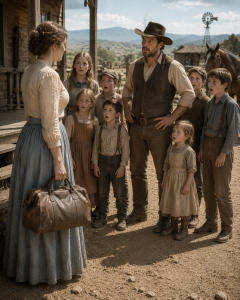
“Kids are at the ranch,” he said as they finally started moving. “All six of them. Mara’s the oldest, seventeen — runs the house better than I do, and’ll tell you so herself. Thomas is fifteen, steady as they come, more comfortable with the horses than with people. Ben’s thirteen and never met a rule he didn’t want to test the edges of. Daniel’s eleven, quiet, always got his nose in whatever book he can find, which around here isn’t many. Then the little ones. Annie’s five, talks enough for all of them put together. Samuel just turned three. Barely says a word most days, but he watches everything.”
“They know I’m coming?”
“They know.” His jaw worked like he was chewing on words he didn’t want to say. “They’ll adjust.”
Which wasn’t an answer at all.
**
The ranch appeared gradually — fencing sagging where it wasn’t missing entirely, the barn listing to one side, weeds growing where they shouldn’t. The whole place had the look of something slowly falling apart while everyone pretended not to notice.
The front door opened before the wagon fully stopped, and six children spilled out onto the porch in a knot of curiosity and suspicion. Mara stood in front — tall, dark-haired, an expression that could freeze water. Thomas hung back near the fence post like he’d rather be with the horses. Ben had already sized up the wagon wheels and was eyeing them for some purpose of his own. Daniel stood half a step behind the others with a battered book still in one hand, finger marking his place. Annie and Samuel peeked out from behind their siblings’ legs.
“This is Mrs. Vance,” Caleb said. “She’ll be staying.”
“Ma’am.” The word from Mara was correct and cold and absolutely hostile.
Annie tugged Mara’s skirt and whispered something. Mara straightened. “Annie wants to know if you’re going to be our new mother.”
The question landed like a stone in still water. Eliza saw Caleb tense beside her. Saw little Samuel’s lip start to tremble. This was a test — maybe not a fair one, but a test nonetheless.
“No,” Eliza said quietly. “I’m not going to be your new mother. You already had a mother, and nobody can replace her. I’m just going to be here to help your father take care of things. That’s all.”
Something flickered in Mara’s expression. Not quite approval. But maybe a fraction less hostility.
“We can take care of ourselves,” the girl said.
“I’m sure you can.” Eliza picked up her bag. “But maybe you could show me where to put my things anyway. And then perhaps you could tell me where the kitchen is. It’s been a long journey, and I expect everyone could use some supper.”
For a moment, Mara just stared. Then she turned and walked back into the house.
Eliza followed her upstairs to a small room at the end of the hall.
“This was the sewing room,” Mara said flatly. “Pa moved a bed in here.”
Then, in the doorway, she stopped. “The last woman only stayed three weeks. She cried every night. We could hear her through the walls. Then one morning she was just gone. Left a note saying she couldn’t do it.”
Eliza set her bag down on the narrow bed. “I’m not going to cry, Mara.”
“Everyone cries eventually.”
“Maybe. But not because this place is hard. Hard I can handle. I’ve handled worse.”
“You don’t look like you’ve handled worse.”
“No,” Eliza agreed. “I probably don’t.”
They stood there, two women sizing each other up across the small room — Mara so young, but with something ancient in her eyes. The look of someone forced to grow up too fast.
That night, after the household had gone quiet, Eliza lit a lantern and pulled out her sewing kit instead of sleeping. The children’s winter coats were falling apart at the seams, and there was work to do — work that couldn’t wait for tomorrow, work that couldn’t wait for her to feel ready.
By the time the first gray light of dawn crept through her window, she’d reinforced three coats and started on a fourth. Her eyes burned. Her fingers ached. She was exhausted in a way that went bone deep.
And she had never felt more certain that she was exactly where she needed to be.
Because Eliza Vance had learned something in the years since her own life fell apart. Survival wasn’t about being the strongest or the toughest. It was about getting up every morning and doing the next necessary thing, even when everything in you screamed to stop.
She had no idea yet that within a month, a blizzard would nearly kill her on a supply run. That the friendly man who’d tipped his hat to her on the platform would nearly cost her everything she’d come to love. That the barn would go up in flames with a horse and her stepson still trapped inside.
Or that by spring, this house full of strangers would be the only thing standing between her and the person she used to be.
—
## Part Two
The truce with Mara held for exactly four days before the fever hit.
It started with Daniel setting his book down mid-sentence, which was how Eliza first knew something was wrong — the boy hadn’t put a book down voluntarily since she’d arrived. Then came the cough. Then Ben, usually first out the door for any mischief going, stayed in bed past sunrise without argument, which frightened Mara more than the fever itself. Then Annie. Then Samuel. Within two days, four of the six children were sick with what looked like the beginning of a serious respiratory infection, and Eliza recognized the signs immediately because she’d nursed her late husband through something similar right before he died.
“He won’t come,” Mara said flatly, when Caleb wanted to ride for the town doctor. “Not for us. Not after what happened with Mrs. Whitmore.”
She was right. Which meant it fell to Eliza.
She worked with a grim determination that left no room for fear — steam treatments, poultices, careful monitoring through nights when every breath the children took sounded like it might be their last. Thomas, well himself, took over the horses and the chores without being asked, working until he swayed on his feet, because it was the only thing he knew how to give. Daniel, once his fever broke enough to sit up, read aloud to Annie and Samuel in a thin, determined voice, insisting stories would help them feel better, and refusing to stop even when his own voice cracked with exhaustion.
The worst came exactly one week in, when little Samuel’s fever spiked dangerously high and his breathing turned ragged and irregular. Eliza sat beside his bed for twelve straight hours.
“Is he going to die?” Caleb asked from the doorway, his voice raw.
“Not if I can help it.”
“That’s not an answer.”
“It’s the only answer I have.”
Near three in the morning, Samuel’s fever finally broke. By the end of the second week, all four children were recovering — weak, still coughing, but clearly on the mend. Eliza had barely slept in fourteen days. She’d lost weight she couldn’t afford to lose.
But something fundamental had shifted in the Mercer household. The children stopped seeing her as an outsider and started seeing her as someone who’d fought to keep them alive when everything else had failed. Mara stopped guarding her mother’s memory quite so fiercely. Ben, of all of them, started trailing after Eliza with a new kind of watchfulness, as if testing whether the change in her was real. And Caleb stopped viewing their arrangement as purely practical.
“The children love you now,” he told her one night in the kitchen, watching her knead bread dough with hands still shaking from exhaustion. “You know that, right?”
“They’re grateful. That’s different.”
“No. They love you.” He paused. “I’m trying to say thank you for coming here. For staying when the town turned on you. For saving my children’s lives. For being exactly what we needed when we needed it most.”
She kept working the dough, using the rhythm to steady herself. “You’re welcome.”
“That’s it? Just you’re welcome?”
“What else do you want me to say?”
“I don’t know. Maybe that you’re glad you came. That you don’t regret answering my letter.”
She stopped then, turned to face him fully. “I don’t regret it. Even with everything that’s happened — even with the town treating us like we’re diseased, even with nearly dying in a blizzard and nursing four sick children for two weeks straight — I don’t regret coming here.”
“Why not?”
“Because for the first time in two years, I feel like I’m doing something that matters. Like I’m building something real instead of just surviving day to day.”
Caleb nodded slowly. “Good,” he said. “Because we’re not even halfway through winter yet, and if this is any indication, it’s going to be a hell of a season.”
He had no idea how right he was.
Three days before Christmas, a young heifer collapsed near the fence line, eyes glazed, foam at her mouth. By the time Caleb and Thomas rode back to examine her properly, two more were showing the same symptoms.
And when Eliza walked the fence line studying the sick animals — the excessive salivation, the muscle tremors, the wild look of pain and confusion — she felt something cold settle in her stomach.
“That’s not natural illness,” she said. “That’s contamination.”
“You’re saying the feed is poisoned?” Caleb asked. “That’s Pike’s feed. Man’s practically a friend of this ranch — sold it to us cheap when he didn’t have to.”
“Friend or not,” Eliza said, “something’s wrong with what’s in that trough.”
She had no way of knowing yet that Dorian Pike had been quietly poisoning half the valley for profit, hiding behind exactly the kind of easy friendliness that made people slow to suspect him — that proving it would nearly cost her life in a burning barn, or that before the snow melted, she would stand in a saloon full of hostile men and force an entire town to confront a truth it had spent years pretending not to see.
—
## Part Three
The town women arrived on a gray Thursday morning, four days after the truce between Eliza and Mara had begun to feel almost real.
Margaret Whitmore led them — the same woman from the train platform who considered herself the unofficial authority on how things should be done in Blackthorn Ridge. She swept into the kitchen Eliza had spent two weeks organizing, took the best chair without asking, and began pulling condescension out of her basket along with the jars of apple butter.
“We heard you’ve been handling the livestock,” one of the women, Helen, said. “That’s really not appropriate work for a lady.”
“People talk, Mrs. Vance,” Margaret added. “A woman mucking about in barns, working like common labor. It reflects poorly on you, on the Mercer family, on all of us.”
Before Eliza could answer, Mara appeared in the doorway, having clearly been listening from the hall, her face flushed with anger.
“Don’t talk about my mother,” she said, when Margaret tried to invoke Elizabeth Mercer’s memory with false sympathy. “You didn’t come here to help. You came here to judge. I heard everything you said.”
“Young lady, you’re overwrought.”
“I said leave.”
The women gathered their things in offended silence. Margaret paused at the door to deliver one final shot. “You’ll regret this, Mara Mercer. Both of you. This town takes care of its own, but only when people know their place.”
When the wagon finally pulled away, Eliza and Mara stood in the kitchen listening to the silence it left behind.
“You didn’t have to do that,” Eliza said.
“Yes, I did.” Mara’s hands were still shaking. “This is our home. Yours now, too. And they don’t get to tell us how to run it.”
It was the first time Mara had defended her without being asked. It was also, Eliza understood later, the moment the town decided to make them pay for it.
**
The social exile began quietly and grew teeth. At the general store, the clerk served Eliza last, even when she’d arrived first. At the feed store, the owner made her wait in the cold, then informed her that her order would be delayed indefinitely — a delay that vanished the moment she announced she’d simply find another supplier two days’ ride away.
Caleb didn’t like it. “The weather’s getting unpredictable,” he warned. “Roads might be bad.”
“The weather’s going to get worse before it gets better,” Eliza said. “If we wait until spring, we won’t have the supplies we need to make it through winter.”
She left before dawn two days later with a wagon, two horses, and a list that would see them through the worst of the season. Crestston Falls, twice the size of Blackthorn Ridge and blessedly indifferent to its politics, sold her everything without judgment or delay.
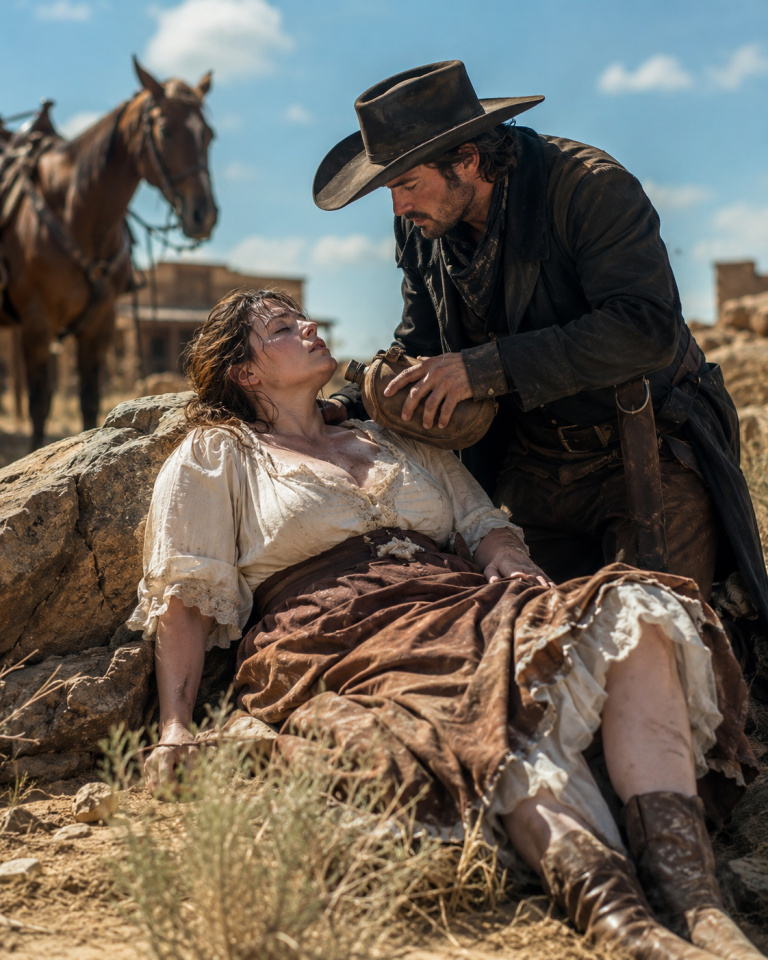
The storm caught her on the second day home. What started as light snow became a near whiteout within hours, the temperature dropping sharply, wind cutting through her coat like it wasn’t there. She should have stopped. Instead, she calculated the distance to home, remembered her promise to be back in four days, and pushed on.
The wagon wheel hit something hidden beneath the snow, and she heard the crack before she felt it tilt. The axle. Damaged badly enough that continuing risked destroying it entirely.
She was stranded, alone, in a blizzard, with darkness coming on fast and every ounce of the ranch’s winter supplies riding in the wagon bed behind her.
*Elizabeth wouldn’t have hesitated,* she thought. But Eliza wasn’t Elizabeth. She was just herself, cold and scared and increasingly certain she’d made a fatal mistake.
She was still standing there, paralyzed, when she heard hoofbeats over the wind.
“What the hell were you thinking?” Caleb shouted, pulling up beside the wagon with Thomas and Ben close behind, all three of them bundled against the storm. “Traveling in this?”
“The wheel broke. I can see that. We need to get you to shelter. Now.”
They dug the wagon out, staked a canvas over it against the wind, and got Eliza onto Caleb’s horse. The line shack they reached twenty minutes later was barely big enough for four people, but it had walls and a roof and a small stove, and by the time feeling started returning to Eliza’s fingers, Thomas and Ben had it burning properly.
“You could have died,” Eliza said. “All of you, coming out in this.”
“So could you.” Caleb poured coffee on the small stove and handed her a cup, plain as fact. “At least this way, if we die, we die together.”
It wasn’t romantic. It was stated so simply that it somehow meant more than poetry could have.
“I wanted to prove I could handle things,” Eliza admitted later, once the boys had fallen asleep near the stove. “That I didn’t need help from the town.”
“You don’t need to prove anything to those people.”
“I needed to prove it to myself.”
Caleb was quiet for a long moment. “You know what Elizabeth used to say? Strength wasn’t about never needing help. It was about knowing when to ask for it.” He glanced at her. “I’m glad you came, Eliza. Even with all the trouble it’s caused. I’m glad you answered that letter and got on that train and didn’t turn back when you saw what a mess this place was.”
“I almost did turn back about a dozen times.”
“But you didn’t.”
“No,” she agreed. “I didn’t.”
They dug the wagon out at dawn and made it home by sunset, five and a half days after she’d left. Mara stood on the porch pale with fear that turned to fury the moment she saw them safe.
“You could have died,” she said. “All of you. For what — supplies we could have gotten somewhere else?”
“There was nowhere else,” Eliza said quietly. “Not without giving in to people who wanted to see us fail. And I won’t do that.”
Mara’s anger deflated into something that looked like understanding. “You’re as stubborn as he is,” she said, jerking her head toward her father.
“Probably.”
“Well, then.” Mara came down from the porch and started unloading supplies. “At least that means you’ll fit in around here.”
**
The cattle started dying three days before Christmas. By the time Eliza walked the pen and identified the contamination pattern, they’d already lost three head, with seven more showing symptoms.
“Dorian Pike,” Caleb said, when she asked where the feed had come from. “One of the ranch hands. Works multiple properties. Good cattleman. Been around forever. Man practically welcomed you to town himself, didn’t he.”
“That’s not natural illness,” Eliza said, and something in her went still, remembering the easy smile on the platform. “Sudden onset, rapid progression, affects the nervous system. That’s contamination. Whether it’s intentional or accidental, I don’t know. But we need to stop using it immediately.”
“If we stop using that feed, we’ll run short before spring.”
“And if we keep using it, you won’t have any cattle left to feed.”
It was brutal logic, but it was true. They spent the day isolating animals, moved the healthy herd to a different pasture entirely, and that evening Caleb announced he was riding into town to confront Pike.
“I’m coming with you,” Eliza said immediately.
“This could get ugly.”
“Then you definitely need a witness.”
They found Pike holding court at the saloon, a big man running to fat but still carrying enough muscle to be dangerous, his eyes holding a calculating intelligence Eliza distrusted now with the clarity of hindsight.
“Seven of my cattle are sick,” Caleb said. “Three more dead. All of them ate from that feed.”
“My feed is fine,” Pike said, still wearing the same easy smile he’d given Eliza at the train platform, though it no longer reached his eyes the way it once had seemed to. “Maybe you should look at how you’re managing your herd instead of blaming other people.” His eyes slid to Eliza. “Or did your new wife convince you of that? Maybe she don’t know as much as she thinks she does. Funny — I thought we got on just fine, Mrs. Vance.”
Every eye in the saloon turned to Eliza — the weight of men deciding whether a woman had the right to speak on matters they considered their own territory.
She spoke anyway.
“The symptoms are acute poisoning. Sudden onset, neurological impact, rapid deterioration. That’s not poor management. That’s contamination. And if you sold that same feed to other ranches, they’re going to have the same problem within days.”
“Lady, I don’t know who you think you are—”
“I think I’m someone who can recognize poisoned livestock when I see it,” Eliza interrupted calmly. “And I think you’re someone who either knowingly sold contaminated feed or was too careless to check your supplies properly. Either way, you’re responsible.”
Caleb moved fast, grabbing Pike by the shirt and slamming him back against the wall hard enough to rattle bottles on the shelf. “Say that again,” he growled, when Pike sneered that Caleb had lost his mind letting an eastern woman run his ranch. “I dare you.”
It took Thomas, arriving in the doorway, to talk his father back down. But as they left, a weathered rancher named Walter Gaines followed them out into the cold.
“Name’s Walter Gaines,” he said. “I bought feed from Pike three weeks ago. Same supplier. If that feed is bad, I need to know now.”
Eliza described the symptoms in careful detail. Gaines listened with the intensity of a man who knew his business, and thanked her before heading back into town — the first crack in the wall of a place that had spent months treating her like an intruder.
**
They lost nineteen cattle in total that week. But word spread. Gaines found the same contamination in his own herd. Three other ranchers did the same. And slowly, a coalition of seven ranches began to form — men who’d all suffered losses they could barely afford, gathering in Walter Gaines’s dining room to decide what to do about Dorian Pike.
Eliza was the only woman present, and she felt every eye in the room sizing her up exactly the way the town women had, deciding whether she belonged.
“Mrs. Vance identified the contamination pattern,” Gaines said. “Maybe she can tell us what kind of evidence would hold up legally.”
She stood and told them what she knew — mycotoxin poisoning, the need for laboratory samples, the week’s travel to Denver it would take to get them tested. When an older rancher named Henderson grumbled about the cost and complained that it was easy for the Mercers to talk, with Mrs. Vance there to help manage things, Eliza didn’t back down.
“Then maybe you should focus less on comparing losses and more on solving the actual problem,” she said sharply. “Every hour we spend arguing is an hour Pike has to cover his tracks.”
The room went quiet. Then Gaines laughed. “She’s got a point, Henderson.”
They built a plan that night — sample collection, written statements, a trip to Denver for testing. Henderson, grudgingly, shook Eliza’s hand on his way out. “You’ve got sharp edges, Mrs. Vance,” he said. “Didn’t expect that.”
“Most people don’t.”
**
The plan held for exactly nine days.
Then Porter, the young rider they’d sent to Denver with the sealed feed samples, came back empty-handed and ashamed. Somewhere on the trail, his saddlebag had been cut open in the night — the samples gone, along with two days he couldn’t account for and a story about a stranger buying him drinks at a waystation that didn’t sit right with anyone who heard it.
Worse, Walter Gaines arrived at the ranch two mornings later, hat in his hands, refusing to meet Eliza’s eyes.
“I have to pull out,” he said. “Pike came to see me. Didn’t threaten me outright — nothing you could take to a judge. Just talked about how accidents happen to a man’s herd, his barn, his family, out here where help’s a long ride off. I’ve got four children, Mrs. Vance. I can’t risk it.”
“He’s telling you to be afraid of him,” Eliza said. “That’s not innocence. That’s a confession.”
“Maybe so. Doesn’t change what I’ve got to lose.”
Henderson pulled back the following week, quieter about it, but just as final. By the time the coalition met again, it was down to Caleb, one stubborn rancher named Poole, and an empty chair where Gaines used to sit.
“We have no samples, no witnesses willing to stand up, and a man who knows exactly how much fear is worth,” Caleb said that night, staring into the fire like it owed him an answer. “Maybe it ends here.”
“It doesn’t end here,” Eliza said. “It just means we do it harder. We collect new samples ourselves, and this time, we don’t send one man alone on a public trail. And we find something Pike can’t threaten away — something that isn’t a man’s word, but a fact.”
It was Thomas who found it, three days later, while checking the far fence line for storm damage: fresh wagon tracks running from Pike’s storage shed toward the Mercer feed store, tracks that matched a peculiar worn shoe on Pike’s own lead horse, the same horse Cooper the ranch hand had seen near their property the week of the fire. Small. Circumstantial. But it was a thread, and Eliza meant to pull it.
**
The barn caught just after midnight, twelve days later, and by the time Eliza’s eyes opened she already knew — some animal part of her recognized the smell of smoke before her waking mind had finished catching up.
She was down the stairs and out the door before she’d fully decided to move, the cold air a slap after the warmth of sleep, the sky above the barn roof already lit an ugly, flickering orange. Horses were screaming. That sound alone nearly buckled her knees.
“Thomas is still in there!” Ben was shouting, half-dressed, dragging at his father’s sleeve. “He went back for the mare — she wouldn’t come, he went back—”
Caleb was already running, but the heat coming off the barn doors was a wall, visible in the way it bent the cold night air. Flames had eaten through the near wall and were climbing the loft ladder, and somewhere past that wavering orange curtain, Eliza could hear Thomas coughing — a wet, panicked sound, closer to the back stalls than the door.
“Thomas!” Caleb’s voice cracked on the name.
“Get low!” Eliza screamed it before she’d thought it, dropping to a crouch of her own, remembering something her father had taught her a lifetime ago about smoke rising and air staying cleaner near the ground. She went in behind Caleb, not because he told her to stay back — he did, twice, in a voice she’d never heard him use — but because four hands moving a trapped boy and a terrified horse were better odds than two.
Smoke rolled thick enough to swallow the lantern light whole. A beam let go somewhere above them with a groan like the whole building was in pain, and burning splinters rained down six feet from where they crawled. Eliza found Thomas first — on his knees by the last stall, one hand locked in the mare’s halter, the animal rearing and screaming and refusing every foot of ground he tried to gain.
“She won’t move!” Thomas coughed the words out, eyes streaming, face black with smoke. “I can’t leave her, I can’t—”
“You can and you will,” Caleb ordered, hauling his son up by the collar, and for one terrible second Thomas fought him, refusing to let go of the halter rope even as the roof groaned again, louder, closer to giving.
“Both of you, back to the house,” Caleb said, and this time there was no argument in it, only command. “I’ll get the mare.”
Eliza didn’t listen — not fully. She got Thomas moving toward the door with a hard shove between his shoulder blades and then turned straight back into the smoke, because leaving Caleb alone in a collapsing barn was not a thing she was capable of doing, whatever he’d ordered.
The mare reared again, hooves flashing dangerously close to Caleb’s skull, and it was Eliza who finally got a hand on the halter from the animal’s blind side, murmuring nonsense words that meant nothing beyond the sound of them, steady and low under the roar of the fire, until something in the horse’s panic broke and she lurched forward all at once. They ran for the door together — horse, man, woman — as the deepening groan overhead became a shriek of collapsing timber, the back third of the barn coming down in a wall of sparks and heat that chased them the last ten feet into the snow.
They went down together in a tangle, gasping, the cold air like knives after the furnace behind them, and for three full seconds nobody moved, nobody spoke, and Eliza wasn’t entirely sure any of them were breathing.
“You’re insane,” Caleb finally managed between coughs, dragging her half upright by the arm, checking her face, her hands, like he needed to confirm with his own eyes that she was whole. “Completely, absolutely insane. You could have died in there. Both of you could have died.”
“But we didn’t.”
“You don’t understand—” His voice broke entirely on the second word, and for the first time since she’d known him, Caleb Mercer looked less like an immovable rock of a man and more like someone standing at the edge of losing everything. “I have already buried a wife, Eliza. I have already had to explain to six children why their mother wasn’t coming back. I cannot — I will not — stand in the snow and watch it happen twice.”
The confession hung between them, raw as an open wound, more honest than anything he’d said to her in the six months she’d known him.
“I’m here,” Eliza said quietly, taking his face in her soot-streaked hands. “I’m right here. I’m not going anywhere.”
He pulled her against him then, hard enough to hurt, one arm still locked around Thomas’s shoulders, the three of them a single shaking knot in the snow while the barn finished its collapse behind them and the horses they’d freed circled loose and frightened in the yard.
**
They lost the barn, the winter hay stores, tools and equipment they couldn’t easily replace. But every horse survived, the cattle in the far pasture were untouched, and in the gray light of morning, Cooper the ranch hand pointed out fresh hoofprints at the tree line beyond the fence — the same worn, distinctive shoe Thomas had already matched to Pike’s lead horse.
“That’s still not proof a judge would take,” Gaines warned when word reached him, though he’d come around at last, ashamed of his own retreat. “But it fits the pattern,” Eliza insisted. “Pike knows we’re building a case against him. Losing our samples and scaring off our witnesses wasn’t enough to stop us, so he tried to burn us out instead. That’s not the behavior of an innocent man.”
**
The barn raising happened on a Saturday in late March, after Porter — given a second chance and an armed escort this time — returned from Denver with laboratory results dense with technical language and one unmistakable conclusion: the feed had been deliberately mixed, moldy grain stretched with clean, a known scam that left a specific, damning pattern in the mycotoxin distribution. Combined with the hoofprints, Cooper’s account, and Gaines finally willing to put his name to a signed statement now that the evidence didn’t depend on his word alone, it was enough.
Forty people showed up to rebuild what Pike’s arson had taken — Gaines and his sons with lumber, Henderson with a crew of hands, families Eliza barely knew arriving with tools and food. Margaret Whitmore did not attend. Her absence, for the first time, felt less powerful than the presence of everyone who did show up.
By sunset, the new barn frame stood dark against the sky — a monument to what people could build when they chose cooperation over conflict.
“There’s talk in town,” Gaines told her that evening. “About what you did. The good kind. People saying you showed courage when everyone else was too afraid to act.”
Marshal Clayton Morris arrived from the territorial capital days later — tall, weathered, incorruptible by reputation — and spent three days building a case that even Pike’s friends couldn’t dismiss. The arrest happened at the saloon, in front of half the town.
“This is because of her,” Pike snarled, pointing at Eliza as the deputies dragged him toward the door. “That eastern woman who doesn’t know her place.”
“Mrs. Vance identified a crime,” Morris said evenly. “She didn’t commit one. There’s a difference.”
Pike was convicted three days later on charges of criminal negligence, fraud, and arson — five years in territorial prison, restitution ordered for every rancher he’d defrauded. Margaret Whitmore’s influence evaporated almost overnight, her judgment proven catastrophically wrong in front of the whole valley.
**
That evening, standing together watching the new barn frame against the darkening sky, Caleb finally said what he’d apparently been carrying for weeks.
“I underestimated you when you first arrived,” he admitted. “I thought you were just another woman answering a desperate advertisement because you had no better options.”
“I was that woman.”
“No. You were more than that. I just couldn’t see it yet.” He turned to face her fully. “This arrangement we have — this practical partnership — it’s become something more. At least for me. It has been since that night in the barn, if I’m honest, since I understood what it would do to me to lose you.”
“Caleb, I’m not asking you to love me.”
“I’m not asking you to change anything. I just wanted you to know that when I look at you now, I don’t see a stranger, or a hired hand, or a mail-order bride. I see my partner. My equal. Someone I trust more than anyone else in this world.”
“That’s a lot of weight to put on a person.”
“I know. If it’s too much, tell me to shut up and we’ll never talk about it again. But I needed to say it once.”
She reached out and took his hand, rough and calloused from years of ranch work. “It’s not too much,” she said quietly. “And I don’t want you to shut up.”
**
Weeks later, at dinner, little Samuel — who rarely spoke — asked the question none of the adults had dared voice out loud.
“Are you going to marry Pa for real now? Not just the paper kind?”
Caleb choked on his coffee. Mara looked fascinated. Ben grinned like Christmas had come early. Thomas, still healing from a burn on his forearm he wore like a badge, smirked into his plate. Daniel didn’t even look up from his book, but a smile tugged at one corner of his mouth.
“It’s more complicated than that,” Eliza said carefully.
“Why?” Samuel persisted, with the relentless logic of a child who hadn’t yet learned some questions were supposed to be difficult. “You like her. She likes you. That’s what married people do, right?”
“Everything’s complicated if you think about it too much,” Mara observed. “Sometimes you just have to decide what you want and go after it.”
“When did you become so wise?” Eliza asked.
“I learned from watching you.”
Alone in the kitchen afterward, Caleb crossed the room to stand beside her. “Your children are not known for their subtlety.”
“No. They get that from me.” He took her hand. “But they’re not wrong. About what this has become.”
“Are you asking me to make this official? To actually be your wife instead of just someone who lives here?”
“I’m asking if you’d want that. Because somewhere along the way, your happiness started mattering to me as much as the ranch’s survival.”
Eliza thought about the woman she’d been six months ago — broken, grieving, desperate for nothing more than safety and purpose. That woman had needed a roof and work to fill her days. The woman she was now needed something else entirely.
“Yes,” she said. “Yes. I want that. The real thing. Not just the arrangement.”
He kissed her then, and it wasn’t romantic or perfect the way stories made it seem. It was awkward and uncertain and tasted like coffee, and it was absolutely right.
**
The wedding happened quietly two weeks later — just the family, Walter Gaines as witness, a traveling minister passing through the territory. Eliza wore a simple dress Mara had helped her sew. The children stood as witnesses, all of them beaming like they’d personally arranged the entire thing.
“I do,” Eliza said, when the moment came, thinking of every loss and fight and desperate struggle that had brought them here.
“I do,” Caleb echoed.
And just like that, the arrangement became something real.
The reception was held in the new barn — not fancy, but the food was good and the company better. Even some of Margaret Whitmore’s former circle attended. Henderson gave a toast about stubborn women who changed things for the better. Gaines told embarrassing stories about Caleb’s early ranching failures.
Late in the evening, Eliza stood outside looking at the same stars she’d looked at her first night in Blackthorn Ridge, when everything had seemed impossible and she’d nearly gotten back on the train.
Mara came to stand beside her.
“I’m glad you stayed,” the girl said. “I know I gave you hell at first. Made things as difficult as possible. But I’m glad you stayed anyway.”
“So am I.”
“You know what the best part is? Watching you prove everyone wrong. Everyone who said you were too weak, too soft, too eastern for frontier life. You proved them all wrong just by refusing to quit.”
“That’s not the best part,” Eliza said. “The best part is learning that strength isn’t about never needing help. It’s about being brave enough to accept it. That survival isn’t a solo act. It’s something we do together.”
**
Years unfolded from there, the way they always do — slowly, then all at once. Thomas took over ranch management with the same steady hands he’d always had, and the horses he’d once run back into a burning building for became the finest stock in the valley. Ben, older and only slightly less inclined to test the edges of every rule, went on to run the feed store honestly, as if to make up for the one man who hadn’t. Daniel left for a few years to study, then came home anyway, because it turned out he loved this land more than any book about somewhere else. Mara married the ranch hand she’d been stealing glances at, and taught her own daughters the recipes Eliza had taught her. Annie learned to read, curled up in Eliza’s lap by lamplight, insisting until the day she was grown that Eliza had always been her favorite. And Samuel, of all of them, grew into the one who talked the most, as if he’d spent his silent years simply storing up everything he had to say.
Travelers who passed through Blackthorn Ridge in later years heard stories about the widow who’d arrived with nothing and helped bring down a criminal who’d been poisoning a whole valley for profit. About the woman who’d run into a burning barn to save a horse and a boy, and stood up to men twice her size in a room that wanted her silent.
But those weren’t the stories Eliza cared about.
The stories that mattered were smaller. Quieter. Caleb, years older, still reaching for her hand on the porch in the evening like it was the most natural thing in the world. A family built not from blood but from choice — from showing up, day after day, even when it was hardest, especially then.
On cold winter nights, sitting by the fire watching that family move through its evening routines, Eliza would sometimes remember the terrified woman who’d stepped off a train into an uncertain future, who’d almost turned back a dozen times before the wagon ever reached the ranch.
She was grateful, every time, that she hadn’t.
Because this life — with all its hardships and complications and unexpected, hard-won joys — was exactly what she’d needed. Not the life she’d planned.
The life she’d earned.
And that made it worth everything.
THE END