HE FOUND A WOMAN DYING IN A FROZEN CABIN — THEN HE FOUND THE WANTED POSTER SHE’D TRIED TO BURN, AND THE LEDGER THAT COULD DESTROY AN EMPIRE

PART 1
January, 1887.
The Bitterroot Mountains, Montana Territory.
The locals called it the Great White Death, and they were not being poetic.
The winter of 1887 was the kind of cold that did not simply arrive — it conquered. Pine trees burst open in the dead of night, the sap inside them freezing and expanding until the heartwood gave way with a sound like cannon fire that rolled through the valleys and put animals to flight and woke men from their sleep in a cold sweat. Springs froze solid at their sources. Elk starved in the deep drifts and were found in the spring thaw standing upright where they’d died, as if the cold had simply decided to keep them.
Silas Montgomery had been on his trap line for three months.
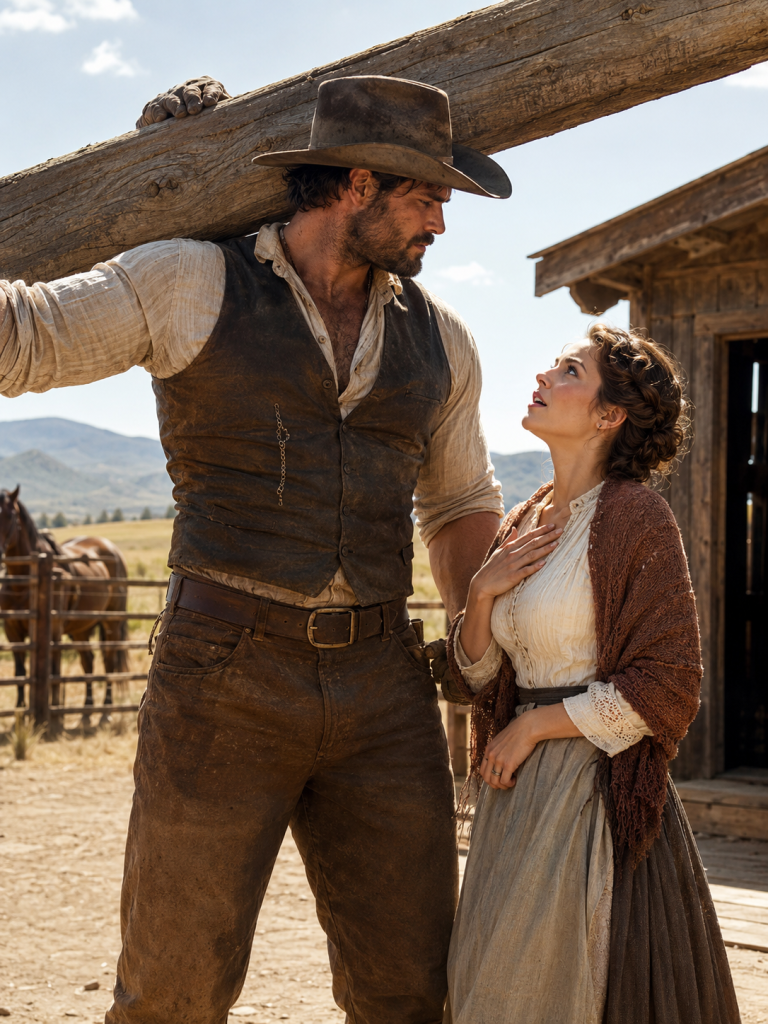
He was a large, quiet man — not the theatrical largeness of a man who is accustomed to being watched, but the natural, dense, gravitational largeness of something that has spent decades in a landscape that does not accommodate weakness. He wore wolf pelts and carried the scent of wood smoke and pine resin everywhere he went, and the few people who saw him coming down to the trading post at Ezekiel Cobb’s twice a year mostly stepped back without meaning to, the way you step back from something in the wild before you’ve consciously identified what it is.
He had been up near the high ridges since late October, running his lines in the silence that he preferred to almost everything civilization offered. The mountains were honest in their brutality. They did not dislike you. They did not lie to you. They did not build towns on other men’s blood and call it progress. They simply were, and either you adapted to what they were, or you didn’t, and the accounting was clean.
He was tracking a wounded elk on the morning the smoke caught his eye.
It was mid-January. The blizzard had finally broken, leaving the world underneath it pristine and lethal — deep powder over hidden ravines, surface crust thin enough to drop a horse through, the deceptive beauty of a landscape that had just killed everything it could reach. Silas moved on snowshoes through the white silence, following the blood trail of the elk down into the ravine known as Deadman’s Creek.
He crested a ridge.
Stopped.
The color was wrong.
Not movement — movement he might have dismissed. It was color: a thin, exhausted smudge of slate gray against the blinding white of the sky. Smoke. Coming from the direction of the old trapper’s cabin that had been rotting at the bend of the creek for longer than anyone could remember, that nobody used, that nobody came to in January because nobody with any sense came to Deadman’s Creek in January.
Silas lowered his Sharps rifle and studied the smoke.
It was not the confident smoke of a fire with fuel behind it. It was desperate smoke — thin and fighting, the kind that required constant tending by someone who was running out of things to tend it with. He looked at the terrain around the cabin, reading the snow the way another man might read a printed page. No tracks coming or going. Which meant whoever was inside had been there before the last storm, which was at least a week ago. Possibly longer.
He moved through the timber without sound, a skill the mountains had taken years to teach him and the mountain had never refunded.
The cabin, when he reached the edge of the clearing, was worse than he’d expected. The roof sagged under accumulated snow in the particular way that meant it was one good wind from coming down entirely. The single window had been boarded with mismatched planks. But thin, desperate smoke was fighting its way out of the crumbling chimney, and the door showed fresh frantic scratch marks around the iron latch — someone working from the inside, trying to break the ice that had sealed it shut.
He crossed the clearing, snow crunching despite his care.
He raised his fist and knocked twice.
The response was instantaneous.
*Clack-clack.*
The dry, mechanical sound of a lever-action rifle being cocked, from just beyond the thin wood. A sound Silas knew in his bones.
*You take one more step and I’ll blow a hole clean through that door. And you right along with it.*
Female. Raw from smoke and cold. But underneath the damage, underneath the obvious exhaustion and dehydration and fear, absolutely without hesitation.
*Put the iron down, ma’am.* Silas kept his voice even, low, the voice he used around spooked animals. *I saw your smoke. Figured you might need pulling out of this ice box.*
*I don’t need pulling out of nowhere.* A deep, rattling cough took the end of the sentence. *You turn around and walk back the way you came.*
Silas looked at the cabin. At the snow piled against it. At the complete absence of any tracks, any woodpile, any indication that the person inside had any means of surviving another twenty-four hours.
*If I walk away,* he said, *you’ll be dead by nightfall. The wind is picking up. That roof is bowing. It’ll come down on you, or the cold will take you in your sleep.* He kept his hands where she could see them through the gaps in the boards. *I’ve got dried venison, coffee, and a saw to cut proper timber.*
Silence.
Not the silence of someone considering. The silence of someone who has already made a calculation and is now simply deciding whether to trust it.
The heavy wooden beam scraping back from the door was the loudest sound in the world.
The door opened an inch. A single blue eye appeared in the gap, wild and bloodshot and burning with the particular ferocity of something backed into its last corner. The muzzle of a Winchester pressed through the gap beneath it.
*Drop your rifle in the snow. Step back.*
Silas complied without argument. He set the Sharps down, stepped back three paces, kept his hands visible. He had dealt with enough cornered things in the mountains to know that compliance, offered without performance, was the only language that worked.
The door opened.
She was wrapped in layers of filthy blankets and a canvas coat three sizes too large for her, the coat dark with stains that had dried to brown and had not come from an animal. Her face was gaunt, soot-smeared, her cracked lips bleeding at the corners. She was maybe twenty-five, though the frontier had borrowed years from her face and not given them back. She held the Winchester with hands that trembled, not with fear exactly, but with the particular tremor of severe depletion — the shaking of a body that has been operating past its limits for too long and is now running the math on what’s left.
Her eyes were a striking, piercing blue. And they looked at him the way something wild looks at a thing it has not yet classified: with total, suspended, furious attention.
*Clara,* she said. *Clara Hayes. And if you try anything, mister, I promise you won’t live to regret it.*
*Silas Montgomery.* He dipped his chin. *And I don’t doubt it, Miss Hayes. But right now the only thing trying to kill you is the mountain, and it’s winning.*
He didn’t wait for an invitation.
He moved around the side of the cabin to where a dead spruce leaned against the eaves, drew his hatchet, and got to work. He spent three hours in the brittle air splitting deadwood, reinforcing the sagging roof beams, packing the worst of the gaps in the exterior logs with mud he found under the snow at the base of the tree line. Clara stayed in the doorway the entire time with the rifle across her arms, watching every move he made with the paranoid intensity of a person who has learned that trust is a luxury they cannot afford.
He did not push. He did not speak unnecessarily. He worked.
When he finally brought a bundle of split firewood inside and dropped it beside the hearth, the smell of the interior hit him the way the cold sometimes hit — everywhere at once. She had been burning the floorboards. The room was stripped to its bones: a pallet of straw, a single battered saddlebag in the corner, nothing else. He unpacked his kit without comment, tossed her a brick of hardtack and a thick cut of dried venison.
She fell on it like something that had not eaten in days, because she had not eaten in days, and the Winchester got set down for the first time.
Silas built the fire up and boiled snow for coffee, and he watched her eat, and he noticed the saddlebag in the corner.
The leather was dark with old blood. Not a small amount of it. And it wasn’t from an animal.
*Why are you out here, Miss Hayes?* he asked softly.
Clara stopped chewing. The fierceness returned to her eyes like a lamp being turned back up.
*That’s none of your concern, Mr. Montgomery. You’ve done your Christian duty. Now leave.*
Silas stood. He looked at the saddlebag for one more second.
*I’ll be back tomorrow,* he said. *Keep the fire hot. Don’t burn green wood — the smoke will blind you.*
He picked up the Sharps from the snow outside and walked back into the timber.
He did not sleep that night.
—
PART 2
He made camp in a shallow cave a mile down the ridge and sat by a smokeless aspen fire in the dark, turning the puzzle of Clara Hayes over in his mind the way he turned stones at a river crossing — methodically, looking for the thing underneath.
She was running. That was the first fact, and it was the firmest one. You did not choose Deadman’s Creek in January unless the alternative was worse than dying there. Whatever was behind her, it had driven her past the point where civilization was an option, past the point where help was a thing she could ask for.
The blood on the coat. The blood on the saddlebag. The way she moved — even half-starved, even trembling, her body had a fluid, economical quality to it, a practiced awareness of space and angle that wasn’t the movement of a prospector’s wife. She moved like someone who had spent a long time in situations where moving wrong could get her killed.
He was back at first light with a dressed mule deer over his shoulders.
The temperature had dropped further overnight, the air so brittle it felt like glass in the lungs. When he crested the ridge overlooking the clearing, he stopped.
The snow around the cabin had been disturbed.
Not by Clara — her tracks were the small, close-set prints of someone conserving energy, moving only when necessary. These were different. Deep, wide, the heavy impressions of a large man pacing a deliberate circuit around the cabin’s perimeter. The tracks went to the boarded window. They lingered. They retreated into the timber toward the east.
Someone had been there in the night.
Someone had stood outside that window and listened.
Silas studied the tracks for a long moment in the silent cold. Scout’s tracks. Patient tracks. The tracks of a man who had found what he was looking for and gone back to report it.
He knocked on the door.
It opened faster this time.
Clara looked worse than the day before — the temporary flush the food had given her was gone, replaced by a gray, stretched pallor. She held the Winchester, but the barrel pointed at the floor.
*You came back,* she said.
As if this were something that required accounting for. As if it were a thing she had not expected to be true.
—
PART 3
*Brought meat,* Silas said, and dragged the mule deer inside.
He didn’t mention the tracks. Not yet. The mountain had taught him that information, like everything else, had a right time. You didn’t set a trap before the animal was moving. You waited until you understood exactly what you were dealing with.
Over the next two days, he established a rhythm at the cabin.
He hunted at dawn, brought back firewood and game, continued the work of fortifying the structure. He reinforced the door hinges with iron he’d salvaged from a rotted hinge on the back wall, and he rigged a heavy crossbar from a thick pine branch that fit the brackets with satisfying solidity. He patched the exterior logs with mud and moss from the base of the trees, packing the gaps methodically, working from the bottom up.
Clara watched. Then, gradually, she began to help — handing him the pieces he needed, holding the timber while he set it, learning the logic of the work without being asked. The Winchester stayed close, but it moved from her hands to her back, and then to a hook near the door, within reach but not in hand. He noted the progression without commenting on it.
By the third evening, color had returned to her face.
She was tough — that was the quality that revealed itself most consistently as the days accumulated. Not the performance of toughness that Silas had sometimes seen in people who wanted to be seen surviving, but the real thing: quiet, internalized, expressed mostly in the simple refusal to stop. She ate everything he brought and asked for nothing else. She worked until he told her to stop and sometimes past it. She slept lightly and woke fast, which was not a skill she had acquired recently.
The fire was built up high on the third evening, the wind coming off the peaks in long, mournful surges. Clara had her knees pulled to her chest and her eyes on the flames, and the silence between them had taken on a different quality — not hostile exactly, but expectant. As if something had been building toward a threshold.
*My husband was a prospector,* she said.
Her voice had lost the defensive edge. It was simply quiet now, the voice of someone choosing to speak.
*Josiah. We had a claim down near the Silver Bow. It wasn’t much, but it was ours.* She turned the tin coffee cup in her hands, watching the surface of it. *We finally hit a vein. A good one. Kept it quiet, or so we thought.*
Silas kept whittling. He said nothing. In his experience, people told you the things they needed to tell you if you didn’t interrupt them.
*A gang rode into camp three weeks ago,* she continued. *Men who’d rather steal a man’s sweat than work for their own. They shot Josiah in the back while he was washing at the creek.* She stopped. Started again, quieter. *I was in the tent. I grabbed the saddlebag with our gold dust and ran. They tracked me for a week. Pushed me higher into the mountains until the blizzard hit. I holed up here. I think the storm killed them.* A pause. *Or at least I prayed it did.*
Silas stopped whittling.
He looked at her.
The story was tragic. The story was plausible. The story was also, piece by piece, a lie.
He had spent three days cataloguing the evidence, the way he catalogued sign in the mountains — not looking for any particular thing, simply noting everything and letting the pattern assemble itself. The calluses on Clara’s hands were wrong for a woman who panned for gold and kept a camp. They were the calluses of someone who handled heavy leather reins regularly and gripped a firearm as a matter of daily life. The way she’d assessed him in the doorway — the quick, lateral sweep of the perimeter before she’d focused on him, checking angles — was not the instinct of a prospector’s wife who’d stumbled into danger. It was the assessment of someone for whom danger was a habitual condition.
And there was the paper.
He had found it the previous morning, while Clara slept and he had gone out for firewood. A gust off the ridge had dislodged something from behind a loose log near the chimney — a piece of heavy folded paper, half consumed by fire, charred at all four edges but preserved at its center by the thickness of the fold.
He had caught it before it could flutter into the snow.
He had stood in the cold clearing and unfolded it carefully and looked at the face printed on it.
It was Clara.
The name printed beneath the sketch was not Clara Hayes.
It was *Black-Eyed Bessie Vance*, wanted for the robbery of the Union Pacific payroll train outside Cheyenne and the murder of two Pinkerton guards. Five thousand dollars, dead or alive. The sketch was accurate — the sharp cheekbones, the particular set of the eyes — except that in the sketch they were not desperate. They were calculating. The eyes of a woman who had decided something and acted on the decision without looking back.
Silas had folded the paper and put it in his coat pocket.
He had not spoooked a predator prematurely in the mountains. He was not going to start now.
*I’m sorry for your loss,* he said, keeping his voice level and his face the same way. *The mountains are cruel. But the men who roam them are crueler.*
Clara looked at him then, and something in her expression shifted — a reweighing, a recalculation. *You don’t strike me as cruel, Silas,* she said. Her voice was more careful now, more deliberate. *Why are you helping me? Truly?*
*Because a mountain man knows that an animal backed into a corner will fight to the death.* He held her gaze. *And I don’t like watching things die needlessly.*
She watched him for a moment.
*Josiah’s gold is in that bag,* she said. *When the spring thaw comes, I’ll pay you for your trouble. We could split it. Enough money for you to leave this frozen hell. Buy a ranch in California.*
*I like the cold,* Silas said.
He told her the storm made it safer to stay, which was true, and took the far corner of the cabin for the night, laying his head on his saddle with the Sharps across his chest. He closed his eyes.
He did not sleep.
He listened.
—
Around two in the morning, her breathing changed.
It was subtle — a shift from the deep, regular rhythm of genuine sleep to something shallower and more controlled. The breathing of a person who is awake and trying not to sound like it.
Silas opened his eyes a fraction.
Clara was sitting up in the dark, her head turned toward the door. She wasn’t looking at the wood. She was listening past it, the way you listen when you’ve learned to identify sounds that other people don’t notice yet.
He heard it too.
Not the wind — he knew the wind in this ravine in the way you know a voice you have heard a thousand times. This was different. The faint rhythmic compression of snow under heavy boots, more than one set, moving with the careful spacing of men who do not want to be heard. The faint clink of metal against metal — spur rowels, the sound muffled by the cold. The low edge of a voice, barely above the level of the storm.
They hadn’t died in the blizzard.
They had been waiting for the surface crust to harden enough to walk on top of it instead of through it. The tracks he’d seen two days ago had been a scout’s tracks — a man checking whether she was still there, still alive, still containable. Now the full party had come up the ridge.
Clara moved toward the Winchester with the slow, deliberate care of someone who had been expecting this.
She looked over at Silas’s corner.
She thought he was asleep.
He watched her decide, in the dim moonlight filtering through the wall cracks, to let him stay that way. Whether that meant she intended to face them alone, or whether she intended to use him as a distraction — he couldn’t determine, and perhaps the distinction didn’t matter.
*Don’t shoot through the door,* Silas said.
Clara’s body jerked. The Winchester swung toward him, and he held up one open hand in the darkness.
*The wood will deflect the slug. Wait until they breach it.*
A silence.
*You’re awake.*
*Been awake since I found the scout’s tracks two days ago.* He was already on his feet, moving to the shadows beside the window frame, reaching into his coat for a fresh brass cartridge. *And since I found the Pinkerton poster you tried to burn, Bessie.*
The name landed between them like a thrown stone.
For a long moment, Clara — Bessie — did not move. She held the Winchester at a neutral angle and looked at him across the dim cabin, and he could see her calculating: the geometry of the room, the rifle, the man who had just told her he knew exactly what she was, the men outside who were going to kill her regardless.
She made the calculation.
*All right,* she said quietly. *All right.*
The shotgun took the door off its hinges.
The blast was enormous in the enclosed space — a physical pressure wave, a simultaneous explosion of sound and splinter and cold air. Silas pulled the double set triggers of the Sharps and the answering roar filled the cabin with white gun smoke so thick it whited out his vision entirely. He heard the impact before he could see it: the specific, heavy sound of a large man being thrown backward into deep snow.
*Get down!*
He was already moving, dropping to one knee, hands finding the next cartridge by muscle memory and sliding it into the breech. Bessie had gone flat on her stomach, the Winchester through a gap in the lower logs, firing in a continuous, controlled rhythm that lit the dark outside in strobing orange bursts.
*Hold your fire!*
The voice from the tree line was a trained voice — authoritative, carrying, accustomed to being obeyed. *You’re wasting lead, Bessie. We’ve got the cabin surrounded. Six rifles at that doorway. You twitch and we turn that shack into a sieve.*
Silas pressed his back against the solid timber beside the window frame, the Sharps reloaded, his breathing steady.
*Who’s doing the talking?* he whispered.
Bessie levered another round, her jaw tight. *Galt. The railroad’s chief fixer.* She was breathing hard but her hands were not shaking. *He’s not here to arrest me, Silas. He’s here to bury me. And everything in that bag with me.*
Silas processed this.
*Mr. Galt,* he called out, his voice calm and carrying. *You’re trespassing on a very cold night. I suggest you take your dead man and walk back down this mountain before the frostbite takes your toes.*
A short, hard laugh came through the darkness. *I don’t know who you are, mountain man, but this isn’t your fight. The woman stole fifty pounds of gold dust and a leatherbound ledger from the Union Pacific. Walk out with your hands empty and I let you fade back into the timber. Stay and you die with her.*
Silas looked at the saddlebag in the corner.
*A ledger,* he said.
Bessie’s blue eyes found his in the dark. The calculation in them shifted into something else — something that had been held back, that had been waiting for a moment when it could be said.
*They murdered my husband for our land,* she said. Her voice was stripped of performance. *The gold was back pay for what they took. But the ledger —* she paused, and the pause carried the weight of everything she’d survived to carry it, *— the ledger has the names. Every homesteader they killed to clear the right-of-way for the new rail line. Every payoff, every order, every signature. If Galt gets it back, those men died for nothing. I die for nothing.*
The pieces assembled themselves.
The brutal winter pursuit. The Pinkerton agents killed not to protect a payroll but to protect what the payroll was cover for. The railroad’s chief fixer personally leading a team into the high Bitterroots in January, which was not something a man did for fifty pounds of gold dust.
This was not a robbery. This was evidence. And Bessie Vance had been carrying it through three weeks of blizzard, burning her furniture to survive, pointing a rifle at the door every night, because she understood exactly what it was worth and exactly what the men who wanted it back were capable of.
*They’re going to burn us out,* Silas said. *The roof is dry under the snow. One kerosene lantern and we’re smoked like hams.*
*Then we fight,* Bessie said, her jaw setting.
*No.* He looked at the back wall of the cabin. *We hunt.*
—
He had spent three days reinforcing the cabin.
He had also, with the particular foresight of a man who has survived the mountains by planning for the worst, left the back wall intentionally compromised. The rotting logs were patched only with mud and moss that had frozen solid in the cold — sturdy enough against the wind, brittle enough against a hatchet.
*When I say go,* he said, moving to the back wall, *you empty the magazine at the tree line. All of it. As much noise as you can make. Then grab the bag and follow me.*
He swung the blunt head of the hatchet against the frozen mud.
It shattered like glass.
Two more strikes and three of the heavy logs gave way, collapsing outward into the deep snowdrift behind the cabin and opening a gap in the wall just wide enough.
*Now.*
Bessie rose to her knees and opened fire.
The Winchester in the enclosed cabin was deafening, the muzzle flash strobing against the walls, brass casings spinning across the floorboards. Return fire erupted from the tree line immediately — a hail of lead tearing through the walls, the air suddenly full of splinters and the flat crack of impacts. Silas grabbed her by the collar of her canvas coat and hauled her backward through the hole.
She scrambled through, dragging the saddlebag.
He followed.
Behind them, through the gap in the wall, the orange light of a kerosene lantern preceded its arc through the ruined doorway by half a second, shattering against the stone chimney. The dry floorboards caught with a sound like a held breath releasing.
The cold outside hit them like a wall.
Silas took the saddlebag without discussion, slung it over his shoulder, and took her hand and moved.
He went up. Not down the ridge, not toward the trail, not toward any direction that made sense to men who thought in terms of roads and exits. He went up the steep face of the ravine wall, through waist-deep powder, breaking trail with his body, pulling Bessie behind him. The burning cabin threw light across the snow below them, and in that light he could see the figures of Galt’s men moving, shouting, beginning to understand that their quarry had exited through a wall.
Two hundred yards above the cabin, a granite outcropping jutted from the slope — a jumble of massive boulders that the mountain had arranged over centuries into something that functioned, for a man who knew it, like a fortress. Silas got Bessie into the shadows of it and looked down at the scene below.
The cabin was fully involved now, fire eating through the dry structure with the greedy efficiency of something that has been waiting for fuel. Galt’s men circled it, frantic, realizing their trap had caught only air. He could count them in the firelight: four still moving, which meant two were not.
*Stay down,* he said. *Rifle ready.*
Bessie looked at him. *Where are you going?*
He checked the cylinder of the Colt, the blade of the hunting knife, the second cartridge tucked inside his coat.
*I told you,* he said, his eyes already moving down the slope, reading the terrain, plotting the approach. *I don’t like watching things die needlessly.* He paused. *But these men aren’t things. They’re monsters. And the mountain is hungry tonight.*
He stepped out of the rocks and the blizzard took him.
—
From the outcropping, Bessie watched the hunt.
She had done violent things in her life — had made hard decisions in hard seconds that she had not let herself examine too closely afterward, because examination was a luxury for people who were not being chased. But what she watched from those rocks was something different. Not violence for its own sake. Not even violence as necessity, though it was that too.
It was mastery.
Silas moved through the storm the way the storm moved — without resistance, using the same forces that worked against his pursuers as his allies. He knew where the hidden drop-offs were, where the crust would hold a man’s weight and where it would give. He led Galt’s men past things without being seen, and the men fell, and the storm absorbed the sound, and then he was somewhere else entirely.
One man vanished mid-step into a ravine Silas had guided him past in the darkness.
Another was taken from behind, efficiently, before he’d fully registered that he was alone.
Fear moved through the survivors like weather.
Galt fired into the blizzard, shouting orders that the wind dismantled and scattered. The mountain gave him nothing back but silence.
Then a single shot struck the snow at his feet.
Not through him. Not threatening. A placement — the equivalent of a hand laid on the shoulder. *I see you. I could have.* An offer, extended in the language of men who know the difference.
Galt dropped his weapon.
He went to his knees in the snow.
By the time Bessie reached them, coming down through the drifts with the saddlebag across her shoulder, the remaining men were disarmed and bound against the trunk of a lodgepole pine, and Galt was on his knees with his hands empty and the fight entirely gone from him.
He looked up at her with something that had moved past anger into a kind of exhausted bitterness.
*You know the railroad doesn’t stop,* he said. *You know that. They’ll send more men. They’ll send better men. They’ll —*
*I know,* Bessie said.
She set the saddlebag down. Opened it. Lifted out the ledger.
It was a plain leather-bound book, the kind a clerk would use, water-stained at its lower edge from weeks in the Montana wilderness. She held it for a moment — just held it, feeling its weight, the weight of what was written inside it. The names. The payments. The orders. The careful, documented record of a corporation that had decided that the men and women homesteading along the rail corridor were an inconvenience to be resolved, and had resolved them.
Josiah’s name was in there.
She had read it in a tent at the Silver Bow claim, sitting next to what the railroads ledgers referred to as a *land acquisition resolution*, a transaction completed three weeks before the men rode into their camp.
She had read her husband’s name described as a *compliance obstacle, resolved.*
She had taken the gold that night because it was there, because it was theirs, because she was leaving anyway and gold traveled better than grief. But she had taken the ledger because she had understood, in the cold fury of that moment, that it was the only thing in the world that could make any of it mean something.
Silas came up behind her.
He looked at the ledger in her hands.
*This could bring them all down,* he said quietly.
*It’s not about the gold,* Bessie said. She was not crying — she was past that, had been past that for three weeks — but her voice had something in it that she couldn’t fully control. *It’s about justice.*
Silas stepped toward Galt.
His voice, when he spoke, was the voice of the mountain itself — cold and flat and entirely without malice, because malice implied feeling, and this was simply a statement of conditions.
*Here is what happens,* he said. *You leave this mountain with your men. You survive the descent if you move fast enough. You go back and you tell the railroad that Bessie Vance is dead. You tell them the ledger burned in the cabin. You tell them the matter is closed.*
Galt stared at him.
*And if I don’t?*
*Then the mountain keeps you,* Silas said. *And in the spring, someone finds what’s left.*
Galt looked at Bessie. At the ledger. At the smoking ruin of the cabin below them, the orange glow fading now as the structure consumed itself.
He nodded.
Silas cut him loose from the tree.
They watched him and his remaining men disappear into the timber — moving fast, moving downslope, moving with the specific urgency of men who have been given permission to leave and intend to use it completely.
When they were gone, the mountain was silent.
Bessie became aware, for the first time in what felt like weeks, of the cold. Not the aggressive, enemy cold of the past three weeks but simply the cold — the ambient temperature of the world they were standing in, which was manageable now that it was just weather again and not a weapon being used against her.
She looked at Silas.
He had blood on the right sleeve of his wolf pelt coat, a long shallow cut that he hadn’t mentioned. He was looking at the tree line where Galt had disappeared, reading it with the habitual attention of a man who double-checks his work.
*You had a marshal’s badge,* she said.
He looked at her.
*I saw it in the cave,* she said. *The first night. When you had the fire going. It fell out of your coat when you shifted.*
A long pause.
Silas reached into his inner coat pocket and produced the badge. It was old — the silver tarnished to near-black, the pin backing worn smooth. He looked at it for a moment with an expression she couldn’t read, and then he turned and dropped it into the snow.
It disappeared.
*I used to believe in the law,* he said. *Then I learned what the law believed in.* He picked up the saddlebag. *Now I believe in doing what’s right. They don’t always overlap.*
Bessie looked at where the badge had gone under the snow.
*Josiah used to say something like that,* she said.
*Smart man.*
*He was.* She took a breath of the brittle mountain air. *He would have liked you.*
Silas looked at her with the expression she was beginning to recognize — the particular stillness that meant he was feeling something he didn’t have language for and was choosing not to manufacture it.
*We’ve got a long way to go,* he said.
*I know.*
*Ledger goes east. Needs to reach someone outside the railroad’s reach. Someone federal — Justice Department, not the marshals, not the territorial courts. Someone the railroad hasn’t bought yet.*
*I know a man in Washington,* Bessie said. *A congressional aide. He was on the Silver Bow claim the year before Josiah and I. He got out before they came for him. He’s been waiting for something to give him a reason.*
*Then we move in the morning.* Silas looked at the sky, reading it with the ease of practice. *Storm’s finished. Surface will harden overnight. We can make the first outpost in four days if we move.*
Bessie nodded.
She looked one more time at the cooling ruins of the trapper’s cabin at Deadman’s Creek — the structure she had burned piece by piece to stay alive, that had sheltered her through the worst three weeks of her life, that was now a char mark in the snow.
Then she turned her back on it and followed the mountain man into the dark.
—
The weeks that followed were the hardest miles either of them would ever account for.
They crossed four frozen passes in January, which was the kind of undertaking that later, when she tried to explain it to people in warm rooms, she simply stopped trying to explain. Silas kept them alive with a competence so total and habitual that it ceased to register as extraordinary, the way the functioning of one’s own heart ceases to register — you simply noted it was happening and continued. He knew where the water ran under the ice and how to get to it. He knew which ridgelines sheltered and which ones funneled wind. He knew when to move fast and when stopping was more important than progress.
Bessie matched him. She was not a woman who needed saving — she had survived three weeks alone in that cabin, and she had understood from the first night that what Silas offered was not rescue but something more like partnership. She carried her weight and then some. She took the watch shifts he tried to give her more than half of and refused to give up any portion of. She learned, watching him, and he let her learn without making it into anything.
They talked, in the way people talk during long hard shared labor — not continuously, not with the anxious filling of silence, but specifically, when something needed saying.
She told him about Josiah. Not the ledger version of Josiah, not the *compliance obstacle resolved* version, but the real one — the man who had taught himself to read at twenty-two, who had a specific theory about the best time of day to pan that turned out to be correct, who had laughed at his own jokes before he’d finished telling them, which was infuriating, which she had told him regularly, which she would give anything to tell him one more time.
Silas listened in the way he did everything — with complete, unhurried attention, offering nothing in return except the particular quality of his presence, which communicated without words that he was holding what she said carefully, that it would not be dropped.
He told her about the badge.
Not much. The broad shape of it: he had served as a deputy marshal for three years in Wyoming Territory, long enough to understand the distance between what the law was supposed to be and what it actually was, how that distance had widened every year until the gap between them became impossible to straddle. A homesteader family, a railroad injunction, orders he had been given that he had not followed, which had ended his career and started the solitary decade in the Bitterroots.
*You chose the mountains over the law,* she said.
*I chose the mountains over following orders I knew were wrong,* he said. *The mountains were just where that left me.*
She considered this.
*The law didn’t protect Josiah,* she said. *The territorial marshal’s office knew about the land acquisitions. They knew what was happening in the Silver Bow corridor.*
*I know,* Silas said.
*Then what’s the difference between what you did and what I did? You walked away from a corrupt institution. I robbed one.*
He was quiet for a long moment.
*You killed two men,* he said. Not an accusation. A fact laid on the table.
*They were drawing on me,* she said. *Both of them. I have witnesses if witnesses mattered to anyone, which they don’t.*
*No,* he agreed. *They don’t.* He looked at the snow ahead of them, the long slope of the pass. *The difference, if there is one, is what happens next. What you do with what you took.*
*I’m doing it.*
*I know.*
The silence that followed was not uncomfortable. It had the quality of two people who have, in the course of surviving together, arrived at a mutual understanding that doesn’t require elaboration.
—
They reached a settlement of sufficient size to have a telegram office in the first week of February.
Bessie sent three telegrams. One to the congressional aide in Washington she had mentioned, a carefully worded message that conveyed without explicitly stating that she had what he needed and was prepared to deliver it. One to a newspaper editor in Chicago who had been writing about railroad land abuses for two years and needed exactly the kind of documentary evidence that was currently in the saddlebag she was carrying. One to a woman in Missouri who had been Josiah’s sister and who did not know yet that she had lost her brother, and who deserved to hear it from Bessie before she heard it from anyone else.
The Washington aide responded within twenty-four hours.
He sent a courier, not a wire — a young man who arrived on horseback in the worst weather of the decade with papers that established Bessie’s legal cooperation with an ongoing federal investigation and provided, in specific technical language that had clearly been drafted by someone who knew exactly how the railroad’s lawyers would attack it, a framework of protection for herself and her evidence.
She read the papers twice.
Then she handed them to Silas to read.
He read them slowly, with the attention of a man who reads carefully because he does not do it often and wants to do it right.
*It won’t protect you completely,* he said.
*Nothing will,* she said. *But it protects the evidence. That’s what matters.*
*Is it?*
She looked at him.
*After everything,* he said, *is it enough? To bring them down, to have the names in the papers, to see the arrests. After Josiah. Is it enough?*
She was quiet for a long moment.
*No,* she said honestly. *It’s not enough. It will never be enough. Josiah is dead and the accounting that comes after doesn’t change that.* She looked at the papers in her hands. *But it’s true. And true matters. It’s the only thing I’ve got left that he’d recognize.*
Silas nodded once.
—
The ledger went east in the third week of February, carried by a federal courier with an escort that the congressional aide had arranged through channels the railroad did not own. Bessie had made two complete handwritten copies before she let it go — one for the newspaper editor in Chicago, one held back in a location she told only Silas, in case the courier was compromised.
The original arrived in Washington in early March.
The federal investigation was already underway by the time the ice broke in the Montana passes. The arrests came in waves through the spring and into the summer — executives, lawyers, territorial officials, two judges whose signatures appeared in the ledger on orders that had not been described as what they were. The newspaper editor published a ten-part series. The congressional aide testified before a committee. The land grants were challenged.
The stolen wealth could not be returned — what had been taken from the homesteaders in the Silver Bow corridor was time and labor and life, and there was no financial instrument that covered that. But the men who had taken it were made to answer for it in the ways that the law, when it functions as intended, can make men answer.
Bessie read about it in a newspaper on the porch of a house in Oregon, in a valley that Silas had known about for years and described once, matter-of-factly, as the closest thing to the right kind of place he had ever seen.
The house was small and solid, built the previous fall by a man who built things to last, backed into the shelter of a ridge with south-facing windows and a good view of the approach. There were no close neighbors and no particular reason for anyone to come looking.
She read the front page until the light got too thin for it, then folded the paper and set it on the rail.
Silas came out with two cups of coffee and sat in the other chair and looked at the valley below them, the long fall grass going gold in the evening light.
*They got Harrington,* she said.
Harrington was the vice president of the western land division, the man whose signature appeared more than any other in the ledger. The man whose orders had been carried to the Silver Bow claim by men on horseback who had waited for a morning when Josiah was washing at the creek.
*I know,* Silas said. *Saw the wire yesterday.*
She looked at him.
*You didn’t tell me.*
*Wanted you to read it yourself.* He handed her the coffee. *Wanted you to have that.*
She took the cup.
She thought about Josiah — the specific, involuntary way she thought about him sometimes, not the grief of it but just the fact of him, the way you suddenly notice the weight of a thing you’ve been carrying for so long it has become part of your sense of your own body. She thought about the ledger and the weeks in the blizzard and the burning cabin and the night she had pulled the Winchester on a mountain man who knocked on her door, which felt, from here, like something that had happened to a different person in a different life, though she knew it hadn’t.
*It’s not enough,* she said, which was what she had told him in February, which remained true.
*No,* Silas agreed.
*But it’s something.*
*Yes.*
They sat with that for a while, the two of them, in the particular comfortable silence of people who have survived something together and come out the other side into a life that neither of them had planned and both of them, in the way of people careful about wanting things, were grateful for.
The evening light went off the valley.
The first stars came out.
*Cold tonight,* Bessie said.
*Always is,* Silas said.
He reached out and covered her hand with his, and they stayed where they were until the cold became serious, and then they went inside, and the door closed behind them, and the Oregon night did what nights do, which is continue.
And neither of them was running anymore.
—
*THE END*