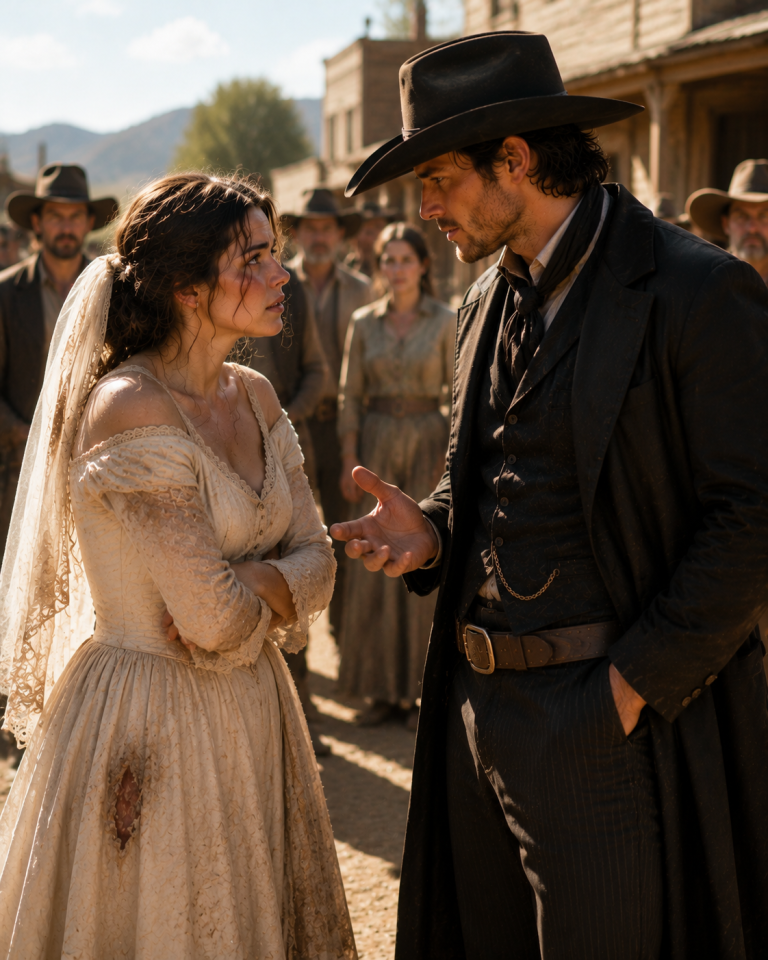
HE CAME HOME FROM THREE WEEKS ON THE TRAPLINE TO FIND SMOKE IN HIS CHIMNEY AND A STRANGER COOKING HIS VENISON — THEN A WANTED POSTER IN A TRADING POST TOLD HIM EXACTLY WHO SHE WAS

Part 1
The Bitterroot Mountains chewed up solitary men and spat out bones. Heck Montgomery had survived the brutal freeze of 1883 expecting nothing on his return but an empty, ice-cold cabin.
Instead, smoke curled from his chimney.
Heck was thirty-two, built like the granite peaks he called home, his face buried under a frost-crusted beard, his eyes a pale, watchful gray that missed nothing. He’d spent three weeks deep in the high country running trap lines for beaver and marten, sixty miles from the nearest scrap of civilization — a trading post run by an old-timer named Jebediah Miller. He’d chosen this isolation on purpose. The world of men was noise and deceit and blood, and he’d seen enough of all three riding with the cavalry through the Dakotas to last a lifetime.
He cresting the final ridge above his hidden valley and stopped dead. His pack mule, Barnaby, bumped his shoulder and snorted a plume of white vapor into the cold.
Smoke. Rising steady from his own chimney.
Instinct took over before thought caught up. Heck unslung his Winchester, thumb resting heavy on the hammer. Trespassers in deep winter were rarely friendly — desperate outlaws, starving drifters, men looking to strip a season’s worth of furs and leave the trapper bleeding in the snow. He tied Barnaby off a hundred yards out and moved in silent, keeping the wind in his face so his scent wouldn’t carry.
At the door, he expected gruff voices, the clink of stolen whiskey. Instead he heard the rhythmic scrape of a wooden spoon against cast iron — and then the smell hit him. Not just woodsmoke. Roasted venison, seasoned with wild thyme and garlic and something sweet, maybe the dried huckleberries he kept jarred in the cellar. His stomach growled loud enough to embarrass him.
Heck kicked the door open, the heavy wood slamming the log wall, rifle level at chest height.
“Don’t move a muscle.”
A glass jar shattered on the floorboards. Standing at the hearth was not an outlaw. It was a woman — small, swallowed whole by one of Heck’s spare flannel shirts, dark hair a tangled mess around a face pale with terror and streaked with soot. She hadn’t raised her hands. She’d snatched up his iron fire poker and was holding it out like a cavalry saber, hands shaking, chin set.
“Who are you?” Heck demanded, rifle steady. “How’d you get up here?”
“I — I was lost. The storm. I found the cabin.” Her voice was a raspy whisper, cultured underneath the exhaustion. “Please put the gun down.”
Heck stepped inside and kicked the door shut behind him to hold the heat. The cabin was warmer than he’d felt it in years. The floor was swept. His usual chaos of provisions sat stacked neat on the shelves, and on the potbelly stove a proper stew bubbled beside a fresh pan of sourdough biscuits.
He lowered the Winchester, uncocked the hammer.
“You’re holding my fire poker.”
She looked at the iron rod, then at the massive snow-crusted man filling her only exit, and the fight went out of her all at once. The poker clattered to the floor. Her knees gave, and she went down onto them, hands over her face.
“I didn’t steal anything,” she sobbed. “I just needed to be warm. I’ll leave. I’ll pack my things and walk out right now.”
Heck glanced at the frosted window. Sun already dipping behind the peaks, the temperature sliding toward zero. Sending her out now was a death sentence dressed up as mercy.
“Ain’t nobody walking out of here tonight,” he grumbled, leaning the rifle against the wall, shrugging off his buffalo hide coat. “What’s your name?”
She hesitated, eyes still wet. “Abigail. Abby.”
“Well, Abby.” He crossed to the stove, peeling off frozen gloves. “Seeing as you cooked my meat and used my flour, you’re going to sit down and eat it with me.”
That evening the cabin’s silence gave way to the clink of tin plates. Heck ate like a starving wolf, but he couldn’t stop watching her — a bruise blooming yellow at the edges on her left cheekbone, her hands blistered from something that wasn’t mountain work. She ate delicately, in a way that spoke of a life that had no business being five thousand feet up in the Bitterroots.
She had changed his world in the space of an afternoon. The cabin wasn’t just shelter anymore. Tonight it felt, unmistakably and dangerously, like a home.
But watching the dark, haunted thing move behind Abigail’s eyes, Heck understood one fact as clearly as he understood weather coming: trouble had followed her up this mountain, and sooner or later it was going to knock on his door.
Six weeks passed, and the Bitterroot winter locked them in an icy embrace, snow drifting up to the windowsills until the cabin sat like an island in a white sea. In that time, the wary distance between them wore down into something neither of them named out loud. Abigail — if that was even her name, Heck often wondered — mended his torn canvas trousers with tiny, careful stitches. She rationed their provisions so well he stopped having to hunt through the worst of the blizzards. In the evenings, while he cleaned traps or oiled his rifle, she read aloud from a battered copy of *Great Expectations* she’d found on his shelf, her voice chasing the old ghosts clean out of the room.
Heck found himself doing things he hadn’t done in a decade. Chopping extra wood just to keep her warm. Carving a small cedar comb for her tangled hair. Smiling — actually smiling — when she scolded him for tracking mud across her swept floor. For a man who’d sworn off the world entirely, he was dangerously, foolishly close to falling for the woman who’d invaded his sanctuary.
But Abby never spoke of her past. Whenever Heck pressed her, gently, about where she’d come from or how she’d ended up crossing a deadly mountain pass alone in November, her eyes would glaze with that same first-day terror, and she’d retreat into scrubbing the cast iron pans until her knuckles went raw.
There was one night, midway through February, when she almost told him anyway.
A storm had shut them in early, snow piling against the shutters faster than the wind could carry it off, and Heck had built the fire up higher than usual, watching Abby stare into it with the particular stillness she got when her mind had wandered somewhere he couldn’t follow.
“You flinch,” he said, not looking at her, working a whetstone along the edge of his skinning knife, “every time a door bangs in the wind. Every time a horse whinnies down in the valley, though there ain’t a horse for sixty miles.”
Her hands went still in her lap.
“I didn’t ask you to notice that.”
“Didn’t ask permission either.” He set the knife down, finally looking at her. “I’ve spent ten years up here on account of men I don’t trust and things I’ve seen that I can’t unsee. I know what it looks like on a person when they’re running from something worse than winter.”
Abby’s jaw tightened, and for a moment Heck thought she might actually say it — whatever sat behind her eyes, coiled and waiting. Instead she pulled the oversized coat tighter around her shoulders, the way she always did when a question got too close to the bone.
“If I tell you,” she said quietly, “you can’t unknow it either. And then it’s your danger too, not just mine.”
“Ain’t much left up here that scares me, Abby.”
“It should.” She said it so plainly, so certain, that something cold moved through Heck’s chest despite the fire roaring three feet away. She didn’t say anything else that night, and he didn’t push, but he found himself checking the door latch twice before he slept, and adding an extra length of cord to the trip line he kept meaning to string along the eastern trail.
By late January, they were dangerously low on coffee, salt, and kerosene. The weather broke just enough for a supply run to Miller’s trading post — three days there and back.
“I don’t want you to go,” Abby said at the door, gripping the collar of the oversized coat he’d given her, a tremor running under her voice.
“I’ll be back before the next front moves in.” Heck’s voice came out softer than he meant it to. He reached out, his rough thumb grazing her cheek, right where the bruise had finally faded. “Keep the fire hot.”
The ride down was brutal, but Heck pushed through, and when he finally shoved open the doors of Miller’s trading post, the warm stale air hit him like a wall — tobacco, cheap whiskey, and the beginning of the end of everything he thought he understood about the woman waiting for him back up the mountain.
Part 2
“Thought the winter got you, Heck.”
“Takes more than snow to kill me, Jeb.” Heck tossed a sack of prime beaver pelts onto the counter. “Need salt, beans, kerosene, and coffee. Real coffee, not that chicory dirt.”
As Jebediah weighed the pelts, he shook his head. “Crazy times down in the flatlands. Trains getting robbed. Cattle wars over in Wyoming.” He glanced up. “And the country’s been crawling with Pinkertons and hired guns the last month.”
Heck stiffened. “Pinkertons out here?”
“Yep. Looking for a woman.” Jebediah reached under the counter and pulled out a crumpled wanted poster, sliding it across the wood. “Came all the way from Denver. Caused a hell of a stir. Fella paying the bounty’s a railroad tycoon. Richer than God.”
Heck looked down at the paper, and the breath left his lungs like he’d taken a mule kick to the chest.
Staring back at him was a charcoal sketch of the woman currently sitting in his cabin. The aristocratic nose. The shape of the eyes. Unmistakably her. But the name printed above the sketch wasn’t Abigail.
*WANTED DEAD OR ALIVE — CHARLOTTE LEIGH BOWMONT. BOUNTY $2,000 IN GOLD COIN. WANTED FOR GRAND THEFT OF $50,000 AND THE ATTEMPTED MURDER OF PROMINENT DENVER BUSINESSMAN ARTHUR PENDLETON.*
Two thousand dollars. A man could buy a ranch in California for that kind of money. Men had slaughtered whole towns for half.
“Dangerous little bird,” Jebediah muttered, tapping the paper. “Pendleton claims she shot him in the chest while he slept, stole his safe of bonds, and fled on a northbound train. They lost her trail near Missoula before the big blizzard hit. Reckon she froze to death out there.”
“Reckon so,” Heck said, his voice terrifyingly calm.
He folded the poster with slow, deliberate hands and pushed it into his inner coat pocket. His mind was a roaring storm. Attempted murder. Grand theft. The woman who carefully carried spiders outside instead of crushing them.
He gathered his supplies and rode out within the hour, pushing his horse hard against the fading light — climbing back toward the woman he’d already half fallen in love with, and the question of whether everything she’d told him, and everything she hadn’t, was about to get them both killed.
Part 3
The journey back up the mountain was an agonizing battle between his heart and every instinct that had kept him alive this long. He was harboring a high-profile fugitive. If the Pinkertons found out, they’d burn the cabin to the ground and hang him from the nearest pine for aiding her. And yet the more he turned it over — Arthur Pendleton, rich and powerful, and the faded yellow bruise that had sat on Charlotte’s cheekbone the first night he found her — the colder and darker the anger in his chest became.
When Heck finally kicked the cabin door open two days later, coated in ice and exhaustion, Charlotte was sitting by the fire mending a sock. She jumped up, a bright, relieved smile breaking across her face.
“Heck — you’re safe.”
He didn’t smile back. He dropped the heavy burlap sacks on the floor with a thud, reached into his coat, pulled out the crumpled wanted poster, and slammed it onto the wooden table.
“Dinner smells good, Lady,” he said, his voice dropping into something low and dangerous. “Now why don’t you tell me why I shouldn’t tie you to the back of my mule and collect my two thousand dollars.”
Charlotte stared at the poster on the table, and the color drained out of her face until she matched the snow drifted against the windowpanes. Her breathing went shallow. For a long, agonizing stretch, the only sound in the cabin was pitch pine crackling in the hearth. She didn’t reach for the skinning knife on the counter. She didn’t bolt for the door.
Her shoulders simply slumped, the oversized wool coat swallowing her whole.
“Two thousand dollars,” she whispered, hollow. “Arthur always believed every problem in the territory could be solved by throwing gold at it.”
Heck stood by the door, his frame blocking the only way out, pale gray eyes hard as flint. He’d survived his whole adult life trusting his gut, and right now his gut was at war with itself. The poster called her a ruthless thief and a killer. But the woman in front of him — the one who’d nursed a frozen songbird back to health on his kitchen table — didn’t carry the cold blood of a murderer, not that he could see.
“I reckon you better start talking, Lady,” he said. “And it better be the unvarnished truth. Because if the Pinkertons are hunting you, they won’t stop at Miller’s trading post. They’ll pay Jebediah a fortune for my location, and they’ll come riding up that ridge.”
Charlotte closed her eyes. A tear cut a track through the soot on her cheek.
“My true name is Charlotte Bowmont. My father, Henry, owned lucrative silver claims near Leadville. We were wealthy, Heck. Too wealthy. It attracted the wrong kind of men.” The fear in her eyes was suddenly overshadowed by something colder — a hatred that had been sitting in her a long time. “Arthur Pendleton isn’t just a Denver businessman. He’s a railroad magnate, a shadow partner in the Jay Gould syndicate. He wanted my father’s land for the Denver and Rio Grande. My father refused to sell.”
Heck unbuttoned his buffalo coat and stepped further into the room. Out west, the railroads were wrathful gods that crushed anything standing in their right-of-way.
“When Arthur couldn’t buy the land legally,” Charlotte continued, “he orchestrated a panic. Called in fake debts. Bribed the assayers. Ruined my father financially inside of a season. His heart couldn’t take the shame of it. He died two days after the bank seized our estate.”
“And the fifty thousand?”
“It wasn’t his money.” Her small fist came down hard on the table. “It was the bearer bonds and the original deeds to our claims. Arthur kept them locked in his Denver mansion. He forced me to move in with him — promised that if I married him, he’d let my younger sister live in peace. If I refused, he’d ruin her too.”
She looked down at her own calloused hands, hands that had once played piano in velvet-draped parlors.
“I lasted three weeks. One night, drunk on scotch, he cornered me and tore my dress. I grabbed a silver letter opener off his desk and drove it into his shoulder. While he was bleeding, I opened the safe, took my family’s deeds, and ran. Rode freezing boxcars north until the line ended, then walked into the mountains.”
Heck looked at her, then down at the wanted poster. The law out here was a purchased commodity, and Arthur Pendleton could buy a hanging rope before breakfast if he wanted one.
He reached across the table, picked up the crumpled poster, walked to the potbelly stove, and without another word, fed it into the flames. They watched the charcoal sketch curl, blacken, and turn to ash together.
“Two thousand dollars wouldn’t buy a single hair on your head, Lady,” Heck said quietly. “But we’ve got a serious problem. Winter’s breaking.”
The deep freeze was already yielding to an early thaw, which meant the passes wouldn’t stay impassable much longer — and neither would the road that led men with rifles and warrants straight up to his door.
—
Heck spent the following days preparing for war. He oiled the Winchester and a double-barreled shotgun. He strung trip wires hung with empty tin cans along the trail below the cabin. Inside, he taught Charlotte the brutal mechanics of the heavy shotgun.
“If men come, they won’t knock,” he warned, watching her load a heavy brass shell with hands that had stopped shaking somewhere in the last week. “You don’t hesitate. You point, you pull the trigger, and you don’t look at their faces.”
On the ninth morning, the dread finally broke loose.
Barnaby let out a panicked bray. Heck, dozing by the hearth, was awake instantly. He blew out the lantern, dropping the cabin into darkness.
“Lady,” he hissed. “Root cellar. Now.”
Charlotte grabbed the shotgun instead. “I won’t let you fight my war alone.”
Before he could argue, the sharp clink of a tin can rang out from the eastern ridge. Heck peered through the shutters. Out of the morning mist, three men came on spiked snowshoes, and when the leader stepped into the pale light, Heck’s blood went to ice — he recognized the man from the blood-soaked legends whispered up and down the territory. Deacon Jim Miller, a devout-sounding man who murdered for a living, always in a heavy black frock coat, carrying a modified Sharps buffalo rifle. Pendleton hadn’t just put a bounty on Charlotte’s head. He’d guaranteed her execution.
“Three of them,” Heck whispered, racking the Winchester. “The one in black’s Jim Miller. Professional killer. If I fall, Lady, you shoot him, and you don’t stop until the gun’s empty.”
The assault opened without a word of warning, tearing through the quiet dawn. A heavy slug from Miller’s Sharps obliterated the solid oak of the door like it was dry parchment, shattering a ceramic pitcher on the counter before burying itself in the log wall in a spray of splinters. The boom rolled out across the whole valley, silencing every bird for a mile.
Heck didn’t flinch. He kicked open the window shutter, leveled the Winchester, and fired twice into the mist. A scream tore the cold air — one of Miller’s thugs took a round to the shoulder and spun hard into a melting drift.
“Flank him, you fools,” Miller barked from the treeline, calm and rhythmic, entirely without fear. “Burn the cabin to the ground if you have to.”
Bullets tore through the wood and shattered the last of the frosted glass. Heck moved with the fluid, deadly economy of a man who’d survived the Indian wars under General Crook — fire, move, fire again, keeping the two men rushing the front pinned behind the lodgepole trunks. But Miller was a tactician, and while Heck’s attention held the front, the assassin vanished like smoke into the white haze.
The back window exploded inward. Glass rained down on Charlotte. A man’s upper body shoved through the frame, revolver aimed blind into the dim room.
Charlotte screamed — but the week of training took over before the panic could. She didn’t freeze. She raised the shotgun, shut her eyes against the coming flash, and pulled the front trigger. The recoil knocked her flat onto her back, bruising her shoulder against the floorboards, but the blast did its work. The man in the window pitched backward into the slush, his revolver clattering uselessly to the floor.
“Lady — are you hit?” Heck roared, ducking as another volley chewed through the front wall.
“I’m all right.” Her ears rang violently as she scrambled to her knees, hands already reloading the empty breech on instinct.
Heck turned back to the front. The last surviving thug made a desperate sliding run for the lean-to, hoping to use Barnaby for cover. Heck tracked him down the iron sights, let out one slow breath, and fired. The man dropped in the snow and didn’t move again.
A heavy, suffocating silence fell over the clearing, thick with sulfur and burnt powder.
“Miller!” Heck shouted into the mist, voice a graveled threat. “Your boys are dead. You walk out into the cold right now, you keep your miserable life.”
A low, chilling laugh answered from the treeline. “A mountain man giving *me* terms. That’s a rich joke. I don’t leave a contract unfinished, Montgomery.”
Before Heck could track the direction of the voice, the ruined door was kicked clean off its hinges. Deacon Jim Miller filled the frame, black frock coat billowing with no wind to move it, a Colt revolver leveled straight at Heck’s chest.
Heck swung the Winchester, but the assassin was faster than anything he’d ever seen. Pain erupted white-hot in his left shoulder, spinning him hard, dropping him to his knees, the rifle slipping from a hand that no longer answered him. Blood soaked through his flannel in seconds.
Miller stepped into the wreckage of the cabin with a cruel smile under his dark mustache, cocking the hammer, pointing the barrel down at Heck’s head.
“Nothing personal, mountain man. Just a matter of commerce for Mr. Pendleton.”
From the kitchen shadows, Charlotte stepped forward. Her hands had stopped shaking entirely. The shotgun sat level, aimed square at Miller’s chest.
“Get out of my house.”
Miller chuckled without taking his eyes off Heck. “Little Charlotte. Go ahead and shoot, sweetheart. Hardened steel breastplate under this coat. You’ll just make me angry.” It was frontier legend — half the lawmen in the territory had put a bullet square in Deacon Jim Miller’s chest only to watch him laugh and return fire.
“I know,” Charlotte said. “My father read all about you in the Denver papers.”
She lowered the barrels two feet, aiming at his knees instead.
Miller’s smug expression cracked into something closer to panic. “Wait—”
Charlotte pulled the trigger. At close range, the buckshot obliterated his right kneecap. Miller’s scream tore through the clearing as his leg gave out completely, dropping him to the floorboards in a heap, revolver falling from his hand as he clutched the ruin of his knee. Heck, fighting through the haze of his own wound, lunged with his good arm, snatched the fallen Colt off the floor, and brought the steel butt down hard against Miller’s temple. The assassin slumped over, unconscious.
The battle was over.
Charlotte dropped the shotgun and fell to her knees at Heck’s side, hands pressing frantic against the blood soaking his shoulder, tears cutting clean tracks through the powder residue on her face.
“Heck — I’ll get the bandages, I’ll fix this—”
“I’m all right, Lady.” He gritted his teeth, reaching up with his good hand to touch her face, wiping a tear away with a bloodied thumb. “Passed clean through the meat.”
For the next hour she worked with a desperate, focused efficiency, cleaning the wound with boiling water and whiskey. When the adrenaline finally faded, a stark reality settled over both of them, hard and cold as the snow outside.
“He won’t stop, Heck,” Charlotte said softly, staring into the fire. “When Miller doesn’t come back, Arthur Pendleton will send an army. As long as he thinks I’m alive, he’ll keep hunting.”
Heck looked around at the shattered remains of his sanctuary — the door off its hinges, the walls chewed through with lead, the window frame full of broken glass — then at the aristocratic girl who’d just crippled one of the deadliest men in the West to save his life.
“Then he won’t think you’re alive,” he said quietly.
Charlotte looked at him, confused.
“We leave Miller and his boys out in the snow.” Heck’s mind was already working through it, piece by piece. “We take their horses. We leave your wool coat and that silver locket in the blood by the door. When Pendleton’s men finally brave the pass, they’ll figure Miller killed you and I killed Miller before bleeding out myself. They find the blood, they find the locket, Pendleton closes the book.”
“But your home, Heck.” Her voice had gone very small.
He pulled her close.
“A home’s just wood and stone, Lady. Ain’t worth a damn if it’s empty.”
—
By nightfall they’d packed the mule and saddled Miller’s surviving horses. They left the cabin looking like a frozen tomb — blood in the doorway, a silver locket half-buried in the snow, a story already writing itself for whoever came looking. As they crested the northern ridge, the winter moon broke through the clouds, lighting up an endless wilderness stretching toward the Canadian border.
Heck looked back once, at the only home he’d known for ten years, now a wreck of splintered wood and gun smoke behind him.
For the first time in a decade, he didn’t feel lonely at all.
He turned his horse north, riding into the great unknown beside the woman who had walked into his cabin as a stranger and left it as something closer to a wife than the law had ever bothered to make official. The Bitterroots had chewed them both up — but instead of bones, the mountain had spat out an alliance forged in iron and fire.
Heck Montgomery had lost the only home he’d ever built with his own two hands. Looking over at Charlotte riding steady beside him toward the Canadian line, chin up, eyes fixed on the horizon instead of the wreckage behind them, he understood the truth of it plainly, the way he understood weather and tracks and the particular silence before a storm breaks.
The cabin had never been his sanctuary.
She was.
THE END