THE WHOLE TOWN WAS WHISPERING ABOUT HER — So He Sat Down Beside Her in the Last Pew and Dared Them to Keep Talking

PART 1
May, 1872. Crimson Creek, Colorado.
The town hadn’t changed. That was the first thing Violet had noticed when the stage coach rolled in — everything exactly where she had left it, the same false-fronted buildings and dusty hitching posts and the church steeple visible from the edge of town, unchanged as a reproach. She had been gone five years. The town had apparently decided she had been gone doing something scandalous and interesting, which was worse than the truth, which was that she had been teaching algebra and grammar to girls in Boston and trying very hard not to think about Crimson Creek.
She hadn’t succeeded at the last part.
Now she was back, because Aunt Martha’s letters had grown shakier and the spaces between the lines had grown longer, and you did not leave the last person who loved you without condition to face declining health alone. So Violet had packed her trunks and said goodbye to Boston and come home to the place that had broken her heart, because home was home even when it was also that.
The reception had been exactly what she had anticipated.
Cold stares at the general store. Whispered conversations that ended when she approached. And now, the Sunday congregation of First Methodist gathering in their clusters around the aftermath of a sermon she had barely heard, their voices carrying precisely far enough for her to understand that her reputation had been thoroughly redecorated in her absence with colors she had never chosen.
She had told herself she would leave the moment the sermon ended.
Her legs had not cooperated.
Now the man sitting beside her — Kieran Ali, who had been a boy when she left and had become something considerably more significant in the intervening years — was looking at her with the same directness he had always possessed, as if the opinions of the room were genuinely irrelevant to him.
“Mr. Ali,” she managed. “I didn’t know you were still in Crimson Creek.”
“Most days I’m not. Rangework keeps me moving. I was just passing through.”
He had been away too — she had heard pieces of it, the way you hear things about people you’ve tried to stop caring about. The Texas Rangers. Something about horses. A reputation that people described in contradictory terms depending on what they needed him to be.
“You shouldn’t pay them any mind,” he said, nodding toward the clusters of parishioners. “Most haven’t had an original thought in decades.”
Despite everything, she felt the corner of her mouth move toward something.
“You always did speak your mind, Mr. Ali.”
“Kieran,” he corrected. “Think we’re past formalities, considering our history.”
Their history.
Five years ago they had been young and reckless and certain, stealing kisses behind her father’s barn with the absolute conviction of young people who believe they have invented the feeling they are having. Until the afternoon she had walked down to the creek and found him with Sarah Williams, his arms around her, the two of them close together in a way that had rearranged everything Violet thought she knew.
She had not waited for an explanation.
Two weeks later she had been on a train heading east, and she had told herself she was not running. She had been wrong.
“I should go,” she said now. “My aunt is expecting me.”
“Let me walk you.” He stood and offered his hand. “Give them something real to talk about.”
She hesitated exactly as long as it took to understand that she was going to agree.
She placed her gloved hand in his calloused one, and they walked toward the exit, and the whispers went silent in a way that was more conspicuous than the whispering had been.
Outside, the May sunshine was brilliant and indifferent.
They descended the church steps into the dusty main street, and Violet kept her chin at exactly the angle required to suggest she was unbothered, which she was not.
“I heard you were back to care for your aunt,” Kieran said.
“Yes. Her health is failing. I couldn’t let her face it alone.”
“Kind of you to come, considering the reception you’re getting.”
“Family is family.”
They walked past Mr. Hollister at the general store, who swept his boardwalk with the methodical energy of a man who wanted to be seen not watching. Kieran nodded at him pleasantly. Hollister’s eyes went to Violet and away.
“Don’t worry about Hollister,” Kieran said. “He’s suspicious of anyone who’s seen the world past county lines.”
“I spent five years in Boston, not sailing around the Cape.”
“Might as well be the same to some folks.”
They reached the fork in the road where her aunt’s house lay one direction and town the other. Violet withdrew her hand from his arm.
“I can find my way from here.”
Kieran studied her face for a moment. She had the unsettling feeling he was looking for something and had found it.
“I’m heading to the Preston Ranch tomorrow,” he said. “Work that’ll keep me a few weeks. But I’d like to call on you properly when I return. If you’d allow it.”
Her heart did the thing again.
“Why would you want to do that?” she asked.
“Because five years is a long time to wonder if you made the biggest mistake of your life,” he said. His voice was low. “And because those people back there don’t know the first thing about you, Violet Reed. Never did.”
Before she could answer — before she could formulate any of the reasonable, measured responses that had been constructing themselves in her mind — he tipped his hat and turned toward the livery stable with the unhurried confidence of a man who is comfortable leaving things unfinished.
She stood on the corner in the brilliant May sunshine with her pulse in her throat.
Aunt Martha was rocking on the porch when she arrived.
“Saw you walking with young Ali,” the old woman said, her eyes sharp as ever. “Tongues will be wagging.”
“They were already wagging,” Violet said, sitting on the porch step.
“I can’t win in this town, Aunt Martha.”
Her aunt rocked steadily. “Never tried to win,” she said. “Just tried to live. There’s a difference.”
Violet looked at the road.
She thought about a man who had sat down beside her in front of the entire congregation and offered his hand like it was simply the obvious thing to do.
She thought about what she didn’t know.
She was beginning to suspect there was a great deal of it.
—
PART 2
The visit came on a Thursday morning.
Violet opened the door to find Mrs. Preston — wife of the rancher who employed Kieran — standing on the step with the expression of a woman who has prepared a speech.
“I’ll be direct,” the woman said, once installed on the edge of Aunt Martha’s best chair. “My husband has hired Kieran Ali to break some new horses. Good man, reliable worker. But I understand he’s shown an interest in you.”
“Mrs. Preston—”
“Let me finish. You’ve been gone a long time, Miss Reed. Things have happened that you don’t know about. Kieran Ali deserves a fresh start with someone untainted by this town’s history.”
“Untainted,” Violet repeated.
“I mean no offense.” The woman’s tone suggested otherwise. “But your sudden departure and the rumors that followed—”
“Were rumors,” Violet said. “Just that.”
“Nevertheless, people remember. And Kieran has suffered enough because of the Reed family.”
Violet went very still. “What do you mean?”
Mrs. Preston rose. “Ask your aunt,” she said. “Just consider what I’ve said. Good day, Miss Reed.”
Violet was at her aunt’s bedroom door before the front gate had closed.
“What did she mean, Kieran suffered because of our family?”
Aunt Martha set down her mending and looked at her niece for a long moment.
“Sit down, child. There are things you should know.”
The story came out quietly, without drama, which made it worse.
Two months after Violet left for Boston — while she was still on the train, probably, still telling herself she was not running — her father had accused Kieran Ali of stealing horses from their property. The accusation had moved fast, the way accusations move in small towns where people are looking for something to be certain about. It had nearly gotten Kieran hanged. Only the last-minute testimony of a ranch hand, who admitted to the actual theft, had saved him.
By then, the damage was done.
Kieran’s reputation had been gutted. He’d left for the Rangers shortly after.
“Why didn’t you tell me?” Violet’s voice was barely steady.
“Your father forbade it. And by the time he passed, two years had gone by.” Aunt Martha met her eyes. “What good would it have done?”
Violet spent the following weeks processing this while caring for her aunt and tearing up letters she couldn’t finish. She didn’t know what to say to Kieran. She didn’t know how to hold the image of her father she’d carried for five years against the shape of what she’d just learned.
June arrived in a wave of heat.
She was hanging laundry in the yard when she heard hoofbeats.
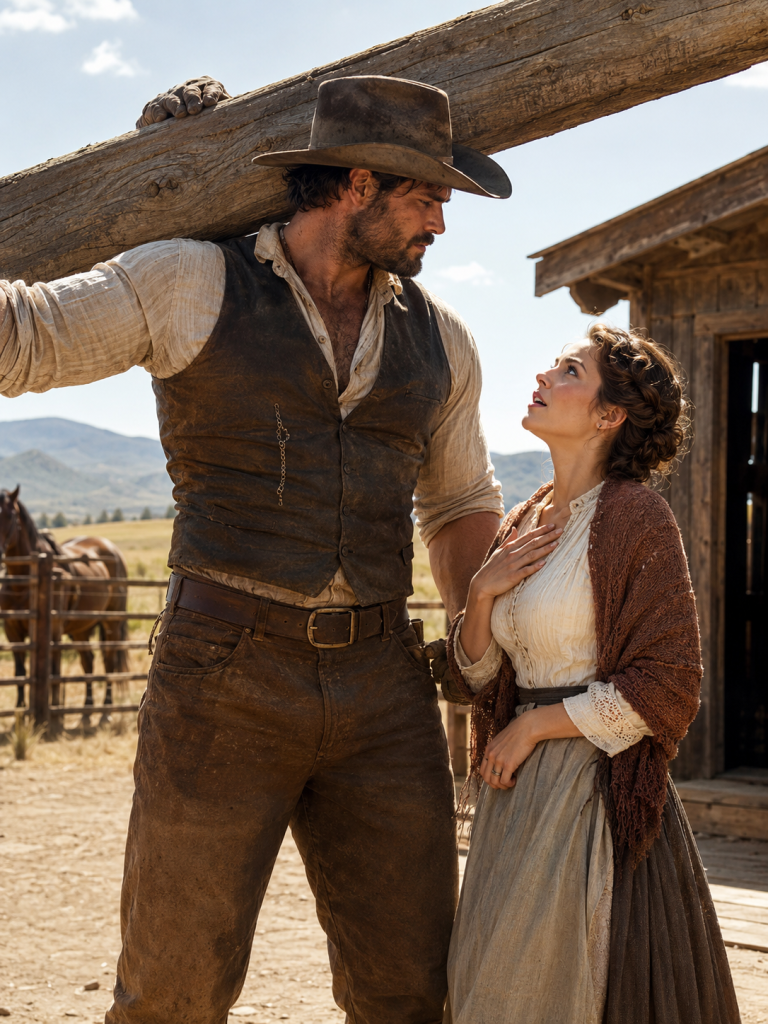
Kieran dismounted at the gate, removing his hat, his face sunburned from weeks in the open range. He looked tired. He looked like a man who had come back because he said he would.
“Miss Reed,” he said, formal and careful, aware of the neighbors who might be watching.
“Mr. Ali.” She was suddenly aware of her plain dress and the loose hair the breeze had made of her careful pinning.
“I finished earlier than planned.” He hesitated, which she had never seen him do before. “I was wondering if you’d allow me to escort you to the social at the town hall tomorrow evening.”
The monthly social. Dancing and food and communal gossip — the single most observed event in Crimson Creek’s calendar.
“You want to escort me,” she said, “after everything my family did to you?”
His expression changed. Not hardened — something more careful than that. “So you’ve heard.”
“My aunt told me. Kieran, I’m so sorry—”
“It was your father’s doing, not yours,” he interrupted. “I never held you responsible.”
“But the town will talk.”
A quiet smile crossed his face. “Let them. I’ve faced worse than wagging tongues.”
She found herself agreeing before she had fully decided to.
The following evening she wore her best dress — pale blue, brought from Boston — and waited on the porch with her hands not entirely steady. Kieran arrived at seven in a clean black suit, his hair trimmed, the jaw she remembered clean-shaven.
“You look beautiful,” he said. Simply, without embellishment.
The social was already in full swing when they entered. Conversation faltered. Every head turned. Violet felt the weight of the room like something physical.
“Ignore them,” Kieran said, his hand a light pressure at the small of her back.
They joined the dancing.
And for a few minutes — the room narrowing to just the two of them, the music, the movement — she remembered exactly why she had fallen for him all those years ago.
“Why did you never marry Sarah Williams?” she asked, during a pause.
His expression shifted. “There was no engagement. Despite what you might have heard.”
“I received an announcement—”
“Her father’s doing,” he said. “He wanted the land my property adjoined. When I refused to sell, he announced an engagement that didn’t exist to force my hand.”
Violet processed this as they moved toward the refreshment table.
“That day by the creek,” she said. “When I saw you with her—”
“She’d lost her mother’s locket. She was crying. I was trying to help her find it.” He handed her a cup of punch. “I tried to tell you. But you’d already left town.”
She stood with the punch in her hand and felt five years of misunderstanding rearrange themselves into something that made a terrible, coherent kind of sense.
Then, across the room, Sarah Williams began moving toward them.
And the evening tipped into something else entirely.
—
PART 3
Kieran excused himself to speak with the sheriff, and Violet was standing alone near the refreshment table when Sarah Williams appeared.
She had changed — harder around the eyes, the softness of girlhood entirely gone. She looked at Violet the way people look when they have been saving something up for a long time.
“You have some nerve,” she said, low and precise, “showing your face here with him.”
“I believe that’s between Mr. Ali and myself,” Violet replied.
“You ruined everything when you came back.” Sarah’s voice was gaining volume. People nearby were turning. “If you’d stayed gone, he would have—”
“From what I understand,” Violet said carefully, “that was never going to happen.”
Sarah’s face contorted. “You Reeds think you’re better than everyone. Your father was a thief and a liar, and the apple doesn’t fall far from the tree.”
It hit like a physical blow.
The room had gone very quiet.
“My father made a terrible mistake—” Violet began.
“He deliberately framed Kieran,” Sarah said, louder now, the restraint breaking apart. “Everyone knows it. He did it to get him away from you. And now you’re back doing the same thing — destroying what could have been—”
“That’s enough.”
The voice belonged to Sheriff Taylor, who had come in from the edges of the crowd with the expression of a man who has been holding something back and has decided the time has come.
He looked uncomfortable, and determined, in equal measure.
“Jacob Reed didn’t frame Kieran Ali alone,” the sheriff said. The room was absolutely still now. “He had help from the Williams family, who wanted the land that bordered theirs.”
Mrs. Williams, who had followed her daughter out, went pale.
“That’s a lie,” she sputtered.
“Got a signed confession from your ranch hand Peterson last month,” the sheriff continued. “Before he died of consumption. Said you and your husband cooked up the scheme together. Reed took the primary blame when it went wrong because—” He paused. “Because he was already dying of the cancer that took him two years later. He knew he didn’t have long. He figured he could absorb the consequences.”
The silence that followed was the loudest Violet had ever heard.
The ground seemed to tilt.
*He knew he was dying.*
She felt Kieran beside her before she heard him return — felt his presence, the steadiness of it, a hand at her elbow.
“He took the blame to protect you from the scandal,” Kieran said quietly. “Your father loved you in the only way he knew how, which was clumsily and with very poor judgment about means. But he loved you.”
Violet could not speak.
The crowd began to murmur and shift. The Williams women retreated — not elegantly, not with any particular dignity, but with the irreversibility of people who have been publicly exposed and have nowhere further to go. Sarah was crying by the time they reached the door. Her mother’s face was the flat, expressionless face of someone already constructing their next version of the story.
No one watched them leave with sympathy.
Kieran led Violet out into the cool dark of the June night, away from the light and noise of the town hall, along the familiar road toward the edge of town where the creek ran.
They walked in silence until the sounds of the social fell behind them.
—
The creek was silver in the moonlight.
The water ran quick and clear over the smooth stones, making the soft sound it always had, the sound she had heard in her dreams in Boston on certain nights when she couldn’t quite push Crimson Creek out of her mind.
“This is where I last saw you,” Kieran said. “Before you left.”
“I know.”
“I thought about what I should have done differently approximately every day for five years.”
“Why didn’t you write to me?” she asked. “I waited. I thought—”
“I did write.” He looked at the water. “Dozens of letters. Your father returned them unopened.”
She stared at him.
“By the time I found out he was intercepting the correspondence, you’d been gone almost a year. I assumed you’d built a new life. That you’d decided you didn’t want to hear from me.” He paused. “Seemed like your right.”
“Kieran.”
“I know.”
She looked at him, this man who had been her first love and her first heartbreak and apparently also the recipient of her father’s most elaborate and wrongheaded attempt at protection, and felt the sheer accumulated weight of all the wasted time settle through her like something finally completing its fall.
“All those years,” she said. “Because of misunderstandings and lies.”
“Not wasted,” he said. “We’ve both become people who might actually build something worth keeping.” He turned to her. “The question is whether you want to.”
She looked at the moonlit water.
She thought about Boston. The school, the girls she’d taught, the modest apartment with the window that faced a courtyard, the life that had been genuinely good in many ways and had been missing something she had refused to name for five years because naming it would have required admitting what she’d left behind.
“He returned all your letters,” she said.
“Every one.”
“I never knew you’d written them.”
“I know.”
She looked at his face. The scar along his jaw. The lines around his eyes that she hadn’t put there but that were part of the man who was standing here now.
“Then we have some catching up to do,” she said.
The smile that crossed his face was slow and complete.
“Miss Reed,” he said, “I believe that is the most sensible thing you’ve said since I sat down next to you this morning.”
—
The following weeks transformed Crimson Creek in the way that exposed hypocrisies sometimes transform small communities — not gradually but all at once, like a weather change. The Williams family’s involvement in Kieran’s framing became the new scandal, eclipsing anything that had been whispered about Violet. Old conversations were revised. New ones began.
People started to treat her differently.
Not all at once, not perfectly. But the cold shoulders warmed to cautious nods, and the cautious nods became occasional greetings, and the greetings became something that was beginning to resemble ordinary social life.
Kieran called on her properly.
Buggy rides on Sunday afternoons. Walks after church. Long evenings on Aunt Martha’s porch, learning each other as the adults they had become — filling in five years of gaps, finding where they were the same and where they had changed.
He told her about the Rangers. Two years of it, dangerous and sometimes necessary work that he had taken because he needed to go somewhere that required everything he had and didn’t leave room for thinking about what he’d lost. He’d come back to ranching because it was what he actually was, underneath everything else.
She told him about Boston. The school, the students, the colleagues who had become friends, the city’s particular loneliness — how you could spend a day surrounded by people and come home to an apartment that held only your own life, no spillover from anyone else’s.
“Did you ever consider staying?” he asked.
“I considered it seriously,” she said. “I had a good life there. I was valued.”
“And?”
She looked at the valley below the ridge where they were sitting in the late summer evening light.
“And Aunt Martha’s letters kept getting shakier,” she said. “That was the reason I told myself.”
He waited.
“But I think I was also looking for permission to come back,” she said. “I think I’d been homesick for a long time and didn’t want to admit it, because admitting it meant admitting that I’d left things unfinished.”
He was quiet for a moment. “Things,” he repeated.
“People,” she corrected.
He took her hand.
They sat like that until the sun was entirely gone.
—
In late August she received an offer to teach at Crimson Creek’s schoolhouse.
She had not been expecting it. She sat with the letter for a long time, turning it over in her hands, feeling the shape of the decision it represented.
She accepted.
Aunt Martha received the news with the expression of someone who has been waiting patiently for the obvious to be confirmed. “Your mother would be pleased,” she said. “She always liked that boy.”
“He’s not a boy anymore, Aunt Martha.”
“No,” her aunt agreed. “He grew up well, considering.”
The warm September evening when Kieran took her riding to the ridge overlooking the valley was one of those evenings that feel specifically designed for significance — the light coming down at exactly the right angle, the aspens along the creek already beginning to turn at the edges, the air holding that particular quality of early autumn that makes everything feel momentarily and beautifully finite.
He stopped his horse at the highest point and helped her down. They stood together looking out at the valley — the creek silver through the trees, the rooftops of the town they had both left and returned to, the wide Colorado sky doing what it always did in autumn, which was burn through every available color before it gave in to darkness.
“I’ve loved you since we were eighteen,” he said, holding her hands in both of his. “That’s not an arrangement I made. It just happened, and it persisted through five years and a framing and my own letters going unopened and a good deal of time spent convincing myself it was finished.” He looked at her. “I aim to love you till my last breath, Violet Reed. If you’ll have me.”
Her answer was unhesitating.
“Yes.”
—
They married in October, when the aspens had turned the color of struck gold.
The ceremony was in the same church where Violet had sat alone in the last pew four months earlier with her handkerchief pressed to her mouth while people whispered around her. The same building. The same wooden floor, the same modest altar, the same filtered light through the same windows.
Different in every way that mattered.
The pews were full. Not of people tolerating her presence, or watching with the particular attention of those hoping for additional scandal to report later, but of people who had arrived because they genuinely wished the couple well. Even old Mr. Hollister from the general store, who had watched Violet with suspicion from his boardwalk on that first Sunday, presented them with a silver serving set and the stiff warmth of a man making a sincere if somewhat awkward peace.
Reverend Collins, who had looked as though he’d swallowed something unpleasant the day Kieran walked her out of church, performed the ceremony with evident pleasure.
Aunt Martha cried, quietly and without apology, from the front row.
Kieran had purchased land on the eastern edge of town and built a house with his own hands over the summer — not large, but solid, the kind of construction that announces the builder intended it to last.
On their wedding night, he carried her over the threshold.
“Welcome home, Mrs. Ali,” he said, against her hair.
She had been thinking about those two words — welcome and home — for a long time. What they meant together. Whether Crimson Creek would ever feel like the second one again.
It did.
—
Their life together unfolded with the seasons.
Violet taught at the schoolhouse through autumn and winter and spring, adapting what she had learned in Boston to the particular needs and circumstances of Colorado ranch children, who had different practical knowledge than her Boston students and the same fundamental hunger to understand the world. She was good at the work. She had always been good at the work.
Kieran raised horses. His reputation for producing exceptional stock grew steadily — not through advertising but through results, the way genuine quality spreads. When he wasn’t working with horses, he occasionally assisted the sheriff, which he did with the same quiet competence he brought to everything, never using more authority than was necessary.
Aunt Martha’s health, freed perhaps from the daily anxiety of facing illness alone, improved unexpectedly. By the following spring she was well enough to travel to California to visit her sister, departing on the stage coach with her trunk and her opinions and a promise to return for Christmas.
“Never seen Martha so spry,” Reverend Collins commented after church one Sunday.
“She’s happy,” Violet said. “It improves most things.”
By their first anniversary, Violet was expecting their first child.
The whispers in town — and there were still whispers, because there are always whispers in small towns, that is the nature of proximity — were of an entirely different quality now. Admiring, mostly. Speculative about names and whether it would be a boy or a girl. The particular warmth that communities produce around new life when they have decided to embrace it.
“Funny how things change,” Kieran said one evening, as they sat on the porch of the house he had built, watching the late summer light change over the valley.
“A year and a half ago,” Violet said, “I was crying in the back of that church while they whispered about me.”
“Then a handsome cowboy sat down beside you.”
She laughed. “Is that how you’re telling it?”
“That’s how it happened.”
“Then a very foolish cowboy walked out before I could ask him any of the questions I immediately had.”
“Tactically,” he said, “that was the correct move. Leave her wanting answers.”
“You were not being tactical. You just thought it sounded better than anything else you had.”
He looked at her with an expression she had come to know as his version of conceding a point.
“I may have been somewhat at a loss,” he admitted.
She put her hand over his.
“It was still the bravest thing anyone had done for me in a long time,” she said. “Sitting down like it was the obvious choice.”
“It was the obvious choice.”
“Not to the room.”
“The room,” he said, “was wrong.”
—
Their daughter was born on a December morning when snow was falling soft outside the window and the stove was warm and Aunt Martha, who had returned as promised and showed no signs of leaving again, was in the kitchen making coffee and attempting to pretend she was not anxious.
They named her Catherine Martha Ali — Catherine for Kieran’s mother, Martha for the aunt who had kept faith with both of them through the long years of misunderstanding.
The town celebrated with the communal enthusiasm of people who had arrived late to supporting something and were compensating with volume. Even Mrs. Preston arrived with a handmade quilt and the expression of a woman performing a peace offering with full awareness of what it was.
Violet accepted it graciously.
—
As the years passed, their family grew.
A son came two years after Catherine. Twin girls in 1877, who arrived in the manner of twins everywhere — all at once, decisively, changing the household’s center of gravity permanently and for the better.
Kieran’s horse business expanded until it was among the best-regarded operations in the territory. Violet was eventually named headmistress of Crimson Creek’s school, which had expanded along with the town it served. She hired two additional teachers, established a small lending library, and argued successfully with the school board for a curriculum that assumed her students were capable of more than they were currently being given.
She was usually right.
The town itself transformed around them.
The railroad arrived in 1880, bringing new residents and the particular energy of connection to elsewhere — telegraph lines, newspapers from Denver arriving the same week, a hotel on the main street that served meals worth eating. The old church was replaced with a larger structure. Gas lamps gave way to electric lights on Main Street by the mid-eighties.
Through it all, certain things remained.
Sunday mornings in the front pew — the same church, now larger, now full of familiar faces that had mostly become friendly ones. The children arranged beside them in descending order of age, wearing varying degrees of patience. The particular feeling of being known, and choosing to stay known, and finding that it accumulated into something over decades that was different from and better than anything that could be built in a shorter time.
On their twentieth anniversary, Kieran surprised Violet by taking her back to the creek on an evening in late spring, when the aspens had gone full green and the water was high from the mountain thaw.
Their children ranged along the bank. The older ones had brought the younger ones, and the younger ones were doing what children always do by water, which is attempt to get as wet as possible while technically remaining on the bank.
“Remember when I found you crying in the church?” Kieran asked.
“How could I forget.” She leaned into him. “I thought my life was over that day.”
“Instead it was just beginning.”
“Best decision I ever made,” he said. “Sitting down next to a woman crying in the last pew while everyone stared.”
“And the bravest,” she said. “Thank you for being brave enough for both of us.”
He kissed her temple.
Below them the creek ran clear and quick over the smooth stones, making the same sound it had always made — the sound of a town Violet had left and returned to and made hers, or perhaps made herself to fit, or perhaps — most accurately — had built herself into along with it, the way all the best versions of belonging work.
The whispers had long since faded.
What remained was the particular settled quality of a life that had been genuinely chosen — not fallen into, not settled for, not arranged by other people’s designs. Chosen, repeatedly, on ordinary mornings and unremarkable Tuesday evenings and the significant milestones and all the undistinguished time between them.
Violet, who had sat alone in the last pew of a church in May of 1872 pressing her handkerchief to her mouth while the town whispered, had ended up with something she could not have predicted then and could not imagine trading now.
A man who had sat down beside her.
A town that had become hers.
A life that was, in all the ways that counted, exactly what she would have asked for if she had known what to ask.
In Crimson Creek, they still tell the story.
The woman who came back in disgrace and the cowboy who defied the whole room to sit beside her. Some people say it’s become a legend, romanticized and simplified the way stories get when they pass through enough hands.
But the Ali descendants know the real version.
They keep the letters — Kieran’s dozens of letters that Jacob Reed returned unopened, and the later ones they exchanged across the years, yellowed now, the ink faded to brown in places, but the handwriting still legible if you hold them in good light.
And in the handwriting you can read what actually happened.
Not a legend. Not a simplified thing.
Two people who were lied to and misled and kept apart by other people’s fears and ambitions and misguided love, and who found each other anyway — not in spite of the time lost but carrying it, the way you carry all the weight of your life, which is the only way it can be done.
A man who had sat down in the last pew because it was the obvious thing to do, and been right.
A woman who had taken his hand and stood up, and been brave enough to walk out through the doors.
A beginning that had been waiting patiently for five years to actually begin.
THE END