She Wore White And My Daughter’s Moon Bracelet To The Memorial — By Morning, Her Whole Life Belonged To Me

## Part 1 — The Woman in White at My Daughter’s Memorial
St. Aidan’s chapel sat on a low hill outside Philadelphia, ringed by dogwoods just past bloom, the kind of quiet, old-money quiet that makes grief feel like it should be tasteful. It had been three years since the machines at Children’s Hospital went silent, three years since I learned a mother’s heart can keep beating even after it stops working, three years since my husband held me in a hallway for exactly ninety seconds before excusing himself to take a call from a partner at the firm.
Nora had been seven. She loved pancakes shaped like bears, yellow rain boots with ducks on them, and the moon, which she was convinced followed only the people it loved. “It doesn’t follow everyone,” she told me once, scandalized by my lack of imagination. “Just the ones it’s keeping an eye on.”
When she died, there was no cinematic rain, no swelling score, nobody who could say she was in a better place and make it sound like anything but a performance. There was paperwork. Casseroles. Colleagues sending white orchids to the house and then, within the week, asking my husband when he’d be back at his desk. We had her cremated, because she’d once informed me, with total seriousness, that she intended to become “star dust.” Half her ashes lived in a small moon-shaped urn in her old room. We scattered the rest beneath the magnolia behind the house.
Every year I held a small memorial — just me, my sister Cass, Nora’s favorite nurse, a few mothers from her school who still remembered how she laughed. My husband, Julian Ashworth, cried beautifully the first year. He arrived late the second. By the third, he had a proposal.
“A foundation luncheon,” he said, pouring scotch older than our marriage. “Nora’s name doing real good — pediatric research, scholarships. It would give your grief some direction.” I should have heard the business plan folded inside the compassion. I didn’t, not then. I wanted so badly to believe the man who’d once painted glow-in-the-dark stars on our daughter’s ceiling because she was afraid of the dark was still somewhere underneath the tailored suits.
So the small memorial became the Nora Wren Ashworth Foundation Remembrance Brunch. The guest list quadrupled. Photographers waited outside the chapel. Donors arrived with quiet security. Women in black designer dresses murmured about how strong I was, which is the word people reach for when they don’t know what else to do with somebody else’s pain. They called me strong because I didn’t collapse where they could see it. They had no idea I’d already come apart in private, so completely and so quietly that what was left of me wasn’t fragile anymore. It was precise.
That morning I wore black wool with a neckline high enough to feel like a wall. Julian stood at the chapel entrance in charcoal, greeting donors, accepting condolences for a daughter he hadn’t mentioned at our dinner table in six months, his hand resting on the small of my back — not for comfort, I understood now, but the way you keep a hand on a gate you don’t fully trust to stay shut.
Then a silver Mercedes pulled up at the curb. Julian’s second car, the one he swore he kept downtown for client emergencies.
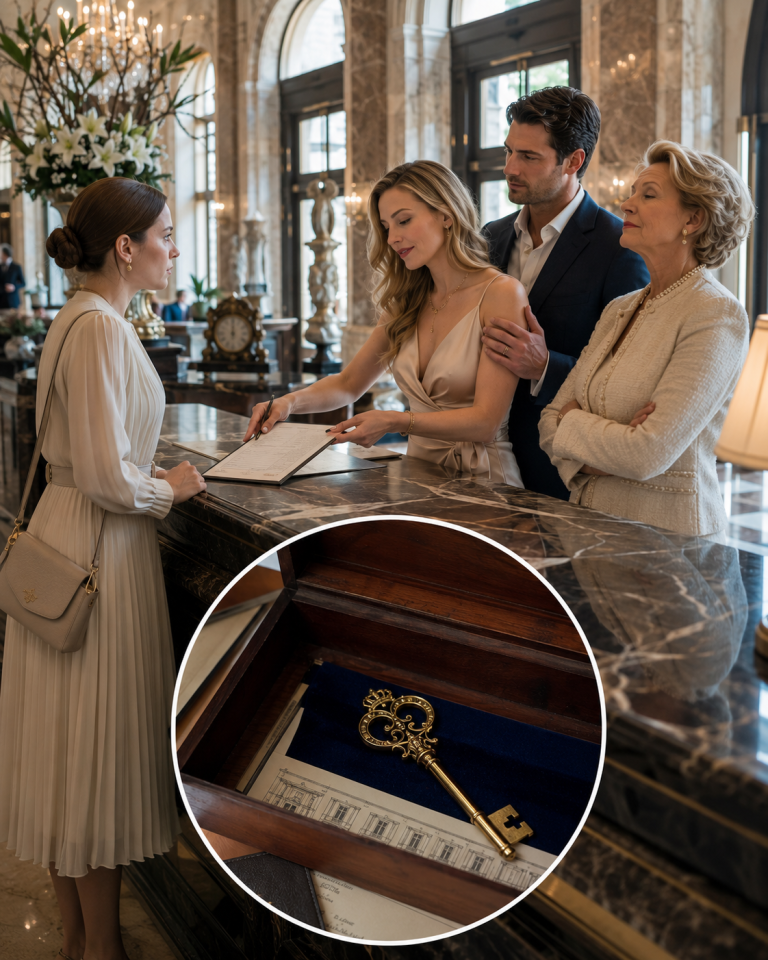
Sabrina Voss stepped out of it in a fitted white dress that caught the April light like something borrowed from a bridal shop. White heels. White pearls. White gloves thin as an excuse, folded around lilies she had no right to be holding at my daughter’s memorial. Twenty-eight, a body built by Pilates and a laugh built for cameras — the kind of woman whose entire personality was a curated photograph of a life she hadn’t earned yet.
The murmurs started before I’d fully turned around. A woman in white at a memorial rearranges a whole room’s attention, whether the room wants to give it or not.
Julian’s hand tightened at my back. “Stay calm,” he said, low, through a smile aimed at the donors behind me.
Not *I’m sorry.* Not *I didn’t know she’d come.* Not *she needs to leave.* Just — stay calm. As if I were the one about to make a scene.
Sabrina crossed the gravel slowly, savoring every step. The crowd parted for her, because cruelty in the right dress is so often mistaken for confidence.
“Margot,” she said, soft and rehearsed. “I wanted to pay my respects.”
I looked at the lilies. Nora had hated lilies — the smell made her sick on her worst treatment days. Sabrina couldn’t have known that unless somebody told her.
“She made a generous gift to the foundation,” Julian said, clearing his throat, as though a check could purchase an invitation to my grief.
Of course it had.
My sister Cass appeared at my elbow, sharp as ever. “What in God’s name is she wearing?”
I didn’t answer, because by then I’d already seen it. The bracelet. Tiny silver chain. Moon charm. The scratch near the clasp.
My knees went cold. Not weak — weak makes you fall. Cold makes you still.
Sabrina lifted her wrist, brushing hair from her face like it was an accident, and the charm caught the light. A signature. A confession dressed in silver.
“For God’s sake, Margot,” Julian hissed. “Not here.”
I smiled, and it seemed to unsettle him more than tears would have.
“Of course not,” I said, and walked into the chapel, already rebuilding myself from the inside out.
The service was elegant — a string quartet, embossed programs, white roses instead of the sunflowers I’d asked for. Julian gave a speech about courage and a father’s love, describing bedtime stories he’d read Nora in the hospital, though I knew for a fact he’d been in Chicago the week she asked for him every single night. The room wept on cue. Sabrina sat in the second row dabbing dry eyes with a white handkerchief, the bracelet gleaming on her wrist like a blade she didn’t know she was holding.
When it was my turn at the podium, I looked out over donors and reporters and old friends and one particular woman in white, and I let the silence stretch a beat longer than comfort would allow, long enough that a few people shifted in their seats, unsure whether I’d lost my place or found it. I hadn’t lost anything. I had spent three years losing things I couldn’t get back, and I’d finally arrived at the one loss I intended to do something about.
“My daughter believed the moon only followed the people it loved. She believed gardens could fix sadness, and that people got better when you loved them properly.” I let my eyes rest on Julian for exactly one second. “I used to believe that too.”
Something shifted through the room — not understanding yet, just instinct, the way a crowd smells smoke before it sees fire.
“But Nora also taught me love isn’t the same thing as weakness. And memory isn’t decoration. It’s sacred.” I closed my notes. “Today, I’m asking everyone here to help protect what’s sacred. Thank you for remembering my daughter.”
I stepped down before Julian could catch my elbow.
And somewhere between the podium and my seat, I stopped being his grieving wife.
I became his consequence.
## Part 2 — What the Porcelain Angel Saw
The first thing to disappear was a yellow hair ribbon, untied from the neck of Nora’s stuffed rabbit. Then her music box, the little wooden carousel that played *Clair de Lune*, a gift from my father the Christmas before her diagnosis. Then, worse than either, my late mother’s silver locket, the one she’d given Nora the week before we learned the word *leukemia*.
Julian told me I was imagining things. “Grief makes people paranoid, Margot,” he said, adjusting his tie in the mirror. “You need rest, not accusations.” But grief hadn’t made me paranoid. Grief had made me exact.
I called Renata Cole, a former federal forensics investigator my sister knew, the kind of woman wealthy wives quietly hire when they’ve stopped believing their husbands’ explanations. Renata walked through Nora’s lavender-walled room without touching a single thing, then helped me install two motion-activated cameras — one behind the porcelain angel on the dresser, one inside the vent above the bookshelf. Legal. My house. A room no guest had permission to enter.
“Let the evidence come to you,” she said. “Don’t go looking for it every hour.”
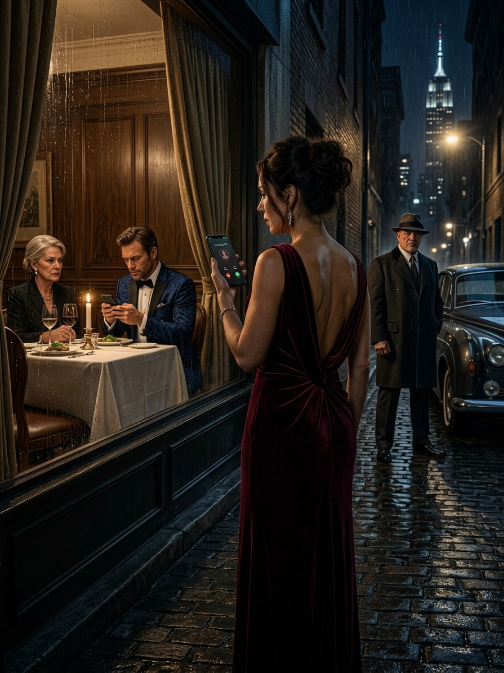
Two weeks of nothing. Then, on a Tuesday I’ll never fully stop replaying, an alert buzzed against my palm while I sat outside a florist choosing arrangements for the very memorial that hadn’t happened yet. I opened the footage with my heart already sinking through the floor of the car.
Sabrina walked into my daughter’s bedroom like she already owned the deed to it. Not sneaking — sneaking would have implied she felt something like fear. She went straight to the dresser, opened the memory box, and lifted the moon bracelet to the light like she was choosing earrings before a date.
Julian’s voice drifted in from the hallway. “Hurry up.”
“It’s just a bracelet. Relax.”
“She notices everything in that room.”
“Maybe she should stop living in a shrine.”
He stepped into frame beneath the glow-in-the-dark stars he himself had painted. Not ashamed. Annoyed.
“Can I keep it?” Sabrina asked.
“Why would you even want it?”
“Because she loves it.”
The silence that followed had weight even through a phone screen in a parking lot in the rain.
Julian shrugged. “Fine. Just don’t wear it where she can see.”
Sabrina slipped it into her purse. Julian closed the memory box — not gently, not reverently, like closing a filing drawer.
I watched the clip three times. Once as a mother. Once as a wife. Once, finally, as a plaintiff building a case.
Renata’s reply came within minutes: *Do not confront him. Save everything. Call me tonight.*
That evening I cooked his favorite dinner and poured his favorite wine and let him tell me about a merger and a difficult partner and a judge he golfed with, and when he reached for my hand and told me I “seemed better,” I said, “I feel clearer,” and meant something entirely different than what he heard.
For a month I became the wife he wanted — quiet, useful, photographed beside him at every event as proof of our tragic, resilient marriage — while Renata and I built a file so thick it needed its own drawer. Foundation money routed through a shell vendor called S.V. Creative Group had quietly paid Sabrina’s Rittenhouse Square rent for eight months. A chunk of our marital assets had migrated into a Delaware trust controlled by Julian’s college roommate. The beneficiary on a life insurance policy I’d never known existed had been changed without my signature. A credit card opened in the foundation’s name had funded jewelry, spa weekends, and a trip to Aspen during a week Julian told me he was meeting pediatric researchers in Denver.
There were smaller cruelties buried in the paper trail too, the kind that only mean something to the person holding the receipts. A florist’s invoice for lilies delivered to an apartment on the same week Julian had told me lilies made him think too much of hospitals to ever order them again. A dinner reservation logged for two, on Nora’s birthday, while I sat at home with a cake no one but Cass came to help me eat. None of it would matter in a courtroom. All of it mattered to me.
My attorney, Diane Marsh — silver-haired, red-lipped, a framed quote behind her desk that read *do not confuse composure with consent* — watched the bedroom footage without blinking.
“Your husband,” she said finally, “is either reckless or arrogant.”
“Both,” Renata said.
“Good,” Diane said. “Arrogant men are generous with evidence.”
I slid a second folder across her desk — documents even Julian didn’t fully know existed, land and shares and a narrow brownstone off Delancey Street, left to me by my grandmother Josephine Wren, who had taken my face in her papery hands on my wedding day and whispered, *love him, darling, but never hand a man the map to every room inside you.* I’d thought it cynical at twenty-six. I thought it holy now.
“This is separate property,” Diane said. “And he doesn’t know the scope of it?”
“No.”
“Then let him keep believing you have nothing left but grief.”
That became the plan. Let Julian move. Let Sabrina pose for photographs. Let them both underestimate the woman standing quietly in black — right up until the moment it stopped being quiet, and stopped being underestimated, and became something neither of them could survive without consequence.
## Part 3 — The Foundation He Never Read Closely Enough
By early summer Sabrina had stopped hiding anything. She posted from restaurants Julian claimed never to visit, wore a bracelet from our joint account statement, tagged a location in Nantucket and then deleted it, forgetting that screenshots are a language every wronged woman speaks fluently now. Her bio read *building a beautiful life.* I wondered, more than once, whose ruins she planned to build it on.
Julian, meanwhile, turned strategically kind — flowers, compliments, a gentle suggestion that I try a “discreet wellness retreat outside Sedona,” no phones for the first two weeks. No phones. Of course. Renata later found an email he’d sent a psychiatrist named Dr. Owen Price, asking, without using my name, about inpatient intervention for a spouse showing “delusional attachment to a deceased child’s belongings.” He was building his narrative before I’d even realized there was a narrative to fight.
“He wants the foundation,” Diane said. “And an affair that looks like grief instead of betrayal. If you’re unstable, his cruelty becomes a symptom of his suffering.”
I hosted a quiet dinner at the Delancey Street brownstone — the one Julian believed belonged to my cousin — for three foundation board members, including Helena Byrne, who had once held Nora at a fundraising picnic and remembered the bracelet the second she saw the footage.
“My God,” she whispered. “That was Nora’s room?”
The brownstone itself had become something like a war room by then, though it hadn’t started that way. My grandmother had furnished it in quiet luxury — antique mirrors, linen sofas, oil paintings of stormy Atlantic coastline — and for years after Nora died I’d avoided the place entirely, because it hurt too much to be somewhere she’d loved without her in it. Now the dining table that had once hosted her birthday parties held bank statements, shell-company invoices, and a legal pad where Cass had written, in her own private shorthand, a running list of every lie Julian had ever told at that same table.
“He’s going to say you’re vindictive,” Helena said quietly, after the numbers had done their work on the room.
“I’m not vindictive,” I said. “I’m thorough. There’s a difference, and it happens to be the same difference between a marriage and an alibi.”
Within forty-eight hours the board froze discretionary spending. Within seventy-two, an independent audit opened. Julian found out on a Thursday evening and came home slamming the front door hard enough that the whole house seemed to flinch.
“What did you do?”
I kept arranging tulips. “That depends what you mean.”
“You turned the board against me.”
“I turned the truth on. You did the rest.”
“You’re unstable,” he said, quiet and rehearsed, the first line of the story he intended to tell everyone. “Fixated on objects. Can’t let go.”
“Which objects?” I asked, watching his eyes flick, just barely, toward the stairs, toward Nora’s door.
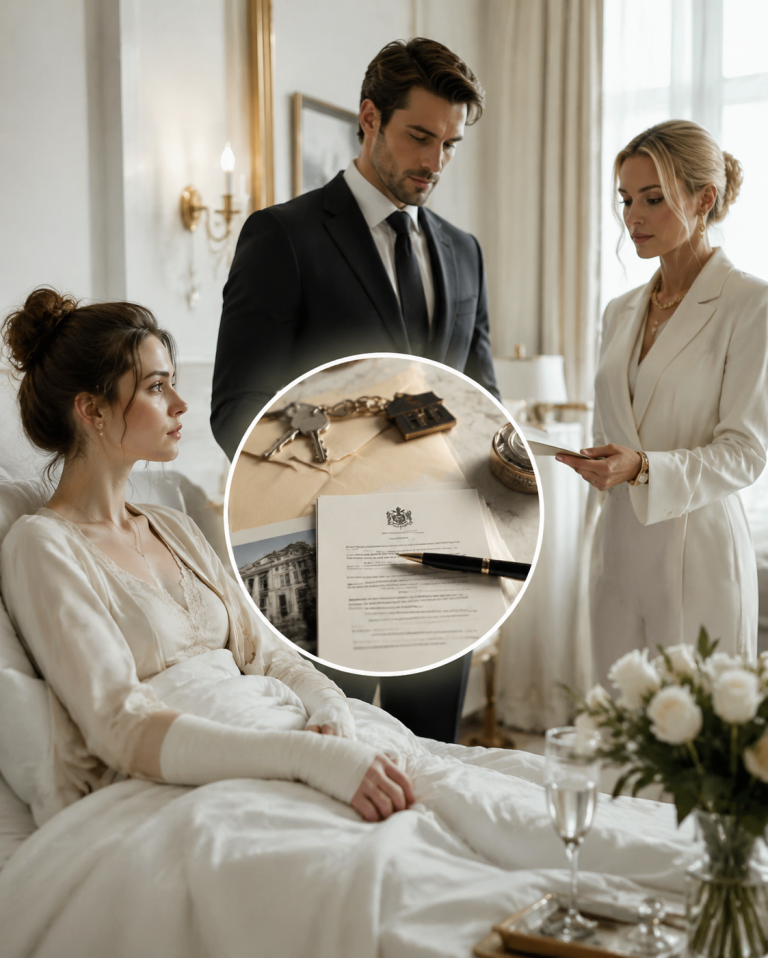
He left that night with a leather bag and a line about needing space. Sabrina posted a photo of two champagne flutes on a balcony over the Schuylkill: *peace looks good on me.* Three days later, Julian filed for divorce, describing me as emotionally volatile and requesting temporary control of both the foundation and our home, on the grounds that it would harm me to remain “in a residence saturated with traumatic triggers.” He never mentioned Sabrina. He never mentioned the bracelet. He never mentioned the camera.
That omission was the whole case.
The weeks before the hearing were their own strange education in grief’s second life. It doesn’t announce itself the way people expect. It shows up as a locksmith rekeying the study while you sign for a grocery delivery. It shows up as your sister quietly removing a second toothbrush from the guest bath so you don’t have to be the one to find it. Julian called eleven times that first week. I answered twice. The first time, he wanted to know whether I’d leaked the wire transfers to the board myself, as though being caught mattered more to him than what he’d done to get caught. The second time, he asked if I’d told my mother “the whole story,” and I understood, with something close to pity, that he was still trying to manage which version of himself would survive being retold. I told him my mother had suspected long before I let myself catch up to her. He didn’t call again.
Helena requested one more private meeting before the hearing, in a tea room she’d chosen for its chandeliers, the kind she found reassuring. She asked, gently, whether there was “any world” in which this could be handled quietly, for the sake of the foundation’s name. I told her there was — the same world where Julian hadn’t manually let his mistress into our daughter’s bedroom to take whatever she wanted. Helena didn’t finish her tea either.
The Montgomery County courtroom was smaller and colder than anyone expects from television, all beige walls and a vending machine that ate Cass’s dollar without producing pretzels. Julian arrived with two attorneys and the posture of a man who still believed money bought gravity. Sabrina sat three rows back in pale gray, auditioning for innocence.
His attorney painted me as isolated and erratic, referencing my “unfounded suspicions” about marital property and the “discomfort” I’d caused at a charitable memorial. Diane stood, calm as still water, and asked permission to enter exhibits relevant to credibility and misappropriation. The invoices came first — the shell vendor, the apartment lease, the Aspen receipts. Then the email to Dr. Price, admitted only in part, but admitted. Then the footage.
Julian went very still watching himself on that screen, the way a man goes still when he realizes the floor under him was never marble at all.
*It’s just a bracelet. Relax.*
*She notices everything in that room.*
*Maybe she should stop living in a shrine.*
*Can I keep it?*
*Why would you even want it?*
*Because she loves it.*
*Fine. Just don’t wear it where she can see.*
The gallery made a sound I felt more than heard. Diane placed one final photograph on the exhibit table — Sabrina in white at the memorial, wrist lifted, moon charm catching the light. Someone in the back row said, quite audibly, “Jesus.”
The judge denied Julian’s request for the house. She restricted his access to foundation funds pending review. By evening, someone had leaked the memorial photograph — not the courtroom footage, Diane would have ended me for that — and by midnight it had traveled through Philadelphia society like fire through dry grass. *The mistress who wore a dead child’s bracelet to her memorial.* Sabrina deleted her accounts before sunrise. The foundation board announced a full independent investigation by morning.
Julian texted seventeen times. *You’ve gone too far. This hurts Nora’s legacy. We can fix this privately. I loved you once.* That last one almost worked, because I had loved him once too — the version of him who cried in a hospital gift shop worried a pair of shoes wouldn’t fit his daughter by Christmas, who carried her through snow because she wanted to touch it falling. But love doesn’t raise the dead, and it doesn’t excuse robbing them either. I read each message once, closed my phone, and went back to helping Cass alphabetize exhibits at the kitchen table, because grief, I’d learned, does not pause for an apology that arrives eleven days too late and asks for something in return.
When Sabrina’s attorney offered to return the bracelet by mail, I said no. “I want it entered into evidence,” I told Diane. “Nothing stolen returns untouched anyway. I’d rather it mean something.”
The last discovery undid what remained of Julian’s certainty entirely. Six months before filing, he’d tried quietly transferring our house into an LLC tied to his Delaware trust — except the house had never been his to move. It had come to me through a family trust my grandmother established before my marriage, leased to us through a structure Julian had never bothered to read closely, because he’d always assumed anything that looked like ours would eventually just become his. When Diane laid the deed history out on her desk, tracing it back through three generations to my grandmother’s own careful signature, she looked up at me with something close to admiration. “Your grandmother,” she said, “understood exactly what she was protecting you from, didn’t she.” I told her Josephine Wren had buried two husbands and outlived a great deal of foolishness, and had never once mistaken affection for ownership.
Buried deeper still was a single clause I’d insisted on when we drew up the foundation’s bylaws, back when Julian was too busy picking board photographs to argue: in the event of ethical misconduct by a founding director, voting control transferred temporarily to the child’s maternal next of kin. Not *surviving parent.* Not *spouse.* Me.
He’d signed it without reading it. Men like Julian tend to believe paperwork is for other people.
At the emergency board meeting, he arrived ready to negotiate, apologizing for “distractions” and “poor judgment,” suggesting he step back while staying on in an advisory role, ending with, “We all want what’s best for Nora’s legacy” — as though her name in his mouth still carried any weight with me at all.
Diane read the bylaw aloud. Julian objected that it couldn’t possibly apply. “You signed it,” she said simply. The vote to remove him was unanimous. Foundation funds were redirected toward direct hospital grants, family housing, and a new program Nora would have adored — small rooftop gardens for children in oncology wards, something living within reach on the worst days of their lives.
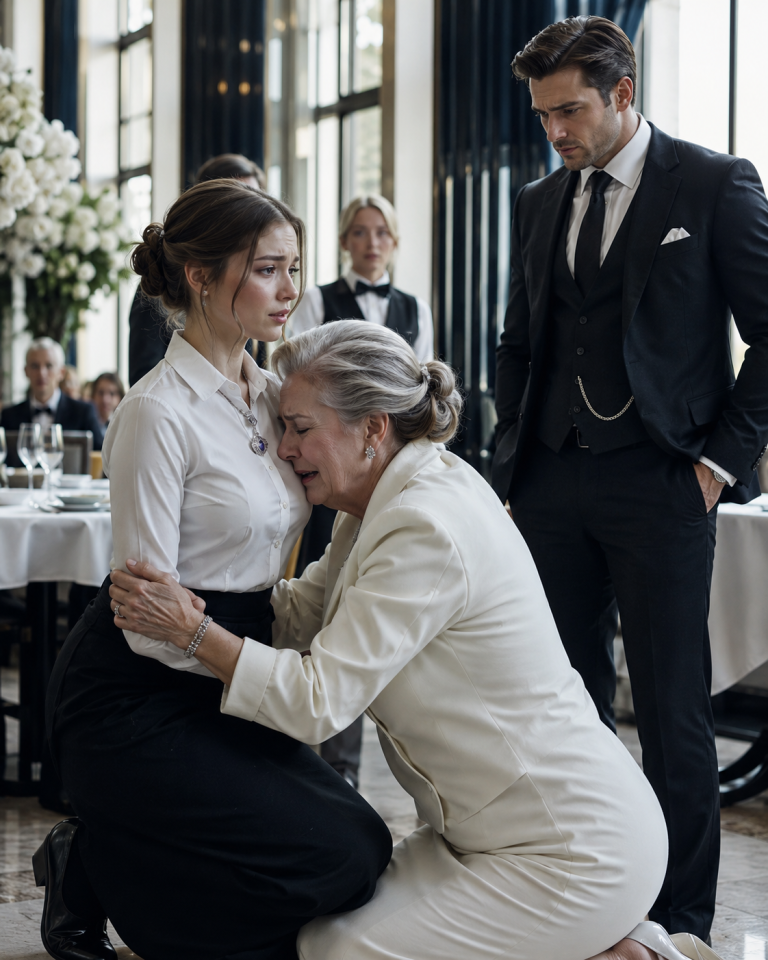
When the room emptied, Julian stayed seated, looking older than I’d ever seen him, less like a man built from privilege and more like what he actually was underneath it. “Was this worth it?” he asked. “Destroying me?”
“You brought her into our daughter’s room,” I said. “You let her take the bracelet. She rode to the memorial in your car.” I set one last document in front of him — notice terminating his occupancy of a house he had never actually owned. He read it twice, and I watched him finally understand that none of it — not the house, not the foundation, not our story — had ever fully belonged to him. It is a strange thing, watching a man discover in real time that certainty was never the same as ownership.
“Nora would hate this,” he said, reaching for the one cruelty he had left.
Even Diane went still.
“Nora hated lilies,” I said. “You forgot that. She hated being alone in that hospital room, and you forgot that too. She loved the moon, and pancakes shaped like bears, and yellow rain boots, and a garden she promised to buy me one day. But she never once hated justice.” I picked up my bag. “You brought her into my grief. I brought you into court.” Then I walked out and didn’t look back.
—
A few weeks after the settlement papers were signed, a young reporter from a regional business weekly asked to sit with me for what she called a “quiet profile” — no scandal, no bracelet, just the woman quietly rebuilding a foundation under her own name. I almost declined out of habit. Then I thought of my grandmother, who used to say the loudest version of a story is rarely the truest one, and I said yes.
Near the end of the interview, she asked whether I regretted marrying Julian at all. I told her no, and meant it in a way that surprised even me. Nine years with him had taught me exactly how much of myself I was willing to hand over before I noticed the account running dry — and exactly how quickly I could rebuild once I stopped making excuses for the withdrawals. Regret, I told her, is for people who haven’t yet learned anything useful from their own history. I had learned plenty. I only intended never to be tested on it twice.
She asked one last question almost as an afterthought, packing away her recorder: what had I felt, standing outside that chapel the moment I first saw the bracelet on Sabrina’s wrist. I considered giving her something cleaner for print. Instead I told her the truth — that for exactly one second I’d felt like the girl who used to trip over her own church shoes as a child, small and caught out in front of an audience she hadn’t chosen. And then the second passed, and what replaced it wasn’t sadness at all. It was clarity, the specific, weightless clarity of finally holding proof for something you’d spent years being told you’d imagined.
Six months later, the first Nora Wren rooftop garden opened at Children’s Hospital — nothing grand, which was exactly what made it beautiful. Raised beds of lavender and strawberries, pale yellow benches, wind chimes shaped like tiny moons, a mural of stars painted by kids on the oncology floor. A small sign near the entrance read: *for Nora, who believed the moon only follows the people it loves.*
I stood there in navy, not black. Cass cried and blamed pollen. Renata came in sunglasses and insisted she was only there for a security assessment. Diane sent flowers with a card that read *composure was never consent.* Julian didn’t come. By then our divorce was final, his firm had let him go before he could resign first, and Sabrina had given one tearful interview about being “manipulated” before disappearing to Florida with a smaller following and a longer list of regrets.
A little girl in a pink knit cap rolled her IV pole over to the strawberry bed and touched a green berry with one finger. “When will it turn red?” she asked.
“Soon,” I told her.
She looked up at the pale daytime moon. “My grandma says the moon’s shy in the daylight.”
“My daughter used to say it follows the people it loves.”
The girl considered this with total seriousness. “Maybe it followed her here,” the girl said, quite seriously, as children often are about the things adults have stopped believing in.
I didn’t answer right away, because my breath had caught somewhere gentle and unexpected. “Maybe it did,” I finally said.
That night, back at the house the trust had returned fully to my name, I had the lilies pulled from the front beds and sunflowers planted along the drive instead. In Nora’s room, I opened the windows and let spring air move the curtains. The porcelain angel still sat on the dresser. The camera was long gone — it had done its work. I opened the blue velvet memory box and set inside it a photograph from the garden opening: children painting stars, yellow benches, moon chimes, and my own hand wearing Nora’s bracelet. Then I closed the lid — not like a drawer this time. Like a promise.
I walked out to the magnolia where we’d scattered her ashes, barefoot in the cooling grass, and stood there until the moon came up over the rooftops, round and patient and unhurried, following whoever it had decided to keep watch over. I no longer wondered whether Nora would be proud that I’d merely survived. Survival had never been the whole of it. I had protected her name. I had turned a stolen bracelet into evidence, a public humiliation into a verdict, and a house full of ghosts into a garden where something could actually grow.
There is a particular kind of quiet that comes after a war finally ends — not peace exactly, not yet, but the absence of a specific, familiar dread you’d carried so long you’d almost mistaken it for a personality trait. I noticed it first in small ways. I slept without waking at three in the morning to check whether a door downstairs had opened. I stopped rehearsing arguments in the shower. I found myself, one ordinary Tuesday, laughing at something Cass said on the phone before I’d even realized I still knew how.
And when the wind finally moved through the magnolia blossoms that night, I didn’t hear the sound of everything that had been taken from me anymore.
I heard my daughter laughing.
Soft. Silver. Free. And for the first time in three long years, that sound was the only thing left in the room worth listening to.