The Waitress Who Yanked a Stranger Under the Table Before the Bullet Hit — And Learned Too Late Who He Was

## PART ONE
There’s a particular hour of the night when a city stops pretending. Not midnight, which still belongs to the drunks and the lovers, but later — that gray, hollowed-out stretch after three, when even the neon outside seems tired of buzzing and the streets go quiet in a way that feels less like peace than held breath.
That was the hour I lived in. The Starlight Diner ran a skeleton shift, and I was the skeleton.
I had been scrubbing the same table for the better part of five minutes, working at a stain that had fused with the laminate years before I was hired, because scrubbing was easier than standing still. Standing still let me think, and thinking led straight to the folded slip of paper taped to my bathroom mirror — the one with the red lettering, the one that used the words *final notice* like they meant nothing at all. Rent was sixteen days late. My tips that night fit in one apron pocket with room to spare. My feet had gone past aching into a kind of numb hum, and I could feel every hour of the double I’d worked pressing down on the back of my neck.
I was twenty-six and I had learned to make myself invisible, which is a skill nobody tells you that you’ll need. Men clicked their fingers at me without lifting their eyes from their screens. I had trained my mouth into a smile that cost me nothing because it meant nothing, and I served the coffee, and I said *sure thing, hon,* and I did not let them see that some nights I wanted to pour the pot over their heads and walk into the river.
The bell over the door gave its thin little rattle. I didn’t look up. Cab drivers, night nurses, insomniacs — the door meant nothing at that hour.
Then the room changed.
I can’t explain it better than that. The air seemed to cool and tighten, the way it does a half-second before lightning, and the three men still scattered at their tables went utterly quiet, the kind of quiet that has a texture to it. When I finally raised my head, three figures stood framed in the doorway against the wet neon glow of the street, and every instinct I owned stood up at once and told me to run.
They wore charcoal suits cut so close they looked less like clothing than like something grown. Two of them were clearly there to watch, hands loose at their sides in a way that was studied, professional, wrong. The third walked in ahead of them, and the whole room bent slightly toward him without meaning to, the way a field of grass leans before a storm.
He was tall, dark-haired, unhurried. He crossed to the back booth with the economy of a man who has never once wondered whether a space belonged to him, and when he sat, he sat facing the door — of course he did — and let his gaze move across the diner once, slow and clinical, counting exits, weighing threats, filing each of us away. His eyes were a pale, wintry gray, and they were the most intelligent and least kind eyes I had ever seen on a human face.
One of the watchers stepped up to the counter. “Coffee,” he said. Not a request. A single word laid down like a coin.
My hands weren’t steady when I lifted the fresh pot. I walked over anyway, head down, the old habit, and I set the cup and poured without looking at the man in the booth, because some part of me already knew that looking at him would cost me something.
“Long night,” he said.
His voice was low and unhurried, a dark current under still water, and there was an accent buried in it — something Eastern, something that had been worn smooth by years of speaking other people’s languages better than they did.
“Long enough,” I managed.
“Your name.”
I should have lied. I had a dozen fake names for exactly this kind of man. Instead the truth walked out of me before I could stop it. “Nadia.”
He repeated it once, quietly, turning it over as if testing its weight. *Nadia.* And I felt the strangest, coldest certainty that I had just handed something over that I would not be getting back.
I retreated behind the counter and pretended to refill sugar jars and told myself the rumors weren’t true, that the man in the back booth wasn’t the man the whole neighborhood spoke about in lowered voices. The Zorin name got said the way you’d say the name of an illness. Aleksei Zorin owned the waterfront, the freight, the card rooms, and the darker traffic underneath all of it that kept the lights of the city humming. And here he was. At my counter. At three in the morning. Watching me over the rim of a cracked mug.
Thirty minutes crawled by. He made low calls in a language I didn’t speak. His men never stopped scanning the street.
Then the bell rattled again — and this time the air didn’t cool. It sharpened, went metallic, went to knives. Two men came in from the rain, and they didn’t have the look of anyone who wanted a meal. The one in front had a seam of old scar dragging down one cheek, and his eyes went straight past me to the booth.
“Zorin,” he said, in a voice like stone grinding stone.
And I watched a man who had not been afraid of anything all night go very, very still.
—
## PART TWO
Aleksei didn’t rise. He didn’t reach for anything. He simply looked up, and every ounce of warmth I hadn’t known his face held drained out of it.
“You shouldn’t have come here, Marek,” he said. Quiet. Almost gentle. “This part of the city stopped being yours.”
Marek laughed — a wet, ugly sound with no humor anywhere inside it — and his hand slid into his jacket.
After that, time stopped behaving.
I saw the metal clear the fabric. I saw the black eye of the muzzle begin to turn toward the booth. And I did the single most insane thing I have ever done in my life: I crossed the space between us. Not bravely. Not by choice. My body simply threw itself forward while my mind was still three seconds behind, screaming.
My fists closed on his lapels and I dragged all my weight down, and we went off the bench together as the first shot obliterated the window where his head had been. We hit the floor tangled up, and the world detonated into sound — a second round tearing through the booth above us, foam and vinyl bursting like something gutted, glass raining down, a chair going over, men shouting words I couldn’t parse over the shriek of my own pulse.
He turned us. Even there, even then, some part of him was still in control, and he rolled his body between me and the room and clamped one hand around the back of my skull, pressing my face into his shoulder so hard I could feel his heartbeat against my cheekbone. It was slower than mine. Steadier. The heartbeat of a man who had done this before.
The gunfire climbed to a peak and then, all at once, fell off a cliff into silence — a silence so total it rang.
“Clear,” someone said, breathless. “They ran.”
I felt the tension bleed out of him by degrees. But he didn’t let go. He held me in the wreckage a moment longer, his hand still cradling my head with a tenderness that made no sense coming from those hands, and when he finally drew back far enough to see my face, his gray eyes searched mine like he was reading a document written in a language he’d thought was extinct.
“Nadia,” he said again. But it came out different this time. Cracked open. Almost reverent.
He rose in one smooth motion and pulled me up after him, one hand firm at my waist so my knees wouldn’t fold. The diner around us looked like the inside of a shell that had gone off. And through the ringing in my ears I understood the thing that would rearrange my entire life:
I had just saved the life of the most dangerous man in the city. Which meant I was no longer allowed to be no one.
“You’re coming with me,” he said.
It wasn’t a question. And God help me — I didn’t say no.
—
## PART THREE
The SUV swallowed us into leather and silence.
The windows were tinted so dark the city dissolved the instant the doors shut, and the noise of the wrecked diner, the sirens I could already hear gathering somewhere blocks away, the whole ruined night — all of it was simply sealed off, as if it had happened to other people. Aleksei sat beside me, close enough that I could feel the heat coming off him, and gave a single word to the driver.
“Home.”
I stared at the smear of neon dragging past the glass and tried to make my brain accept that I was being carried away from everything I owned by a man I’d met an hour ago. “My apartment,” I heard myself say, and even as the words left me I knew how absurd they were. What was in that apartment? A mattress on the floor. A shelf of secondhand paperbacks. My grandmother’s little wooden jewelry box with its broken clasp. Nothing that could weigh against the memory of a gun turning toward my face.
He glanced at me, and for a moment something moved behind the winter of his eyes that I would later learn to recognize as the closest he came to gentleness.
“It’s already handled,” he said.
And I understood, with a small cold drop in my stomach, that in his world nothing was ever *solved.* Things were handled. Made to disappear. He lifted his phone and spoke in that low melodic language again, moving people and problems around a board I couldn’t see, and the sheer casual scale of his power frightened me more than the guns had. Marek had a gun. This man had a city.
The building he brought me to looked less like a home than a fortress that had learned to wear a tuxedo — pre-war stone, iron, a doorman who did not so much as blink at the woman in the coffee-stained uniform being walked in out of the rain. A brass elevator rose in near silence and opened directly into a penthouse that was beautiful the way a blade is beautiful. Cold. Exact. Every surface deliberate. One wall was made entirely of glass, and beyond it the city spread out and glittered like something he’d conquered and hung on the wall.
“The guest room is at the end of the hall,” he said. “You’ll be safe here.”
I believed him. Not because I trusted him — I didn’t, not remotely — but because his certainty was a physical thing, and I had run out of the strength to doubt it. He turned and walked away, precise as a closing door, and left me alone with the enormous, humming quiet and the knowledge that the girl who had scrubbed that table five hours ago was already, quietly, ceasing to exist.
I didn’t sleep. I walked the length of that beautiful cold room until the sky over the skyline started going the gray of old ash, and I replayed it all — the muzzle, the glass, his slow heartbeat against my cheek, the way he’d said my name like he was surprised to find it fit in his mouth.
—
The days that followed had the texture of a strange, gilded dream.
I was watched constantly — guards whose eyes tracked me with the flat patience of security cameras, who appeared at the edges of rooms without sound. I was fed, deferred to, treated with a careful courtesy that never once let me forget I could not leave. The penthouse was luxurious and it was a cage, and after the first few days I stopped being able to tell the difference.
But something else was happening underneath, something I didn’t have a name for yet.
We talked. Not easily — we circled each other like two animals who both smelled the trap and couldn’t stop approaching it anyway. But he talked. Late at night, when the city below had gone to its uneasy sleep, he’d find me at the glass wall and stand a careful distance away and let a little more of himself out into the dark.
I learned that the empire had been his father’s, built on blood and terror by a man who’d loved neither of his sons. I learned that Aleksei had never wanted it, had been sent abroad to study economics and philosophy and had come home for a funeral to find a crown already welded to his head. I learned that he drew lines other men in his position didn’t — no traffic in people, no children, protection paid *by* him to the families in his district rather than extorted from them — and that these lines had made him respected by some and marked him as weak by others.
“They think mercy is a crack in the wall,” he told me one night, not looking at me, looking out at the lights. “They spend their whole lives searching your walls for a crack. And when they find one, they call it a door.”
“Is that what I am?” I asked. “A crack in the wall?”
He turned then. Looked at me for a long time.
“I don’t know what you are yet,” he said. “That’s the problem.”
I should have been afraid of the way he looked at me. Instead I felt something in my chest lean toward him like grass before a storm, and I hated how badly I wanted it, and I couldn’t stop.
There was a night, maybe the ninth or tenth, when I found the kitchen and decided — half out of boredom and half out of some stubborn need to prove I still existed — to cook. Not the food his people brought, the dishes plated like museum pieces, but the thing my grandmother used to make when the money ran out at the end of the month: onions and potatoes and whatever was left, fried down slow until the whole apartment smelled like childhood. His kitchen had every tool a person could invent and nothing a person actually eats. I found potatoes anyway. I found a battered pan behind the gleaming ones, the one someone had clearly kept for reasons of memory rather than use.
He came in halfway through, drawn by the smell, and stopped in the doorway like he’d walked into the wrong apartment.
“What is that,” he said.
“Dinner. Real dinner.” I didn’t turn around. “You can have some if you stop looming.”
For a long moment I thought he’d leave. Men like him didn’t eat potatoes fried in a dented pan by a woman in a borrowed sweater. Then I heard the scrape of a stool, and when I set the plate in front of him he looked at it the way other people look at something holy, and he ate every bite in silence, and at the end he set down his fork with a strange care.
“My mother made this,” he said. “Before my father. Before all of it.” He wasn’t looking at me. “I had forgotten there was a before.”
That was the night I understood he was as much a prisoner of that penthouse as I was. The walls were just made of something you couldn’t see.
We were impossible. A waitress and a man the whole city feared, two people from realities that were never meant to touch. And still we bent toward each other night after night with the slow inevitability of two things falling toward the same point in the dark.
I learned his tells, the way you learn a second language — by immersion, by failure, by paying attention when it mattered. I learned that when he pressed his thumb to the old scar on his knuckle he was making a decision he already knew would cost someone. I learned that he read history at night, biographies of men who’d built things and lost them, as if he were studying for an exam whose subject was his own downfall. I learned that he had a younger brother, Grigor, exiled to a quiet life in another country and kept there deliberately, safe, ignorant, alive — the one soft thing Aleksei had managed to smuggle out of the fire.
“You keep him away because you love him,” I said one night.
“I keep him away because love is the door,” he answered. “I told you. They spend their lives looking for the door.”
“Then I’m dangerous to you,” I said. “By that logic.”
He was quiet for so long I thought he wouldn’t answer. When he did, his voice had gone rough. “Yes,” he said. “You are the most dangerous thing that has walked into my life in ten years. And I find I don’t care.”
—
Before I tell you about the night everything cracked open, I have to tell you about the afternoon it started to.
It began with the guards. I’d learned their rhythms by then — where they stood, how often they rotated, the particular boredom that settled over men whose job was mostly not to be needed. And one afternoon that boredom was simply gone. They stood differently. They spoke in shorter sentences. One of them, a broad quiet man named Tomas who had softened toward me over the weeks, checked the same window three times in an hour, and when I asked him what was wrong he gave me a smile that didn’t reach anywhere near his eyes and told me not to stand in front of the glass.
I stopped standing in front of the glass.
That evening Aleksei came home two hours late with a bruise blooming along his jaw and a stillness in him that was worse than any shouting. He didn’t tell me what had happened. He poured two glasses of something amber and handed me one and stood at the window — behind the wall of it, I noticed, not in front — and drank in silence until the tumbler was empty.
“Talk to me,” I said. “You don’t get to bring me into a locked tower and then decide I’m too fragile for the weather.”
Something almost like a laugh moved through him. “No,” he agreed. “I suppose I don’t.”
And then he told me about Damian.
He said the name the way you’d name a diagnosis. Damian Vero had come up from the south with money nobody could trace and an appetite for territory that reason couldn’t touch, and Marek — the scar-faced man from the diner — had been one of his lieutenants, sent to open the war with a single clean killing in a place no one would think to guard. The diner had been the opening move. I had been an accident inside it. Aleksei was the target of a campaign that had been planned for months, and the sit-down he would leave to attend was less a negotiation than a test — a place to see whether the other side still remembered how to honor the shape of a truce, or whether they’d forgotten that too.
“And if they’ve forgotten?” I asked.
“Then I’ll know it,” he said, “by whether I walk back out of the room.”
I hadn’t known I was going to say it until it was out. “Promise me you’ll come back.”
He was pulling on his coat. He went still. The same stillness I’d seen in the booth, the moment before violence.
“I don’t make promises I can’t keep,” he said quietly. “It’s the one honest thing left in me.”
“Then promise me you’ll try.”
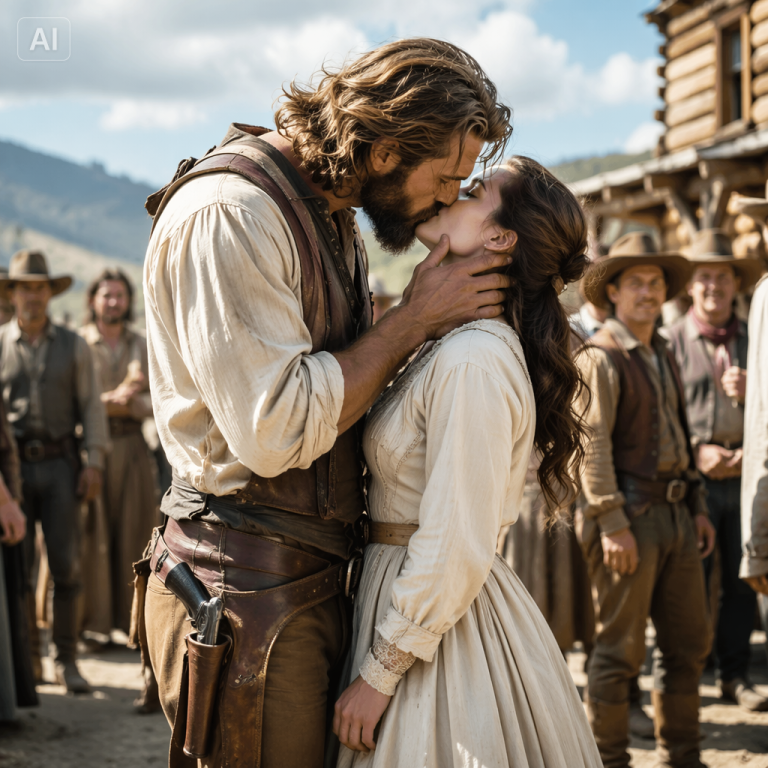
And he crossed the room and kissed me — hard and desperate and tasting like a goodbye, one hand splaying warm against the back of my skull the way it had on the diner floor, as if that was the shape his hands took when he needed to protect the one thing he’d decided to keep. Then he pressed something cold and heavy into my palm. A pistol.
“If anyone comes through that door who isn’t me,” he said, “you don’t ask questions. You understand?”
He left. And the hours that followed hollowed me out.
The penthouse magnified every sound — the tick of the heating, the settle of the building, the far-off complaint of the city. I sat with the gun in my lap and I learned what it means to wait for news that could end you. And then, near three in the morning — always three, that thin gray hour — I heard the elevator. And I heard voices. And they were not his.
I was in the guest room with the door locked before I’d decided to move. Boots in the hall. A fist on the wood. A voice telling me to open up, that it would be easier if I opened up, that they only wanted to talk.
My whole life I had made myself invisible so that men like this would look past me. I was done being invisible.
When the door burst inward I did not hesitate. The gun bucked in my hands and the sound was a physical blow inside the small room, and the shape in the doorway staggered back, and there was shouting, and then there was the sound I will never forget as long as I live — the sound of men choosing to leave. Retreating. Deciding I was more than they’d been paid for.
I was still standing in the ruined doorway, ears ringing, both hands locked white around the grip, when the elevator opened again and Aleksei came through it — bloodied, wild-eyed, a gash above his brow painting half his face red, alive.
He saw me. He saw the gun. He saw the door.
He crossed the room and pulled me into him so hard the pistol was crushed between us, and he held me the way a drowning man holds the thing that floats, and into my hair he said something in his own language, over and over, that I didn’t need translated.
The waitress was gone. She’d been left on the floor of the Starlight under a hail of broken glass. The woman he was holding had been forged somewhere hotter, and she was not going anywhere.
—
The war didn’t end that night. Wars like that don’t end so much as they resolve into a new arrangement of power, and Aleksei was better at that arithmetic than any man alive.
The morning after, a doctor came — a tired man with kind hands who clearly asked no questions for a living — and stitched the gash above Aleksei’s brow while I held a lamp closer than I needed to just to keep my own hands busy. When the doctor left, Aleksei caught my wrist.
“You fired on two men in a locked room,” he said. “Alone. And they left.” He studied me like the puzzle he’d said I was the first night, except now he’d solved a piece of it and didn’t seem to like the answer. “Most people freeze. You should have frozen.”
“I froze for twenty-six years,” I said. “I think I used it all up.”
He didn’t smile. But he lifted my wrist and pressed his mouth to the pulse there, and I felt him breathe out against my skin like a man setting down a weight he’d carried a very long way.
That was when things changed between us in earnest — when he stopped treating me as something to be protected from the weather and started treating me as someone standing in it beside him. He began to tell me things. Not everything, never everything, but enough. Who was loyal and who was merely afraid, which was a different and more dangerous thing. Where the money moved. What a silence in a certain room meant, and what it cost to break it. I found I had a mind for it — for the reading of people, the weighing of what went unsaid — and I understood at last that invisibility had never been my weakness. I had spent years watching people who didn’t think they were being watched. It turned out to be the single most valuable skill in his entire world.
But I want to tell you what I remember instead of the violence, because in the end the violence was never the point.
I remember learning his world from the inside — not as a hostage but as a partner, reading the small shifts of loyalty in a room, understanding how a single word could carry more weight than a drawn gun, sitting at his side while men who’d once snapped their fingers at waitresses like me learned to lower their eyes when I spoke. I remember the first time he asked my opinion on something that mattered and then *took* it. I remember the way the fear I’d felt for him slowly, quietly turned into something that stood beside me instead of over me.
Damian Vero overreached, in the end, the way men made only of hunger always do. He mistook Aleksei’s restraint for the crack in the wall he’d been searching for, and he called it a door, and he walked through it, and it closed behind him. I won’t pretend I mourned. I had held a gun in a locked room and fired it at men who’d come to erase me. I had stopped being someone the world could do things to and started being someone who decided.
We built a life. Not a normal one — I gave up on normal the night the window turned to spray — but *ours,* something neither wholly his nor wholly mine but grown up new between us out of the wreckage, the way things grow in the cracks of ruined places, stubborn and green and alive.
There was a evening, months after Vero, when Aleksei took me to the Starlight. Or to what had been the Starlight — it had closed, of course, the way places do after the police tape comes down and the story spreads. He’d bought the building. I didn’t ask why until we were standing inside it, the booths gone, the counter gone, the neon dark, just an empty room smelling of dust and rain and old grease.
“I couldn’t stand that it was only where you almost died,” he said. “I wanted it to be something else.”
He was going to turn it into a place, he said — nothing grand, a small room where the people in that district who worked the thin gray hours could get a hot meal for what they could pay, and sometimes for nothing. He’d already found a cook. He wanted me to run it. Not because I needed to. Because he’d watched me pour coffee for men who never once saw me, and he thought the person I’d become should own the room instead of disappear inside it.
I stood in the empty shell of the worst and most important night of my life and I cried, which I almost never did, and he held me in the exact spot where the booth had been, and neither of us said anything, because there was nothing left to say.
There are still shadows at the edges of our life. There always will be. But we stopped fearing them and learned to read them instead, the way you learn the tides of a dangerous coast until you can walk it in the dark.
—
Tonight I’m standing at that same wall of glass, watching the city blink its endless Morse code of ordinary human lives, and I’m thinking about a girl in a faded blue uniform scrubbing a stain that would never come out, sixteen days behind on rent, so tired she’d forgotten she was a person. I wonder sometimes if she’d recognize me. I don’t think she would. I think she’d be afraid of me, a little, and I think she’d be glad.
Aleksei comes up behind me the way he always does, without sound, and folds his arms around my waist and sets his chin against my hair. His heartbeat is slow and steady against my back, and it doesn’t frighten me anymore. It’s the metronome I fall asleep to.
“You’re far away,” he says.
“I’m thinking about how far we’ve come.” I lean back into him and let him hold my weight. “And how much it cost.”
“And how much we kept.” His voice is quieter than I’ve ever heard it. His hand finds the small gold key that hangs at my throat — the one he gave me the day he told me there was nothing in his life he’d lock away from me again. “That’s the part I try to remember.”
Below us the city sprawls out, vast and indifferent and beautiful, no longer a place I move through like a ghost but a thing that is partly, impossibly, ours. I close my eyes and listen to the heartbeat that has become, in every way that matters, my own, and I know that whatever comes for us next — and something always comes — we’ll meet it standing up, side by side, the two of us who found each other in the wreckage and refused to let go.
We didn’t just survive that night in the diner.
We were remade by it. And I have never once wished to be the woman I was before.