A WOMAN COLLAPSED INTO A SALOON HALF-FROZEN AND WAS TOLD SHE WASN’T WORTH A JOB — THEN A GRIEVING RANCHER STOOD UP AND OFFERED HER HIS NAME

PART 1
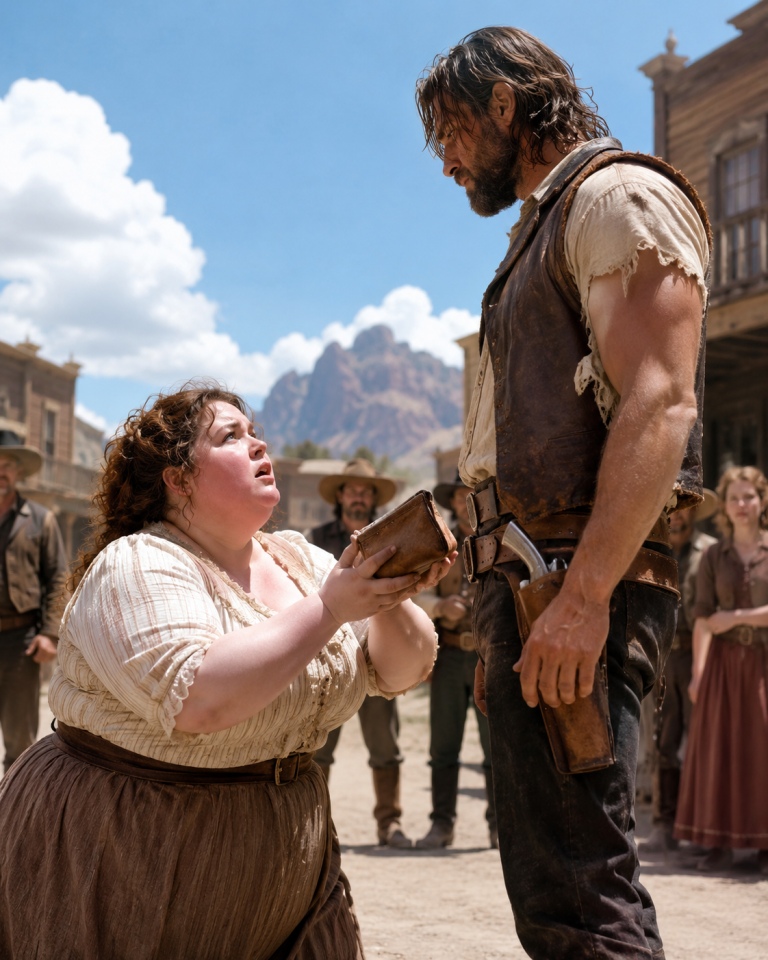
Nobody heard her knock because she didn’t knock. When you have walked fifteen miles through a Colorado blizzard with rags for gloves and ice in your boots, you don’t knock. You fall through the door and hope what’s on the other side is warmer than what nearly killed you getting there.
The cold detonated into the saloon like something with a grudge. Twenty men froze mid-sentence, mid-drink, mid-breath. The cast iron stove lost the argument instantly.
And then they saw her.
Large, trembling, lips the color of a bruise, a coat so thin it was practically a rumor. Snow packed into every fold of her, and she hadn’t brushed a single flake away, because she had stopped feeling her own body around mile seven and simply kept walking on willpower alone.
Twenty men stared. Not one moved.
But in the far corner, a man who had been sitting alone with an untouched whiskey and four months of quiet grief looked up, and something in him that had gone completely dark since September came back to life without asking his permission.
Neither of them knew yet what was coming.
—
Silas Miller had the kind of face that had never learned to hide what it was thinking. He came around the bar slowly, thumbs hooked in his apron strings, and looked Mercy Higgins up and down the way a man looks at livestock he has already decided not to buy. Portly himself, a fact that appeared to cause him no self-reflection whatsoever, he carried his authority over this establishment the way small men carry big titles — loudly, and with great attention to who was watching.
“We’re not a shelter, ma’am.” He said *ma’am* the way some men say *mistake.* “Kitchen’s full, floors full, and frankly—” he let his eyes travel her frame one more time, slowly, so the room could follow “—I don’t think you’d last a full shift on your feet.”
Nobody laughed. Three men smiled into their glasses, which was worse.
Mercy did not flinch. She had flinched at this particular cruelty so many times, across so many years, that the muscle for it had simply worn out. She stood there and received it with the stillness of a woman who has learned that reacting is a luxury she cannot afford.
“I can cook,” she said quietly. “I can clean. I can keep accounts. And I can work longer hours than any man in this room. If you’d like a demonstration, I’ll start with the dishes.”
Silas opened his mouth.
The chair scraped. It was not a loud sound. In a room that had gone that quiet, it didn’t need to be.
Every head turned toward the corner table where Gideon Thorne had been sitting alone for the better part of two hours, nursing a single whiskey he had barely touched, staring at the grain of the wood like it owed him an answer to something. He stood up slowly — taller than the room seemed to expect, broad across the chest, weathered the way Colorado weather makes a man who works outdoors daily and grieves indoors, wearing it all without complaint until the weight of it simply becomes the shape of him. His coat was good quality, but old. His boots caked with the honest mud of a working ranch. He was not a man who had dressed for anyone’s approval in a very long time.
He walked to the bar without hurry, set two coins on the counter, his tab paid clean. Then he turned — not to Silas. To Mercy.
He looked at her the way he’d been looking at that tabletop. Carefully. Like he was trying to understand something true.
“You walked fifteen miles in that storm, I’d guess. Maybe more. That deserves better than what you just received,” he said. His voice was low and unhurried — a voice accustomed to open land and animals and the kind of quiet that has no bottom.
Mercy said nothing. She was watching him with the particular caution of a woman who has learned that kindness from a stranger almost always costs something.
“My name is Gideon Thorne,” he continued. “I run a cattle operation six miles east of here. Lost my mother in September. Lost my hand in October. The ranch is sound, but the house—” he paused, just briefly, something moving behind his eyes he did not let reach his face “—the house needs a person in it. A capable one.”
He reached up and removed his hat. Such a small, old-fashioned gesture of respect that something in the room shifted, almost imperceptibly.
“I am not in a position to offer you a job, miss. What I can offer you is a household, a wage, a separate room, and my word — which in this county still means something — that you will be treated with more dignity than you received in the last five minutes.” He held her gaze steadily, without pressure, the way a man holds a door open without demanding you walk through it. “I recognize this is an irregular proposal. Take whatever time you need.”
Outside, the blizzard pressed its full weight against the walls of the Montezuma saloon. Inside, in the light of an amber lamp that made everything look like the last warm thing on earth, Mercy Higgins looked at Gideon Thorne and did the arithmetic of her life in about four seconds flat. She had nothing. He was offering something. He had looked at her — all of her — and his eyes had not changed.
“I’ll need to know one thing first,” she said.
He waited.
“Are you a man who keeps his word when it becomes inconvenient to do so?”
Gideon Thorne considered this with the seriousness it deserved. “Ask me again in forty years,” he said. “I expect by then you’ll have your answer.”
—
Widow Abernathy’s boarding house sat three doors down from the saloon, close enough to hear the piano on a still night, far enough that respectable women could pretend they couldn’t. Gideon had spoken to the widow at the door while Mercy stood behind him in the snow, which she noted without comment. He had not explained the situation in full — only that the lady required a room for the night, that he would cover the cost, and she was to be treated as any other guest.
The widow, sharp-eyed, sixty, with the excellent instinct never to ask questions she didn’t want answered, had looked past Gideon’s shoulder at Mercy for exactly one second, then opened the door wider without another word.
The room was small and immaculate. A single iron bed with a quilt in a double wedding ring pattern, the irony of which was not lost on Mercy. A candle already lit on the sill, as though someone had been expecting a guest who needed light more than anything else.
Mercy stood in the center of it and did not move for a long moment, because she had not been inside a room that was only hers in so long she had forgotten what to do with the silence.
She ran the facts as she had them. A man she did not know had offered her a legal marriage, a separate room, a wage, and his word. He had removed his hat. He had not looked at her body as a problem to be managed. And when she had tested his character directly, he had answered with forty years instead of five minutes — which was either the response of a deeply honorable man, or a remarkably patient liar. In her experience, remarkably patient liars rarely bothered with women who had nothing worth stealing.
She thought about the alternative — the storm breaking in two or three days, eleven cents to her name, no contacts in Leadville, and a body the world had spent thirty-one years informing her was an inconvenience to everyone, including herself. She could wait out the thaw and walk back into the same country that had already taken everything from her.
Or she could walk into something unknown, with a man who had, in the span of ten minutes, treated her with more basic decency than most people managed in a lifetime.
By the time the candle had burned down a third of its length, she had stopped thinking and simply knew.
PART 2
She found him at seven the next morning standing outside the widow’s door with his hat in his hands and two cups of coffee, one in each fist, both still steaming in the frozen air. He had not assumed she would say yes — she could tell that immediately. No triumph in his face. He looked, if anything, like a man who had slept poorly and was prepared to be told no with the same quietness he’d offered everything else.
She took the coffee. “Yes,” she said. “But I want it in writing. The separate room and the wage.”
He nodded once, as though this was not only reasonable but exactly what he’d have required himself. “I’ll have Reverend Amos draw up the terms before the ceremony. This morning. Weather’s going to break by afternoon — I need to get back to the ranch before it does.” He paused. “If that suits you.”
It did not particularly suit her. Nothing about the morning suited her. But she had made her decision by candlelight, and she was not in the habit of unmaking things in daylight.
“Give me twenty minutes,” she said.
The widow had anticipated something — a dark blue wool dress laid across the parlor chair, let out at the seams with careful, invisible stitching. Mercy dressed, pinned her hair, and went out into the cold.
Reverend Amos read them the terms first — separate quarters, a monthly wage equal to a skilled ranch hand’s, full legal standing as Mrs. Thorne in all matters of property and contract. Mercy read every word and asked one question about the property clause. Gideon answered it directly and without irritation, which told her something useful about him.
The ceremony was brief. No flowers, no guests, no music. When Reverend Amos reached the part about the ring, Gideon produced a plain gold band that had clearly belonged to a woman before. His mother’s. Mercy understood without being told.
The ring was a half size too small. He worked it gently over her knuckle, and when it was on, he held her hand a moment longer — not romantically, but the way you hold something you’ve just been entrusted with and are determined not to break.
“You may kiss your bride,” said Reverend Amos.
An entire unspoken negotiation passed between them in about two seconds. Gideon brought her hand up instead, and pressed his lips briefly, formally, to her knuckles. Reverend Amos noted it in his register without comment: *Gideon Thorne and Mercy Higgins, joined in lawful matrimony, 14th of January, 1877. Witnesses, none. Weather poor.*
Outside, the blizzard had begun, almost imperceptibly, to ease.
They rode out of Leadville in silence — not uncomfortable, but the silence of two people who have just done something enormous and are quietly, separately, beginning to understand what it means.
The Thorne Ranch announced itself gradually. A fence line, straight and well-maintained. A barn, large and sound. The house itself, two stories of squared pine log, set back on a slight rise as though it had chosen the position deliberately.
Mercy took it in the way her father had taught her to read a set of accounts — what was present, what was absent, what the gap between the two was trying to say. What was present: structure, order, function, a man who maintained things faithfully. What was absent: any sign someone had been happy there recently.
Gideon showed her to a south-facing room upstairs. “This is yours,” he said plainly. “I had my mother’s things moved to the chest in the hall. You can do with the room as you see fit.”
She heard what was underneath it. He had prepared this before she’d said yes.
“Thank you,” she said. “I’ll take good care of it.”
They ate supper that first evening at opposite ends of the long table, strangers sharing a meal without pretense or performance — the very first stone laid in the foundation of something that would outlast them both.
PART 3
She discovered the books on a Thursday, three weeks into her life at the Thorn Ranch, behind a door she had assumed was a closet, and turned out to be something closer to a confession. A small room off the main parlor, three walls lined floor to ceiling with shelves — old, beloved books, spines cracked at the most visited passages, natural history volumes annotated in a woman’s careful hand.
She found Gideon in the barn. “The room off the parlor,” she said. “With the books.”
He didn’t turn around immediately — she’d learned that wasn’t rudeness, just how he moved through difficult things. “My mother’s,” he said. “I haven’t. I’ve left it as it was. May I use it?”
He turned. “It’s your house,” he said. “You may use any room in it.”
She had not yet thought of it as her house. The word landed differently than she expected.
She began spending her evenings there after supper, choosing a book with the deliberateness of a woman who has been hungry for something and is finally allowing herself to eat. It was on the ninth evening that Gideon appeared in the doorway, passing through on his way to the kitchen, and simply paused when he saw the lamplight.
“She annotated the margins,” Mercy said, without preamble. “Your mother. Very precise opinions about migration patterns.” She turned the book so he could see.
Something moved across his face he did not try to control. He came in and sat in the second chair — the one that had always been there, waiting.
“She would have liked you,” he said finally. Quietly. With certainty.
Mercy reached across to turn the page and her hand passed over his where it rested on the book. Neither of them moved away. Then she pointed to a marginal note so emphatic he made a small, low, entirely genuine sound.
That was the first time she heard him laugh.
—
The Vances arrived on a Wednesday without warning. Martha Vance walked into the kitchen, set a covered dish on the table, and sat down as though she’d done it a hundred times. Outside, the men walked the fence line in the slow, considered silence of men conducting a conversation mostly made of quiet.
Over supper, Mercy told a story about her father, a schoolteacher who’d once read *Don Quixote* aloud at the table until her mother laughed so hard she dropped a ladle in the pot. Everyone laughed. She looked up when it settled, and found Gideon watching her — not with the careful, neutral regard he’d maintained these weeks, but the way you watch something you have been looking at for so long that you stopped seeing it, and then one ordinary afternoon you see it completely.
She held his gaze a moment. Then Martha said something about the pudding, and the moment folded itself quietly into the evening.
—
The kiss came in April, quiet and unremarkable, beside the kitchen window on a morning when the snow had finally withdrawn from the lower pasture. Gideon had been pointing out where he intended to run the new fence line. Then neither of them was talking about the fence, and it lasted only a moment, but it rearranged the house the way moving a single piece of furniture rearranges an entire room.
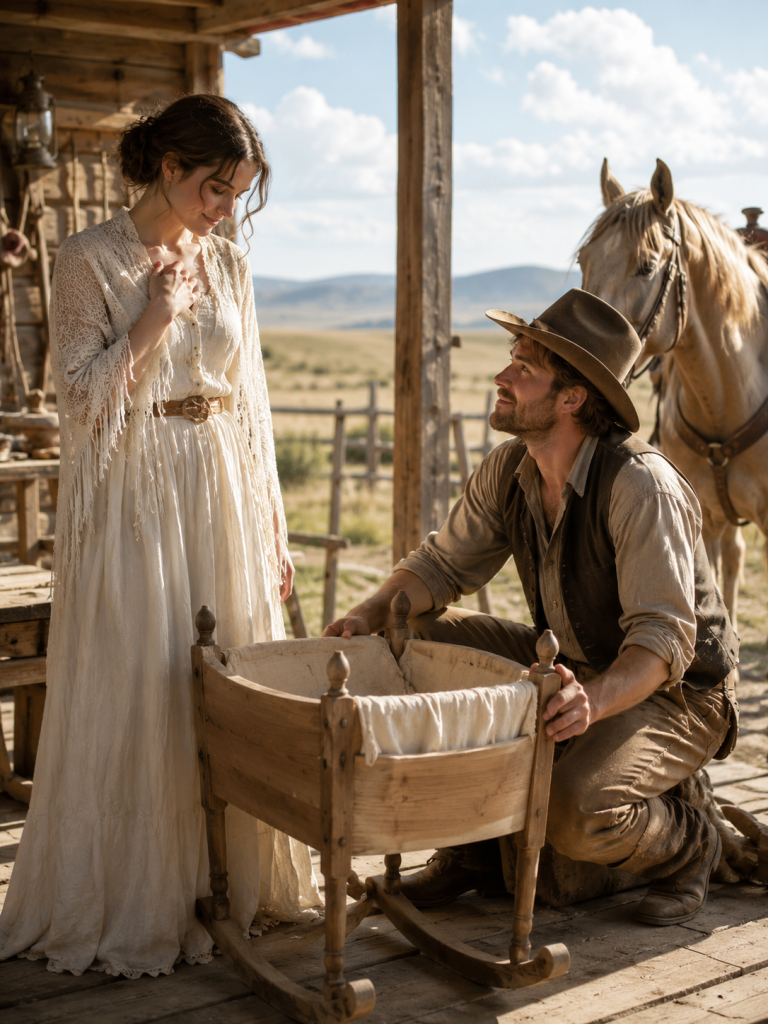
Andrew was born the following February in a blizzard Mercy said she should have expected, given her history with Colorado winters. Gideon sat outside the bedroom door eleven hours with his hat in his hands, and when the crying started, he pressed his forehead against the doorframe and did not move for a long moment. Watching him hold their son for the first time, Mercy thought: *There it is. The last wall down.*
Emily came eighteen months later, solemn and watchful. Then Alice, who laughed at everything. Then Aaron and Alexander together in the autumn of 1884, which nearly killed Mercy and did not, because she was not, as the doctor remarked with undisguised admiration, a woman who yielded to circumstances without an argument.
The ranch grew with the children. Gideon added acreage, a proper barn, a second hand. Mercy kept the accounts with the same precision she brought to everything, margin notes doubling as private correspondence with the land itself. *Good year. Hard summer. Lost two calves to the cold, but the rest came through strong.*
Evenings, she read aloud in the parlor room, the children arranging themselves around her instinctively, like animals around warmth. Gideon would come in from the last barn check and stand in the doorway a moment before anyone noticed him, just watching. He had spent a long time in a quiet house. He understood now what the quiet had cost him.
—
It was Andrew who suggested it, arriving at the ranch one Tuesday in October, 1917, hat pushed back, wearing the expression his mother recognized from when he was seven and had already decided something.
“Forty years,” he said at the kitchen table, like presenting evidence. “You ought to go back.”
Mercy, sixty-eight now, looked at him over her coffee. “Back where, exactly?”
“You know where.”
She did. They drove into Leadville on a Friday. The town had changed the way frontier towns change — some roughness smoothed away, new buildings where old ones had burned. The mountains behind it all exactly as they had been.
The Montezuma saloon was still there, smaller than she remembered — or perhaps she was simply larger now, in every way that counted. Inside it smelled the same. Gideon ordered two whiskeys they did not drink, because the point was never the whiskey.
Mercy stood in the middle of the room and looked at the place where she’d stood shaking, and the corner where Gideon had been sitting. The distance between those two points — no more than fifteen feet. Which had been, in another sense, the longest distance she had ever crossed.
“I thought you were going to say no,” Gideon said beside her, his voice deepened with age into something that reminded her of a good fire.
“I thought you were going to change your mind,” she said.
“I considered it.” A pause. “For about four seconds.”
She looked at him — the white hair, the weathered face, the hands that had fixed ten thousand fence posts and held five newborn children and turned the pages of his mother’s books while she read aloud — and felt the full undiminished weight of forty years pressing warmly against her chest.
She took his hand. He folded his fingers over hers, the way he always had. Completely. Without reservation.
Outside, the first snow of the season was beginning to fall on Leadville, soft and indifferent and very beautiful. They stayed until the light changed. Then they went home.
—
Mercy died on a Thursday in March, which she would have considered a practical choice. She had been slowing since Christmas — not surrendering, but like a fire that has burned long and well and is simply, at last, running out of material. Gideon slept in a plain wooden chair beside her bed the last three weeks, waking often, reaching across each time to find her hand in the dark.
On the last morning she was lucid, she told him to fix the north fence post, which had been shifting since the autumn thaw. He told her he would. She told him not to let Emily make all his decisions for him. Then she looked at him directly, completely, the way she had across a supper table forty years before.
“It was a good life, Gideon,” she said. Not *I love you* — that had passed beyond the need for language long ago. The larger thing. The thing that contained everything else.
“It was,” he said.
She died the following Thursday morning with the early light coming through the window and all five children somewhere in the house, not alone, not performing — simply present, and then quietly not.
Gideon lived eleven more months. He fixed the north fence post in April. He sat evenings in the small room off the parlor, one of her books open in his lap, the second chair beside him, and read. He was found there on a February morning, the lamp long since burned out, the chair at last and permanently empty beside him.
His children buried them together under the cottonwood at the east edge of the property, where the creek could be heard in spring and the mountains were visible on clear days — which in Colorado was most days.
Andrew carved the stone himself. It read:
*Gideon and Mercy Thorne. He asked. She answered. They built something that lasted.*
Which was, by any measure, enough.
THE END.