HER FATHER FORCED HER INTO A LOVELESS MARRIAGE FOR CASH — THEN SHE FOUND A CARVED BIRD THAT PROVED HER HUSBAND HAD LOVED HER FOR FIFTEEN YEARS

PART 1
“Say your vows, Elizabeth, or so help me you will sleep in the yard with the dogs.”
Her father’s words were still lodged in her chest like a splinter too deep to reach as she walked toward the stranger at the front of Oak Haven’s church. The dress had been her mother’s once, let out at the seams with rough thread that pulled and puckered across her hips — a quiet cruelty stitched into the fabric itself.
Before her, William Hale waited with his hat in both hands. He was not looking at the floor. He was not looking at the preacher. He was looking at her directly, steadily, as though he had been waiting a long time.
The pews held no well-wishers. Only hunger — the particular kind people wear when someone else’s ruin is the entertainment.
When the iron ring settled onto her finger, it was warm, as though he had been holding it in his palm the whole time. She did not know what to do with that.
—
The wagon rolled out of Oak Haven before the church doors had fully closed behind them. Elizabeth sat as far to the right of the bench as the wood would allow, hands folded in her lap, eyes fixed on the road ahead. The town fell away in pieces — the feed store, the mill, the long white fence of the Callaway property — and then it was gone, and there was nothing but the open throat of Montana swallowing them whole.
William did not speak.
She had expected him to. Men who bought things liked to talk about what they’d bought. Her father had never stopped talking about the land, about the stock, about what everything was worth and what nothing ever measured up to. She had spent twenty-three years listening to a man perform his own importance, and she had braced herself for another performance to begin the moment the wagon wheels found the open road.
But William Hale held the reins loosely and watched the horizon the way a man watches weather — with patience, and without complaint.
The cold came in around midday. It did not announce itself. It simply arrived the way Montana cold always did, seeping through the wool of her mother’s dress, finding every poorly sewn seam. Elizabeth pressed her arms against her sides and told herself she was not shivering. She was nearly convincing.
Without looking at her, William reached behind the bench and pulled a canvas coat from the wagon bed. He set it on the space between them. He did not offer it. He did not say *you look cold* or *here, take this.* He simply placed it there and returned both hands to the reins, eyes back on the road, as though the coat had always been meant to live in that particular spot.
Elizabeth stared at it a long moment. Then she picked it up and pulled it around her shoulders. It was heavy, and smelled of wood smoke and saddle leather and something else she couldn’t name. Something that was not unpleasant.
He still did not speak. Another hour passed. The road climbed, pines thickening on either side, crowding the pale sky into a narrow strip above them. Her throat had gone dry the way grief sometimes made it — not from crying, but from holding everything in so long the body forgot how to soften.
William reached beneath the bench and brought up a canteen, held it out without looking at her. She took it, drank, handed it back.
“Thank you,” she said. The words came out smaller than she intended.
He nodded once. The road bent north. He followed it.
She had expected cruelty. She knew cruelty — knew its rhythms, knew how it liked to wait until you were tired before it showed its teeth. She had been cataloging William Hale since the moment her father shook his hand, searching for the angle she hadn’t yet found. Men did not pay debts for nothing. Men did not marry women like her for nothing. There was always a price stitched into the lining of a kindness. Always a cost that came due the moment you stopped being useful.
But he had given her his coat without looking at her. Offered water without asking for gratitude. Sat beside her three hours in complete silence, and made that silence feel somehow less like punishment than any room she had ever shared with her father.
She pulled the canvas coat tighter around her shoulders. The mountains ahead were gray and enormous and indifferent to everything — to her history, her shame, the iron band on her finger.
For the first time in longer than she could remember, she did not feel entirely small.
That feeling lasted until Blackwood Ridge came into view. And then it became something else entirely — something she had no practiced name for.
PART 2
She had built the ranch in her mind during the long hours of writing to him — imagined a leaning structure, gray and windbeaten, the kind of place a man builds when he has no one to build it for. She had told herself she could bear it. She had borne worse.
What sat at the end of the ridge road was not that. Modest, not grand — but solid. Logs fitted close and chinked with care. A covered porch, even boards, unwarped. Smoke already rising from the chimney, thin and steady. A window box beneath the front window, empty in the cold, soil recently turned.
Elizabeth sat very still and looked at all of it and did not speak.
Inside, a single room served as kitchen and sitting area, a stone hearth taking up most of the far wall, the fire low but genuine. Then she found the other room — a small bedroom, a bed framed in pine, fitted with a quilt not new but recently washed. A braided rug. A white ceramic pitcher and basin. A single tallow candle.
And on the pillow, folded with the particular care of someone unused to folding delicate things, lay a pale blue ribbon.
She stood in the doorway a long time. It was not a room assembled in haste. Every small thing had been placed by someone who had thought about the person who would stand exactly where she was standing.
That night, she found the provisions before he’d finished with the horses, cooked without being asked. “You didn’t have to do that,” he said, stopping just inside the door.
“I know how to cook,” she said — which was not what he’d meant, and she knew it.
She set his bowl at the head of the table and hers near the hearth, apart, the way she’d always eaten at her father’s — close enough to serve, far enough to be invisible. William looked at the placement a moment. Then he stood, picked up his bowl, moved it to the side, and pulled out the head chair.
“Sit,” he said.
“That’s your chair.”
“It’s your table as much as mine.”
“I’m fine where I am.”
“I didn’t ask if you were fine. I asked you to sit.”
She sat. He ladled the beans himself, filled her bowl first. They ate in silence — but it wasn’t the loaded silence of her father’s table. This one had no teeth. She caught herself reaching for a second helping and stopped.
“Eat,” William said, without looking up.
“I’ve had enough.”
He said nothing. He ladled more into her bowl anyway, and returned to his meal, as though the matter were settled.
She did not feel entirely like a burden. She was beginning to find that more unsettling than if she had.
—
Days later, opening a small drawer for nothing in particular, she found a carved bird. A sparrow, no bigger than her palm, cut from pale birchwood, worn smooth with years of handling. Wings slightly lifted. Head tilted at the angle sparrows held when deciding whether to stay or go.
Elizabeth’s hand went unsteady.
She had owned this bird. At ten years old. Carried it in her coat pocket through a whole winter, held it on the bad days when her father’s voice was at its worst. Lost it on the road outside town one afternoon, gone back three times to search the frozen mud, and cried only once, alone, where no one could add it to the list of things that proved she was too much and not enough.
She had never told a single soul about the bird.
William Hale had her bird.
PART 3
She heard his boots on the porch and closed her fingers around it, standing very still, her heart doing something loud and disorganized in her chest. He came through the door, moved to wash his hands, and she stood in the kitchen doorway looking at the back of him like you look at a door you’ve just discovered leads somewhere you didn’t expect.
She did not ask. Not yet. But the question was alive in her now, wings lifted, deciding whether to stay.
She lasted two more days — watching him from corners, cooking and cleaning with the carved bird sitting in her apron pocket, small and inexplicable and maddening. Telling herself there was a reasonable explanation. That he’d found it on the road. That it meant nothing.
On the third evening, she set his supper down and put the bird between them.
“Where did you get that?” It was not a question. Her voice had gone flat, airless — the voice she used when she’d already decided to survive whatever came next.
William looked at the bird a long moment. Then at her. “You know where,” he said.
Something cracked open in her chest. She had expected denial. Had almost needed it, because denial she knew how to navigate. What she did not know how to navigate was the quiet certainty in his voice, the absence of shame or performance, as though he had simply been waiting for her to find it and was relieved the waiting was done.
“You pity me,” she said, voice breaking on the last word. “That’s what this is. The coat. The chair at the head of the table. The room you built like someone was going to—” She stopped, pressed her hands flat against the table. “I have been pitied my entire life, William, and I will not live inside someone’s charity and call it a marriage. I won’t do it.”
He did not raise his voice. Did not move back. “Sit down, Elizabeth.”
“I don’t want to.”
“Please.” The word was quiet, and it cost him something. She could hear that it did.
She sat.
He was still a long moment, hands around his coffee cup, eyes on the middle distance of a memory she couldn’t see. When he spoke, his voice had changed — not softer exactly, but younger, stripped of the lacquered quiet he wore like a second coat.
“There was a boy,” he said. “Winter of 1861. Dirt poor and too proud to show it, which is a particular kind of cold. He used to cut through the alley behind your father’s property on his way to the mill, where he swept floors for pennies.” He paused. “One morning he hadn’t eaten in two days. He didn’t tell anyone. Boys like that didn’t tell anyone.”
Elizabeth had gone very still.
“A girl came out the back door,” William continued. “Heavy coat, brown hair coming loose from its braid. She had a piece of bread wrapped in a cloth, and she held it out to him. She didn’t say *poor thing.* She didn’t look away from his face while she did it.” His jaw moved. “She just handed it to him. Like he was a person. Like it was the most ordinary thing in the world.”
The fire spoke quietly in the hearth.
“She dropped something when she went back inside,” he said. “I kept it.”
Elizabeth looked at the bird between them. Then at him — really looked, past the weathered face and the careful silence, all the way back to a winter morning and a hungry boy in an alley who had been seen. Her eyes filled. She did not look away.
—
The blizzard arrived that night without apology. She woke to a sound she’d never heard — the wind not howling but *pressing*, a solid, constant weight against the walls. William was already at the window with a candle.
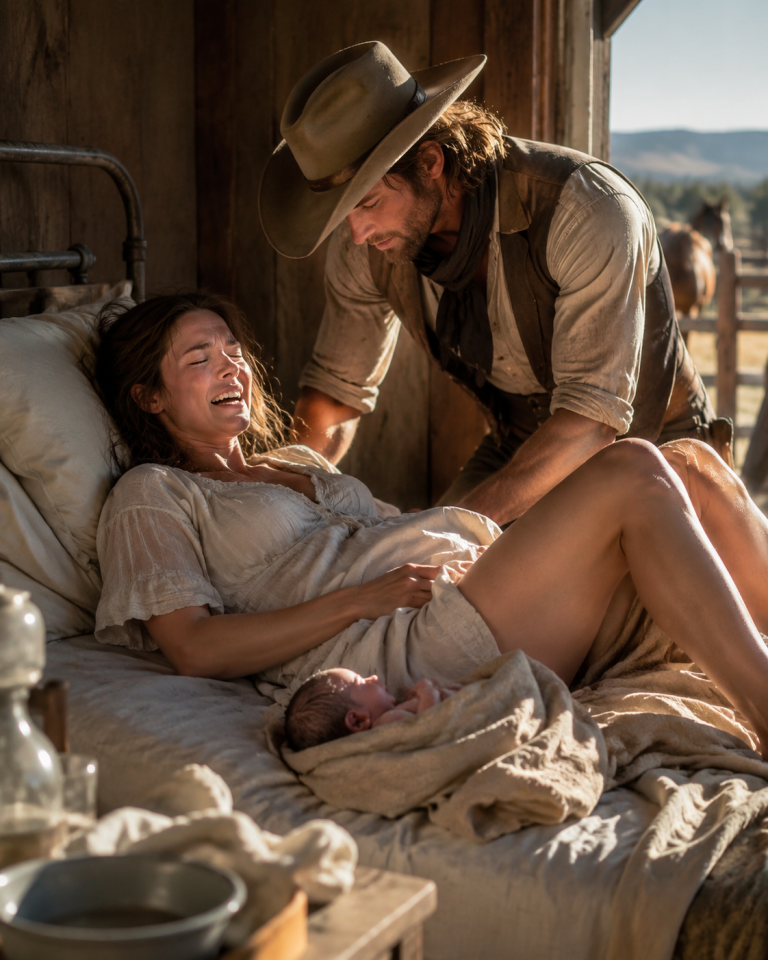
“Stay inside,” he said, without turning. “I need to get to the animals. The mare’s close to foaling.”
“You can’t go out in that.”
“She won’t make it through the night alone.” He was already pulling on his coat.
She built the fire up instead, hands needing something useful to do while the rest of her stood at the window watching the darkness for his shape. He was gone a long time. When he finally came through the door, he brought half the storm with him — snow in the folds of his coat, ice in his beard, hands shaking with cold gone past discomfort.
Elizabeth had the blanket off the chair before the door finished closing. She pushed it around his shoulders and steered him to the hearth without asking permission for either.
“The mare?”
“Settled. Not tonight after all. Maybe tomorrow.”
She heated water, set the basin before him without comment. He looked at it, then at her, something shifting in his expression — not surprise exactly, but the look of a man unaccustomed to being tended to, encountering it again, not yet knowing where to put it.
They stayed close to the fire because the cold had narrowed the world to that radius, and there was no negotiating the geometry of it. She sat on the floor against the stone hearth; he sat above her in the chair. He told her about choosing the ridge for the windbreak, about three winters spent building before he moved a single piece of furniture inside. She told him, without planning to, about her mother’s roses along the fence, and how her father had pulled them out the spring after the fever took her, without explanation.
William was quiet a moment. “I turned the window box last month,” he said. “Figured you might want to plant something come spring.”
The storm pressed against the walls and found them solid. Inside, the fire held its ground.
—
The blizzard broke on the second morning, leaving the ridge glittering, the sky scoured to that particular blue that only exists after great violence has passed. Elizabeth stood on the porch with her coffee, feeling for the first time in her memory that she was standing in a place that was hers to stand in.
William came up beside her.
“I need to tell you something,” he said. “The debt. Your father’s debt.” He paused. “There was no debt. Not before I made one.”
The coffee cup was warm in her hands. She held it tighter.
“I went to your father,” William said, steady, without decoration. “Told him I would cover what he owed the bank, plus enough beyond it to settle his other accounts and drink himself through winter. He didn’t ask a single question about where I’d take you, or how you’d be kept. He asked if I’d go higher.” His jaw worked. “I went higher.”
The ridge was very quiet.
“I’d been watching your father’s house go to ruin for two years,” he continued. “Watching you carry it. Watching you take what he gave you and ask for nothing, and shrink yourself down to a size he found acceptable, and still never be small enough to escape his contempt.” His voice went lower, the way deep water goes when the current picks up. “I knew what that house was doing to you. I’d watched it long enough.”
Elizabeth set her cup on the porch rail with great care, as though sudden movement might break something irreplaceable. “You had no right,” she said softly.
“No,” he agreed. “I didn’t.”
“You should have asked me.”
“You would have said no.” She opened her mouth and closed it again, because they both knew it was true. She would have said no, and meant it, and gone back to that house and continued disappearing one season at a time until there was nothing left to disappear.
“I am not a thing to be rescued, William.”
“I know that.” He turned to look at her fully, his eyes holding something she’d been too guarded to read clearly until now. Not pity — never pity — but a devotion so old and so quietly maintained it had become structural. Load-bearing. Built into him the way the logs of his house were built into each other. “I didn’t come to your father’s house because I thought you were helpless. I came because I’d watched you survive that place for years, and I knew you deserved something better, and I was the only one who was going to do anything about it.”
“You built this house,” she said slowly. “The window box. The room. The ribbon. The quilt washed in cold air and lye soap. You built all of it for me.”
“Yes.” One word, carrying fifteen years.
Elizabeth looked out at the white ridge, the light falling without prejudice over everything it touched. For the first time in her life, she did not feel like a burden someone was enduring.
She felt like a reason.
—
Three days later, she was still learning what to do with that when the sound of a horse on the ridge road brought her to the window. She knew the way he sat a horse before she could make out his face.
Cyrus Thorne rode the way he did everything — as though the world owed him a smoother road and was failing to deliver.
Elizabeth set down her mending and did not move. She heard his boots hit the frozen ground with the heavy deliberateness of a man arriving to collect something. The knock was not a knock. It was an announcement.
She opened the door before he could knock again. He looked older than she remembered.
“You look fed,” he said. Not a compliment.
“What do you want, Papa?”
He stepped forward as though to come inside. She did not move from the doorway. Something crossed his face — surprise, recalibration.
“I want what’s fair,” he said. “Hale paid less than the land is worth. Less than *your* worth, as it happens, now that the Delroy boy has shown some interest.”
“There is no negotiation,” Elizabeth said. Her voice was even. She had not known it would be until it was.
“You don’t speak for the arrangement, girl. Hale does. Go fetch him.”
“I speak for this house.”
Her father’s face darkened in the way she had spent her childhood learning to read as a warning. She read it the same way she always had — and, for the first time, did not reorganize herself around it.
“You were a burden under my roof for twenty-three years,” he said, low and deliberate, the voice he used when he wanted words to leave marks. “Don’t mistake one man’s peculiar charity for an identity.”
The yard was very quiet.
“There’s no negotiation,” she said.
William’s voice came from behind her — not loud, not heated, carrying the authority of a man who has already decided how this ends. He came to stand beside her in the doorway. Not in front of her. That distinction was not lost on Elizabeth.
Cyrus looked at him with an evaluating squint. Whatever he found in William’s expression did not encourage him.
“I have legal—”
“You have nothing,” William said. “The agreement was settled in full. Witnessed. Signed. You rode two days in winter cold to stand in my yard and frighten a woman who doesn’t frighten anymore.” A pause. “Turn your horse around, Cyrus.”
The silence stretched across the yard like ice across a creek, thin in the middle, dangerous to test. Cyrus Thorne looked at his daughter one last time. She met his eyes and held them. Did not apologize for the space she occupied. Did not make herself smaller. Did not look away.
He turned his horse around. Elizabeth watched him go until the ridge road bent and took him from sight.
Then she exhaled, slow and complete, like a woman setting down a weight she had carried so long she had stopped noticing its shape.
William’s hand found hers at her side. She did not pull away.
—
Spring came to Blackwood Ridge the way grace comes to people who have survived a long winter — not announced, not dramatic, but undeniable. The snow pulled back from the south-facing slope first, exactly as William had said it would, and beneath it the ground was dark and willing and alive.
Elizabeth planted roses in the window box, cuttings ordered through the postal writer in February. William had watched her seal the envelope and said nothing, but she’d seen the corner of his mouth move.
It was he who found her in the south field the morning the first cuttings took root. She sat back on her heels, looked up at the sky — so extravagantly blue, the air smelling of thawed earth and pine resin and possibility — and something moved through her chest like a current.
He crouched beside her. She looked at the side of his face and thought about the boy in the alley, and the bread, and the sparrow, and the room built before she arrived, and a hand held out in a doorway, and the long ride home through a Montana she had been afraid of and learned instead to love.
“I want to marry you,” she said.
He turned to look at her. “We are,” he said.
“Differently,” she said.
He was quiet a moment — that particular quiet she’d learned wasn’t absence, but attention, a man giving something its full weight. Then he reached into his workcoat pocket and held out his open palm. The iron band from Oak Haven sat there. Beside it, a second ring, thin and plain, cut from the same pale birchwood as the sparrow, sanded smooth with the careful imprecision of a man who worked better with timber than jewelry.
“I made it in January,” he said. “During the blizzard. While you were sleeping.”
She took the wooden ring and held it between her fingers — this small, carved thing, made in secret during a storm, by a man who had loved her longer than she had known herself capable of being loved.
“No preacher,” she said.
“No preacher. No congregation watching for the fall.” A pause. “Just the field. Just us.”
She slid the wooden ring onto her finger. He took the iron band from his own palm and held it out, and she understood — this was not him claiming her. This was him asking. She took it and placed it on his hand herself, and he closed his fingers around hers, and they knelt together in the dark soil of Blackwood Ridge, the spring sky enormous above them, the roses newly planted, the whole long future of the place stretching out in every direction like a field that had finally been given rain.
No vows were spoken. Everything that needed saying had already been said — in bread given without pity, in a sparrow kept fifteen years, in a chair at the head of a table, in a coat laid down without a word. They had been marrying each other, she understood now, since the very beginning.
She leaned her forehead against his shoulder and closed her eyes, and felt the sun on her face and the earth under her knees and the wooden ring on her finger.
And she was not too much.
And she was not too little.
She was, finally, exactly enough.
THE END.