A RANCHER WALKED PAST NINE HOPEFUL BRIDES AND CHOSE THE ONE WOMAN WHO ADMITTED SHE DIDN’T WANT TO BE THERE

PART 1
Nobody in Harland’s Crossing could explain it afterward. Not the sheriff. Not the preacher. Not the women who’d spent three days pressing their good dresses and rehearsing polite smiles.
They would talk about that Tuesday morning for years — standing in doorways, lowering their voices, trying to make sense of what Everett Cobb had done, and what it meant that none of them had seen it coming.
The morning had started simply enough. Everett rode in from the north just after seven, his horse raising a thin ribbon of dust along the main road. Forty-one years old, broad across the shoulders, a face that had been through weather and hadn’t complained about it. He owned the largest cattle operation within sixty miles — four thousand acres of good grazing land he’d worked mostly alone since his hand Hector left the previous spring. He wasn’t rich in the way that made men loud. He was rich in the quiet way, the kind you only noticed when something needed doing and he was the one who could do it without asking for help.
He had not come to Harland’s Crossing looking for a wife. That was the part people always got wrong later. He’d come for a bolt of copper wire and a new axle pin. The whole situation had been arranged without him entirely.
It was Mayor Aldis Bingham who’d organized the affair — the way Aldis organized most things in Harland’s Crossing, with enthusiasm, without permission, and absolute certainty everyone involved would thank him later. Three weeks prior, a letter had gone out under his personal seal to a placement agency in St. Louis, describing Everett Cobb in careful, flattering terms — his land, his character, his churchgoing habits — and making a quiet but firm case that a man of his standing ought not be living alone on four thousand acres with no one but cattle for company.
The agency sent ten women.
They arrived by stage on a Saturday, tired and dusty and considerably less certain about the frontier than the agency’s pamphlets had led them to believe. The mayor put them up at the boarding house, fed them well, and explained the arrangement with the diplomatic tone of a man who’d rehearsed it several times in a mirror. Most were young, early twenties, neat and capable-looking. Two were genuinely beautiful, in the way that made men loitering near the general store find reasons to stay longer than necessary.
They lined up outside the post office Tuesday morning in their best clothing, faces composed, waiting.
And then there was Joanna Westbrook.
She stood at the far end of the line the way a person stands when they’ve already decided the outcome and are only present out of obligation. Thirty-four, older than the others by nearly a decade. Her dress was clean but had seen better years — a small tear along the hem she hadn’t managed to mend properly, dried mud on her left boot she’d noticed too late to fix. Her dark hair was pulled back without particular care.
She was not trying to impress anyone. She had not come to find a husband. She had come because the agency offered travel and three weeks of room and board, and she had needed both. She planned to be polite. She planned to be passed over. She planned to use the three weeks to figure out her next move.
What she had not planned for was Everett Cobb.
He arrived at nine, tied his horse at the post, collected his copper wire, and was heading back to his wagon when Mayor Bingham intercepted him with the energy of a man who’d been waiting a long time to spring something.
“Everett.” The mayor fell into step beside him. “There’s something I need to show you.”
“I need to get back before noon, Aldis.”
“This won’t take long.” The mayor smiled the smile of a man already certain of his own success. “Consider it a civic matter.”
Everett stopped walking. He looked at the mayor with the expression of a man who’d learned, over many years, that civic matters cost him more time than any other kind.
But he went.
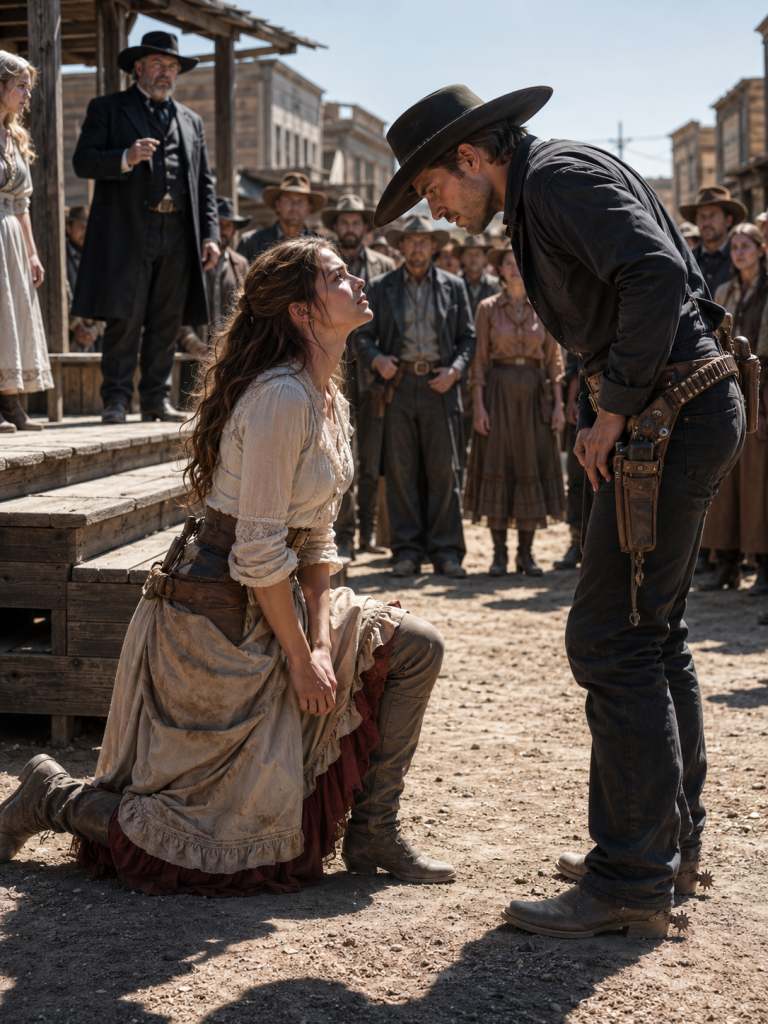
He walked the line slowly — not rudely, Everett Cobb was not a rude man, but with the quiet deliberateness of someone who takes most things seriously, and apparently saw no reason this should be different. He nodded to each woman, said a few words. The mayor hovered nearby, practically vibrating. The two beautiful women at the near end smiled their best smiles; one of them laughed at something Everett said, warm and genuine, and the mayor took it as a promising sign.
Everett kept walking. Past the middle of the line. Past a red-haired woman who looked capable enough to run a small nation. Past a young woman who couldn’t have been more than twenty-two and looked quietly terrified by the entire proceeding.
He reached the end.
Joanna Westbrook looked up at him with the expression of someone interrupted mid-thought and not especially pleased about it. She’d been staring at a point above the rooftops, calculating train schedules in her head.
Everett looked at her for a moment. Just looked — the way you look at something when you’re trying to read it honestly rather than quickly.
“You don’t want to be here,” he said.
Not an accusation. An observation.
Joanna held his gaze. “No,” she said. “I don’t.”
He nodded slowly, as though she’d confirmed something he’d already suspected.
Then he turned to the mayor and said four words that Harland’s Crossing would spend the next decade trying to understand.
“I’ll take this one.”
The silence that followed was the particular kind that happens when a room full of people all have the same thought and none of them dare say it first. Joanna stared at him. The mayor’s mouth opened and closed once.
And somewhere in the back of her mind, beneath the confusion and the instinct to refuse on principle, Joanna Westbrook felt something shift. Something small and old and almost forgotten.
She didn’t know what it was yet.
But she knew it hadn’t moved in a very long time.
PART 2
The paperwork took less than twenty minutes. Mayor Bingham had prepared documents in advance — optimistically, as it turned out, since he’d prepared them for all ten women — and shuffled through the stack with the flustered energy of a man trying to look composed while internally celebrating. Everett signed where he was told. Joanna signed where she was told. Neither looked at the other during the process.
The wagon ride to the Cobb ranch took just under two hours, and for the first thirty minutes, neither of them spoke. The land opened up gradually — flat scrub giving way to rolling grass, the kind of country that looked empty until you’d lived in it long enough to understand what you were looking at.
It was Joanna who broke the silence, the way she broke most things — directly, without softening the edges.
“You should know I’m not what they were looking for when they sent that letter.”
“I know,” Everett said.
“I’m not young. I’m not particularly agreeable. I have opinions about most things, and I don’t keep them to myself.”
“I gathered.”
She looked at him sideways. “Then why?”
He was quiet a moment — not the quiet of a man avoiding the question, but of one choosing his words the way you choose tools, reaching for the right one.
“Because you were the only one out there who wasn’t pretending,” he said.
Joanna had no immediate answer for that. She turned back to the road and sat with it while the wagon rolled on through the afternoon light.
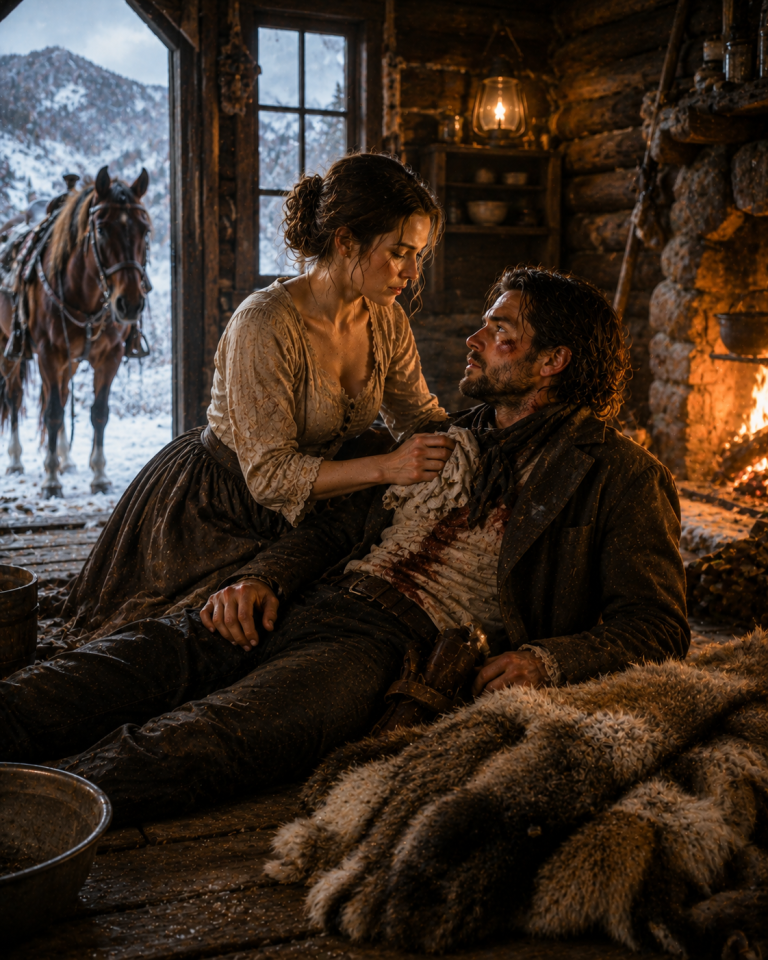
The ranch was not what she’d expected. She’d constructed a version of it in her mind during the ride — something rough and bachelor-worn, dishes in the sink, a broken chair someone kept meaning to fix. What she found instead was a house kept with quiet, methodical care. Sound porch boards. Clean windows. A vegetable garden along the south wall, slightly overgrown but clearly tended — the kind started with intention and maintained out of discipline rather than pleasure.
Inside, the main room was sparse but not bare. A stone fireplace. A good table. Two mismatched chairs, both solid. Books on a shelf — not decorative books, books that had been read, spines worn at the creases.
“It’s a good house,” she said.
“It’s a working house,” Everett said. “There’s a difference.”
She almost smiled. Almost.
The first week passed careful and quiet, the way two strangers sharing a space are always careful and quiet — each one mapping the other’s habits without appearing to. Everett rose before dawn, moving through morning chores with the efficiency of a man who’d done them alone long enough that the sequence had become a language he spoke fluently. He didn’t ask Joanna for help. Didn’t expect it.
She helped anyway. Not demonstratively — she simply appeared where work needed doing and did it. The garden got weeded. The kitchen got reorganized in a way that made considerably more sense. A loose hinge that had been announcing itself with a long creak every morning was silently tightened one afternoon, and never creaked again.
Everett noticed all of it. Said nothing about any of it either.
On the eighth day, something shifted — over a small thing, the way most shifts do. Joanna found a photograph on the mantel, half hidden behind a tin cup, as though placed somewhere between keeping and putting away. A young woman, standing in front of what looked like this same house, an easy smile, her hand raised slightly like she’d just been caught mid-wave.
She heard Everett’s boots on the porch and set it down quickly. When he came in, she was standing at the window, looking out at nothing in particular.
He went to the mantel for the tin cup. Saw the photograph had been moved. Something crossed his face — brief, controlled — before he set it back exactly where it had been.
“I’m sorry,” Joanna said quietly. “I shouldn’t have touched it.”
“It’s fine.”
“Was she your wife?”
The silence that followed had a different weight than any she’d grown used to that week.
“Yes,” Everett said. “Six years ago.”
She didn’t press. She’d learned, early in life, that some doors, when they open on their own, stay open longer than doors you force.
PART 3
She learned the rest of it slowly, from other sources. That Everett’s name carried a history in this county that preceded him. That there were men in Harland’s Crossing who’d once worked for him, others who’d borrowed money from him in lean years and paid it back without being asked twice. That the previous winter had been the hardest the territory had seen in twenty years, and Everett had quietly supplied three neighboring families with cattle feed when their own stores ran out — and told no one about it, and wouldn’t have, except that one family had mentioned it to the preacher.
She learned these things from a woman named Francis Pearson, wife of the dry goods merchant, who came calling on the tenth day with a pie and an agenda.
Francis sat at the kitchen table with the studied casualness of someone who’d prepared her questions in advance. “How are you finding it out here?”
“Quiet,” Joanna said.
“Everett’s a quiet man. I’ve noticed.” Francis cut a slice of pie and slid it across the table with the air of someone preparing to say the real thing. “People in town are wondering about you,” she said. “About the two of you. Nobody can figure out why he chose you.” She said it without cruelty, almost apologetically, the way one might report the weather.
Joanna looked at the pie. Then at Francis. “Neither can I,” she said honestly.
Francis studied her a long moment, something in her expression settling like a question finding its answer. “Well,” she said, picking up her fork. “Maybe that’s exactly why.”
That evening, after supper, Everett sat on the porch in the last of the light, and Joanna brought two cups of coffee out unasked. She handed him one and sat in the chair that didn’t match his — the one she’d quietly come to think of as hers — and they sat together without speaking while the sky turned colors over the grassland.
It was the most comfortable silence Joanna Westbrook had experienced in longer than she could honestly remember. And that frightened her more than anything else so far, because she had not come here to stay. She’d told herself that from the beginning. Three weeks, room and board, figure out the next move. The trouble was, somewhere between the ungreased hinge and the unasked questions and the man sitting three feet away who had never once tried to make her into something she wasn’t, the plan had started to feel less certain than it once had.
—
The trouble started, as trouble often does in small towns, with someone who meant well.
It was Francis’s husband, Gerald, who let it slip at the feed store one Thursday morning — that Joanna Westbrook had not come to Harland’s Crossing looking for a husband at all, that she’d signed on purely for the travel and the room and board, and had never intended to stay past three weeks. He’d heard it from Francis, who’d heard it from Joanna herself, spoken plainly and without embarrassment at the kitchen table ten days prior. Joanna hadn’t said it as a secret. She hadn’t thought it needed to be one.
By Friday afternoon, it had reached the barbershop. By Saturday morning, it had reached the mayor.
Aldis Bingham arrived at the Cobb ranch just after ten, riding with the particular urgency of a man who considers himself personally responsible for outcomes he had no business engineering in the first place. Everett was at the fence line when he saw the mayor’s horse coming up the road, and set down his tools with the measured patience of a man who’d learned certain conversations couldn’t be avoided, only delayed.
“There’s talk,” the mayor said, without dismounting.
“There’s always talk.”
“Talk with a point this time.” Bingham leaned forward on his saddle. “People are saying she never meant to stay. That she came out here under false pretenses. That you’ve been—” he searched for the word “—taken advantage of.”
Everett looked at him a long moment. “Did anyone ask me if I felt taken advantage of?”
The mayor opened his mouth. Closed it.
“Go home, Aldis,” Everett said, and picked his tools back up.
Joanna heard about it from Francis, who rode out that afternoon looking genuinely distressed. “I’m sorry,” Francis said at the door. “Gerald didn’t mean any harm. He just talked.”
“People do,” Joanna said. She invited Francis in anyway, made coffee, listened to the full account with the stillness of someone who’d received bad news before and knew the value of not reacting until she’d thought it through.
After Francis left, Joanna stood at the kitchen window a long time. She had not lied to anyone. She had not made promises she hadn’t kept. She had told Everett exactly the circumstances, openly, without decoration, on the wagon ride out. He had known. He had chosen anyway. But the town didn’t know that part, and the part the town didn’t know had a way of becoming the only part that mattered.
She found Everett at the barn just before supper, working a saddle repair. She stood in the doorway until he looked up.
“You heard,” she said.
“Francis’s husband talks. Known that for fifteen years.”
“It’s going to cause you problems.”
“I’ve had problems before.”
She stepped inside, arms crossed — not defensively, but the way someone steadies themselves for an honest conversation. “I want to tell you something,” she said. “And I want you to let me finish before you say anything.”
He set the saddle down and waited.
“When I came here, I had no intention of staying,” she said. “That was true. I needed the travel and the three weeks, and I told myself the rest would sort itself out. I didn’t come here thinking about you, or this ranch, or any of it.” She paused. “I want you to know that, because I don’t want you to think something was built on a foundation that wasn’t there. Whatever this has been these three weeks — it started from nothing on my side. No expectation. No plan.”
Everett was quiet.
“But it didn’t stay nothing,” she said. She stopped, looked at the barn floor briefly, then back at him. “That’s what I wanted you to know.”
The silence that followed was not uncomfortable. It was the silence of two people arriving at the same place from different directions, taking a moment to confirm they were reading the same landmark.
“I know it started from nothing,” Everett said finally. “Most things worth having do.”
She stayed.
Not because the town expected it, and not because the paperwork made it tidy, and not because she’d run out of other options — though the town would construct each of these explanations in turn and find them all unsatisfying.
She stayed because on the nineteenth morning she woke before dawn for no particular reason and lay in the stillness of the ranch house, listening to the land outside, and realized she had not once in nineteen days thought about where she was going next.
For a woman who had spent the better part of a decade thinking about where she was going next, that was not a small thing.
—
The wedding was held on a Saturday in early October, in the yard of the Cobb ranch rather than the church, because Joanna had said she preferred open sky, and Everett had said that was fine with him. Francis Pearson cried. Mayor Bingham shook everyone’s hand twice. The preacher kept it short, at Everett’s specific request.
Joanna wore a dress Francis had helped her alter — not the frayed one from the lineup, but a deep green one that had been packed at the bottom of her travel bag since St. Louis, brought along for no reason she’d been able to articulate at the time, and understood completely now. When the preacher asked if she took this man, she said yes the way she said most things — plainly, directly, without embellishment.
Everett smiled at that. A real smile. The kind that changed his whole face. She hadn’t seen it before. She decided immediately she intended to see it again.
The years that followed were not easy ones — no years on the frontier ever were. Dry summers, hard winters, a cattle sickness in the third year that cost them more than either wanted to count. Disagreements, some of them loud, most resolved by morning. Neighbors who never quite stopped being curious about the choice Everett had made that Tuesday morning outside the post office.
But there were also two children — a boy named Samuel, with Joanna’s directness and Everett’s patience in equal measure, and a girl named Francis, for a woman who’d shown up with a pie and an agenda and turned out to be one of the finest friends either of them ever had. There was the porch, and the two chairs that didn’t match, and the evening light over the grassland that never looked exactly the same twice. There was the photograph on the mantel, which stayed exactly where it was, because Everett was a man who carried his history honestly, and Joanna was a woman who understood that loving someone means making room for everything they’ve already been.
And there was the quiet — the particular, comfortable, hard-earned quiet of two people who had each stopped pretending somewhere along the way, and found, to their mutual astonishment, that what was underneath was more than enough.
The town of Harland’s Crossing never fully agreed on why Everett Cobb had walked past nine women and stopped at the tenth. Some said he’d seen something in her eyes. Some said he’d recognized a kind of pride that matched his own. Some said it was simply one of those things that couldn’t be explained, only accepted.
Joanna, when asked — and she was asked more than once over the years — gave the same answer every time.
“He saw me not trying,” she said. “And he decided that was enough.”
Most people nodded at that, as though they understood.
A few of them actually did.
THE END.