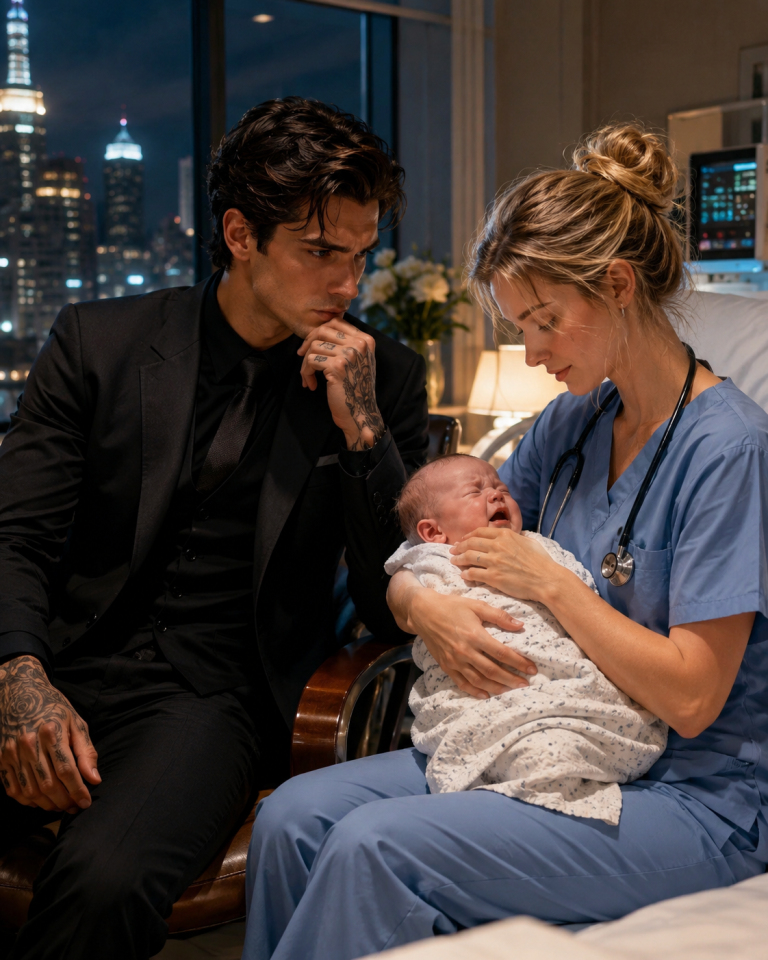
THE MAFIA BOSS HEARD “YOU ARE THE FATHER” ON A HOSPITAL CALL — THEN ARRIVED WITH THREE MEN, A MEDICAL TEAM, AND A PROMISE THAT CHANGED EVERYTHING

**PART 1**
The first time Matteo Falcone heard he had a son, he did not congratulate me. He did not ask for proof. He did not even raise his voice.
He went silent.
And that silence was worse than screaming.
Because on the other side of that phone call, our seven-month-old baby was lying in a Boston emergency room with a fever so high the doctors were preparing to put a needle into his spine.
And Matteo — the man I had run from fifteen months earlier, the man New York whispered about but never accused out loud — said only one sentence.
“Put the doctor on the phone.”
My hands were shaking so badly I nearly dropped the phone.
Three hours later, he walked into that hospital like a storm in a black suit.
But it started in my apartment, with a diaper bag sliding off my shoulder for the third time and Gabriel whimpering against my chest.
“Almost there, baby,” I whispered, fumbling with the lock.
The hallway smelled like old carpet and someone’s burnt dinner. My building in Dorchester had an elevator that worked when it felt generous and heat that seemed to quit whenever the rent was due. I pushed the door open with my hip, kicked it shut behind me, and felt the cold air inside wrap around us.
I’d forgotten to adjust the thermostat before work.
One more thing. That was my life now: one more bottle to wash, one more invoice to ignore, one more daycare payment to somehow make, one more night pretending I wasn’t drowning.
I set Gabriel in his playpen. His little fist stayed curled into my olive-green blouse like it was the last safe thing in the world. Seven months old, nearly eight, with wild black hair that never stayed flat and dark brown eyes that made my heart hurt every time he looked at me.
Matteo’s eyes. Always Matteo’s eyes.
Fifteen months since the divorce. Fifteen months since I left marble floors, crystal chandeliers, private elevators, and a marriage that looked flawless from a distance but felt like suffocation from inside.
My phone buzzed. Probably Priya again — she’d been checking on me all afternoon since I mentioned Gabriel seemed fussier than usual. I let it ring and went to warm his bottle, the microwave humming in the silence like company.
Boston had seemed like the right choice after the divorce. Far enough from New York I’d never accidentally see Matteo at a restaurant or a gala. Close enough to still build a career. I found work at a mid-size corporate law firm — nothing glamorous, but it covered most of the bills if I didn’t look too closely at my bank account.
The rent was due next week.
Gabriel cried. Not his normal cry — this one was thin and sharp, the kind that split straight through my ribs. I grabbed the bottle and rushed back. When I lifted him, his forehead burned against my chin.
Too hot.
“No, no, no,” I murmured, carrying him to the bathroom. “It’s just a little fever. We’ll take your medicine and you’ll be okay.” But I’d already given him infant acetaminophen two hours earlier.
The thermometer beeped. 103.1.
My knees nearly gave out. I called the pediatrician. Voicemail — of course, Friday night after six. Priya’s name lit up my screen again. This time I answered.
“Natalie, I’ve been trying to reach you. Are you okay?”
“Gabriel has a fever,” I said, hating how small my voice sounded. “One-oh-three. He’s not acting right.”
“Take him to the ER. Now.”
“I don’t know if—”
“Natalie. Now.”
She was right. I knew she was right. Still, for one horrible second, all I could think about was the hospital bill. The copay. The deductible. The questions. The blank space on Gabriel’s birth certificate where his father’s name should have been.
Then Gabriel’s body went limp against me.
Nothing else mattered.
I stuffed his rabbit, a change of clothes, my wallet, and his insurance card into the diaper bag. The elevator was broken again, so I carried him down four flights, counting the steps to keep from losing my mind. Outside, October rain hit us like ice.
By the time I buckled him into his car seat, my blouse was soaked and my hair was plastered to my face. His eyes were half closed. He should have been fighting me — crying, kicking. Anything but that awful stillness.
“Stay with me, Gabriel,” I whispered. “Please, baby. Stay with me.”
The hospital was twelve minutes away. I made it in eight, ran two red lights, and didn’t care who saw.
The ER entrance glowed harsh white against the storm. I burst through the automatic doors with him in my arms. “I need help. My son has a very high fever and he’s not responding normally.”
The triage nurse took one look and called for assistance. Suddenly there were people around us — scrubs, gloves, questions.
“Age?”
“Seven months.”
“Weight?”
“About eighteen pounds.”
“Allergies?”
“None that I know of.”
“Medical history?”
“He was healthy. He’s always been healthy.”
“Is the father present?”
The question stopped me cold. For fifteen months I’d built a wall around that answer, telling myself I was protecting Gabriel, protecting myself, protecting the life I’d rebuilt from nothing. But in that bright, sterile hallway, with strangers wheeling my baby away, the lie collapsed.
“No,” I said. “It’s just me.”
They took him through double doors I wasn’t allowed to cross. A nurse in lavender scrubs led me to a small waiting room with plastic chairs and fluorescent lights, told me someone would come soon, told me to stay calm.
Stay calm. As if calm was something a mother could choose when her whole world weighed eighteen pounds and was burning up behind locked doors.
Minutes stretched into something cruel. Then a young doctor appeared — exhausted but kind, wire-framed glasses, tired eyes.
“Ms. Reyes? I’m Dr. Whitfield. Your son is stable for now, but we need to run tests. His fever is concerning, especially at his age.”
“What kind of tests?”
**PART 2**
“We need to rule out serious infection. Meningitis is one of our concerns.”
The room tilted. “Meningitis?”
“We’ll need to perform a lumbar puncture. A spinal tap. I know that sounds frightening, but it’s the only way to know for sure.” He paused. “I also need a complete medical history. Especially the father’s. Blood type, genetic conditions, immune disorders — anything relevant.”
Matteo’s face flashed in my mind. Strong jaw. Dark eyes. The small scar on his chin from a fight he never explained. A man who could negotiate with senators in the afternoon and receive silent phone calls at midnight that made him leave without a word.
“I don’t know,” I admitted. “His father and I don’t have contact.”
“Can you reach him? Even blood type could matter. Time is important.”
Time. The one thing I had wasted. For fifteen months I’d kept Gabriel a secret, telling myself Matteo had made his position clear. Six months into our marriage I’d asked him if he ever wanted a family. He’d looked at the ceiling and said, *”Children are leverage, Natalie. In my world, you don’t give people leverage.”* I heard rejection. Maybe he’d meant fear.
But when I found out I was pregnant a month after the divorce, standing barefoot in my new apartment surrounded by unopened boxes, I made a decision. I would not let my baby become leverage. I would not let Matteo’s world swallow him whole.
Now my son needed him.
“I can try,” I said.
I no longer had Matteo’s number — I’d deleted it the day I moved to Boston, as if removing ten digits could erase a marriage. But my divorce attorney had it. She answered on the fourth ring. “Natalie? Is everything okay?”
**PART 3**
I broke. Not gracefully. Not quietly. I sat on the hospital floor with tears running down my face and told her everything.
“Gabriel is in the ER. They think it could be meningitis. They need his father’s medical history.”
Silence. Then, softly: “I still have Matteo’s private number.”
Five minutes later my phone rang. Unknown number. I almost didn’t answer.
“Natalie.”
Just my name. Nothing else. But I recognized his voice immediately, and fifteen months disappeared in one heartbeat.
“Matteo…” I whispered.
“What happened?”
And suddenly I was crying harder. “Gabriel is sick.”
Another silence. Then: “Who is Gabriel?”
I closed my eyes. “Our son.”
Nothing. No breathing. No words. No anger. Only silence.
Finally, in a voice I had never heard from him before: “How old?”
“Seven months.”
More silence. Then: “When was he born?”
I told him. I heard him inhale sharply — because he understood immediately. Gabriel had been conceived while we were still married.
“Put the doctor on the phone.”
Dr. Whitfield explained everything. Matteo answered every question — blood type, family history, allergies, genetic conditions. Then he asked, quietly:
“Will my son survive?”
Dr. Whitfield paused. “We believe so. But time matters.”
“Do whatever is necessary.”
The call ended.
Three hours later, the doors to Boston Mercy opened, and Matteo Falcone walked inside.
Not alone. Three security men. A pediatric infectious disease specialist flown in from New York. Two nurses. His personal physician. The entire waiting room went silent.
He saw me. For fifteen months I had imagined this moment — anger, accusations, questions. Instead he walked straight toward me, then stopped, because I was still wearing the same olive-green blouse from before the divorce. The one he’d bought me in Florence.
His eyes filled with tears. “He’s really mine?”
I nodded.
For one terrible second I thought he would hate me. Instead he dropped to his knees in the middle of the hospital — the feared Matteo Falcone, the man politicians respected and enemies avoided, actually crying.
“My son was born and I wasn’t there.” His voice cracked. “I missed his first smile. I missed everything.”
I had never seen him broken before.
Then he stood, wiped his face, and became terrifying again — not angry, focused. He turned to his medical team. “Whatever my son needs, he gets.”
No one argued.
By sunrise, Gabriel’s test results came back. Not meningitis. A severe viral infection — dangerous, but treatable.
Dr. Whitfield smiled. “He’s going to be okay.”
I nearly collapsed. Matteo caught me before I hit the floor.
Hours later, we stood beside Gabriel’s hospital crib. Our son slept peacefully, tiny fingers wrapped around his stuffed rabbit. Matteo stared at him like he was looking at a miracle. Then Gabriel opened his eyes and smiled.
His first smile at Matteo.
The mighty Matteo Falcone completely lost the battle. He started crying again. “Hello, little man.” Gabriel reached for him, and for the first time in his life, Matteo Falcone held his son — looking terrified, like someone had handed him the universe.
That afternoon, I finally asked the question I’d carried for fifteen months. “When I asked if you wanted children, you said they were leverage.”
He looked at me with pain. “My father used me to punish my mother.” His voice was quiet. “I promised myself I would never bring a child into my world.” He looked down at Gabriel. “I thought refusing to have children was protecting them.”
I started crying again, because all this time we had both acted out of fear, and fear had stolen fifteen months.
Three days later, Gabriel was discharged. When we arrived outside the hospital, I stopped. There were six black SUVs waiting.
“You brought an army?”
He looked offended. “My son is coming home.” Then he opened the rear door himself. Inside sat a brand-new car seat, installed perfectly. Beside it, a small stuffed elephant, and a note in shaky handwriting: *For Gabriel. From Dad.*
That night, back in New York, Matteo showed me something I had never seen — the nursery. He’d built it during our marriage. Secretly. Painted blue. Bookshelves. A rocking chair. Baby clothes still hanging in the closet, unused for almost two years.
“I never destroyed it,” he admitted quietly. “I couldn’t.”
I cried so hard I could barely breathe, because the man I thought never wanted children had spent fifteen months sleeping beside an empty nursery.
Six months later, Matteo officially stepped away from the empire his father built. He sold businesses. Closed accounts. Walked away from power. People said he was crazy. He didn’t care — because every morning he made pancakes for a little boy with wild black hair, and every evening Gabriel waited at the front door screaming, “Dada!”
One year later, Matteo proposed again. Not in a ballroom. Not on a yacht. Not with reporters. He proposed barefoot in the kitchen while Gabriel sat in his highchair throwing blueberries at the dog.
“Marry me again,” he whispered. “This time with no secrets.”
I said yes.
On the day we renewed our vows, Matteo held our son in his arms and made one promise in front of everyone. “I spent fifteen months missing my child.” His voice broke. “I will spend the rest of my life making up for every second.”
Ten years later, when Gabriel graduated elementary school, his teacher asked the students who their heroes were. Most children wrote athletes. Actors. Superheroes.
Gabriel Falcone wrote three words.
*My dad, Matteo.*
And when the teacher asked why, Gabriel smiled and answered: “Because no matter how busy he is, he never misses anything.”