Cast Out at 18 With Nowhere to Sleep, She Inherited a “Worthless” Cave—But What She Built Inside Made the Whole Frontier Kneel

Part 1
The floorboard creaked upstairs, and Wren Calder stood perfectly still in the kitchen, listening to her father not come down.
She had known he wouldn’t. Hollis Calder had perfected the art of absence the way other men perfected a trade — the slow scrape of his chair, a cough swallowed too long in a throat ruined by drink, footsteps that always seemed to be heading somewhere else whenever his eldest daughter needed him to be anywhere at all. He knew she was leaving this morning. He simply wasn’t going to watch it happen.
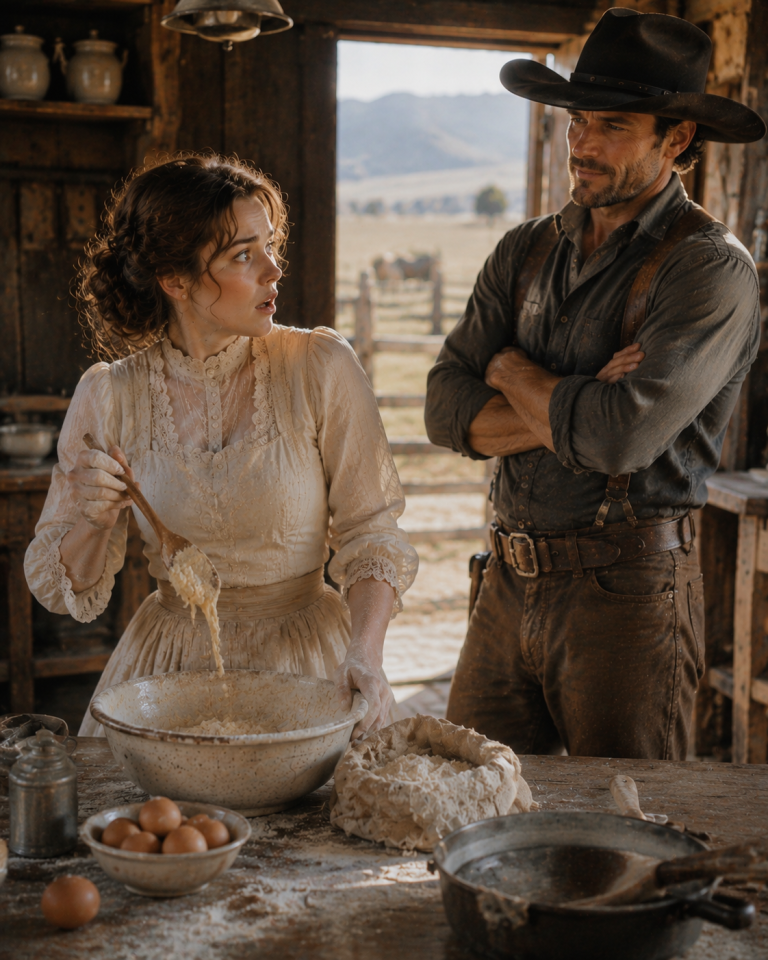
At the table, her stepmother Ruth sat with both hands wrapped around a cup of coffee gone cold. Only thirty-one, but worry had already carved hollows under her eyes that made her look a decade older. In the next room, two small children slept — Thaddeus, seven, and tiny June, four — and there wasn’t enough food in that house to make kindness affordable to everyone in it.
“You’ve got everything you need?” Ruth asked.
“Everything I need.”
“That’s not what I asked you.”
Wren glanced down at the canvas rucksack she’d sewn herself from old feed sacks. One change of clothes. A wool blanket, scorched at one corner. Her grandmother Odessa’s hunting knife. A tin cup. Dried venison wrapped in cloth. A fistful of barn nails pulled by hand, straightened one by one over a stone. And folded carefully at the bottom, the only thing in the bag that mattered: a deed.
Crow’s Hollow Ridge. Sixty acres of shale, scrub pine, and wind, with a cave at its heart that men in Larkspur Junction laughed about over their whiskey. The county clerk had called it worthless on the record. The ranchers called it a death trap around campfires. Even old Tom Ferris at the general store said her own grandmother — toughest woman in three counties — had never once tried to live up there.
But it was land. And it was hers, which was a word Wren had rarely been permitted to use about anything in her whole life.
Ruth rose without another word, crossed to the cupboard, and drew out a small folded cloth. Inside: two silver dollars and a scatter of smaller coins.
“Take it.”
“That’s yours, Ruth.”
“It’s mine to give away, isn’t it.”
Wren looked at the money, then at the woman across from her — a woman who had never managed to love her like a daughter, but had also never once enjoyed making her suffer either. Ruth had done the brutal arithmetic of a failing farm and arrived, alone, at the conclusion nobody wanted spoken out loud. Wren was eighteen. Wren could leave. The little ones could not.
“Half,” Wren said.
“All of it.”
“Half. You’ve got two children to feed through winter.”
For a long moment, neither woman moved, two people standing on opposite sides of a problem that belonged to neither of them. Then Ruth peeled two coins back into her own palm and pressed the rest into Wren’s hand.
“You are exactly as stubborn as your grandmother was.”
“Good,” Wren said, almost smiling despite everything. “She lived to be seventy-six.”
She walked out the door without once looking back up the stairs.
The road into Larkspur Junction ran six frozen miles, and her father’s old boots — two sizes too large, stuffed with rag at the toe — had her heels bleeding by the time the first buildings came into view. She ignored the pain the way girls raised on hard luck learn to ignore most things that won’t kill them outright.
The town itself looked like it was waiting to be told whether it was already dying. Half the storefronts stood shuttered. A line of anxious men stretched outside the bank, trying to retrieve money that might not exist anymore. The saloon, naturally, was doing a brisk trade regardless.
Tom Ferris lowered his newspaper as the bell over his door rang.
“Heading somewhere, Calder?”
“Crow’s Hollow Ridge.”
He stared at her a long moment, set the paper down entirely.
“By yourself?”
“Unless you’re volunteering to come along.”
He didn’t laugh, and something in his silence made her chest go tight.
“Wren,” he said, careful as a man stepping around broken glass, “that ridge is shale and rattlesnakes and a cave that goes back further than good sense allows. You cannot farm rock.”
“I’m not planning to farm rock.”
“Then what exactly are you planning?”
She set her pack on his counter. “A hand ax. As much rope as seven dollars buys. Cornmeal. Salt. Seed potatoes, if you’ve got any with eyes still on them.”
He gave her more than seven dollars should have bought — a small ax, nearly twenty feet of good rope, cornmeal, salt, lard, a dozen sprouting seed potatoes — and pushed it all toward her with his jaw set tight.
“If it doesn’t work,” he said, “you come back here. I’ll find you something. Sweeping floors, stocking shelves, anything. You don’t have to die up on that ridge just to prove something to this whole sorry town.”
“I appreciate that, Tom. But I won’t be coming back.”
Outside, near the saloon, a voice called her name before she’d gone twenty steps.
Garrett Holloway owned close to a thousand acres south of town, and he wore ownership the way other men wore their coats — like it had simply always belonged to him. Two ranch hands flanked him, grinning at whatever joke they assumed was about to happen.
“Word is you’re headed for Crow’s Hollow.”
“Word travels fast in a town this small.”
“It does.” He stepped closer, hands tucked easy in his vest pockets. “Let me save you the trouble. Fifteen dollars, cash today, for that land.”
Fifteen dollars was nearly everything Wren had in the world. Enough for a train ticket somewhere warmer, busier, cruel in entirely different and unfamiliar ways.
“It’s not for sale.”
He smiled the way a man smiles at a child he assumes simply hasn’t grasped the situation yet. “That ridge is a rock pile with a hole punched through it. Nothing more.”
“Then why do you want it so badly?”
His smile flickered — just for a second, but she caught it.
“Because I’m a generous man.”
“No,” Wren said evenly. “You are not.”
She turned and kept walking while the men’s laughter trailed after her down the street, and didn’t once let her shoulders drop.
By dusk, after losing the trail twice, tearing her palms on deadfall, and scrambling up shale that slid out from under every footstep, Wren finally reached the rocky bowl beneath Crow’s Hollow Ridge.
It was every bit as bad as everyone in town had promised.
A basin ringed by shale walls and sickly pines, thin grass clinging to thinner soil, wind moving through it with nothing to slow it down. On the far side, the cave mouth opened low and black into the ridge face, like the mountain had lost a tooth long ago and never bothered healing the gap.
Wren let her pack drop to the ground.
The cold air smelled of pine, stone, and something older — old water, patient and unhurried.
“Well,” she said to nobody at all. “Here we are.”
She slept that first night at the cave’s mouth with a small fire burning between herself and the dark, and somewhere deep inside the stone, water dripped with the steady patience of a heartbeat that had been keeping time long before she arrived — and would, though she didn’t yet know it, still be keeping time long after Garrett Holloway learned exactly what was hidden fourteen feet inside her property line.
Part 2
The cave was not a grave. That was the first thing Wren understood, ducking through the low entrance the next morning with a candle stub held ahead of her.
After the first ten feet, the ceiling lifted away into a chamber forty feet wide and sixty deep, the stone floor mostly dry, and along the left wall, clear water seeped steadily down the rock into a natural basin worn smooth as though some patient hand had shaped it across centuries.
She cupped a palm beneath the seep and drank.
Cold. Clean. No bitterness, no sulfur edge.
Real water.
She stood in the center of the chamber and held her hand up the way her grandmother had once taught her — feeling for the air itself. Still, but not stale. Warmer than outside. Steady in a way that didn’t care what the weather above was doing.
Deeper passages branched away. One pinched too narrow for her shoulders. Another bent toward dark she didn’t trust yet. A third opened into a low chamber where the floor lay inches deep in dried, crumbling bat guano, dark as old coffee grounds.
Most people would have gagged and backed straight out.
Wren crouched, rubbed a pinch between her fingers, and laughed out loud, the sound bouncing strange off the stone.
“Fertilizer.”
Her grandmother Odessa had grown tomatoes people talked about three counties over, and had told her more than once that bat guano ran richer than manure, richer than any compost — rich enough to wake up soil that had given up on itself.
The men back in Larkspur Junction had looked at this cave and seen a hole in a mountain.
Wren saw water, shelter, warmth, fertilizer, and a reason to keep breathing.
By sundown she had something close to a plan — not a good one yet, maybe not even a sane one, but a plan was a rope thrown across despair, and she meant to grab hold of it with both hands.
She would build a cabin against the cave mouth, letting the stone become its back wall and its hidden heart. The cabin would take the wind. The cave would hold water, food, animals, anything that couldn’t survive a frost. She would lay garden beds inside the main chamber, mixing guano with scraped topsoil and sedge grass from the spring, and grow food underground where winter couldn’t reach it.
It was impossible.
So was walking back down that mountain in defeat.
She began with timber. The hand ax was too small for proper felling, but it was the only ax she owned, so she used it — one trunk at a time on the north slope, chopping until her arms shook, resting, chopping again, dragging logs down by rope looped over her own shoulders while bark ground through her shirt. Her hands blistered, split open, bled, and slowly hardened into something closer to leather.
The cabin rose crooked. She notched logs by guessing, then by failing, then by guessing better, inventing a system of forked-branch levers and rope so she could raise wall logs alone, inch by stubborn inch — every lift a small negotiation with gravity, every notch that finally seated itself feeling like an argument won against the whole county at once.
The fireplace collapsed the first time she lit it, smoke rolling back into the cabin in a choking wave.
She cried then, briefly, though she told herself afterward it had only been the smoke.
Then she rebuilt it.
On the second attempt, the chimney drew badly for nearly an hour before a thin column of smoke finally rose straight and clean. Wren sat on the packed dirt floor and watched the fire burn like it was a small, specific miracle sent purely to embarrass her own despair.
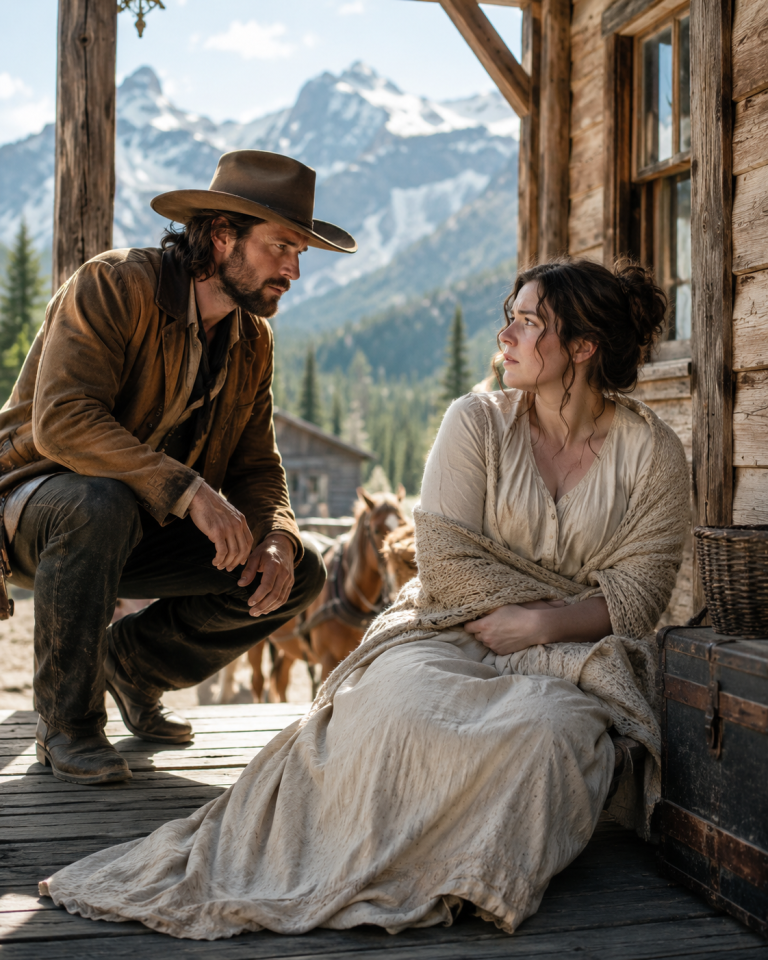
That was when Silas Crane rode in on a tired mule, gray-bearded, loose in the saddle, pale eyes that had clearly seen more than they let on.
“Name’s Silas Crane,” he said. “Trap along the North Fork. Heard somebody was fool enough to build up here. Didn’t believe it till now.”
“Well, now you’ve seen it.”
He studied the cabin a long moment. “Southwest corner’s wrong. Top log’s pushing outward. First hard freeze, that wall’ll rack right over and land in your lap while you sleep.”
Wren had sensed something was off there without knowing what. “How do I fix it?”
He told her, plainly, without softening any of it. Then he looked at her again, longer this time.
“You’re Odessa Calder’s granddaughter.”
“You knew her?”
“Everybody knew Odessa. Tough as boiled leather, and twice as hard to chew through.” His eyes moved over the cave mouth, the stacked logs, the thin smoke rising from her corrected chimney. “She’d have liked this.”
“Most people think I’ve lost my mind.”
“Most people generally have,” he said, and rode off after promising he’d check back if she was still drawing breath.
The next morning she fixed the notch exactly as he’d described, and the wall held true.
The cave beds came next. She hauled guano up from the deeper passage by the bucketful, mixed it with topsoil, sedge, clay dust, and rotted leaf mold, and framed raised beds with flat stone along the chamber wall. The smell was wretched. The labor was worse. But when she finally pressed the seed potatoes down into the dark, rich soil and watered them from the basin, something in her chest came unlocked for the first time since she’d left her father’s house.
Something would grow here. She could feel it in her own ribs.
A few weeks later, Garrett Holloway rode back into the bowl with two men trailing him, the way a man inspects land he already considers his.
“Well,” he said, looking around. “She’s still here.”
Wren stood in her rough doorway, arms crossed. “Mr. Holloway.”
He nudged his horse close enough to lay a palm against her cabin wall — and noticed, with visible surprise, that it didn’t give.
“Built yourself a shack against a cave.”
“I built myself a home.”
His mouth thinned. “I’ll give you twenty dollars.”
“No.”
“Wren, I’m a practical man. This winter’s set to be the worst this county’s seen in twenty years. You’ll be snowed in, out of food, and entirely alone up here.”
“Why do you want this land so badly, Mr. Holloway?”
His eyes flickered again — that same half-second tell. “It connects my north range to the timberline. I don’t like gaps in my holdings.”
Part truth. Part curtain drawn over the rest.
“It is not for sale,” Wren said. “Not for twenty dollars. Not for a hundred.”
He studied the cave mouth far longer than he studied her face, then tipped his hat and turned his horse without another word.
“My offer stands,” he called back. “For now.”
After he’d gone, Wren unfolded the deed by firelight and read it through twice in the flickering light, though she already knew every word of it by heart.
Sixty acres. Her name. Her ridge.
She slept that night with the paper tucked under her pack and her grandmother’s knife close to her hand.
Part 3
By late autumn, Crow’s Hollow Ridge had begun to answer her back.
The cabin door fit snug in its frame now. The walls no longer whistled with every gust. The fireplace drew clean after she’d angled a flat stone into the flue. In the cave, garden beds sent up green shoots in open defiance of the freezing nights outside.
When Silas Crane came back through, he stood a long time studying the potatoes and garlic growing under rotating candlelight in the dim, steady underground warmth.
“You’ve got crops growing in winter,” he said finally.
“Small crops.”
“In winter.”
“The cave holds steady. No frost reaches it. Water’s right there. Light’s the only real trouble — I rotate the candles room to room.”
He crouched and pressed two fingers into the dark soil. “This is good earth.”
“I made it.”
He glanced up at her, and something like genuine respect settled quietly into his weathered face. “I’ve looked at this cave a dozen times over the years, you know.”
“And?”
“I saw a hole in rock. You saw a house.”
“I saw what I needed badly enough to find it.”
He told her about Bess Calloway in town, a widow with laying hens and a flooded cellar that had ruined half her cookware. Wren traded two clay pots she’d shaped and fired herself for five hens, and carried them home in a crate, complaining the entire four-mile walk back.
She built their coop into a side passage of the cave where foxes couldn’t reach and cold couldn’t bite, and the first egg arrived the very next morning, small and warm and faintly miraculous in her cupped palm. She ate it slowly, savoring every bite like it was something rare.
Then came the conversation she’d been waiting, without knowing it, to overhear.
Cutting deadfall on the south slope one gray afternoon, Wren heard Holloway’s voice carry up from below, talking to a stranger.
“Won’t work if she won’t sell,” the stranger said.
“She’s an eighteen-year-old girl alone on that ridge,” Holloway answered. “She’ll come around by February.”
“And if the survey doesn’t confirm the line you need—”
“It’ll confirm it. Pruitt knows exactly what I’m paying him to find.”
Wren stood frozen behind a stand of pine until the voices faded entirely.
Her deed described the eastern boundary by old survey stakes, chains, links, and a marked stone she had never once walked carefully herself. The next morning, she did — pacing every chain length, checking every pin against the deed’s faded ink, until at the fourth marker, hidden beneath moss and a season of fallen leaves, she found exactly what Holloway wanted so badly.
A spring, clear and strong, breaking from the base of the ridge and cutting a real channel south through solid stone. Not a seep. Not a trickle that would dry by July. A genuine water source — enough for cattle, enough to carry a herd clean through any summer drought, enough to turn supposedly worthless land into the single most valuable parcel in the district.
And it sat just inside her boundary line. If Holloway’s man could shift that line even twenty feet, the spring would belong to him instead.
She went straight to Tom Ferris.
He listened without once interrupting her.
“Ezra Pruitt,” he said when she finished. “County surveyor when it suits him, private surveyor when the price suits him better. Holloway’s used him before, more than once.”
“What do I need to do?”
“Your own survey, filed first. An honest man. Old Garrick Heartwell, out at the county seat.”
“How much would that cost me?”
“Twelve dollars, generally.”
She had nowhere near twelve dollars to spare.
Tom thought it over, drumming his fingers on the counter. “Heartwell’s wife has been after good rabbit hides for years.”
Wren had eleven cured hides at the cabin, each one representing a cold morning’s snare work and careful skinning. She bundled them and sent word, and waited.
Old Heartwell arrived twelve days later — wiry, white-bearded, steady-handed, carrying surveying instruments older than the county clerk’s office itself. He accepted the hides without comment, walked the entire boundary line himself, located every original stake, measured the spring’s exact position, and made his careful notes in a leather-bound book.
“Fourteen feet inside your property line,” he said at last.
“Fourteen feet.”
“Fourteen. And that is not a mistake, Miss Calder. That is ownership, plain and recorded.”
His survey was filed within the week.
When Holloway’s ranch hand rode up not long after with a final offer of thirty dollars, Wren didn’t let him finish his sentence.
“No.”
“Pruitt says the spring line might actually—”
“Heartwell’s survey is filed, dated, and witnessed, sitting in the county office right now. Whatever Pruitt says comes second to that, and you can tell Mr. Holloway I said so.”
The young man shifted uneasily in his saddle. “There’s a storm coming. Bad one — worse than the one back in ’83, folks are saying. You’re alone up here.”
“I’m aware of that.”
“I just thought you ought to know.”
“I appreciate the warning. Go on home and get ready yourself.”
The sky had already gone flat and iron-gray, the exact color her grandmother used to warn her about. Wren spent the next three days hauling extra wood, moving the hens deeper into the cave, storing water in clay pots, pulling the last potatoes and garlic and cattail roots, and banking her fire like her life depended on every single coal staying lit.
The storm arrived without ceremony. Then the wind began, and didn’t stop.
By afternoon it struck the cabin like something alive, snow flying sideways hard enough to sting skin through cloth, the temperature dropping past anything her homemade thermometer could measure. The cabin held, though it groaned with every gust. Behind the canvas curtain, the cave stayed steady — chickens huddled warm in their side passage, water running unfrozen, green leaves standing patient under candlelight.
On the fourth night, through the storm’s full roar, someone pounded at her door.
Wren threw it open and a half-frozen man collapsed straight into the cabin.
Not Silas. A stranger — a trapper named Walt Dorsey, his bare hands gone white with frostbite, barely able to force words out through chattering teeth.
“Others,” he gasped. “South slope. Three. Maybe four more.”
Wren sat him by the fire, pressed warm water and a potato into his shaking hands, tied one end of her rope to an iron spike driven into the cave wall, took up Silas’s old ax and her lantern, and walked straight back out into the blizzard without a second’s hesitation.
She found them by the dying gleam of a dropped lantern behind a deep drift.
Bess Calloway — the very woman who had told the whole town Wren would be dead before Christmas — half-buried and barely conscious. Two Pruitt brothers beside her, faces gray. A fourth man further off, breathing in thin, shallow pulls.
Wren hauled two of them in first, fighting the rope hand over hand, then went back out for the others. She dragged the last man by his coat collar through snow deep enough to swallow her to the knees, lost feeling entirely in one foot somewhere along the way, her lungs burning raw with every breath of frozen air.
Five people crowded into a cabin built for one that night.
Bess sat trembling near the fire, both hands wrapped white-knuckled around a tin cup. “You came back for us.”
“I said I would.”
“You don’t even know me.”
“I know you well enough, Mrs. Calloway.”
Bess’s composed face broke entirely. “I told everyone in town you wouldn’t last a season up here.”
“You weren’t the only one who said it.”
Wren fed them potatoes, eggs, beans, and whatever else she had left, while outside the storm tried with everything it had to pry apart walls she’d raised with her own two hands.
It failed completely.
Part 4
The storm finally broke on the sixth day, leaving the bowl buried beneath three full feet of hard white silence.
Five people woke that morning in Wren’s cabin, blinking at one another like survivors washed up together on the same unlikely shore. They had slept in shifts, eaten from the same chipped clay bowls, shared fire and breath and fear and warmth through five long nights. None of them would ever again speak of Crow’s Hollow Ridge as some empty, worthless waste of stone.
But Wren understood exactly what it had cost her.
Her winter stores sat dangerously low. Feeding five extra people for six days had eaten through potatoes she couldn’t replace until her cave beds matured again, cornmeal stretched thin as paper, nearly every drop of rendered lard she’d carefully saved.
Walt Dorsey saw it on her face before she said a word.
“How bad is it really?”
“It’s manageable.”
“You fed five strangers from a one-woman winter store, Miss Calder.”
She gave him the honest numbers anyway.
He listened without flinching, then nodded slowly. “My trapper’s cabin sits four miles northeast of here. I’ve got dried venison, elk meat, dried beans stored up. I can make the walk there and back.”
“Your hands are still frostbitten.”
“My legs work fine, and so do my arms, mostly.”
“Is it really worth that risk to you?”
The question seemed to catch him somewhere honest. “You walked out into that storm twice, for people you’d never met. I can manage four miles for the woman who kept me from freezing to death in a snowdrift.”
He returned the next morning with the younger Pruitt brother and two full sacks of meat and dried beans, and that night Wren cooked a stew thick enough to finally quiet the whole room.
Bess asked, eventually, about the cave beds glowing faint with candlelight in the next chamber. “How does anything grow down there? Underground, in the dead of winter?”
“Stable temperature. Water from the seep. Rotating candlelight. And the right soil.”
“What kind of soil makes that possible?”
“Bat guano, mostly. Mixed with topsoil and sedge grass and good compost.”
Bess stared at her for a long moment, then laughed — the first real laugh anyone had heard from her since the rescue. “You’re growing garlic in bat droppings, child.”
“Finest fertilizer there is, if you don’t mind the smell getting there.”
Hosea Pruitt, the larger of the two brothers Wren had dragged through the snow, spent the better part of an hour studying her raised stone beds with real focus.
“I farm bottomland myself,” he said eventually. “Spring flood kills my first planting nearly every single year without fail.”
“Your beds drain straight through stone instead of sitting in standing water. Took me three tries to get the framing right.”
“Would you teach me how you built them?”
She did, sketching the whole system out by firelight until he understood every angle of it.
By the time the survivors finally left for home, the way they looked at Wren Calder had changed completely. Hosea shook her hand firmly. The younger Pruitt brother handed over his father’s old folding knife without a word of explanation needed. Bess Calloway stood out in the snow with tears standing openly in her eyes.
“I thought you were simply too proud to know when you’d already been beaten,” she admitted. “But I had two kinds of pride mixed up in my head. There’s the kind that blinds a person clean through. And there’s the kind that keeps a person working long after everyone else has quit.”
After they’d gone, Wren stood alone in the bowl and noticed the silence had changed shape somehow.
Not emptier than before.
Larger.
Garrett Holloway rode in that same afternoon, alone this time, and didn’t bother dismounting.
“I heard what happened up here,” he said. “Dorsey talks plenty when he’s been drinking.”
“He does, from what I gather.”
“I also saw Heartwell’s filed survey.”
“Then you already know exactly where my lines sit.”
His jaw tightened visibly. “Pruitt’s competing survey is going to disappear. Permanently.”
Wren kept her face carefully still. “Why are you telling me that?”
“Because I was working to change something that never should have been touched in the first place.” He looked past her toward the cave mouth, still calculating, but differently now — more honestly. “And because I want to make you a fair offer instead. Not to buy you out. That conversation is finished between us.”
“Yes,” Wren said. “It is finished.”
“I need water for my north herd come summer. Your spring is the best source between here and Fenwick Creek, and we both know it. I want seasonal access. I’ll pay you for it, cash or goods, your choice.”
“In writing,” Wren said immediately.
“Agreed.”
“Witnessed and filed at the county office.”
“Agreed.”
“And I set every term myself. Hours of access, number of head allowed, volume drawn, specific dates.”
Holloway swallowed something that looked uncomfortably close to pride. “Your spring. Your rules entirely.”
“Payment in advance, before any access at all.”
He nodded once, sharp.
She hadn’t made him a friend that day. But she had made herself someone he now had to deal with honestly, because dishonesty toward her had simply become too expensive a habit to keep.
In some situations, that mattered a great deal more than friendship ever could.
Part 5
January wore slowly into February, the written agreement passing back and forth between them twice more, Wren crossing out clauses she didn’t like and adding terms she did, before finally filing the completed copy herself at the county office. Tom Ferris watched her walk out with the stamped receipt folded carefully in hand.
“Heard about the storm,” he said.
“Everyone in three counties has heard about the storm by now, I’d imagine.”
“You could have died going out into it like that.”
“I could have died six different ways since September alone, Tom. That’s never been reason enough to simply stop doing things.”
He studied her a long moment, something shifting behind his eyes. “I’ve got two families looking at land north of your ridge right now. Decent tools, a little money, but they don’t know this country at all. You do.”
“You want me to advise them?”
“I want you to start charging good money for knowing what they don’t.”
At first the idea felt almost absurd to her. She was nineteen years old. She’d built one crooked cabin and survived a single brutal winter through luck, desperation, and pure stubbornness stacked on top of each other.
Then she actually thought through what she’d learned along the way.
Reading land for hidden water. Finding seep lines under willow growth. Watching what plants told her about soil nobody else bothered checking. Using a cave’s stable temperature instead of fighting against it. Building soil where none had existed before. Building with rock instead of stubbornly against it. Asking what land was already trying to do before deciding what it supposedly couldn’t.
She had learned every piece of that the hard way, in conditions that punished foolishness almost immediately and without mercy.
That kind of knowledge had real value, whether she’d grown up believing that or not.
“Set up the meeting,” she told him.
By spring, Wren Calder was being paid actual money to tell grown men exactly where not to build their homes.
Spring came late to Crow’s Hollow Ridge that year, but when it finally arrived, it came carrying proof. Snow pulled back from the spring first. The cave beds thickened with green. Garlic came in strong and sharp. Bean shoots pushed up through guano-rich soil faster than even Wren had expected. The hens laid steadily through the thaw, and two goats joined the ridge that spring after a trade involving eggs, clay pots, and one argument Wren won simply by learning to stand perfectly still while the other party ran clean out of words.
Silas Crane came back through in March and said almost nothing useful for a full hour, just walking the improved roofline, the corrected chimney, the new goat lean-to, the careful fencing, the cave beds, the second bat colony passage she’d deliberately marked and left entirely undisturbed.
Finally he set one weathered hand flat against the cave wall.
“What you’ve built up here isn’t normal, you understand.”
“I’m aware of that.”
“I mean that as plain fact, not flattery. Hard work alone doesn’t save people, Wren. I’ve watched plenty of hard workers die anyway. Hard work paired with the right idea, at exactly the right moment — that’s a far rarer thing.”
He took his hat off entirely, which she’d never once seen him do. “Odessa knew something when she left this land to you.”
“She never once set foot up here herself, far as I know.”
“Maybe not. Smart people sometimes leave the right things to the right person without fully understanding why themselves.”
Before he rode out, he handed her an old book, its spine repaired with rawhide stitching: *Practical Observations on Frontier Land and Climate, Volume Two.*
“Volume One burned back in ’68,” he said. “There’s a whole chapter on underground cultivation in there. I expect you’ll find you already agree with most of it.”
“Thank you, Silas.”
“Don’t bother thanking me. Go build something worth thanking somebody for.”
She did exactly that.
The first family Tom Ferris sent her bought land two miles northwest of the ridge after Wren walked the property and found a hidden seep beneath a stand of willow growth nobody else had thought to check. She advised them to build against a south-facing rock shelf instead of the open meadow they’d originally preferred, and by winter their house held heat better than any new build in the entire district. A second family only half listened to her advice, and their first spring flood taught them the half they’d chosen to ignore.
Hosea Pruitt wrote her letters about his raised beds for months afterward, and Wren answered each one three pages deep, explaining drainage and compost ratios and stone framing and reasonable substitutes for guano in places where caves simply didn’t exist. Before long, farmers across the eastern valley were building stone beds above their floodlines and crediting Wren Calder by name, in the same respectful tone they’d once reserved only for old men with decades of weather knowledge behind them.
Walt Dorsey started bringing fellow trappers to her kitchen table, paying cash outright for her advice on proper winter storage at elevation. Bess Calloway traded seeds for consulting time. Tom Ferris, half-joking but only half, began referring to Crow’s Hollow Ridge as though it were a proper office rather than a cave in a mountainside.
Then, one warm morning in May, Ruth came up the trail with Thaddeus trailing behind her.
Wren spotted them from the kitchen garden and set down her water bucket without a word.
Ruth looked worn thin, older than her years had any right to make her. Thaddeus stood at the edge of the bowl with his mouth hanging open, staring at goats and chickens and the cabin and the garden and the cave mouth and his own stepsister, as though he’d wandered straight into a story he hadn’t known was real.
“Tom Ferris told me how to find this place,” Ruth said.
“I asked him to, if you ever came looking.”
Ruth’s eyes flicked away toward the ridge. “Your father left back in February. Took what little money there was left with him. The bank’s taking the farm now.”
“I’d heard.”
Of course she had. Larkspur Junction was small enough that a woman’s ruin traveled faster than any good news ever could.
Wren looked between Ruth and the boy, and made up her mind before she’d even finished forming the thought.
“I want you and the children to come live here.”
Ruth stared at her, speechless for a moment. “Brenna — I mean, Wren—”
“There’s room,” Wren said. “Not comfort, not yet. But room, and food, and honest work. I can’t pay wages, but we’d split whatever the land produces. Whatever we build together, we’d own a fair share of, both of us.”
“You gave — I gave you two silver dollars, that’s all, when I had two children of my own to feed.”
“I remember exactly what you gave me, Ruth. I’ve never once forgotten it.”
Ruth’s eyes filled, though she didn’t quite let the tears fall. “What would I even do up here?”
“The kitchen garden. The hens. Soap — you make the finest soap in the whole county, and my own hands look like old fence rail by comparison. And honestly, I need someone sensible enough around here to tell me when I’m working myself half to death.”
Ruth laughed then, tired but entirely genuine. “I’d need to bring Marigold along.”
“The milk cow?”
“She was my own mother’s, before me.”
“The lean-to will hold her just fine.”
“Thaddeus needs proper schooling.”
“The trail down will be in better shape come fall.”
Ruth looked slowly around the whole bowl — the cave mouth, the spring, the goats, the rough crooked cabin, the garden beds, the ridge itself rising up behind it all. A place the entire county had called worthless, now quietly become a working homestead because one desperate girl had been forced to pay close enough attention to see what it actually held.
“All right,” Ruth said finally. “We’ll come.”
They moved in over the following two weeks. The cow balked hard at the final stretch of trail. June fell instantly in love with the chickens. Thaddeus attached himself to the goats with solemn, total devotion. Ruth brought real coffee, two cast-iron pans, soap molds, seeds saved carefully from the old farm, and the kind of steady daily order Wren had never quite managed to give the place entirely on her own.
Crow’s Hollow Ridge shifted, slowly but unmistakably, from bare survival into something closer to enterprise. Eggs went down to Larkspur Junction every Wednesday without fail. Soap followed soon after. Then cave-grown garlic, early greens, potatoes, fired clay pots, goat milk, and advice carefully recorded in Wren’s ledger at prices she eventually stopped apologizing for charging. Holloway’s water payments arrived on time, every single month, though Wren kept her own records regardless.
By the second winter, the ridge supported six people, fourteen hens, four goats, one stubborn cow, and more curious visitors than Wren strictly wanted but considerably fewer than Tom Ferris kept sending her way regardless.
By the third winter, families came specifically to ask her where to dig their wells, where to build their houses, where to plant their first crop, and where not to waste their strength at all. Wren walked their land herself, read the water beneath it, listened carefully to the wind, and told them the plain truth whether they wanted to hear it or not.
“The land isn’t what you want it to be,” she’d tell them, every single time. “It’s what it already is. Your job isn’t to conquer it. Your job is simply to understand what it’s already willing to give you, if you’re willing to actually look.”
Some people called her blunt to her face.
Others called her brilliant behind her back.
Wren understood, by then, that she was simply no longer willing to make herself small so that other people could feel large by comparison.
Crow’s Hollow became something close to a real settlement, slowly, without any sign or charter to mark the change — just root cellars and goat sheds and cave gardens and spring channels and cabins built exactly where the land itself had quietly advised. The first families stayed on. Others rebuilt higher after learning the hard way. Two trapper families kept their winter stores using Wren’s careful plans. A school trail got cut and kept clear by every household whose children walked it.
Silas Crane lived long enough to see the whole ridge filled with smoke rising from honest chimneys. One autumn afternoon, he sat outside Wren’s cabin and watched Thaddeus — taller now, louder, thoroughly at home — mending a fence while June scattered feed for the hens.
“Empire,” Silas said, watching it all.
Wren snorted, not looking up from her own work. “It’s goats and mud, mostly.”
“Most empires generally are, when you look close enough. Yours is just considerably more useful than most.”
Years later, people tended to forget how little she’d actually started with. They saw the terraced gardens instead, the spring channels, the storage caves, the livestock pens, the steady trade wagons rolling down to Larkspur Junction each week. They saw Ruth’s soap stamped CROW’S HOLLOW, Wren’s ledgers thick with land consultations, Thaddeus’s careful schoolhouse maps of the watershed lines, June’s neat hand-lettered signs marking each seed bed.
They said Wren Calder had simply been lucky to inherit such fine land.
She never bothered correcting them out of anger.
She only smiled, because she understood something they didn’t.
Luck, she’d come to know, was simply what people called survival once the actual danger had safely passed them by.
The cave had always been there. The spring had always been running beneath the stone. The bats had always been quietly making fertilizer in the dark, with no one to thank them for it. The ridge had always held exactly what it held.
The only real difference was that one eighteen-year-old girl, with bleeding feet, seventeen dollars, two silver coins pressed into her palm by a tired stepmother, and nowhere else left to go, had been forced by circumstance to look closely enough to actually see it.
On cold nights, when the wind came hard off the ridge and snow filled the bowl below, Wren still stood just inside the cave mouth and listened.
Water dripping steady in the dark. Hens murmuring on their roost. Children laughing somewhere near the fire. Goats shifting in fresh straw. Ruth humming softly over her soap molds. And beyond the canvas curtain, green things growing quietly in the dark, exactly the way they had since that very first impossible winter.
She would think, sometimes, of Garrett Holloway offering fifteen dollars for what he’d called a grave. Of men laughing outside the saloon as she walked past. Of the county clerk’s flat dismissal on the official record. Of her own father, staying upstairs that final morning because silence had always come easier to him than love ever had.
Then she would reach out and touch the deed — framed now, hanging just above the table — and feel no bitterness sharp enough left in her to disturb the peace she’d built with her own two hands.
They had called Crow’s Hollow Ridge worthless.
They had called the cave her grave.
But land, she’d learned, remembered hands far more faithfully than people ever remembered words.
And Wren Calder had put her hands into every single part of it.
She hadn’t built an empire of conquest.
She had built one of attention, patience, and refusal to look away from what was right in front of her — and it lasted, year after year, because it had been founded on the one truth the frontier only ever teaches to those humble enough, and stubborn enough, to survive long enough to learn it:
A place is never truly worthless, once someone desperate, stubborn, and wise enough finally learns how to listen to it.