When the blizzard swallowed the town, the widow’s woodshed was the only place still standing—because of the bottle roof everyone had mocked.

Part 1
The twine cut into Solveig Aurness’s palms before she even finished stretching it across the yard.
Forty-eight feet. That was the verdict. Forty-eight feet between her cabin door and the woodshed, measured twice because grief makes a woman distrust her own hands.
She had buried her husband eleven days ago.
Not from sickness. Not from old age. A felled spruce had rolled wrong at the sawmill, and Iver Aurness had been standing in the one place a man should never stand. He lingered three days, breathing wet and ragged, calling for her in half-finished sentences, before his chest simply stopped trying.
Now there was a boy of four sitting silent on the cabin step, wrapped in his father’s coat like a secret nobody wanted to keep, and there was a woman standing in a yard in northern Minnesota doing arithmetic with rope because numbers, at least, did not lie to her the way grief did.
She remembered the Halvorsen girl. Eleven years old, dead three winters back, frozen solid forty feet from her own front door because the ice took her feet out from under her on the way to fetch kindling, and nobody found her until the lamp oil ran out at midnight.
Everyone in Pinewood Crossing remembered that story.
Nobody who told Solveig she was being dramatic seemed to remember what it meant.
“Mama.” The boy’s voice, when it finally came, was so small it nearly vanished into the wind. “Why are you measuring the snow?”
Solveig knelt in front of him, in front of Anders, and pressed her cold hand to his colder cheek.
“Because I am going to build something between us and that woodpile, min skatt. Something the ice cannot touch.”
She did not yet know what.
She only knew the forty-eight feet had to die before her son did.
That night, with nine dollars counted three times in a tin behind the stove and a draft running clean through the gap in the north wall, Solveig remembered her grandfather. A glazier in Bergen who never made enough money from glass to feed his family properly, but who once built a wall of cast-off bottles behind a neighbor’s barn — green, brown, clear, laid on their sides with the thick bottoms facing south — and stood her inside it on a January afternoon and let the winter sun pour through onto her face like something stolen from summer.
“Light has weight, Solveig,” he had told her. “Catch it right, and it will carry you through what the cold cannot.”
A passage. Roofed. Walled with moss for warmth, floored rough for grip, and somewhere along its length, a section of glass to drink the low winter sun.
It sounded insane.
It was the only plan she had.
The next morning Garrett Thorne arrived in her yard before the frost had even burned off the grass, sixty years old and built like a felled oak himself, with a face that had outlived two sons to winters worse than this one.
“Your husband owed the mill crew two days’ labor,” he said, no greeting offered. “Came to see what’s worth taking.”
He looked at her wall — drafty. Her woodshed — undersized, barely a cord and a half stacked when six cords wouldn’t see her through February. Her open yard.
“Forty-eight feet of nothing between your door and your wood,” he said. “No windbreak. First good storm, you won’t make it across.”
“I will be careful.”
“Careful doesn’t help on ice.” His eyes dropped to Anders, hovering pale and silent behind his mother’s skirt. “Keep stealing logs the way you’re rationing them now, and that boy freezes before the new year.”
The boy made a sound — not a word, not quite a sob, something crushed flat.
Solveig did not look down at him. If she did, she would shatter.
She looked at Garrett Thorne instead. “Thank you for your concern.”
He’d expected tears. He got silence and a closed door.
“Sell to Whitfield before the snow locks in,” he said on his way out. “Take what he offers. Get that boy somewhere with a roof that doesn’t leak.”
“This is somewhere.”
“Not yet, it isn’t.”
That night Anders tugged her sleeve in the dark.
“Mama. The man was angry.”
It was the first full sentence she’d heard from him since the funeral.
Solveig knelt and held his small face between her palms. “No, min skatt. The man is frightened. There’s a difference.”
She lay awake until three in the morning turning her grandfather’s words over like a stone in her pocket, and by the time the first gray light touched the window, she had a plan sketched in the dust of the table: forty-eight feet, a roof, walls of packed moss — and somewhere in the middle, a ceiling built entirely of glass.
She had no idea, yet, how many bottles that would take.
She had no idea a man in town had already decided her land was worth more to him empty than full.
Part 2
Cyrus Whitfield came on a Tuesday, the same day Solveig had buried her husband eleven days before, and she would later wonder if the man timed it on purpose.
He owned the only proper store in Pinewood Crossing, and with it, in some quiet way, half the families who shopped there. Small, polished, with eyes that priced a person before they’d finished a sentence.
He brought an offer folded in his coat — twenty dollars for the claim, cabin and shed and cleared ground included. “Take the boy somewhere with family,” he said. “Begin again.”
“My husband paid thirty-eight for this claim.”
“Your husband,” Whitfield said smoothly, “is no longer positioned to mind the loss.”
The sentence landed like a slap. Not because it shocked her — because it told her exactly what kind of man stood in her yard.
“No,” she said.
His smile thinned at the edges. “The offer drops in November.”
“I expect it will.”
When he was gone, her hands shook for a full minute. Anders, beside her, said quietly in Norwegian, “Mama, that man has no soul,” and she nearly laughed despite everything.
She walked six miles to town the next day with Anders strapped to her back, and bypassed Whitfield’s store for the smaller one run by a sharp-eyed widow named Margit Solhaug.
“Bottles,” Solveig said. “Any kind. Any color. I need hundreds.”
Margit did not laugh — the first small mercy of the day. She had a crate in the back, leftovers nobody wanted hauled away. Forty-three bottles, traded for a nickel.
Not enough. Not nearly enough. But not nothing.
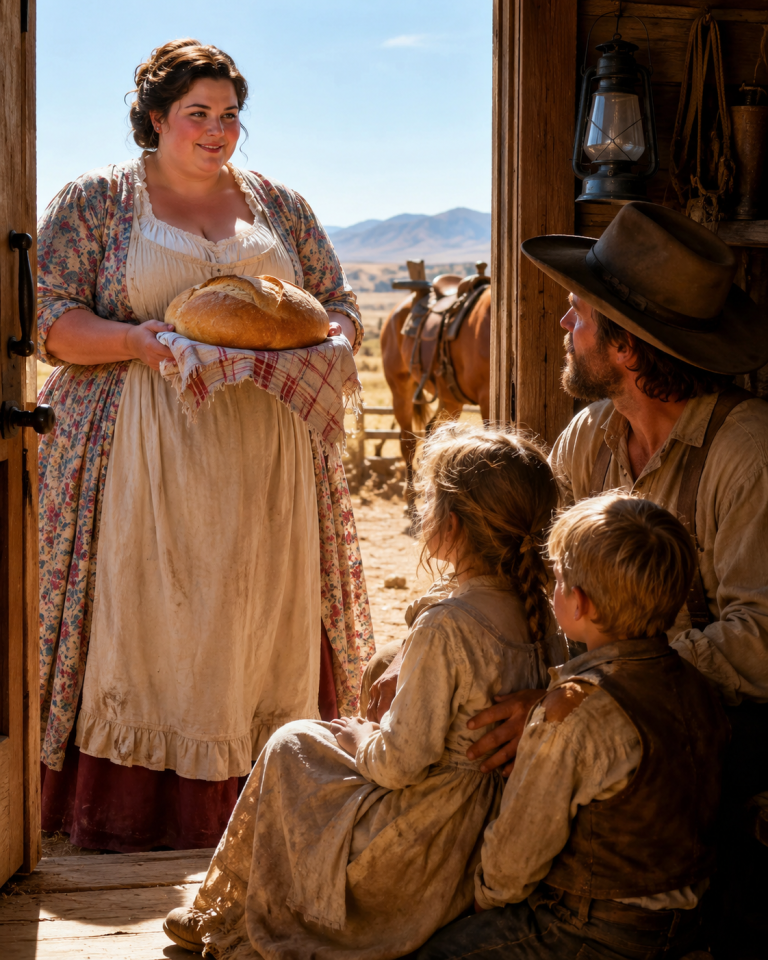
Two days later, a heavyset woman named Helga Brennan appeared at the edge of the yard with a basket of bread and a stillness that Solveig recognized instantly as old grief wearing a calm face.
“I had a daughter,” Helga said, looking at the stakes already driven into the half-frozen ground. “Tess. Eleven years old. She went down on the ice forty feet from this very kind of distance, three winters back. I have walked past empty yards ever since, counting that distance in my sleep.”
Anders held up a green bottle, turning it so the weak sun caught inside it. “For my papa,” he said.
Helga knelt in the dirt in front of him without a word. Then she looked up at Solveig.
“I have eleven bottles at my house. Kept for the dead. One for Tess. I would like my dead to shine in your roof.”
Solveig could not answer for a long moment.
Then a third figure appeared at the tree line, watching, saying nothing — and behind him, though neither woman yet knew it, Whitfield’s lawyer was already drafting the language of a lien, ready to be served the moment the first snow made it impossible for a widow to argue back.
Part 3
The man at the tree line turned out to be Anders Vold — not Anders her son’s namesake by coincidence, but an old countryman, sixty-six, a carpenter’s hands gone stiff with winters, who had heard a rumor of a Norwegian widow building a roof of bottles and walked four miles to see if it was true.
“Your post spacing is wrong,” he said, by way of introduction. “Ice will pull the whole frame inward by January.”
He did not offer to help. He offered to correct her, which turned out to be far more valuable.
For three weeks he came at dawn and left at dusk, never asking for a meal, never wasting a word. Pegs instead of rope — rope stretches, pegs tighten when wet. Moss packed dry, sealed from rain, or it rots and kills the insulation it’s meant to provide. Thick-bottomed bottles in the center where noon sun strikes hardest; green scattered through for no reason he could explain except that green, he said, was the color of living things, and a passage built against death should hold something alive in its bones.
Helga came on Tuesdays and Saturdays with her eleven bottles, each one named aloud before it went into the wall — Tess, her mother, a brother lost to drowning, others — and old Vold took his hat off while she spoke them.
By November the frame had become a structure: posts locked tight, moss packed and protected, a bark roof rising slowly toward the woodshed, a twelve-foot gap in the center waiting to be filled with three hundred bottles nobody yet possessed.
Whitfield returned with a lawyer this time, and a number — sixteen dollars in debt now, interest accumulating, a lien threatened by spring if she didn’t sign.
“Get off my land,” Solveig told him, and meant it, and he left without another word — but she heard, three days later, that he had visited the county recorder asking quiet questions about abandoned claims.
Then her son fell sick.
The fever came the way Iver’s fever had come — wet wool and smoke and a terror she recognized in her own bones — and on the third night, with the passage only two-thirds roofed and the last stretch to the woodshed still open to the sky, the cabin ran out of wood.
She took a lantern. The wind killed it within ten steps. She crossed the unfinished gap by memory alone, filled her apron at the shed, and went down hard on the ice on the way back, wood scattering into the dark.
She thought of Tess Brennan lying in snow for hours nobody came.
She got up. She gathered the wood. She did not stop.
When Helga arrived on the seventh day of the fever, she found Solveig asleep at the table and Anders pale but breathing, and through the window, in failing light, old Vold on a ladder finishing the last roof poles with his bare, frozen hands.
“He’ll kill himself up there,” Solveig whispered.
“He’ll finish,” Helga said. “Then he’ll eat my soup and complain about the salt.”
The roof reached the woodshed two days later. The bottles went in under a hard blue January sky — Helga’s eleven first, named one final time, then dozens more gathered from a cook, a mill hand, a child who refused to say where he’d found his two amber jars. Two hundred. Two hundred forty. Two hundred eighty.
When the last of three hundred and twelve bottles was mortared into place, the winter sun broke through in green and amber and pale gold, and Anders stood in the middle of the passage with light pooling on his upturned palms.
“Papa,” he whispered. “It’s beautiful.”
Four nights later, freezing rain came down on Pinewood Crossing like judgment, and Solveig walked the full forty-eight feet to the woodshed and back without once touching ice, while outside the thermometer read eleven below and inside the passage it held steady near forty.
By dawn, five families had come to her door — Helga’s husband down with his fire dead, a widower with two fingers frostbitten black trying to crawl to his own woodpile, a young mother with a baby gone blue at the lips. Solveig walked her passage thirty-one times that day and gave wood to every one of them.
She took nothing in return.
Two days after that, the church bell tolled three times for a child — the Ashford boy, twelve years old, who had slipped reaching for his family’s woodpile and frozen before his father found him, forty feet from his own door.
Reverend Ashford came to her yard on foot a week later, gray-faced, unshaven.
“My son died for forty-eight feet of ice,” he said. “Your son lives because of forty-eight feet of light. Teach us.”
So she did. She and old Vold sat at her table and wrote it all down — post spacing, bracing, moss packing, bottle angle, mortar — and on the inside cover Vold made her write: *This book belongs to the dead.* Reverend Ashford copied it by hand and carried it through the county, and refused every coin offered for it.
Old Vold died that April, speaking Norwegian in his sleep with Helga and Solveig beside him. At his grave Solveig laid three bottles — clear, green, amber — and Reverend Ashford said the old man had corrected them, and so he had saved them.
Garrett Thorne came a week after that, carrying a box of hand-forged nails, and stood the same ten feet from her door where he’d once told her Anders would freeze before the new year.
“I was wrong,” he said. “I counted your woodpile and missed the light.”
By 1890 there were two dozen covered passages in the valley. By 1895, more than a hundred — some bark and moss alone, some glass-walled like Solveig’s, each family building from what they had. The handwritten book traveled farther than Solveig ever did, copied and recopied into Wisconsin, into Manitoba, into towns she would never see.
Cyrus Whitfield broke his hip on the ice outside his own store in 1888, fifty feet from his woodshed, and lay there three hours before anyone heard him. Solveig came a week after he was carried home.
“I’ve come to offer you a passage,” she said.
“I can’t pay.”
“I’m not asking you to. I want your silence, in the places you used to speak against me.”
“That,” he said, looking at the counter, “I can give.”
She built it. He never thanked her. He never spoke against her again, and when he died in 1910, his will left the store to Anders Aurness, with a note attached that read only: *For the boy who survived my fifty feet.*
Anders grew tall, apprenticed to a glassmaker in his grandfather’s home city, and returned to open his own shop, making bottles built specifically for passages — thick-bottomed, marked with his initials on the base, made to catch the sun the way nothing else in that country could.
He married Tess Brennan’s namesake, Helga’s youngest daughter, in 1905. At the wedding Helga whispered to Solveig, “We are family now,” and Solveig laughed and said they had been for twenty years — the law had simply caught up.
In 1935, nearly fifty years after the first post went into frozen ground, Solveig stood at seventy-six in her doorway and watched another ice storm roll in. A sleigh came up the road, and Anders stepped down with his own daughter, six years old in a coat too big for her, clutching a cloth bag to her chest.
“Bestemor,” the girl said.
Solveig knelt — her knees protesting, kneeling anyway — and pressed a smooth green shard, saved from the very first bottle Helga had ever given her, into the child’s small palm.
“The light isn’t for the wood,” she told her granddaughter, as the winter sun broke through three hundred bottles overhead and scattered green and amber and gold across the floor between them. “It’s for the people who are afraid. The ones who’ve lost someone. The ones who can’t cross the distance alone.”
“What if people laugh at me?”
“Then they haven’t yet seen what you see,” Solveig said. “Keep building until the light speaks for itself.”
She died four years later in her own bed, with three generations around her, and was buried between Anders Vold and Helga Brennan. Her great-granddaughter laid a single green bottle on the grave — blown by her own hands, marked on the base with two small initials.
The passage still stood. Its posts had been replaced five times, its bark roof seven, but the three hundred and twelve bottles remained exactly where they had been set, catching the same low winter sun, year after year, long after every person who built it had gone into the ground beside it.
Outside, the ice kept falling, the way it always had.
Inside, the light never once stopped.