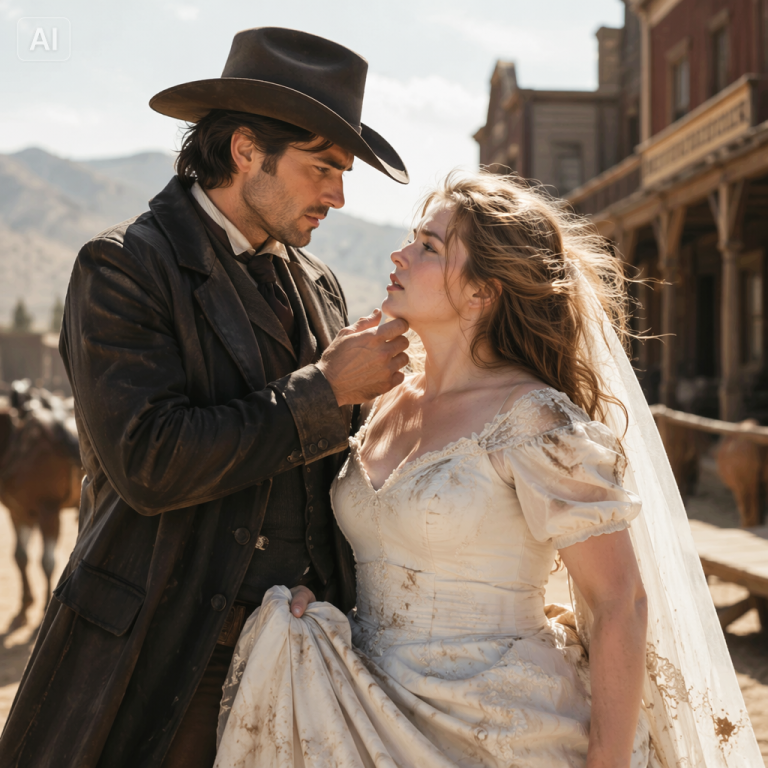
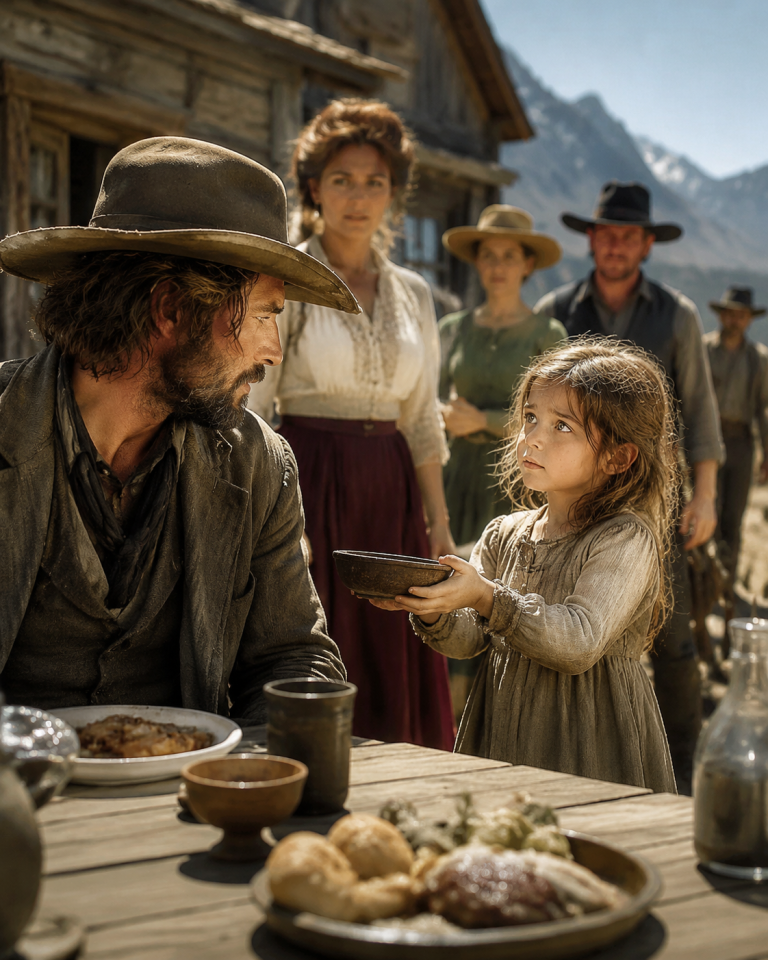
When she lay bleeding in the dirt, too broken to cry for help, a lone cowboy stepped from the dust and whispered, “I won’t leave you”—but the secret he found in her clenched hand changed everything.

PART 1
The desert did not forgive mistakes.
That was the first thing Eleanor understood as she dragged herself across the red wash, her dress torn apart by cactus and stone, her body singing with thirst. She had been moving since dawn. Or maybe before dawn. Time had become unreliable in a way that made survival difficult.
The sun hammered down without mercy.
She could not remember how many days it had been since Eleanor Ashford climbed out of the cellar where her husband had left her chained to a post in the dark. Could not remember if she had made the decision to run or if her body had simply begun moving before her mind caught up.
All she knew: she had survived the first night.
The second morning, that had seemed like enough.
Now, as vultures circled overhead and her vision swam with heat, enough felt like a cruel joke.
Eleanor tried to stand and her legs would not obey. She fell again, palms scraping raw against stone. Blood mixed with dust on her skin. Her lips had cracked so badly she could not form words, which was good because there was no one to hear them.
Above the canyon, a horse whinnied.
Eleanor’s head lifted. Not hope. Hope required strength she did not possess. Just instinct. The animal sound that meant water. Meant people. Meant the possibility of ending this.
A man on horseback appeared silhouetted against the brutal blue sky.
For one terrible moment, Eleanor thought it was Harrison. That he had found her. That running had been pointless and she would spend her final hours regretting the attempt.
Then the rider dismounted with the careful movements of someone approaching a frightened animal.
“Ma’am,” he said.
Eleanor’s one open eye focused on him. Tall. Scarred cheek. Eyes the color of stone. Not unkind, but empty in a way that suggested kindness had been trained out of him years ago.
“Kill me,” she rasped. “Please. Or leave me.”
The man crouched a safe distance away.
“I’m not going to do either,” he said quietly.
Eleanor tried to crawl away from him, which might have been funny if she could remember how to laugh. Her body refused further movement. It had spent itself completely in the effort to survive, and now it was done negotiating.
The man’s name was Samuel Garrett, though Eleanor would not learn this until days later.
He had come to the canyon five years earlier with a gun belt, a broken conscience, and the kind of silence that only comes after a man has done something he cannot undo. He had built a cabin. Raised horses. Spoken to almost no one. Lived in the careful abstinence of a man who had decided he was too dangerous to be near anyone who mattered.
Samuel knew broken when he saw it.
He had been it long enough to recognize the shape.
He carried Eleanor’s weight without complaint, though her body had nothing left but injury and fever. He settled her on his mare and rode back through the canyon as the sun burned red and started dying behind stone ridges.
The cabin was small. Clean. Built by hands that understood precision.
Samuel laid Eleanor on his bed and moved around the room with methodical efficiency. He boiled water. Cleaned what the desert had damaged. Bandaged wounds that had already started to fester. He did not ask her name. Did not ask what had happened. Did not explain why he was bothering with someone who had asked to die.
Eleanor slipped into fever dreams.
She woke to coffee and the understanding that she had survived another day.
For three days, Samuel brought water, broth, tea. Eleanor ate very little. She watched him constantly, calculating. Men who saved women usually wanted something. But Samuel never entered the room without warning. Never locked the door. Never stood over her bed or mentioned gratitude or ownership.
On the fourth morning, Eleanor sat up despite the pain.
Samuel was outside tending a black stallion that looked as wild as Eleanor felt. The horse was scarred across its shoulder. One ear was torn. Its eyes held the kind of intelligence that comes from refusing to be broken.
Samuel moved around the animal with the same quiet patience he showed Eleanor. Not forcing. Not gentling through cruelty. Just remaining present until the horse decided to stop fighting his touch.
“What’s his name?” Eleanor called from the porch.
Samuel looked back. “Trouble.”
Despite everything, Eleanor almost smiled.
A man who named his wildest horse “Trouble” probably understood something about the shape of survival.
Over the next week, Eleanor grew strong enough to stand without Samuel’s hand. She grew strong enough to see herself in the mirror he brought, and learned not to look away from the damage. Swelling had gone down. Bruises had darkened into deeper colors. Her left eye still would not fully open, but it would. Given time.
Time was what Samuel offered without asking for payment.
One evening, Eleanor dressed in a clean shirt he provided and sat near the stove.
“Why are you helping me?” she asked.