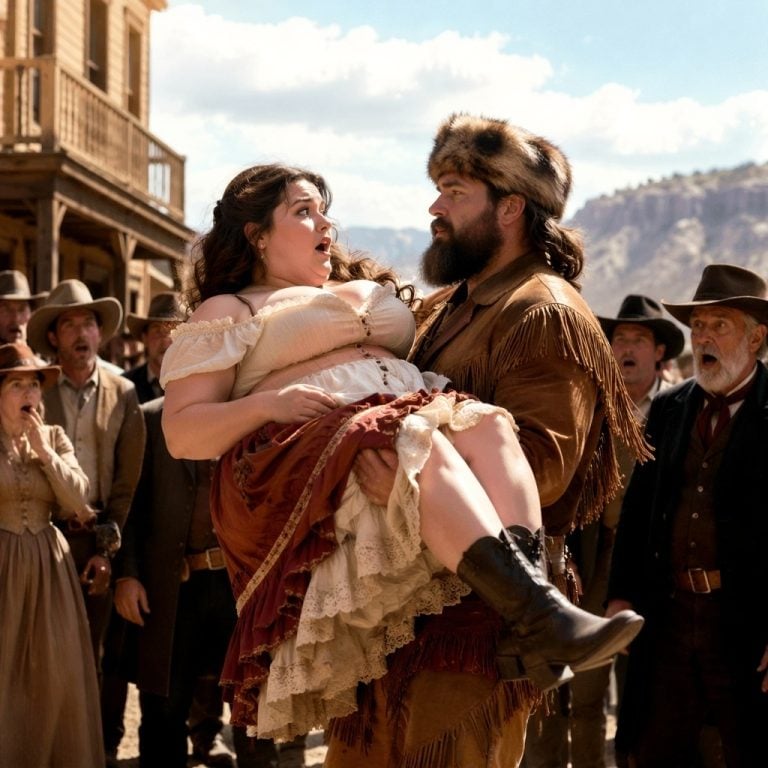
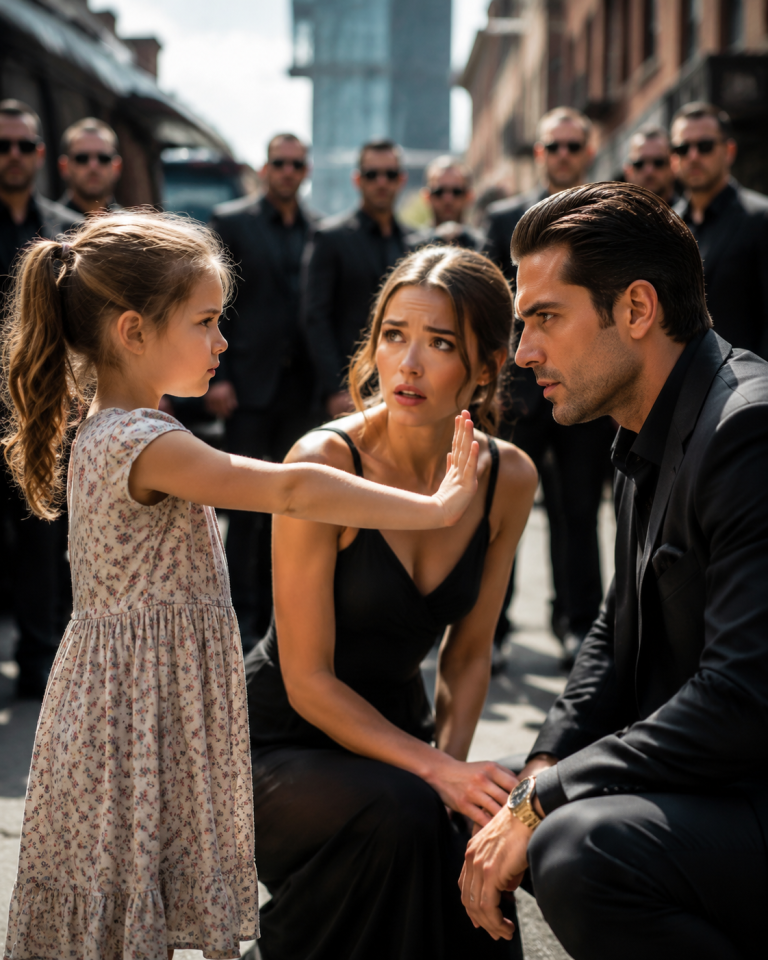
They dragged the mountain trapper to the altar and forced him to marry the county’s unwanted “old maid.” But when the first blizzard sealed them in together, he found a hidden ledger in her trunk… and by spring, every man who tried to own her was begging for mercy.

## PART 1
The rifle shot echoed off the courthouse walls and ran down Main Street in both directions like a rumor looking for a home.
Every head in Dunmore turned.
For one suspended, airless moment, half the town believed they had just heard an execution.
They had.
Only not the kind they were expecting.
Inside the county jail, under a ceiling fan so defeated by August heat it had stopped pretending to try, Colt Hadley stood with chains on his wrists and the shape of a noose already in his future. He had dried blood on his knuckles from when he’d stopped an argument outside the assay office with his fists instead of his words, which was not an improvement on the argument’s terms but which had resulted in the current situation. Beside him stood Vera Colt — no relation, just the town’s joke landing early — who was thirty-four years old, too precise for the men who wanted agreeable wives, too stubborn for the fathers who wanted useful daughters, and too brilliant for anyone in Dunmore who had mistaken intelligence for inconvenience.
Someone had pushed a bundle of dried sage into her hands on the way in. As a joke.
Judge Foss, sweating bourbon through his collar, cleared his throat with the enthusiasm of a man doing something he would absolutely tell the governor he’d refused to do.
“Let’s settle this,” he said.
The men who had come to watch laughed in the quiet way of people who believed they were watching two inconveniences solve each other. A mountain trapper who’d cracked the wrong man’s jaw. A woman nobody had wanted for fifteen years of trying, then stopped trying and started mocking. Together in a jailhouse in August.
Colt didn’t look at the crowd.
He looked at the door, the windows, the rifle in the sheriff’s hands, the deputy by the far wall, and the woman standing beside him.
Vera was straight as a plumb line. Her face had gone the specific pale that came not from fear but from sustained, controlled rage being held back from something decisive.
Sheriff Lane Dorsey grinned around a tobacco plug. “Yesterday you were set to hang, Hadley. Today you get a wife instead. Some men get all the luck.”
Colt’s voice came out low and rough, the way everything did after too many seasons in the high country. “I’ve had better offers.”
A few men in the back snorted.
Vera did not.
She was looking at her father.
Cecil Morse stood near the judge’s desk with a silver watch chain across his vest and the expression of a man completing a transaction, not attending a ceremony. Cecil owned more of Dunmore County than anyone else had the paperwork to prove, and what he didn’t own outright he controlled through the specific social gravity of money that had been in one place long enough to become weather.
“Move it along, Judge,” Cecil said. “I’ve got the afternoon yet.”
Vera turned to him. “This is an afternoon’s business to you.”
Cecil’s eyes settled on her. “It is necessity. You have refused twelve arranged introductions in fourteen years.”
“I have refused to be sold in a sequence of rooms with increasingly nice furniture,” Vera said. Her voice was clear. Not loud. Just clear. The kind of voice that could be heard over other kinds of noise. “The word I’d use is different from yours.”
The room tightened.
Cecil’s jaw moved slightly. One muscle. He was a man accustomed to daughters behaving like receipts, and Vera had always behaved like the auditor.
Judge Foss opened his registry with the reverence of a man cracking an egg. “Miss Morse, Mr. Hadley. Step forward.”
The deputy yanked Colt into position by the chain. Vera moved on her own.
Her hand trembled once around the sage bundle. Then it stopped.
The judge read the vows with the speed of a man reading a livestock bill of sale. “Do you, Colt Hadley, take Vera Morse to be your lawful wedded wife?”
Colt let the silence sit.
He could feel the rope already. He could feel the town hoping he’d bargain, maybe cry a little, make it entertaining. He could feel Dorsey behind him with his hand too close to his gun.
He looked at Vera.
And beneath the controlled anger in her face he saw something else. Not helplessness. Not even fear. The thing he saw was calculation — the specific, patient kind that belonged to a person who had decided that this moment was not the last one, only a difficult one on the way to something else.
He had seen that expression on wounded wolves.
He answered differently than he’d meant to.
“I do,” he said.
A sound ran through the room.
Judge Foss turned to Vera. “Do you, Vera Morse, take Colt Hadley to be your lawful husband?”
She didn’t answer immediately.
Her father leaned slightly on his cane. “Say it.”
“And if I don’t?”
Cecil’s thin smile appeared and disappeared. “Then he hangs at sundown, and you’ll spend the next year explaining why.”
Colt felt something cold move through him. He had spent eleven years in the mountains and knew men like Cecil Morse the way he knew weather. They didn’t make empty threats. They made promises and called them threats because it was polite.
Vera breathed in once, slow and level.
“I do,” she said.
Foss scrawled in the ledger. “Sign it.”
A deputy unlocked one cuff so Colt could hold the pen. The moment his name touched the register, Cecil slid a second document across the desk with the practiced speed of a man who had been waiting for this exact sequence.
Too fast.
Too prepared.
Colt noticed.
Cecil tapped the second sheet with one polished fingernail. “Now that’s settled, we can address the practical matter between men. My daughter owns a parcel west of town called Rim Creek Flats. Worthless rock and scrub. As her husband, you now hold it in common with her. Sign it over to me, I give you eight hundred dollars and a fresh horse, and by dark you’re three counties away.”
Vera’s hand tightened on the sage until the stems cracked.
There it was.
Not reputation. Not family dignity.
Land.
Colt looked at the document. The language was clean and specific and meant to be signed without reading. Deed transfer. Full title. Immediate and irrevocable.
He knew what every word meant.
He also knew what everyone in the room expected. Savage. Illiterate drifter. Convenient.
Vera looked at him then, and for the first time something broke slightly in her composure. Her voice came out low enough that only he could hear it.
“Don’t.”
Dorsey shifted his rifle to his left hand and let his right hand hang casual near the trigger.
Cecil placed a stack of gold coins beside the document. “More than most men make in two years, son. Don’t be proud about arithmetic.”
Colt picked up the pen.
The room leaned.
He held it over the paper long enough for Cecil’s mouth to begin the shape of satisfaction, long enough for Vera’s face to go very still.
Then Colt snapped the pen across his thumb and dropped the pieces on top of the gold.
“I don’t sign paper before reading it,” he said.
Dorsey gave a short laugh. “Can’t read, mountain man?”
—
## PART 2
Colt looked at Cecil and not at Dorsey. “Can’t trust.”
Cecil’s face went the color of a man whose blood remembered what anger felt like.
“You insolent—”
“You already made us married in front of your judge,” Colt said. “You hang me now, every man from Cheyenne to Santa Fe is going to wonder what was worth that kind of desperation.” He paused. “I’m taking my wife to her land.”
Dorsey lifted the rifle. Cecil caught his arm.
Because Cecil Morse was ruthless, not reckless.
Colt watched the calculation move behind the man’s eyes. A forced marriage was scandal already. A dead groom before the ink dried was evidence of something worse. Cecil leaned toward Vera instead, voice dropping to the particular register men used with daughters they’d already stopped thinking of as people.
“Go, then. Take your trapper. Live on your scrub rock. When January strips you bare, you’ll come back and ask me for pennies on the dollar.”
Vera looked at him with the stillness of a woman who had stopped finding his voice frightening and started finding it instructive.
“No,” she said. “I won’t.”
That unsettled him in a way the argument hadn’t.
Colt held out his arm to her. Not like a gesture from a parlor. Like an offer of something solid over a gap.
After a moment, Vera put her hand on his sleeve.
They walked out of the jailhouse together.
The laughter behind them had stopped.
—
The wagon reached Rim Creek Flats at dusk, when the sky had gone the specific red that meant the land wasn’t going to apologize for itself.
Colt drove without talking. Vera sat beside him with her gloved hands folded in her lap with a precision that looked like the only thing holding the day together.
She was the first to speak. “You should have taken the money.”
“Wouldn’t have kept me alive past morning,” he said.
“I meant for your sake.”
“Most people don’t.”
She glanced at him. “I am not most people.”
He glanced back.
There was dust on the hem of her dark dress and one strand of black hair stuck to her cheek by sweat, and she was looking at him with the expression of a woman who had been insulted so many times by people who were wrong that she had stopped being insulted and started being precise.
“What is this place to you?” he asked.
She was quiet for a moment. “My mother’s. Before she married my father.” Another moment. “Before my father became whatever he is now.”
That told him more than a longer answer would have.
The shack at Rim Creek Flats had been fighting the wind for years and losing every round by a small margin. One shutter was held by a single hinge. The stovepipe listed. The well nearby had dried to mud.
Colt climbed down and walked around it once.
“I’ve sheltered worse,” he said.
Vera stepped down beside him. “I haven’t.”
“Good start.”
She turned to him. “Mr. Hadley—”
“Colt.”
A pause. She said it, testing it. “Colt. We should establish what this is. The marriage was forced. I expect nothing from you — not loyalty, not presence, not even the courtesy of remaining past tomorrow. If you leave, I won’t fault you for it.”
“And how long do you think you manage out here alone before your father’s men arrive?”
“That’s my problem to solve.”
“It became mine in that jailhouse.”
“You owe me nothing.”
He rested both hands on the wagon rail. “You’re wrong about that.”
The wind moved through the scrub cedar, carrying the smell of sage and hot stone.
Colt looked at the land, at the particular way Vera was looking at it — not like someone surveying a loss, but like someone reading something she’d memorized and come back to confirm.
“I hate men who use power like a herd dog uses teeth,” he said. “I hate being backed into a corner. Your father did both. So I’m not riding off and leaving you to be run off your own land.”
The expression that crossed her face was not softness. It was something rarer from a woman who had been managing alone for a long time: surprise at the specific shape of a thing being offered.
“You barely know me,” she said.
“Seems enough.”
She made a short sound — not quite a laugh, but the beginning of one, the version that came before a person remembered they’d given up trusting quickly. “That may be the most accidentally kind thing anyone has said to me in years.”
He picked up his bedroll from the wagon. “I’ll fix the roof tomorrow. Tonight we check the stove and keep the snakes outside.”
“You assume I can’t do either.”
“I assume,” he said, “that if we both spend the first week being offended, your father wins without firing.”
She stopped.
Then she nodded. Once. Like a woman who had decided to be practical about something that could have been personal.
—
The first week at Rim Creek Flats didn’t make them friends.
It made them useful to each other, which turned out to be a different and more durable thing.
Colt cut cedar, patched shingles, cleared a drain, cleaned rust from the old stove, shot rabbit and grouse, and found a seep half a mile east that ran cold even in August heat. Vera swept and inventoried and turned three kinds of nothing into meals that tasted like someone had given thought to the person eating them, and she walked the property’s perimeter each morning with a leather notebook and a pace that suggested she was counting something, not wandering.
They spoke when there was reason to.
The silence built its own vocabulary.
He noticed she wrote before dawn in the notebook, which she kept wrapped in oilcloth. He noticed she walked the edges of the property like someone taking testimony, not like someone afraid of trespassing.
She noticed he cleaned his rifle the way surgeons cleaned instruments. She noticed he whittled by lamplight when something was working through him. She noticed he had not once looked at her the way men in Dunmore looked at her — as a problem with varying solutions.
On the ninth morning, the pattern broke.
Vera had gone northeast along the property’s ridge and he was following fresh deer sign along the lower shelf when a sharp whistle cracked from above. He looked up and saw her on a ledge of red stone, both arms moving, not frantic, urgent.
He went uphill.
She was on her knees at the edge of a crack in the rock, skirts dusty, hair half-down from its pins, face bright with something he had not seen in it before. Not anger. Not the measured severity she carried like armor.
Something that looked like vindication.
“Listen,” she said.
He crouched.
Wind. Cedar. Then, beneath them both, deep in the fissure — a sound.
Steady. Faint. Continuous.
He reached into the crack and felt cold movement against his hand.
Not a seep.
A flow.
He brought water to his mouth. Sweet. No mineral bite. No alkaline edge. The specific cleanness of water that had never been near a settling pond or a summer stock tank.
“That’s a spring,” he said.
“Yes.”
“Good fortune.”
“No.” She was already opening the notebook. “Power.”
Inside were survey copies, telegraph notes, land records, and one page so worn it had nearly become cloth. “My father believes this land matters because a rail spur may cross it,” she said. “He’s been planning to collect right-of-way fees. But last winter I found correspondence in his office from a rail engineering company out of Denver. The locomotives they intend for this route can’t manage the grade from the valley floor to the pass without refilling water twice. Dunmore’s wells run mineral. The stock ponds south of town run mineral. The pass is thirty-eight miles from the next clean source.”
Colt looked at the fissure.
The arithmetic arrived all at once.
“This is the only sweet water near the grade.”
“Within forty miles,” Vera said. “And the grade through Rim Creek Flats is three percent gentler than the canyon above it. Whoever controls this spring doesn’t sell right-of-way. They control the only viable refilling point on the entire climb.”
The air between them changed.
“You knew,” he said.
“I suspected. My mother brought me here when I was small. She had me taste the water from the crack in the rock and said, ‘One day men will tell you this place is worthless because they can’t see what’s underneath.’ I didn’t understand her then.” She looked at him. “I understand her completely now.”
He leaned back. “Your father isn’t going to wait us out. He’ll send men.”
“He’s already sent letters,” she said. “And I’ve already sent mine.”
She turned to another page.
Copies of ledgers. Tax records. Private correspondence from her father’s study, copied in a hand so precise it was almost reproduced rather than transcribed.
“How long?” he asked.
“Years,” she said simply.
He looked at her across the open notebook, at the woman the county had spent thirty-four years calling difficult, and understood that she had been building something in the space that difficult had given her.
“What do you need from me?” he asked.
She looked up.
That question did something to her expression he couldn’t fully name. Like a room that had been furnished for emergencies suddenly being used for something else.
“I need three telegrams sent without my father’s knowledge,” she said. “And I need someone who can move through Dunmore at night without being seen by Sheriff Dorsey.”
Colt nodded. “I can do that.”
“The messages go to the territorial land office in Cheyenne, to a man named Hargrove at the Rocky Mountain Railway Acquisition office, and to the telegraph operator here in town. His name is Samuel Wick. He owes me money — the good kind, the kind people pay back.”
“How do you know he’ll hold?”
She looked at the notebook. “Because four years ago I kept my father from foreclosing on his mother’s farm by paying the back taxes from money I had kept hidden from my father for eight years.” She closed the book. “People remember that kind of help.”
Colt thought about what it meant to be underestimated for thirty-four years by everyone who controlled the room you lived in.
He thought about what you could do in that time if you decided to use it.
“You’ve been building a case,” he said.
“I’ve been building a match,” she said. “I just needed something to light it with.”
—
## PART 3
He left two nights later, under a moon thin enough to be polite about.
Dunmore slept badly, the way frontier towns slept — not peacefully but with interruption, dogs loose and drunk men talking to the wrong decade. Colt tied his horse in the cottonwoods past the livery, moved across the back lots on foot, and came through the telegraph office’s rear window without waking anything except Samuel Wick’s reflexes, which were better than he looked.
Wick had a pistol half out before Colt’s fingers touched his lips.
“Easy. I came from Mrs. Hadley.”
The operator’s gun lowered. “Mrs. Hadley.”
Colt gave him a look.
“Right,” Wick said. “Mrs. Hadley.”
When he read the three messages, the sleepiness left his face. What replaced it was the specific alertness of a man who had been waiting for a moment like this without knowing it was coming.
“I’ll send these before sunrise,” Wick said. “I’ll burn the drafts.”
Colt set a coin on the desk.
Wick pushed it back. “She already paid once. Years ago. Tell her it’s settled.”
Colt rode back to the flats thinking about that.
Not the refusal itself. The loyalty. In Dunmore, money bought compliance. Vera had somehow bought something that lasted longer than the transaction.
—
Cecil’s men came on the fifth day.
Two riders on the ridge above the shack, long guns, using cedar scrub for cover. The first shot hit the porch post close enough to Vera’s arm that it pulled splinters through her sleeve. She ran without screaming, which told Colt more about her than any introduction could have.
Fear made noise. Discipline made decisions.
He hit the ground beside the door as the second shot threw up dirt at his boots.
Inside, he grabbed the Winchester. Vera already had the shotgun across both forearms, broken open, checking the loads with the economy of someone who had thought about this moment before it happened.
“How many?” she said.
“Two. South ridge.”
“From him?”
“Without question.”
He moved to the rear window. “I’m going behind the rock line. If either one comes down the slope—”
“I’ll fire,” she said.
“Birdshot at this range—”
“Will turn a man or a horse. I understand.”
He looked at her.
She looked back.
“Second barrel closer,” he said.
“I know,” she said.
He went out the back.
The next ten minutes were the kind that aged a person.
Vera held position under the front window, heartbeat slamming the shotgun barrel, listening to the two men call back and forth on the ridge, listening to a third shot hit the eave, listening to the blood loud in her ears. Her whole life men had taken her steadiness as evidence she didn’t feel anything. She felt everything. She always had. She had simply decided a long time ago that panic was a gift to people who wanted her afraid.
One rider broke from the ridge with a torch in hand, spurring downhill.
Burn it, then.
Of course.
She waited until she could see his beard and the whites of his eyes.
She stood, kicked the door open, planted her feet exactly as she’d practiced two days earlier when she’d had Colt show her the angle and the weight, and fired.
The blast took out the dirt under the horse’s front feet. The animal screamed, reared, spilled its rider backward into the rocky shale. The torch hit the ground and died.
Above, on the ridge, as the second gunman tried to draw down on her, something came out of the rocks behind him — large, fast, without the sound of warning.
Colt’s rifle stock connected with the back of the man’s head. The sound was very final. The man’s legs lost the argument with gravity.
Below, the first rider clawed toward his revolver.
Vera stepped off the porch, reloading as she walked, and pointed the second barrel at his chest.
“Don’t,” she said.
He went very still.
Not because of the gun. Because of the voice.
Colt dragged the unconscious man downhill by the collar and dropped him beside the first. Both men worked for Cecil Morse. She recognized their faces from church, from the square, from the years of small daily dismissals that men like this practiced on women they considered categories rather than people.
Now one of them lay in the dirt looking at her as if she had stepped out of a story he hadn’t been paying attention to.
“Tell my father,” Vera said, keeping her voice the temperature of something that didn’t need to shout, “that if he wants this land, he should come himself and stop sending men who don’t know what they’re riding into.”
Colt added, “And tell him next time I won’t leave evidence they can talk their way out of.”
They let both men go.
Not from mercy.
Because stories traveled faster on living legs.
—
That evening Colt repaired the porch post while Vera reloaded shells at the table, and the lamplight made the room warm and copper-colored, and at some point their hands brushed across the powder horn.
Neither moved.
“You were steady,” he said.
“I was furious,” she said.
“That works too.”
A silence.
“I used to think surviving meant never needing anyone,” she said. “That needing someone was a weakness your enemies would find eventually.”
Colt leaned one shoulder against the doorframe. “And now?”
She trimmed a shell wad without looking up. “Now I think that may be exactly what people like my father teach people like me so we’ll be easier to isolate when it matters.”
He looked at her for a moment.
“Eleanor,” he said.
She looked up.
“Vera,” she said. “My name is Vera.”
“I know. I said it right.”
She blinked.
He was not a man given to speeches. He had spent eleven years in the mountains saying only what needed to be said and trusting the rest to silence. But she had lived in a place where silence had always been used against her, and she needed to hear the thing said out.
“I’m here,” he said. “Not because of the land or because of your father or because of the rope in that jailhouse. I’m here because I watched you stand on that porch with a shotgun and fire at a man on a horse and I understood that whatever was happening, I didn’t want to be somewhere else.”
The firelight was between them.
Vera Morse, who had been called cold and difficult and proud and too much of everything wrong, looked at Colt Hadley, who had been called savage and trouble and barely human by people who’d found him inconvenient, and something moved in her face that had very little to do with the land registry or the spring or the railroad.
“I’ll hold you to that,” she said finally.
“Good,” he said. “Means you’ll still be here to do it.”
—
Henry Hargrove arrived from Denver six days later by stagecoach, all polish and expense and the measured attention of a man who had not gotten his position by being sentimental about opportunity.
Cecil Morse had him at the Continental Hotel’s dining room before his bags were unpacked.
Vera knew by dawn because Samuel Wick sent word through a ranch boy.
She dressed with specific intention. Not vanity — intention. The green wool jacket instead of the black she’d worn since the jailhouse. Hair properly arranged. Gloves. A satchel with everything organized.
Colt shaved, trimmed his beard, and put on the dark vest and clean shirt she had found in the storage trunk — where she had also found them, because she had thought ahead to this.
When he stepped out wearing them, she paused in what she was doing.
He noticed. “What?”
“You look,” she said, and stopped.
“Like a man who still knows where his rifle is?”
“Like someone the room is going to make the mistake of underestimating,” she said.
He offered her his arm. “Let’s go give them that chance.”
—
The Continental went quiet the way rooms went quiet when the math suddenly changed.
Hargrove half-rose from his chair. Cecil nearly upset his bourbon glass.
Dorsey reached for his belt and Colt looked at him with the specific flatness of a man reminding another man of the bones inside his body, and Dorsey’s hand went still.
Cecil said, “What in God’s name—”
Vera walked past him to Hargrove.
“Mr. Hargrove,” she said. “I’m Vera Hadley, owner of Rim Creek Flats.”
Hargrove studied her a moment. “The telegram woman.”
“The landowner,” Cecil cut in. “Or she was. The husband controls it now. Not that it matters, since she’s coming back to Dunmore with me when this—”
Colt reached into his coat and placed a folded, sealed sheaf of documents on the table.
Hargrove opened them.
Then the second.
The room contracted.
“Territorial land office filing,” Colt said. “Temporary management authority granted to wife by husband, witnessed by county clerk and confirmed by wire with the land office in Cheyenne. Filed and registered this morning.”
Cecil looked at Colt as if something had started speaking that wasn’t supposed to be capable of it. “You said you couldn’t read.”
“I said I didn’t sign paper handed to me by thieves,” Colt said. “Those are different things.”
Vera opened the notebook onto the tablecloth and turned it toward Hargrove.
Survey grade percentages. Water yield estimates. Distance charts from the spring to the pass. Fuel consumption per locomotive per hundred feet of elevation gain.
“Rim Creek Flats is not simply a passable route,” she said. “It is the only route that offers both a workable grade and a freshwater source within operating range. Lease from my father and you spend the next decade boiling mineral scale and re-lining your water tanks every third haul. Lease from me and you have right-of-way, elevation advantage, and a gravity-fed water stop.”
Hargrove had the expression of a man who had come for a courtesy visit and found a legitimate transaction. “Mrs. Hadley,” he said, “you’re either the finest liar in the territory or the only person in this county who did their arithmetic.”
“The second one,” she said. “And I can show you the work.”
Cecil slammed one hand flat on the table.
“She’s lying. That spring is a seep. It won’t sustain—”
“It sustains,” Vera said, and slid the water yield estimates — three weeks of measurements she had taken herself every morning — across the table.
Hargrove read.
Then he looked at Cecil Morse with the specific expression of a man deciding whether a second meeting would be worth the time.
Cecil saw it.
Men who had built empires on being the only option in the room recognized the moment they stopped being that. Cecil lunged across the table.
Not for the documents.
For Vera.
Colt moved before Cecil’s hands made contact — caught him by the collar, lifted him clean off his feet, and put him against the wall with a force that rattled every mirror in the room.
“You touch her,” Colt said, very quietly, “and the next conversation we have will be considerably shorter.”
Cecil kicked once, uselessly.
Colt set him down.
Hargrove adjusted his cuffs. “I prefer transactions that don’t involve attempted assault. Mrs. Hadley — shall we find somewhere quieter?”
They signed a preliminary option agreement that afternoon.
—
Three nights later, Samuel Wick came to Rim Creek Flats on a lathered horse.
“He’s brought in outside men,” Wick said. “Seven of them. Badges Dorsey printed himself. They have a warrant claiming Colt forged the agency transfer and coerced you into signing it.”
Colt reached for the rifle rack.
Vera stepped between him and it.
“No.”
“If they come armed—”
“And if you shoot seven men with deputized badges, we spend the rest of our lives being tried for what they forced us into. We win the land and lose the only way to use it.”
His jaw set.
“There are other kinds of weapons,” she said, and she was not performing calm. She was calm. The same way the spring was calm — not because nothing moved inside it, but because everything moved in the right direction.
She opened the desk drawer and took out an envelope she had sealed two weeks before.
“Before the jailhouse,” she said. “I mailed a packet. To the governor’s office.”
Colt stared at her.
“Everything,” she said. “Every ledger copy, every false tax lien, every fraudulent foreclosure, every payment to Dorsey, every orchestrated debt call. Dates. Signatures. Amounts. Names of families ruined by it.”
Wick made a sound.
“The night you took my telegrams into town,” she said, looking at Colt, “I sealed the envelope. I had been waiting for the right moment to send it.”
Colt looked at her for a long time.
“Remind me never to play cards against you,” he said.
The edge of her mouth moved. “You’d lose.”
—
They rode into Dunmore at noon.
Not sneaking. Not quick. In full daylight, at a pace that said they had somewhere to be and they knew where it was.
The boardwalks filled. Dorsey stood outside the jail with seven men in travel dusters and borrowed tin badges. Cecil Morse behind them, recovered from the dining room, wearing the expression of a man who had briefly lost a hand and was about to reclaim the game.
Dorsey raised a warrant. “Colt Hadley. Step down. You’re under arrest for fraud, coercion, and unlawful constraint of Miss Eleanor Bell.”
“My name,” Vera said into the open air of Main Street, “is Vera Hadley.”
Dorsey’s smile arrived. “Not for long.”
Then the bank doors across the street opened.
A man in a federal coat came down the steps, followed by three U.S. marshals and the county clerk, who was walking the way people walked when they had made a decision they couldn’t take back and were committed to it now.
“Stand down, Sheriff Dorsey,” the federal man called.
The moment extended.
He came down the steps slowly. “Deputy Marshal James Crane. Acting under order of the territorial governor and the district court.”
Dorsey’s face lost color by degrees.
Cecil still had his composure. Men who had been powerful for forty years took longer to believe it was ending.
Crane withdrew a document. “We are here in connection with a complaint filed with the governor’s office regarding conspiracy, extortion, tax fraud, unlawful land seizure, falsification of livestock records, bribery of a county sheriff, and obstruction of territorial process.”
The street made a sound. Not words. Just the sound of arithmetic arriving at a public conclusion.
Cecil stepped forward. “This is absurd.”
“We have also received,” Crane continued, “a statement from Mr. Henry Hargrove of the Rocky Mountain Railway Acquisition office regarding attempted commercial fraud in the formation of a land option agreement.”
That ripple went farther.
Because territorial justice was fearsome. Railroad justice was expensive.
Together they sounded final.
Crane turned one page. “There is also evidence of fabricated rustling charges used to eliminate inconvenient witnesses. Including the false arrest of one Colt Hadley.”
Colt looked at Vera.
She was watching her father.
Cecil’s eyes moved across the crowd, across the faces of men and women he had owned for decades, looking for the thing that would reconstitute his position.
He found witnesses instead.
A family from the north end of the county whose land had been taken through a false debt in the third year of a drought. A widow from south of town who recognized Dorsey’s deputy as the man who had served her foreclosure papers at gunpoint. Three ranchers who had copies of sale documents signed under conditions that did not appear in the official record.
“Who filed this?” Cecil said.
Vera answered him.
“I did.”
Two words into the Dunmore street, where she had been dismissed, mocked, managed, and overlooked for thirty-four years.
Not shouted.
Not triumphant.
Just placed there, so everyone standing on those boardwalks could hear exactly where the thing had come from.
Crane stepped toward Cecil.
Cecil looked at Vera with the expression of a man confronting the thing he had made in the process of trying to eliminate it.
“You did this to your own blood,” he said.
“No,” she said. “I documented what you did to everyone else. The result is the same.”
That was the sentence people repeated.
Not because it was elegant.
Because everyone who heard it knew it was accurate.
—
The Bell — the Morse — empire collapsed in the specific way that things collapsed when the only thing holding them together had been the fear of saying them out loud. Once the first testimony appeared, others followed. Families produced notices. Ranchers brought original sale papers. The bank clerk admitted two ledgers had existed for three years.
Within weeks, Dunmore was recalculating what it had called respectable.
The railway deal closed before the first snow.
Rim Creek Flats became the site of a water stop, freight siding, and provisioning station. The spring was expanded and capped and named for Vera’s mother, who had once brought her daughter to taste clean water in a crack in the rock and told her to remember what ran underneath things that looked worthless.
Colt supervised construction because he understood men, weather, and which suppliers were lying. Vera ran contracts, payroll, and property recovery with the efficiency of someone who had been doing the work for years in her head, waiting for permission to do it in the world.
They didn’t move into Cecil’s house in town. Neither of them wanted walls that had learned contempt.
They rebuilt the shack at Rim Creek Flats into something that deserved to be called home — wide porch, stone hearth, glass in every window, with the original one-room cabin kept intact as Vera’s office, which she preferred to call a study.
Vera started a school with the first year’s rail royalties. Real arithmetic. Land law. Bookkeeping and contract reading and the specific skills that turned the daughter of a farmer into someone who couldn’t be dispossessed without consent.
Colt bought three foreclosed homesteads from the recovery proceedings and leased them back to the original families at rates so honest people didn’t trust them at first and then did.
Samuel Wick became the stationmaster at Rim Creek Flats and taught winter arithmetic to older students who were embarrassed to be in a room with twelve-year-olds.
What the county found hardest to absorb was not the arrest, not the railway, not even the money.
It was what Vera and Colt did with what they’d won.
They did not become the thing they had beaten.
They built.
—
The first heavy snow of November came early, softening the ridges, putting white along the cedar line. One evening Colt came in from checking the water tower and found Vera in her study, sleeves rolled, spectacles at the end of her nose, bent over three ledgers and a stack of school invoices.
The lamplight made the edges of her hair warm.
He stood in the doorway a moment.
She looked up. “Something wrong?”
“Depends,” Colt said.
“On what?”
“Whether a man’s allowed to stand in a doorway watching his wife work.”
A faint color moved into her face, brief and real.
They had lived and fought and worked alongside each other for months. Trusted each other with land and legal strategy and their actual lives. And yet some careful distance had remained, as if neither of them had wanted to test what the other thing might be until there was room for it to be something other than gratitude or proximity.
“Depends,” Vera said, setting down her pen.
“On?”
“Whether the wife in question enjoys being watched.”
“Does she?”
She met his eyes directly, which she did with everyone, but the quality of it here was different. Deliberate. Offered.
“By you,” she said. “Yes.”
Colt came around the desk slowly and crouched beside her chair so their eyes were level. He reached up and touched the loose strand of hair near her temple with the back of his knuckles.
“I was married before,” he said. “Four years before I came west. She died of fever six months after the wedding. I spent the next eleven years walking away from everything until I ran out of mountain.”
Vera was very still.
“Why didn’t you tell me?”
“It didn’t seem like useful information in a jailhouse.”
Her expression gentled with the specific quality of a woman who had rationed softness for so long that offering it was its own kind of courage.
“My mother used to say grief doesn’t leave,” she said. “It only learns the house.”
He looked at her.
“I don’t want what we are to stay a legal arrangement,” he said. “It hasn’t been that for a while.”
“No,” she said quietly. “It hasn’t.”
What happened next was not the performance of romance. It was not rescue or relief or the dizzy confusing heat of two people who had almost died together. It was quieter than that and more durable — the kind of thing that came from two people who had watched each other clearly for months and chose what they saw.
When they separated, he rested his forehead against hers.
“Vera Hadley,” he said. “You are the most formidable woman in Wyoming.”
“Only Wyoming?” she said.
He laughed against her mouth, and she laughed back, and outside the November snow was settling on the ridge above the spring her mother had once told her to remember.
—
The version of their story that Dunmore County passed down was the simple one, because people preferred legends that fit in one sentence.
The mountain trapper and the county’s difficult woman beat a cattle baron, saved a railroad deal, and got rich off a spring.
That version was not wrong.
It was not the whole truth either.
The whole truth was that a man who had been running for eleven years found something worth running toward. That a woman who had been called cold because she refused to pretend she was anything less than what she was finally had the room to be exactly that. That a forced marriage between two people everyone had counted on to destroy each other had become, through sustained shared work and the specific honesty that comes from fighting something together, the freest choice either of them ever made.
Years later, train whistles would roll through Rim Creek Flats at dawn, and children from the school would stand on the platform and wave at Vera on her porch or at Colt near the water tower, and travelers on the train would ask how the place got its name.
Old-timers in Dunmore would tell the story with more thunder than it needed, as people did when they had been cowards in someone else’s story and liked the retelling better than the original.
But on certain winter evenings, when the wind hit the house right and the old cabin timbers remembered they were still inside the new walls, Vera would set down her pen and Colt would look up from the fire, and they would both hear the sound of that rifle shot in the jailhouse.
The one everyone in town had mistaken for an ending.
And if someone asked Vera Hadley, years afterward, what had actually changed the shape of her life, she never named the spring or the railway or the governor’s warrant.
She said: “The day they tried to use me as a transaction, they made one mistake.”
“What mistake?”
And she would look toward wherever Colt was — at the water tower, in the yard, reading a contract by the fire — and the corner of her mouth would move.
“They put me beside someone who hated bullies the same way I did,” she said. “They thought that would make us smaller. It made us harder to stop.”
Then she would return to her work.
Because that was the truth of it.
Not that love rescued her.
Not that justice arrived like weather.
Not that being right was ever quite enough on its own.
The thing that worked was simpler and less romantic and more real than any of those: two people who saw each other clearly and decided that what they saw was worth defending.
Everything else was built on that.
*THE END*