They Mocked the Mafia King’s Plus-Size Date at the Wedding of the Decade—Until She Opened One Forgotten Ledger… and Every Powerful Man Stopped Breathing.

## PART 1
The first thing Nadia Gallagher heard when she opened the boardroom door was a man saying her name like it was an error.
“Not her,” Marco Ferrara groaned. “Please tell me you’re not serious, Nico.”
Nadia stopped with one hand still on the brass handle.
The boardroom of Ferrara Logistics was built to make men feel rich before they sat down. Mahogany walls. Persian rug. Floor-to-ceiling windows overlooking downtown Chicago. A long polished table so dark it reflected the ceiling lights like black water.
On paper, Ferrara Logistics moved freight containers, construction equipment, imported stone, and specialty goods across the Midwest.
On paper, it was a legal company.
Nadia Gallagher had spent three years making sure the paper kept looking that way.
She stood in the doorway wearing a beige trench coat with a missing button, sensible black shoes, and horn-rimmed glasses slightly crooked from the wind outside. Her curly auburn hair had escaped its clip again, forming a halo she had stopped trying to control by noon. She had an ink smudge on her chin, a coffee stain on her sleeve, and thirty-six hours of forensic accounting behind her eyes.
In her arms was a thick leather-bound folder that could save the Ferrara family from federal investigation.
Again.
She looked at Marco first.
Then at Nico.
Nico Ferrara sat at the head of the table, perfectly still, one hand resting near a Montblanc pen, the other around a crystal glass of water he had not touched. At thirty-four, he was the kind of man older men lowered their voices around. Dark hair. Tailored charcoal suit. A face handsome enough for magazines and cold enough for funerals. The head of the Ferrara syndicate, though no one said that inside buildings with microphones and lawyers.
He did not look surprised to see her.
That annoyed her most.
“I knocked,” Nadia said. “No one answered. I assumed you were all brooding.”
Marco turned fully toward her, his expression somewhere between panic and disbelief.
“Nadia, this is family business.”
“And I am in the middle of saving your family from a federal indictment,” she said, walking in and letting the door close behind her with a final, heavy click.
Four bodyguards stood in the corners. They watched her the way men watched loaded weapons they could not categorize. Nadia ignored them, crossed the rug, and dropped the folder onto the table so hard the sound cracked through the room.
“Page forty-two.”
Nico’s eyes lowered to the folder.
Marco rubbed his face. “Can this wait?”
“No.” Nadia crossed her arms. “Because Domenico Spata is either stealing from you or has decided he wants to be arrested. Possibly both. He has been skimming from the South Side construction contracts, which is your problem. But he is funneling the skim through a shell company tied to your primary offshore structure, which makes it my problem, because the IRS flag goes up next Tuesday if I do not bury the trail before some ambitious junior auditor decides he wants a promotion.”
Nico opened the folder.
His eyes moved over the numbers.
Nadia continued, clipped and furious. “I spent the last thirty-six hours building a firewall through three charities, two dormant holding companies, and a fake wildlife preserve in Maine that now exists on paper and owns a very emotional number of imaginary owls. You’re welcome.”
Marco stared at her.
“Imaginary owls?”
“Don’t focus on the owls.”
Nico looked up slowly.
Most people wilted under that gaze. Nadia had seen men — violent men, rich men, men with entire neighborhoods afraid of them — sweat when Nico Ferrara looked at them too long. His attention was quiet but it had weight. It made the room smaller. It made breathing feel like permission.
Nadia tapped one finger against the folder.
“Are you going to authorize the transfer or should I start researching federal prisons with decent lighting?”
The corner of Nico’s mouth shifted.
Not quite a smile.
Something more dangerous.
He took the pen, signed the authorization without looking away from her face, and pushed the folder back.
“You are indispensable, Miss Gallagher.”
“I am severely underpaid is what I am.”
Marco made a strangled sound.
Nico’s eyes did not move from her face.
There was an ink smudge on her chin. He had noticed it the moment she entered, just as he had noticed the exhaustion in the set of her shoulders, the anger beneath her professional delivery, the fact that she had arrived not nervous but offended. In Nico’s world, people either feared him or performed for him. Nadia Gallagher did neither.
She corrected him.
She challenged him.
She rolled her eyes at men who had ordered worse people than her to disappear.
And now she stood in his boardroom as if the entire Ferrara empire were one badly organized spreadsheet she intended to fix before dinner.
Marco threw his hands up. “Fine. Owls are saved. Can we return to the wedding problem?”
Nadia grabbed the folder. “I’m leaving.”
“Wait,” Nico said.
She stopped.
Not because he was her employer.
Because of the way he said it — the room paused with her.
She turned back. “If this is about the petty cash discrepancy on the fourth floor, I already told Angelo that if his receipts say ‘miscellaneous’ one more time, I’m reporting him to myself.”
Nico stood.
The air changed.
He was tall, broad-shouldered, elegant in a way that felt less like fashion and more like danger trained to wear wool. He buttoned his jacket and looked at Marco.
“You said I needed to bring someone substantial.”
Marco went pale.
“Nico, no—”
“Someone who commands respect.”
“This is insane.”
“Someone who is not Valentina Moretti.”
Nadia looked between them.
“What is happening?”
Marco pointed at her, horrified. “Nothing. You can leave.”
Nico walked around the table until he stood in front of Nadia. Close enough that she could smell bergamot, leather, and the faint trace of expensive cigar smoke from someone else’s poor decision.
“You are attending my brother’s wedding on Saturday,” he said.
Nadia blinked.
Then laughed.
It came out before she could stop it, bright and genuine and completely inappropriate inside a room where men had been threatened for coughing at the wrong moment.
“Oh, that’s excellent,” she said, clutching the folder to her chest. “Good one. For a second you sounded serious.”
Nico did not laugh.
Nadia’s smile faded.
“You’re serious.”
“Yes.”
“You want me to attend the Ferrara-Moretti wedding.”
“Yes.”
“With you.”
“Yes.”
“As your date.”
“Yes.”
Nadia stared at him.
Then she pointed to herself.
“Me.”
Nico’s expression did not change.
“Yes.”
She looked down at her trench coat, sensible shoes, the coffee stain on her sleeve, the soft stomach hidden beneath practical layers, the body she had spent most of her adult life defending from small comments dressed up as concern. Too big. Too loud. Too clever. Too much. Always too much for rooms designed around women who could disappear beautifully.
“Mr. Ferrara,” she said carefully, “I do your books. I do not do your social performance.”
Marco exhaled with relief.
“Exactly. She does the books.”
Nadia shot him a look.
“Forensic accounting.”
“Same thing with more threats,” he muttered.
Nico ignored him.
“My brother’s wedding is not only a wedding,” he said. “It is a public alliance. The Moretti family expects me to arrive with Valentina.”
“Then arrive with Valentina.”
“I would rather swallow glass.”
Nadia almost smiled. Almost.
“That sounds painful, but not my problem.”
Nico leaned slightly closer.
“It is now.”
Her eyes narrowed.
“No.”
The word landed flat.
Marco froze.
The bodyguards froze.
Nico did not.
“No?” he repeated, and there was something almost amused beneath the softness.
“No,” Nadia said again. “I don’t own a gown. I don’t know which fork is for caviar. I will not flirt with men who have murder in their cuff links. And if one of those rail-thin mafia wives looks at me sideways, I will verbally dismantle her family trust, which I assume is bad for diplomacy.”
“I am counting on it.”
“That was not an invitation.”
Nico’s gaze sharpened.
“Your brother Danny owes forty-five thousand dollars to the Callahan crew.”
The room went silent.
Nadia’s fingers tightened around the folder until the leather creaked.
Nico continued, softer now. “They gave him until Monday.”
Her face changed so quickly Marco looked away. The anger remained, but beneath it something raw flashed through — fear, exhaustion, the particular terror of a sister who had spent months trying to save a brother who had never once thought about what his weakness cost her.
“You looked into my family,” she said.
“I protect my assets.”
“I am not your asset.”
“No,” Nico said. “You are more valuable than that.”
Her breath caught despite herself.
Nico reached into his jacket, withdrew a single slip of paper, and placed it on the table.
“Danny’s debt disappears tonight. Completely. No interest. No broken knuckles. No visits. No reminders. In exchange, you attend the wedding with me. You stand beside me. You let them photograph you. And you do not apologize for existing in the room.”
Nadia looked at the paper.
An order of payment.
Already prepared.
Of course it was already prepared.
Nico Ferrara did not improvise. He arranged the board before anyone knew they were playing.
“You’re using my brother to make me say yes.”
“I am using a problem you already have to offer a solution you cannot afford to refuse.”
“That doesn’t sound better.”
“It is more honest.”
She hated that.
She hated that it was true.
Danny had called her three nights earlier, crying so hard she could barely understand him. He had borrowed from the Callahans to cover gambling losses, then borrowed again to cover the first loan, then lied to Nadia until the men came to his apartment and left his door hanging from one hinge. Their mother was dead. Their father gone since childhood. Danny had always been weak, charming, apologetic, disastrous — and hers.
She had been considering a second mortgage on a condo she did not own.
Nico watched the war move across her face.
Not with pity.
With patience.
“If I do this,” she said finally, “I am not pretending to be someone I’m not.”
“Good.”
“I am not starving myself for two days to fit into someone else’s idea of elegance.”
“I would be offended if you tried.”
“I am not sucking in my stomach.”
“Breathe freely.”
“I am not apologizing for taking up space.”
Nico lifted one hand.
For a heartbeat, she thought he might touch her waist.
Instead, his thumb brushed the ink smudge from her chin with startling gentleness.
Her skin went hot.
“Nadia,” he said quietly, “if I wanted a woman who took up less space, I would not have asked you.”
Marco looked as if he might need to sit down.
Nadia swallowed.
Nico’s thumb dropped away.
The place he touched continued burning.
“This is business,” she said.
“Of course.”
“One night.”
“One night.”
“No expectations.”
His eyes darkened.
“We will see.”
“That is not agreement language.”
“It is accurate language.”
She should have walked out.
She should have told him to take his expensive debt purchase and feed it to the imaginary owls in Maine.
Instead, she looked at the payment order.
Danny would live.
She picked up the paper.
“One night,” she repeated.
Nico smiled.
Small. Devastating.
“One night.”
—
## PART 2
The preparation began at dawn Friday.
Nadia expected Arthur to send her to some glass boutique where attendants would smile with their lips while measuring her body like an inconvenience. She had been in those places. The ones where women like her were told they had such a pretty face and offered black dresses with sleeves, because fashion apparently believed size-eighteen women were born grieving.
Nico did not send her to a boutique.
He sent Madame Russo to her apartment.
The couturier arrived at eight in the morning with two assistants, six garment bags, three cases of fabric, and the energy of a general preparing for war. She swept into Nadia’s cramped two-bedroom South Side apartment, looked her up and down, and clapped her hands.
“Finally,” Madame Russo said. “A woman with architecture.”
Nadia blinked.
“Excuse me?”
“Bones, hips, movement, drama.” The woman circled her. “Half the girls they send me are hangers with perfume. You are a cathedral.”
Nadia did not know whether to be offended or blessed.
Madame Russo grabbed her measuring tape.
“We will not hide. Hiding is for tax evaders and bad husbands. We will reveal strategically.”
“I work for tax evaders,” Nadia said.
“Then you understand structure.”
By noon she had been measured, pinned, turned, lifted, laced, and lectured on posture in three languages. Madame Russo rejected black immediately.
“No mourning.”
Navy.
“No board meeting.”
Emerald.
“No, too Moretti. We do not give the enemy our color.”
Finally, she pulled out crimson silk.
Deep. Rich. Dark as wine spilled under candlelight.
Nadia touched it and felt something strange move inside her.
“That color is loud.”
Madame Russo smiled.
“So are you.”
The dress became a negotiation between beauty and armor.
A sweetheart neckline that did not apologize for her chest. A corseted bodice that shaped without suffocating. A waistline designed by someone who understood that curves were not problems to solve but lines to honor. A sweeping skirt with weight and movement, cut with a slit that revealed one leg when she walked and nothing when she stood still.
When Nadia looked in the mirror on Saturday afternoon, she did not look smaller.
That was the miracle.
She did not look corrected.
She did not look disguised.
She looked like herself translated into power.
Her curls swept up, not tamed, pinned to let some wildness remain. Lips deep red. Diamonds from the Ferrara vault at her throat, heavy enough to remind her this was not her life, not heavy enough to make her bow.
Madame Russo stood behind her, eyes bright.
“There she is.”
Nadia’s throat tightened.
“I don’t recognize her.”
“You will.”
Outside, a car waited.
A bulletproof black Maybach that looked like money had learned intimidation.
Nico leaned against it in a midnight-blue tuxedo, bow tie perfect, cufflinks dark and understated. He was speaking to someone through an earpiece when Nadia stepped from her building.
He stopped mid-sentence.
Not paused.
Stopped.
The bodyguard beside him glanced at him in surprise.
Nico removed the earpiece slowly, as if he needed the movement to gather himself.
Nadia held her clutch in both hands.
“What?” she asked, defensive before he could speak. “Too much?”
His eyes moved over her face, the dress, the diamonds, the bare confidence she was trying desperately to inhabit.
His voice came rougher than usual.
“Extraordinary.”
It should have sounded like a line.
It did not.
Nadia looked away first.
“Danny called. The Callahans dropped his marker. He’s clear.”
“Yes.”
“Thank you.”
“You paid for that already.”
“I haven’t even done the wedding yet.”
“You will.”
She looked at him.
“This is a business arrangement, Mr. Ferrara. You don’t have to perform being swept off your feet.”
Nico opened the car door.
“Nadia,” he said, “I don’t perform.”
—
The ride to the estate felt too long and too short at once.
Chicago changed around them, steel and glass giving way to old money streets, private gates, winter lawns lit by white lights.
“You’re quiet,” Nico said.
“I’m trying not to vomit on silk.”
“That would be memorable.”
“That is not the brand I’m pursuing tonight.”
“What brand are you pursuing?”
She looked at him.
“The woman who survives.”
Nico’s expression shifted.
“You will do more than survive.”
“Because you own the building, the cars, half the judges, and possibly the weather?”
“Because I know them,” he said. “And I know you.”
“You know my balance sheets.”
“I know you have never once lowered your voice when you were right.”
“That’s not a character assessment.”
“It is in my world.”
The Maybach turned through wrought-iron gates.
The Hargrove Estate rose ahead — illuminated stone, glass, winter gardens, wealth arranged as architecture. Cameras flashed before the car stopped. Paparazzi lined the entrance. Guests in jewel-toned gowns moved up the steps like royalty in exile.
Nadia’s stomach dropped.
“They’re expecting Valentina,” she said.
“Yes.”
“They’re going to look at me.”
“Yes.”
“They’re going to judge me.”
Nico turned toward her.
His hand rested near hers on the leather seat.
“Look at me.”
She did.
“If they look at you with disrespect, they answer to me.”
“I don’t want to be protected because I’m embarrassing.”
His eyes sharpened.
“You are not embarrassing.”
“That is easy for you to say. You have never had a saleswoman tell you they don’t carry your size with that face.”
“What face?”
“The pity face. The one that says my body is a clerical error.”
Nico’s jaw tightened.
“You are not an error.”
The words were quiet.
Dangerously quiet.
“If I step out of this car,” Nadia said, “I step out as myself.”
“That is the only woman I invited.”
She inhaled.
“Fine.”
The door opened.
Nico stepped out first.
Cameras exploded. His name rippled through the crowd.
Then he turned and offered Nadia his hand.
Her crimson heel touched the pavement.
A hush moved through the paparazzi like wind through tall grass.
Not silence.
Calculation.
*Who is she?*
*Why her?*
*Is this a joke?*
Nadia’s first instinct was old and automatic. Shoulders inward. Stomach held tight. Chin lowered. Make the body smaller. Make the target less obvious.
Nico felt it.
His arm slid around her waist, firm and warm — not to hide her, but to anchor her upright.
“Head up,” he murmured into her ear.
“I dislike you.”
“No, you don’t.”
“I might.”
“Later.”
A camera flashed inches away.
Nico’s gaze swept the crowd.
His expression changed so subtly that only the front row registered it. Smirks vanished. Cameras lowered a fraction. Men straightened. Women who had been whispering found neutral expressions.
*Look at her with anything less than reverence,* his face said, *and learn what consequence feels like.*
“Nico,” Nadia whispered.
“Yes?”
“You just threatened an entire entrance with your cheekbones.”
“It was effective.”
Despite herself, she smiled.
That helped.
—
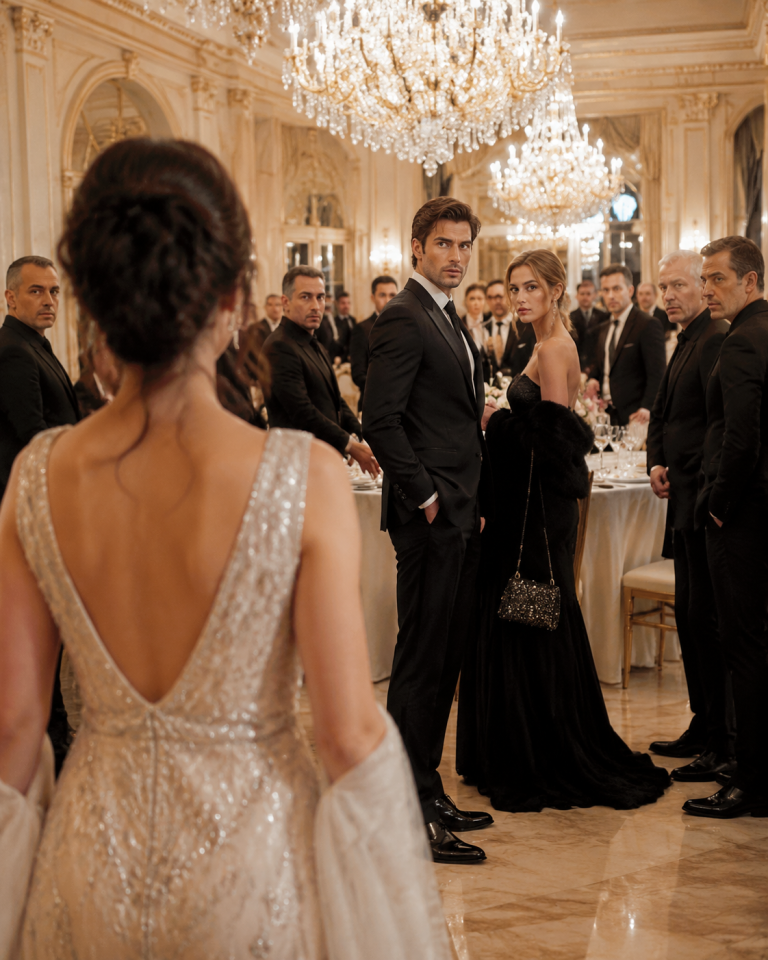
The wedding ballroom looked like a cathedral built for vanity.
Crystal chandeliers hung from vaulted ceilings like frozen storms. White roses climbed gold pillars. A string quartet played near a fountain of floating candles. Men who had ordered violence over lunch stood beside women wearing diamonds large enough to qualify as financial institutions.
At the far end stood Luca Ferrara with his bride, Camila Moretti, beautiful in ivory lace, with the wary eyes of someone marrying for power and hoping affection might follow. Beside her stood Valentina Moretti in emerald satin — tall, glossy, arranged for victory.
When Valentina saw Nico enter with Nadia, her smile froze.
Then cracked.
Nadia saw it across the entire room.
A small, involuntary thrill moved through her, followed immediately by dread.
Valentina detached herself from a cluster of women and crossed the marble floor with deliberate grace.
“Nico,” she said warmly. “You made it.”
Her eyes moved to Nadia.
Not up. Not down.
Across.
Measuring width. Waist. Arms. Hips. Finding the places women like Valentina had been trained to consider weaknesses.
“And you brought a friend.”
Nadia smiled before Nico could answer.
“I brought him, actually. He has trouble with social obligations.”
Someone nearby choked on champagne.
Valentina’s eyes flashed.
“How charming.” She extended a hand. “Valentina Moretti.”
“Nadia Gallagher.”
Valentina’s smile turned sharper.
“I must say, Nico, your taste has—” She paused just long enough for the insult to bloom. “Expanded.”
The air went dead.
Marco closed his eyes somewhere across the room.
Nadia felt the old sting.
It was ridiculous how familiar pain remained sharp even when expected. High school locker rooms. Office holiday parties. Aunts who said she would be so pretty if. Men online. Women in boutiques. The entire world had found creative ways to tell her she was too much body and not enough apology.
Her mouth opened.
She had three devastating responses ready. One about Valentina’s father’s import valuation fraud. One about the family trust leveraged against two undeclared properties. One about the emerald dress being interesting given what she knew about the Moretti shipping accounts.
Nico spoke first.
“Valentina.”
His voice was calm.
Too calm.
“This is Nadia Gallagher. She is my date, my most trusted adviser, and the woman I chose over you.”
Valentina went still.
Nico’s hand tightened at Nadia’s waist.
“I suggest you find your manners. Or by midnight, your father’s import business may develop a tragic relationship with the harbor authority.”
Valentina’s face drained.
Nadia looked up at him.
“Did you just threaten her father’s shipping licenses?”
“Allegedly.”
“That is not diplomacy.”
“She insulted you.”
“I had it handled.”
“Yes,” Nico said. “That’s why she’s still standing.”
Nadia tried very hard not to smile.
Valentina stepped back.
Nico turned fully toward Nadia, all attention, all control softening into something that felt frighteningly like admiration.
“Dance with me.”
“No.”
“Yes.”
“Nico, I don’t waltz. I audit.”
“Transferable skill.”
“Absolutely not.”
The orchestra changed.
Of course it did.
Nico Ferrara did not ask for a dance. The world rearranged itself into music.
He led her to the center of the floor.
Not the edge. Not the shadow.
The exact center beneath the largest chandelier.
“Nico,” she hissed, “I will step on you.”
“I have survived worse.”
“I don’t know where my feet go.”
“With mine.”
“That is vague and arrogant.”
“That is dancing.”
His hand settled at the small of her back. His other hand closed around hers. Warm. Firm. Not trapping. Guiding. The room blurred at the edges as the first notes rose.
“Look at me,” he said.
“I’m trying not to die.”
“Look at me anyway.”
She did.
“Good,” he murmured. “They are ghosts. You are the only real thing in this room.”
The words should have been too much.
Maybe they were.
But as he stepped forward and she stepped back, as her crimson skirt moved around them like spilled wine and the chandelier lit the diamonds at her throat, Nadia realized something impossible.
No one was laughing.
They were watching.
Nico moved with predatory grace, absurdly smooth for a man built like a locked door. He guided her through turns she did not understand until her body understood them before her mind could object. When she stumbled once, he caught her so seamlessly it looked intentional.
“See?” he said.
“I still dislike you.”
“You’re smiling.”
“That is stress.”
“That is victory.”
The music swelled.
Nadia looked past his shoulder and saw Valentina standing rigid near the roses, face pinched with fury. And beyond her — the other women. The ones who did not fit the room’s narrow hunger. A cousin in a dress she kept tugging over her arms. A server near the wall with wide eyes. An older woman whose body had softened with age and who stood slightly taller as Nico spun Nadia under the chandelier.
Something inside Nadia lifted.
Not because Nico made her beautiful.
Because he made public what she had always been forced to keep private.
She was not an apology.
She was not a clerical error.
She was not the too-much woman at the edge of the photograph.
She was center frame.
“Power,” Nico said quietly, as if hearing her thoughts, “is not bloodline. Not thin wrists and inherited diamonds. It is intellect. Loyalty. Nerve.”
His eyes held hers.
“You have more nerve in one finger than this entire room has in its collective ancestry.”
The laugh escaped her before she could stop it.
Arthur smiled.
Not the dangerous smile.
The real one.
For one minute, Nadia forgot the debt, the bargain, the cameras, the ledgers, the federal flags, the fact that she was dancing with a man who could ruin lives with a phone call.
Then the music ended.
Applause came slowly.
Nervous first.
Then stronger.
Nico bowed his head toward her hand, and Nadia, overwhelmed by adrenaline and silk and fury, curtsied just enough to make the front row inhale.
Nico’s eyes darkened.
“Careful,” he murmured.
“With what?”
“Making it impossible for me to remember this is a public room.”
Heat flooded her face.
—
## PART 3
Before she could answer, a skeletal man in a black tuxedo stepped into their path.
Judge Harlan Crawford.
Nadia knew his accounts before she knew his face.
Seventh Circuit. Anti-corruption speeches. Harsh sentencing for low-level defendants. Private dinners with people whose names appeared in ledger margins she was paid to make boring. A man who performed righteousness while laundering favors through offshore structures and family property trusts.
“Nico,” Crawford said, swirling his scotch. “Lovely dance.”
Nico’s body went still.
Nadia felt the shift.
Danger entered him like a blade sliding free.
“Judge Crawford,” Nico said. “Tonight is a wedding.”
“Business never waits.” Crawford’s gaze moved to Nadia with lazy contempt. “Though I must admit, I’m surprised to see you prioritizing — shall we say, charity work — over strategy. The Spata trial starts Monday, and the district attorney is very enthusiastic.”
Nico’s jaw tightened.
Crawford smiled.
“And here you are, dancing with a plus-size secretary.”
The silence was absolute.
Nadia felt Nico’s hand drop from her back.
Slowly.
Too slowly.
Toward the inside of his jacket.
The room recognized the movement before she did. Men stiffened. Marco took a step forward. One bodyguard shifted his weight. Valentina’s face changed from pleasure to alarm.
Nico was about to do something unrecoverable.
In a ballroom full of witnesses.
Over her.
Nadia stepped between them.
Not behind Nico.
Not beside him.
In front.
Nico froze.
“Nadia.”
She did not look back.
“I am not his secretary, Judge Crawford.”
Her voice carried cleanly through the crystal air.
“I am his forensic accountant.”
Crawford’s smile thinned.
“And I am very good at my job.”
Nadia took one step closer.
“I reviewed several offshore transfers recently. Very tedious work. Lots of shell companies. Lots of men mistaking complexity for invisibility.”
Crawford’s face lost a fraction of color.
Nadia smiled.
“Apex Global Holdings, for example. Fascinating structure. Untraceable deposits arriving on dates that align almost perfectly with your dismissal of racketeering charges against the Callahan crew in 2023. And then there is the six-bedroom property in Tuscany, taxes paid by Apex, registered under your wife’s maiden name. Beautiful place. Terrible paperwork.”
No one breathed.
Crawford opened his mouth.
No sound came out.
Nadia tilted her head.
“Mr. Ferrara does not need to grovel for your favor, Your Honor. If the Spata trial becomes inconvenient on Monday morning, a complete ledger of your financial creativity will find its way to the Times, the FBI, and the IRS Criminal Investigation division by noon Tuesday.”
She leaned closer.
“Enjoy the caviar.”
Then she turned her back on him and took Nico’s arm.
“I need a drink,” she said.
Nico stared at her.
Not with amusement.
Not even with desire.
With awe.
It was so naked, so unguarded, that Nadia almost stepped back from the force of it.
“You just blackmailed a federal judge,” he said softly.
“I made a scheduling suggestion.”
Nico’s mouth opened slightly.
Then closed.
“We are leaving.”
“I said I need a drink.”
“You do.”
“Then why are we leaving?”
His hand covered hers on his arm.
“Because if I stay in this ballroom one more minute after watching you do that, I will either kiss you in front of every enemy I have or start a war.”
He paused.
“Possibly both.”
Nadia’s breath caught.
Nico led her toward the exit.
This time, no one whispered.
They parted like the sea.
—
Outside, the night was cold and clear.
The Maybach waited at the end of the stone path. Stars over the estate. The distant sound of music from inside. Her own heartbeat, entirely too loud.
Nadia stopped walking.
“One night,” she said.
Nico turned.
“Yes.”
“That was the arrangement.”
“Yes.”
She looked at him.
“The Spata trial. On Monday.”
“Handled.”
“You’re sure?”
“Crawford made very uncomfortable eye contact with me just before we left the ballroom. I’m certain.”
“I want the details in writing.”
Nico looked at her steadily.
“Which details?”
“The arrangement. What I agreed to. What counts as fulfilled.”
“The night is not yet over.”
“The night is close enough to over.”
He took one step toward her.
Not crowding. Just — closing the distance that the ballroom had maintained.
“Nadia,” he said, “I have been in rooms with men who burn cities and senators who sell them back. I have sat across tables from people who smile while they plan things I will not describe at a wedding.”
She watched his face.
“In twenty years, nobody has stood in front of me and said no the way you say it.”
“You mean with alarming frequency?”
“I mean like you believe it will hold.”
Her throat tightened.
“It does hold,” she said.
“Yes,” Nico said. “I know.”
He was close enough now that she could see the edge of his expression — the specific quality of control he kept over everything that did not belong to the boardroom or the negotiating table. A quality she recognized because she kept the same kind of control over the parts of herself she had stopped expecting rooms to receive.
“You owe me nothing after tonight,” he said. “Danny is clear. Your part is fulfilled.”
“I know.”
“What I am asking now is not business.”
She studied him.
“What are you asking?”
“Whether the woman who danced under that chandelier and blackmailed a federal judge and called herself the only real thing in the room wants a drink with me.”
“That’s quite a description.”
“It is accurate.”
She looked at the estate behind them. Music drifting. Crystal light through tall windows. The entire gilded room arranged around the absence of people like her.
She looked at her own hands in the cold air. Red silk. Diamonds. Her own fingerprints on the night.
“Somewhere quiet,” she said.
“Yes.”
“No bodyguards hovering.”
“Two. Outside. Invisible.”
“That is not invisible.”
“It is the best I can do.”
She almost smiled.
“And Nico?”
He waited.
“When Monday comes and the Spata situation is resolved and the wedding photographs are printed and everything returns to normal—” She held his gaze. “I am still going back to being your accountant.”
“I know.”
“That doesn’t change because you have a good line about real things in rooms.”
“I don’t say things I don’t mean.”
“Men say that all the time.”
“Men who don’t mean it,” he agreed. “Yes.”
She breathed in the cold night air.
“One drink,” she said.
“One drink.”
“And you tell me why you actually needed me there tonight.”
He was quiet for a moment.
“Because Valentina Moretti is strategic and beautiful and completely indifferent to anything I say or do. I have been in a room with her twice and both times I felt nothing at all.”
Nadia waited.
“And you came into my boardroom with ink on your face and a folder full of imaginary owls, and I felt—” He stopped.
“What?”
“Interested,” he said, as if the word cost him something. “For the first time in longer than I want to calculate.”
Nadia looked at him.
The honest ones were always the most dangerous.
“One drink,” she said.
“One drink,” he agreed.
He opened the car door.
She got in.
Behind them, through the tall windows of the Hargrove Estate, the wedding continued.
Crawford had disappeared from the ballroom, Nadia noticed, before the car pulled away. Valentina was surrounded by people who were very carefully not asking her about the dance. Camila Moretti, catching a glimpse of the Maybach through a window, had allowed herself one small, private smile.
And in the front seat, Marco Ferrara stared straight ahead and said nothing for exactly two minutes.
Then:
“I am going to need significantly more money if she is going to be here regularly.”
Nico said, “Raise her salary.”
“I meant mine.”
“You said that wrong.”
“Nico—”
“Raise her salary, Marco.”
Nadia, in the back seat, pressed her lips together.
“I can hear you,” she said.
“I know,” said Nico.
She looked out the window at Chicago moving past — the city she had navigated on her own terms for thirty-one years, full of rooms that had found creative ways to tell her she did not fit.
She thought about the women at the wedding. The ones whose bodies existed outside the frame that room had decided was beautiful. The cousin tugging her dress. The older woman who had stood slightly taller.
She thought about crimson silk and being center frame.
She thought about the specific weight of diamonds that were not hers and the specific, stranger weight of being chosen by someone who did not need her to be anything other than exactly this.
Excessive.
Precise.
Loud.
Useful.
Real.
“Nico,” she said.
“Yes?”
“The owls in Maine.”
“What about them?”
“We should probably donate something to actual wildlife conservation. In case anyone looks.”
A pause.
Then: “How much?”
“Enough that the number is awkward to refuse.”
“Done.”
Nadia nodded.
Outside, Chicago glittered.
She was still the accountant.
But tonight she had been something else too, and she was going to allow herself that — at least until Monday, when the paperwork would need to be filed and the trail buried and the imaginary owls properly documented and the world would require her to be practical again.
Tonight, she had been extraordinary.
She had heard someone say so.
And she had, for once, not argued.
—
*THE END*