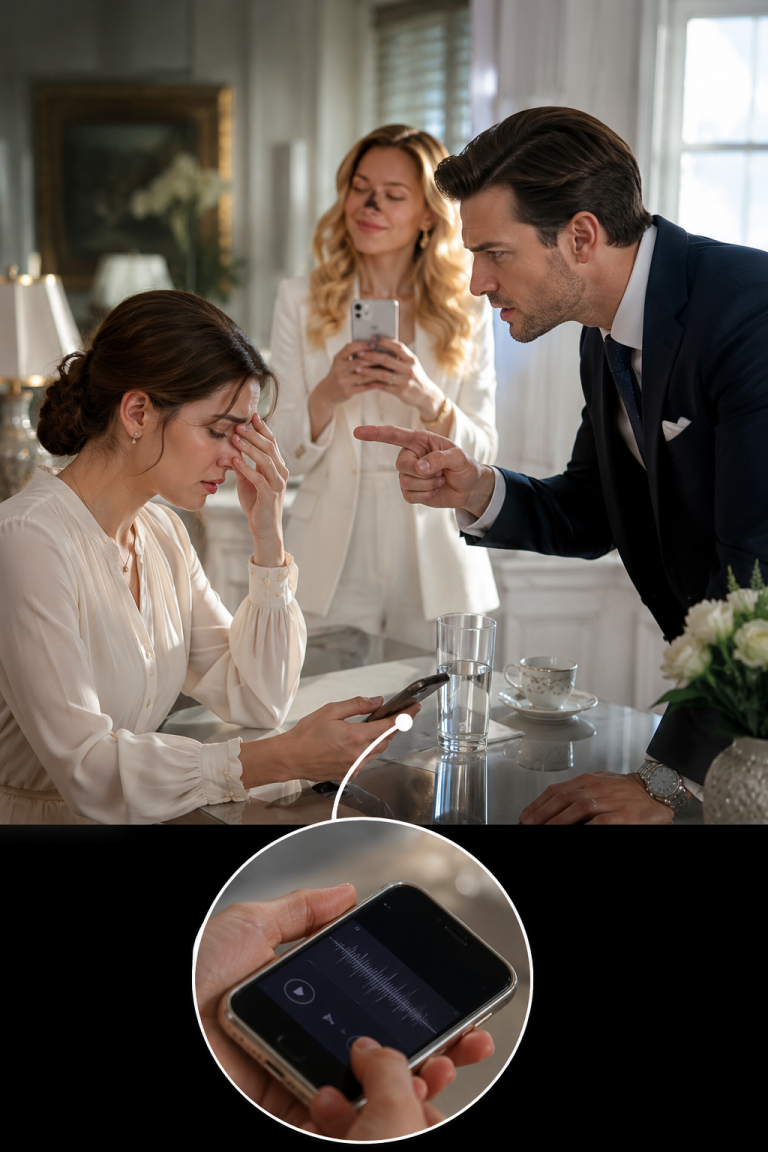
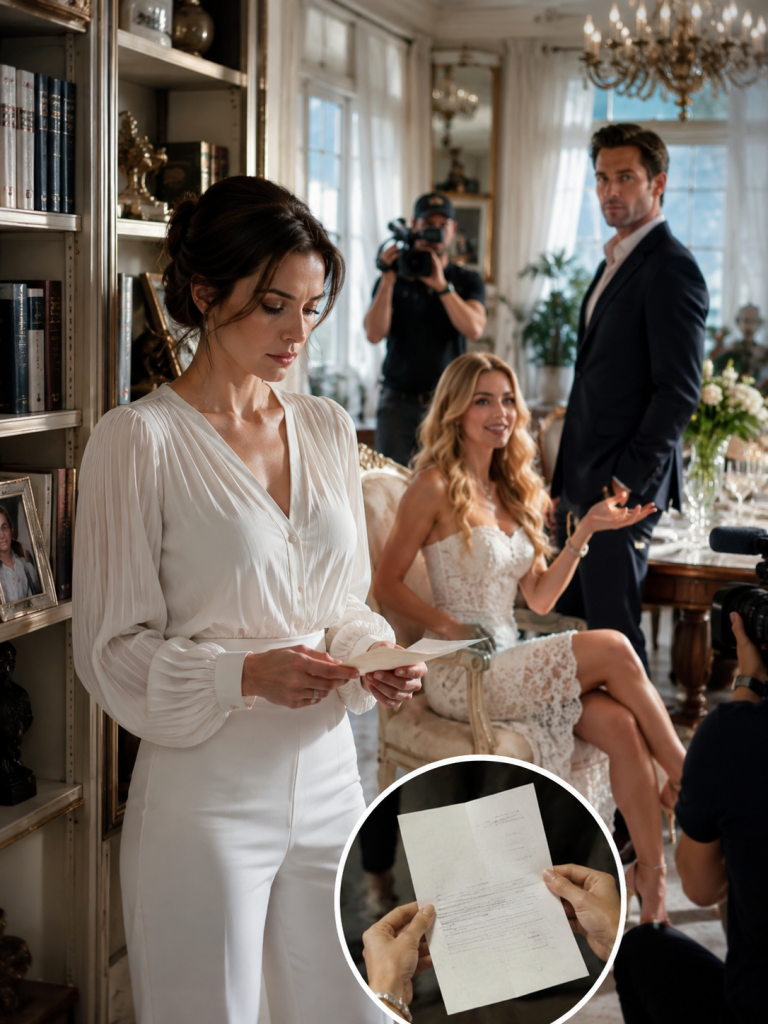
“She Can’t Even Read the Menu!” the Guests Mocked—The Waitress Froze Under the Mafia Boss’s Cold Stare… Then She Answered in Perfect French, and His Expression Turned Deadly

—
PART 1
The lockbox had lived under her bed for eleven years.
Mireille had moved it across four apartments, two boroughs, and one desperate winter when she sold everything else she owned just to keep the electricity on. She had never opened it. Her father’s last coherent instruction, delivered through a swollen mouth and shaking hands on the night she was sixteen, had been simple: *If anyone ever comes asking — and they will come — you know nothing about what I hid.*
She had carried that instruction like a splinter lodged too deep to remove.
Now she was twenty-seven, working the dinner shift at Noir, carrying a leather-bound wine list toward table six, and a woman in a red dress was pointing at her and laughing.
“Look at her, Luca. She’s been staring at that page for ten seconds. I think she’s lost.”
Mireille had not been staring at anything. She had been waiting the professional thirty seconds her training required before interrupting a table. But the woman’s voice carried in the way that cruelty always carries — designed to reach, designed to land publicly.
The man seated across from the woman did not laugh.
He looked up.
That was worse.
—
Noir occupied the ground floor of a pre-war building on West 54th that had previously housed a private bank and, before that, a gentlemen’s club where things were decided over brandy that no one wrote down. The restaurant had inherited a version of that function. The clientele was not wealthy in the ordinary sense — wealthy people came to Noir to feel comfortable around the other kind of wealthy, the kind where the money’s origin was a subject one did not raise.
The maître d’, a man named Étienne who had worked the floor for twenty-two years and survived three ownership changes without updating his suit, had pulled Mireille aside before service.
“The six-top on the east wall is reserved for the Ferrara party,” he said. “You understand what that means.”
She understood.
Luca Ferrara was not famous the way celebrities were famous. He was famous the way weather was famous — not because he announced himself but because his presence changed conditions. He controlled the flow of money through three port authorities and sat on the boards of seven companies that were technically in the import business. What he imported varied depending on who was asking.
“I’ll be careful,” Mireille said.
“Don’t be careful,” Étienne said. “Be invisible.”
She had been invisible for most of her adult life. It came naturally.
—
They arrived at eight-fifteen, which was late enough to signal that punctuality was for people who needed to impress someone.
Luca Ferrara was not what she had pictured, and she had tried not to picture anything. He was lean rather than imposing, dark-suited, with the kind of composed stillness that read, at first glance, as boredom. It was not boredom. Mireille had grown up around men who had things to protect, and she recognized the quality beneath the stillness — the constant low-frequency scan of an environment, the way his eyes moved over the room before he moved through it.
He chose the seat with his back to the wall without appearing to consider it.
The woman beside him was Valentina Greco, whose name appeared in Page Six and in three ongoing civil suits depending on which gossip you trusted. She was genuinely beautiful in a way that required effort to maintain and knew it, which gave her a particular kind of impatience with anything that wasn’t directly serving the performance of herself.
Two bodyguards took the adjacent table.
Mireille waited thirty seconds. She approached. She gave the table her standard greeting — evening, water preferences, was this their first time at Noir — keeping her voice calibrated to the professional warmth that belonged to the uniform rather than to her.
Valentina cut her off mid-sentence.
“The wine list. The real one, not whatever they print for tourists.”
“Of course.”
When Mireille returned with the reserve list — hand-lettered, bound in calfskin that had been old when the restaurant opened — Valentina took it, spent forty-five seconds scanning it with narrowed eyes, and then held it out toward Luca.
“Darling, you choose. It’s all running together.”
Luca barely glanced at it. “Find the ’86 Burgundy. The Romanée-Conti.”
Valentina went back to the book. Her expression shifted through several stages: concentration, confusion, something approaching panic dressed as irritation.
She flipped to a page and pointed. “Here.”
Mireille’s eyes moved to the entry without intending to.
That was not the Romanée-Conti.
That was a négociant Bourgogne from a cooperative in the Côte Chalonnaise, marked up aggressively for tables who wouldn’t know the difference. Serviceable wine. Four hundred dollars on this menu. The bottle Valentina was trying to order cost nine thousand.
Mireille did not say anything.
She was not supposed to correct guests. She was supposed to be invisible.
But she was also not supposed to let a table order a four-hundred-dollar bottle when they had asked for a nine-thousand-dollar one, because that was the kind of mistake that became a complaint that became a conversation with Étienne that she did not want to have.
She drew breath.
Valentina caught the movement before she spoke.
“Oh, perfect.” Valentina set the book down with the particular satisfaction of someone who has just found a moving target. “She’s going to tell us something. Look at her face, Luca — the waitress thinks she knows better.”
Luca looked up.
“Do you?” he said.
His voice was even. Not unkind. Not kind either. Simply a question with significant weight behind it.
“She can’t even read the menu,” Valentina said, laughing now, reaching for this the way a person reaches for something they’ve been carrying. “Can you? Go on. Read something. I want to see.”
The table beside them had gone quiet. The couple at the next booth were not pretending not to listen.
Mireille felt the familiar heat that moved through her chest whenever something like this happened — not shame, exactly, but the pressure of having to decide what to do with it.
She thought about the lockbox under her bed.
She thought about her father’s shaking hands.
She thought about eleven years of making herself small enough to disappear into rooms.
Then she thought: *enough*.
—
PART 2
She did not reach for the wine list.
She already knew exactly where the entry appeared — page nine, third column, four lines from the bottom, the ink slightly darker than the surrounding text because the book had been reprinted the previous spring and that section had been re-lettered by a calligrapher who pressed harder than his predecessor.
When Mireille spoke, it was in French.
Not the careful French of someone who studied it or performs it at appropriate intervals. The French of someone who grew up moving between a diplomat’s residence in the 7th arrondissement and the countryside properties of extended family — a French that carried terroir, that had the particular rhythm of a language lived in rather than learned.
“*La Romanée-Conti 1986 figure en page neuf, troisième colonne, avant-dernière sélection. Le millésime est exceptionnel — vendange tardive, structure concentrée, tanins fondus après trente-sept ans de garde. Ce que vous avez sélectionné, madame, est un Bourgogne générique de négoce. Il mérite certainement sa place sur une table — mais pas celle-ci.*”
The room held its breath.
Mireille reached across the table, turned the wine list to page nine, and placed her finger on the correct line without looking.
Then she looked at Valentina.
“The bottle you indicated retails at sixty euros wholesale,” she said, switching back to English with the same neutrality she might use to report the weather. “The restaurant lists it at four hundred and twenty. The Romanée-Conti, which is what Mr. Ferrara requested, is on the following page. Shall I bring both for comparison, or will you proceed with the original selection?”
Valentina’s mouth was open.
No sound came from it.
The man at the adjacent table covered his mouth with his napkin. His partner looked at the ceiling.
Valentina found her voice. “How dare—”
Luca raised one hand.
One finger, extended slightly.
Valentina stopped.
The entire restaurant appeared to stop.
Luca Ferrara looked at Mireille with an expression she could not read — not because it was blank, but because it was too full of things moving at once, like watching something calculate at a speed that exceeded what the face was built to display.
“What is your name?” he said.
The question hit her somewhere below the ribs.
That exact question, in that exact register — quiet, unhurried, carrying the weight of a man who did not ask things without having already considered what the answer would cost him.
Her survival instinct said: *give a false name, give your shift alias, give anything except—*
“Mireille,” she said. “Mireille Dubard.”
Valentina laughed, too sharp and too late. “Oh, for god’s sake, Luca. She’s a waitress—”
“Leave.”
One word.
Valentina blinked. “What?”
“I said leave, Valentina.”
“You’re not serious.”
He looked at her.
She grabbed her clutch and her coat and her dignity in whatever order she could manage, and she left.
The bodyguards stayed.
The restaurant resumed the quiet hum of people pretending they had not just witnessed something.
Luca Ferrara looked at Mireille.
“Sit down,” he said.
“I’m working.”
“I know. Sit down anyway.”
She pulled out the chair across from him and sat, which was either the most professional or least professional thing she had done in four years of waiting tables, and she was not entirely sure the distinction mattered anymore.
“Dubard,” he said. “Your father’s name?”
The floor shifted.
“Why?”
His eyes held steady. “Because twenty years ago I knew a man named Henri Dubard who worked for the French consulate and handled financial channels I was involved in. And then he disappeared. And something he was carrying disappeared with him.” He tilted his head. “You have his eyes.”
Every nerve in Mireille’s body fired at once.
“I don’t know what you’re talking about.”
“I think you do,” he said. “I also think you’re frightened, which makes sense, and I think you’ve been frightened for a long time, which I am sorry for.”
She stared at him.
“Your father,” Luca said carefully, “took a ledger when he ran.”
The lockbox.
The lockbox that had moved across four apartments and two boroughs and one desperate winter.
“He stole from my family,” Luca said. “And that ledger has been the source of significant violence in the years since. People looking for it. People dying because they were thought to have it. Or thought to know where it was.” He paused. “People like your father.”
Her throat closed.
“You killed him.”
Luca said nothing for a moment.
“No,” he said. “My father did.”
The door to Noir opened.
Three men entered who did not look like customers.
—
PART 3
She recognized one of them.
It took her a moment — the face was older, the scar over the left eyebrow more pronounced than she remembered from childhood — but the recognition was absolute when it landed, the way some memories don’t fade so much as wait.
This man had come to their apartment in Paris. He had sat in their kitchen and drunk coffee while her father went pale across the table. She had been nine years old and had watched from the hallway through the gap in the door, close enough to see her father’s hands trembling against his coffee cup.
She had not known who he was then.
She knew now, looking at him, that he had not come for dinner.
Luca had seen them the moment the door opened. He had not moved, but the quality of his stillness changed — it went from composed to something else, something that reminded her of a wire pulled to its tightening point.
“Don’t stand up,” he said quietly.
“Who are they?”
“They work for my uncle.” A pause. “Who has been trying to locate your father’s ledger for considerably longer than I have, and with considerably fewer reservations about how that search is conducted.”
The man with the scar swept his gaze across the restaurant. It landed on Mireille and stopped.
She watched him recognize her the same way she had recognized him — a slow, cold process, certainty arriving in stages.
He smiled.
It was not a good smile.
He said something quietly to the man on his left, who moved toward the restaurant’s back exit. The third man stayed near the front door.
“He’s going to cut the exits,” Mireille said.
Luca looked at her. “Yes.”
“You knew they might come tonight.”
“I suspected. This table has been under observation for two days.” He kept his voice very even. “What I didn’t expect was to find Henri Dubard’s daughter already here.”
“If you suspected, why come?”
“Because I needed the ledger, and I had reason to believe it might surface through this restaurant’s ownership connections.” He paused. “Which is a longer conversation than we have time for currently.”
The man with the scar was walking toward their table.
The restaurant’s ambient noise had dropped — not to silence, but to the cautious half-quiet of people who had noticed something wrong and were trying to decide whether to acknowledge it.
Étienne had disappeared somewhere near the host station.
Luca’s two bodyguards were on their feet now, positioned.
“Luca Ferrara,” the scarred man said, stopping five feet from the table. He did not look at Luca. He was looking at Mireille. “And the Dubard girl. Both in one room.” He clicked his tongue. “Giulio will be pleased.”
“Giulio can contact my lawyers,” Luca said pleasantly.
“Giulio doesn’t want to contact your lawyers.” The man pulled a phone from his jacket and set it on an empty table beside him, screen facing up. “He wants to speak with you. And he wants the girl to tell us where Henri’s lockbox is being kept. She’ll know — Henri always kept his children informed. Sentimentality was one of his flaws.”
“My father didn’t tell me anything,” Mireille said.
The man looked at her for the first time with his full attention. The scar pulled at the corner of his expression.
“You were sixteen when he died,” he said. “Old enough. And you’ve been carrying something for eleven years — I can see it in the way you’re sitting.” He tilted his head. “You look exactly like him, you know. He was frightened all the time too. Just better at hiding it.”
Something broke open in her chest at that — not grief, but anger, which was grief’s sharper twin.
“Don’t talk about my father.”
“Why not? He was a thief. He stole documents that could have ended careers, triggered investigations, taken apart an organization my employer spent forty years building.” The man shrugged. “I hold a certain professional respect for the audacity, honestly. But the ledger belongs to Giulio Ferrara, and it’s time to bring it home.”
Luca had not moved. “The ledger belongs to no one. What it contains is evidence of crimes that Giulio has been trying to erase for two decades. Henri Dubard didn’t steal it. He preserved it.”
The scarred man looked at Luca with something approaching pity. “Your loyalty to a dead consulate worker is touching. Less touching is the fact that you’ve spent ten years building a case against your own uncle using a document you don’t even have yet.” He picked the phone back up. “So. Where is it?”
Silence.
Mireille thought about the lockbox.
She thought about the way her father had looked that last night — not just afraid, but resolved, which was a different thing. Afraid meant you wanted to run. Resolved meant you had already decided what you were willing to lose.
She thought about four apartments, two boroughs, one terrible winter.
She thought about eleven years of carrying something she didn’t understand because a man with shaking hands had asked her to.
She said: “It’s in a storage unit in Greenpoint. Unit 14C. The key is taped inside the fire alarm housing in my apartment building, third floor landing.”
Luca looked at her.
“Mireille—”
“I know what I’m doing,” she said.
She did not know what she was doing. But she had understood, in the last thirty seconds, that she had been making the wrong calculation for eleven years. She had been protecting the lockbox. She should have been thinking about what the lockbox was for.
Her father hadn’t hidden it to keep it hidden.
He’d hidden it to keep it safe until someone could use it.
The scarred man was already on his phone, relaying the address. His attention had shifted — the efficiency of a man completing a task, already mentally moving to the next step.
Which meant he had stopped watching her hands.
She reached across the table, picked up Luca’s water glass, and threw the contents into the scarred man’s face.
In the half-second of his surprise, Luca moved.
She had not seen him move like that before. It was compact and immediate and completely without hesitation — he was across the table before she had time to process the motion, his bodyguards converging at the same instant, and the restaurant dissolved into the specific chaos that happens when a room full of people trying to pretend nothing is wrong can no longer maintain that pretense.
She went down behind the table, instinct dropping her low, the sound of furniture moving and voices raised and something ceramic shattering against the floor.
It lasted perhaps forty seconds.
Then Luca crouched beside her, one hand on her arm, his suit jacket gone somehow, his voice steady.
“Are you hurt?”
“No.” She checked. “No.”
“Good.” He helped her up.
The restaurant looked like a room where something had happened and been rapidly contained. The scarred man was on the floor with his hands zip-tied behind him, which seemed impossibly tidy given the forty seconds available. His two companions were being escorted out through the kitchen by men Mireille had not seen arrive — Luca’s people, apparently, who had been here all evening.
“You had backup,” she said.
“I said I was expecting something.”
“You could have told me.”
“You were a waitress who might or might not be Henri Dubard’s daughter. I didn’t know who I was dealing with.” He paused. “I know now.”
Étienne materialized from near the host station, straightened his jacket, and said to the remaining diners with admirable composure: “The kitchen has prepared a complimentary dessert course. We apologize for any disruption.”
Mireille almost laughed.
—
They sat at a different table, away from the windows. Someone brought coffee without being asked. Luca’s hands were on the table, and she studied them for a moment — steady, which she had expected, but also marked with the kind of use that desk-bound people didn’t accumulate, which told her something about the distance between who he appeared to be and who he was.
“The address I gave him was real,” she said.
“I know.”
“If he gets there first—”
“He won’t. I have people already there.” He looked at her. “I told you. I’ve been looking for that ledger for ten years. I wasn’t going to let tonight end without it.”
“Then why do you need me?”
“I don’t. Not for the ledger.” He was quiet for a moment. “The ledger is evidence. What it proves is that my uncle has been running an operation underneath the legitimate structure for the last twenty years — trafficking documentation, financial fraud, arrangements with people who are currently protected by the same political connections that Giulio spent a generation buying.” He paused. “Evidence is only useful if someone can present it. If I present it, I look like a man making a play against his uncle for control of the family business, which is how Giulio will frame it, and which half of the people in the relevant rooms will believe because it’s the more comfortable story.”
Mireille looked at him.
“But if a diplomat’s daughter presents it,” she said slowly.
“A diplomat’s daughter who has been carrying it for eleven years without knowing what it was, while people died trying to find it — that’s a different story. That’s a witness. That’s a narrative that doesn’t have a self-interested explanation.” His eyes were level. “I’m not asking you to do this. I want to be clear about that. You’ve been carrying this since you were sixteen, and you’ve already done more than anyone asked of you. If you hand me the key and walk away tonight, I will consider the debt to your father more than paid.”
“What debt?”
He was quiet.
“He came to you,” she said. “Before he ran. He came to you with the ledger because he thought you’d use it.”
“Yes.”
“And you were twenty-three and not yet in a position to do anything with it.”
He looked at her steadily. “Yes.”
“So he ran instead. And Giulio’s people found him.”
A long pause.
“Yes.”
Mireille turned her coffee cup once. The porcelain was warm.
“He was protecting me,” she said. It was not a question. “When he ran, when he hid the lockbox and told me nothing — he was trying to make sure I couldn’t tell anyone anything, because if I didn’t know, I wasn’t useful to them.”
“That was his reasoning. Yes.”
“And then he died anyway.”
“Yes.”
She thought about the four apartments. The winter with no heat. The lockbox that she had carried like an obligation she couldn’t name.
She thought about her father’s resolved face.
“Okay,” she said.
Luca looked at her.
“I’ll do it,” she said. “I’ll present the evidence. I’ll give testimony about how I came to have it, what my father told me, the chain of custody as far as I understand it.” She paused. “But I want to understand everything first. All of it. Everything in that ledger and everything it connects to. I’m not walking into a room and saying things I haven’t verified.”
“That will take time.”
“Then we take time.”
He studied her for a moment with the same expression he had worn when she’d recited the wine note in the middle of a silent restaurant — something between assessment and something she couldn’t categorize.
“Your father said you were the most careful thinker he had ever met,” Luca said. “He said that to me, in this city, in a different restaurant, twenty-three years ago. He was trying to convince me he was worth trusting.” A pause. “He said if anything ever happened to him, his daughter would handle it better than he had.”
Mireille’s throat tightened.
“He was right,” Luca said. “For what it’s worth.”
She looked at the table.
“It’s worth something,” she said.
—
The lockbox was opened at eleven-forty that night in the back office of a law firm on the thirtieth floor of a building in Midtown, with three attorneys present, a notary, and a digital recording running with timestamp verification. Luca sat across the table. His two senior associates flanked the attorneys.
Mireille opened it herself.
Inside: a ledger, hand-written, approximately two hundred pages, indexed in her father’s meticulous civil servant’s hand. Accompanying documents. Photographs. A personal note, addressed to no one, that she read once and folded back without showing anyone.
Her father’s handwriting was the same as she remembered.
The note said, in part: *You will be braver than I was. You already are. You just don’t know it yet because you haven’t been asked.*
She had been asked now.
—
The legal process took four months.
It was not four months of testimony and courtrooms, which was what people imagined when they thought about evidence and accountability. It was four months of attorneys and depositions and sealed filings and careful, grinding work that happened mostly in offices and conference rooms and secure document exchanges, and Mireille was present for all of it because she had said she would verify everything and she kept that commitment.
Giulio Ferrara’s attorneys filed twelve motions in the first six weeks.
All twelve were denied.
By the end of the fourth month, three federal agencies were involved and the ledger had generated two hundred and forty-seven pages of annotated findings. The political protection that Giulio had spent two decades purchasing dissolved at a speed that surprised people who didn’t understand that political protection is only durable when the protected party can continue to threaten worse exposure than the exposure already occurring.
He couldn’t.
Mireille was not present for the indictment. She was in a law library in lower Manhattan, working through a case precedent that one of the attorneys had flagged as potentially relevant to the civil recovery proceedings she was considering on her father’s behalf, and she found out the way she found out most things now — a phone notification, text from one of Luca’s associates, two words: *It’s done.*
She sat with that for a moment.
Then she went back to her research.
—
She did not see Luca again for three weeks after the indictment, which was exactly the right amount of time — long enough that the meeting, when it happened, was chosen rather than required.
They met at a different restaurant. Her choice, deliberately, which she felt he understood.
It was a small place in the West Village that served no wine list at all, only a rotating selection that the owner described verbally and changed by the week. She had eaten there twice before and liked it. It did not require her to be anything she wasn’t.
He was there when she arrived, already seated, which meant he had arrived early, which was new information.
“You look different,” he said.
“I’m not wearing a uniform.”
“That’s part of it.”
She sat. “The civil suit is moving forward. The attorneys think recovery is viable, given the documentation.”
“Good.”
“I won’t get everything back. My father spent a lot of what he managed to take with him, and the rest was — well.” She paused. “It doesn’t matter. The point was never the money.”
“What was the point?”
She looked at him. “That it meant something. That he didn’t just die for a lockbox.”
Luca nodded slowly.
“It meant something,” he said.
The server appeared, described the evening’s selections, left again. They sat in the kind of quiet that was not uncomfortable, which was its own information.
“What will you do now?” he asked.
She had thought about this. During four months of conference rooms and depositions and late nights with documents spread across a desk in a borrowed office, she had thought about the question of what came after.
“I don’t know yet,” she said. “I’ve been a ghost for most of my adult life. I’m going to have to figure out what I’m actually like when I’m not hiding.” She paused. “My French is apparently excellent. That seems like it should be useful for something.”
The corner of his mouth moved.
“It made an impression,” he said.
“On the entire restaurant.”
“On me,” he said. Quietly. Precisely.
She looked at him.
Outside, the city ran its usual current — cabs, rain beginning again on the pavement, voices moving past the window in fragments of other people’s evenings. A city full of things happening just below the visible surface, which was always true and which she had understood for a long time, and which no longer frightened her the way it used to.
“My father believed you were worth trusting,” she said. “Twenty-three years ago, with everything at stake, that was his judgment.”
“I know.”
“He was right about most things.” She picked up her glass. “That seems like reasonable due diligence.”
Luca looked at her steadily, and something in his expression shifted — not toward calculation, but away from it, which was the direction she had been watching for without knowing it.
“Reasonable due diligence,” he repeated.
“I’m a careful thinker,” she said. “I was told that recently.”
“By someone credible?”
“Extremely.”
The wine arrived.
He let her describe it.
She did — the region, the vintage, the particular quality of the finish, the reason it worked with what they had ordered — and she did it not for the table beside them or the room around them or anyone’s benefit but her own, because she knew these things and had spent eleven years pretending she didn’t, and that was over now.
Her father had spent his life preserving something valuable long enough for someone to use it.
Mireille was going to spend hers differently.
She was going to use it herself.