The Waitress’s Hands Shook as She Wrote “4 Outside. 20 Minutes.” on the Mafia Boss’s Bill—Twenty Minutes Later, Blood Hit the Streets… and by Morning, Everyone Wanted Her Found.

—
PART 1
She had written exactly two things on that receipt.
The first was the total. The second was a decision she could not take back.
*Three outside. Fifteen minutes.*
Nora Vale scratched the words into the bottom margin of the bill with a pen that had been running out of ink all shift, and the irony of that was not lost on her — a message this dangerous, delivered in fading ink, to a man who could have her disappeared before the coffee finished brewing. She set the check on the table like it weighed nothing. Like she had not just inserted herself into something that had already swallowed one person she loved.
“Take your time,” she said.
Take your time.
As if there was any time to take.
As if two men were not standing stationary beneath the awning across the street, rain dripping off their hats in steady sheets, hands tucked too deliberately inside their coats.
As if the man who had walked in twenty minutes ago — ordered nothing, stood near the register, and then slipped back outside while pressing his phone to his ear — had not said, just loudly enough: *corner booth, four of them, quarter hour*.
As if Nora had not spent the last four years learning how to be invisible.
She was good at invisible. She had cultivated it the way other women cultivated careers or relationships or savings accounts. She worked at the Rust & Rain diner on the edge of Red Hook because no one who mattered ever came to Red Hook. She kept her hair pinned flat and her smile professionally empty. She remembered who wanted their eggs soft and who complained about cold coffee and she did not, under any circumstances, allow herself to remember the things she had seen in another city, in another life, when she had been a different kind of woman entirely.
And then the four men walked in.
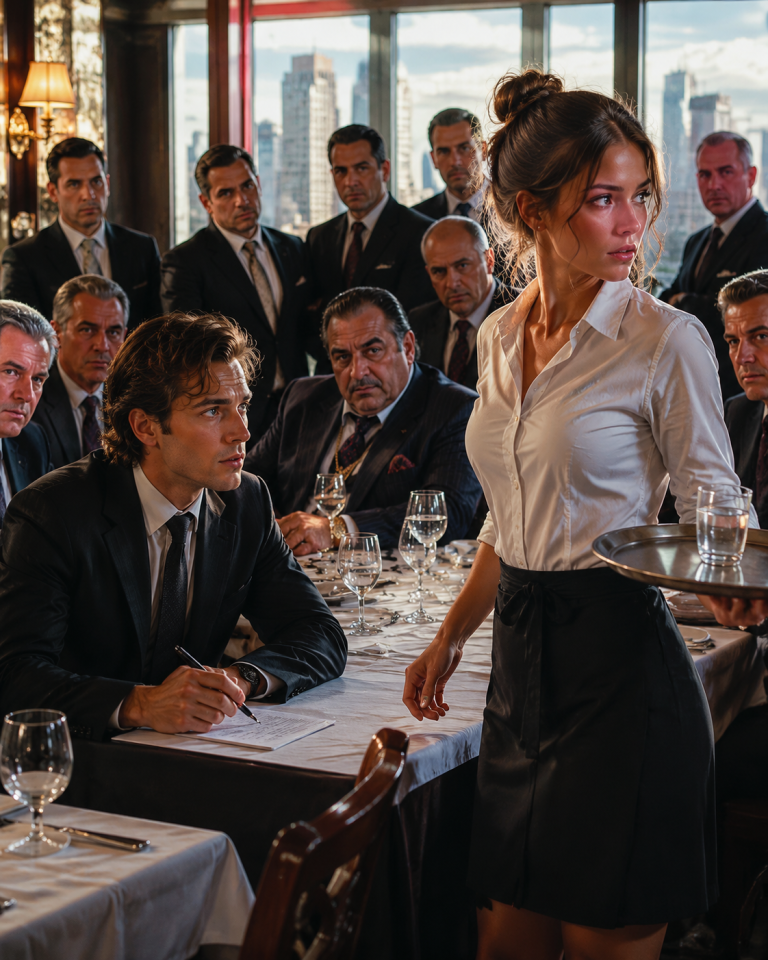
The diner had been quiet that Wednesday — properly quiet, the kind that only existed between eight and ten at night when the dinner rush had died and the late-night crowd hadn’t arrived yet. Rain against the windows. A truck driver named Calvin nursing his fourth coffee at the far end of the counter. An older couple splitting a slice of lemon meringue at booth two. The cook, Pete, scraping the grill with the rhythm of someone doing it in their sleep.
Nora felt it before she saw it.
The bell above the door rang — it always rang, that was the point of bells — but the quality of the room changed. Like a pressure shift. Like the moment before lightning when the air tastes different.
The man who entered first was around forty, dark-haired, built like someone who had spent a lot of time carrying things heavier than furniture. He wore a wool overcoat the color of smoke and he did not look around the diner the way customers did — taking in the menu boards, the pie display, the staff. He looked around the way a general looked at terrain. Exit over there. Window line of sight to the street. Kitchen door, back egress, blind spot at the bar.
Then he chose the corner booth and the other three men sat down without being asked.
Nora carried menus over. Her voice came out steady and professional, which was either proof that four years of practice had actually worked, or that something inside her had gone too quiet.
“Evening, gentlemen. What can I get you started with?”
Coffee, water, Coke. The dark-haired man in the wool coat looked up at her.
“Black. No sugar.”
She noticed the slight Italian cadence. She noticed the way his two words carried the expectation of immediate compliance. She noticed the ring on his right hand — heavy, silver, no insignia — and the scar that ran beneath his jawline in a thin pale arc.
She also noticed one of his men glance toward the street, and the way that glance was answered by the faintest narrowing of the dark-haired man’s eyes.
He’d already clocked it.
He just hadn’t moved yet.
Pete leaned over the pass-through when Nora handed off the drink order.
“You know who that is?”
Nora shook her head.
“Marco Vitelli.” Pete’s voice dropped to the register people used for things they didn’t want to say but couldn’t stop themselves from saying. “He runs the south Brooklyn import business. Which means he runs everything that comes in through the south Brooklyn ports.”
Nora poured the coffee. “And?”
“And he doesn’t eat at places like this unless he doesn’t want to be found eating at places like this.”
She looked at the booth. Marco Vitelli was cutting his steak with quiet efficiency, speaking in low Italian to the man beside him.
She had not thought about Philadelphia in eleven months.
She thought about it now.
—
She was on her way back with the coffee refill when she saw the black sedan ease to a stop across the street. No plates visible through the rain. Three men climbed out and did not go anywhere. They just positioned themselves.
Her stomach dropped straight through the floor.
The man in the Yankees cap who’d made the phone call was gone now. But his role was done. He’d been the spotter. The confirmation. The same role a man named Gus had played outside a bar in South Philadelphia three years ago, twenty minutes before—
*Don’t.*
Her brother’s voice, the way she always heard it now: not what he’d actually said, but what he’d say now if he could. *Don’t go there, Nora.*
But she was already there.
She was already counting exits and watching hands and calculating angles the way he had taught her to, back when she still thought his lessons were just paranoia.
One of Vitelli’s men shifted beneath the table. His jacket moved wrong.
*Fifteen minutes* was probably eight minutes now.
She grabbed the bill from the register. She wrote it fast, in the margin, with the dying pen. She did not let herself hesitate because if she hesitated she would talk herself out of it and people would die in this diner — Calvin with his coffee, the meringue couple, Pete who had never done anything to anyone — and she would spend the rest of her life adding that to the list of things she didn’t stop.
She walked back to the corner booth.
She set the check face-down on the table.
She said, “Whenever you’re ready, sir. No rush.”
Marco Vitelli picked up the bill without urgency.
And then his eyes stopped moving.
The booth went absolutely still. It happened fast — the kind of fast that looked slow because every movement inside it was precise. One man’s hand disappeared beneath the table. Another half-rose from his seat.
But Vitelli raised one finger.
Just one.
And the booth froze.
He looked up at Nora.
His eyes were the color of old iron — gray with something darker underneath.
“Who sent you that information?” he said.
His voice was not loud. It was the opposite of loud. It was the kind of voice that didn’t need volume because the room already understood what it cost to make him repeat himself.
Nora kept her expression exactly neutral.
“No one sent me anything.”
He studied her for a long moment that felt like a physical thing, like being held under water.
Then the first headlight swept through the rain-streaked window.
Then the second.
Then all three black vehicles rolled to a stop in front of the Rust & Rain, and every man in Marco Vitelli’s booth reached beneath the table at the exact same instant.
—
PART 2
The front window exploded inward before anyone reached the door.
Nora hit the floor behind the counter on instinct, glass raining across the linoleum around her, the sound of gunfire splitting the diner’s quiet into something unrecognizable. Calvin was already down, smart enough or frightened enough, his coffee mug shattered somewhere. Pete had killed the kitchen lights.
Vitelli’s men moved like they’d trained for exactly this moment — because they had.
The heavy center table flipped sideways. Two men fired through the broken window in coordinated bursts. The third covered the kitchen corridor. And Marco Vitelli himself rose from behind the overturned table and moved toward the door with a calm that made Nora’s blood run completely cold.
She had seen men panic under gunfire.
She had never seen anything like this.
Two attackers breached the entrance.
Neither of them made it past the threshold.
The shooting stopped as fast as it had started. Four, maybe five seconds of silence. Rain through the broken window. Smoke. The smell of gunpowder and spilled coffee.
Then footsteps.
One set. Deliberate. Unhurried.
A man stepped through the shattered doorway.
He was older than Vitelli — mid-sixties, silver-templed, dressed in a coat that cost more than everything in this diner combined. He removed his gloves one finger at a time. His face held the particular expressionlessness of someone who had not been surprised by anything in a very long time.
Marco Vitelli went completely still.
The kind of still that had nothing to do with fear.
“Uncle,” he said.
The older man smiled.
“Hello, Marco.”
The word *uncle* landed in the diner like something thrown hard against stone.
The older man — Vitelli’s uncle — scanned the diner slowly, and when his gaze reached the counter where Nora was crouched in the broken glass, it stopped.
“Interesting,” he said softly. “The waitress.”
Marco said nothing.
His uncle took one step forward, something shifting in his expression. From mild curiosity to the look of a man deciding whether to prune a branch or pull the whole tree.
“She warned you.”
His hand moved to his jacket.
“That’s a problem.”
—
PART 3
The shot came fast.
Nora saw the gun clear the coat. She saw it angle toward her. And then something crossed the diner at a speed her mind couldn’t properly sequence — Marco Vitelli, moving, covering the distance between the booth and the counter in the span of a breath, putting his body between her and the bullet like it was a calculation he’d already run and accepted the cost of.
The sound.
Then the silence after.
Then the weight of him — heavy, sudden, warm — as he staggered back into her.
“Get down,” he said. Or tried to say. The words were wrong, too quiet.
Nora caught him by reflex, both arms, and they went down together behind the counter as the diner erupted again. His men opened fire. His uncle dove behind the overturned booth. Glass. Noise. Someone shouting in Italian.
Blood was spreading across Vitelli’s white shirt in a dark, rapid bloom.
Nora pressed her hand against it, already knowing the arithmetic was bad.
“Why?” she said. It came out almost angry.
His eyes found hers.
Not cold now. Not the iron-gray calculation she’d watched assess the diner like a battlefield. Just — eyes. Tired and sharp and searching.
“You recognized the signal,” he said.
It wasn’t a question.
She felt her chest close up. “I don’t know what you—”
“The spotter. The phone call. The way they positioned on the exit.” He coughed. “That’s not something civilians notice.”
A bullet hit the counter above them. Nora pulled him lower, and he let her, which told her how bad the shoulder was.
“Who are you?” he asked.
“Nobody.”
“Nobody doesn’t write warnings on mafia receipts.”
“I—” She stopped.
He was watching her with the focused patience of a man who understood that time was finite and wasn’t going to waste what was left of his on partial answers.
“Philadelphia,” she said. “I knew someone who worked adjacent to an organization there. I watched how these things moved. I learned the geometry of it.”
“Who?”
Her throat tightened. “My brother. His name was Daniel.”
Something happened to Marco Vitelli’s face that she had not expected and could not explain.
Not recognition, exactly.
Shock.
Real shock. The kind that doesn’t perform itself.
“Daniel Vale,” he said.
The name in his mouth — her brother’s name, her actual brother’s name, not a guess, not a near-miss — stopped every thought in Nora’s head.
“How do you know that?”
He closed his eyes briefly. Opened them.
“Daniel Vale died protecting me.”
The diner kept going around them — gunfire, shouting, the sound of furniture breaking — but Nora stopped hearing any of it.
“That’s not possible.” Her voice came out flat. “He died in a shooting. Outside a bar. They said it was random.”
“It was not random.”
“The police—”
“The police were told what they were told.” His jaw tightened. “He saw something he wasn’t supposed to see. About my uncle. About what Renato was doing with the eastern operations. He made a choice to tell me instead of disappearing. He thought—” Vitelli stopped. Something moved behind his eyes. “He thought warning me was worth the risk.”
Nora felt the floor tilt beneath her, even though she was already on it.
“He died because of you.”
“Yes.”
She had expected him to soften that. To frame it differently. He didn’t.
“He died because of a choice he made,” Vitelli said, “that I have not stopped paying for.”
She stared at him.
“There’s a letter,” he said. “In my interior pocket. Left side.”
She didn’t move.
“Nora.”
Her name. He knew her name.
“It’s been there for three years,” he said quietly. “Your brother wrote it the night he died. He gave it to one of my men with instructions — find his sister, make sure she’s safe, give it to her when the time is right.” His voice roughed at the edges. “I kept the first two parts. I failed the third. Not because I forgot. Because every time I located you, you were living clean and quiet and far from all of this, and I decided that delivering a dead man’s letter was not worth dragging you back in.”
Nora’s hand, still pressed against his wound, had gone numb.
“That was not your decision to make.”
“No,” he agreed. “It wasn’t.”
She reached into his jacket with her free hand.
The envelope was there. Old. Soft at the edges from being carried so long. Her name on the front in her brother’s handwriting — the slightly too-large D he’d never quite grown out of, the way he crossed his *a*s like printed type.
She couldn’t open it. Not here. Not like this.
She folded it against her chest.
“Your uncle knew about me,” she said. “He knew immediately. He said *the waitress* like he’d been briefed.”
“Yes.”
“Which means someone here—”
“Or someone who knew where I was eating tonight.” His voice tightened. “Renato has been building a case for years. He wants the operation. He’s been eliminating anyone with loyalty to me and manufacturing reasons for the council to support the transition.” He looked toward the gunfire, still ongoing. “Tonight was supposed to look like an ambush. No survivors to contradict the story.”
“And me?”
He met her eyes. “A loose thread. He doesn’t know who you are. He just knows you helped me.”
“That’s enough, isn’t it.”
“Yes.”
Above them, the fight was shifting. Vitelli’s men were pushing back — she could tell by the movement of the sound, the way the shooting retreated from the front of the diner toward the street. His uncle was either down or in retreat.
Vitelli tried to push himself upright.
She pushed him back. “Don’t.”
“My people will secure the building. But Renato’s network is wide. When word gets out that the hit failed—”
“Everyone who works for him will know I was here.”
“Yes.”
She thought about the apartment in Carroll Gardens with its three locks and its view of a church. She thought about the four years of careful, deliberate invisibility. She thought about her brother’s handwriting on the envelope pressed against her ribs.
“Where do I go?” she asked.
“With me.”
She looked at him.
“I know how that sounds,” he said.
“It sounds like a kidnapping dressed as a rescue.”
Something crossed his face. Not quite a smile. The shadow of one.
“Your brother said you were difficult.”
That hit differently than anything else had.
“He said that to you?”
“He talked about you constantly.” Vitelli shifted, wincing. “He said you were the smartest person he knew and that you would never let anyone help you without arguing about it first.”
Nora’s eyes burned. She blinked it back hard.
“He was right,” she said.
“I know.” He extended his uninjured hand. “Come anyway.”
—
She argued about it.
Of course she did.
She argued in the back of the SUV that materialized in the diner’s alley while two of Vitelli’s men carried him out through the kitchen. She argued at the private clinic in Bay Ridge where a doctor who asked no questions removed the bullet from his shoulder and stitched the exit wound with the practiced calm of someone who had done this before. She argued while a woman named Camille — sharp-eyed, fortyish, who seemed to run the logistical dimensions of Marco Vitelli’s life — handed her a phone, a change of clothes, and a room key.
“I have a life,” Nora said.
“You had a life,” Camille said, without cruelty. “That ended when you wrote on the receipt.”
She wasn’t wrong. Nora had known that when she picked up the pen.
She opened Daniel’s letter alone, at three in the morning, sitting on the edge of a bed in a safe house that smelled like cedar and coffee, with the kind of silence outside that only existed in places where security was paid for.
The handwriting was shakier than she remembered. He must have written it fast.
*Nora—*
*If you’re reading this, I’m gone and Marco kept his promise, which means he’s a better man than I had any right to ask him to be.*
*I need you to know a few things.*
*I wasn’t innocent. I was working for people I knew were dangerous because I thought I could stay on the outside of what they did. That’s not how it works and I knew that before I ever started and I did it anyway. So the first thing I need you to know is that what happened to me was not random and it was not bad luck. It was a consequence. I’m not asking you to forgive that.*
*The second thing: Renato Moretti—Vitelli, his name’s Vitelli—has been building something for a long time. The eastern operation. I saw enough of it to know it goes deeper than Marco knows. There’s a ledger. Physical, not digital. It’s held at a property in Canarsie. If anything ever goes sideways, that ledger is the only thing that can collapse what Renato’s built.*
*The third thing is the only one that matters.*
*You spent four years making yourself smaller because of me. Because you thought being close to me made you a target. Stop that. You were never the liability you thought you were. You were always the person in our family who figured out what no one else could see. Use it.*
*I love you. I’m sorry I made you carry this.*
*—Daniel*
She read it three times.
Then she folded it carefully, put it back in the envelope, and pressed it flat between her palms.
—
In the morning, Marco Vitelli was sitting up in the clinic bed, which impressed her more than it should have, given the prior twelve hours. His color was wrong — too pale, too gray around the edges — but his eyes were fully clear.
“Canarsie,” she said.
He looked at her.
She handed him the letter.
He read it without expression. When he reached the end, he was quiet for a moment.
“You trust this?” he asked.
“He was my brother. I trust his handwriting.” She paused. “I also ran through everything he described and it fits a gap I noticed in Renato’s movements six months ago, when I was still tracking what I could from the outside.”
Vitelli looked up.
“You’ve been tracking this.”
“Lightly.”
“From the outside.”
“I told you. I learned the geometry.”
He was quiet again. Then: “I can take the Canarsie property. But if Renato moves the ledger before we get there—”
“He won’t have moved it yet. He thinks last night succeeded. He doesn’t know you’re alive.” She pulled the phone Camille had given her from her pocket. “He won’t know for another few hours at most. Which gives you a window.”
Marco studied her for a long moment.
“Your brother was right,” he said finally.
“About the arguing?”
“About all of it.”
She looked at the letter in his hands, then at him.
“That ledger ends this,” she said. “Not just for you. Renato has been reaching into things your family built for decades. People who believed in what your father created have been dying on Renato’s orders and being written off as losses.” She paused. “Daniel knew that. That’s why he came to you instead of running.”
Something shifted in Marco’s face. Not grief — he had clearly processed whatever grief he had a long time ago. Something more like resolve.
“He deserved better than what happened to him,” he said.
“Yes,” Nora said. “He did.”
She took the letter back. Tucked it into the inside pocket of the jacket Camille had given her — the same pocket Daniel’s letter had lived in, against Marco’s heart, for three years.
It felt right to carry it that way now.
—
The Canarsie property was a warehouse that operated as a cold storage distribution center, the kind of legitimate business that created enough paperwork to make accountants fall asleep and enough foot traffic to make surveillance difficult. Vitelli’s men moved on it just before dawn, while Renato’s network was still operating on the assumption that their boss had successfully eliminated a problem.
Nora did not go in. That was not her role, and she understood her role clearly enough now to accept its shape.
She waited in the SUV with Camille, who turned out to speak six languages and have opinions about late-period Coltrane, and they drank terrible coffee from a thermos while the sky went from black to gray to the tentative blue of early morning.
The ledger was there.
Exactly where Daniel had said it would be.
Three years of transactions. Names. Amounts. Territory agreements that contradicted every public position Renato had taken within the family’s structure. Enough to bring to the council and dismantle not just Renato’s play for the operation, but the entire infrastructure he’d spent a decade building in shadow.
When Marco came back out and put the ledger in Nora’s hands — not his own, hers — she understood what the gesture meant.
Evidence has weight. The person who carries it matters.
“This goes to the council tomorrow,” he said.
“And Renato?”
Marco looked at her steadily. “Renato will be handled.”
She did not ask what that meant. She understood the language well enough by now.
“And me?” she said.
He was quiet for a moment. Behind him, the warehouse and the water and the early blue sky of a city that had been trying to kill both of them for different reasons across different years.
“That depends on what you want,” he said.
Nora thought about the apartment in Carroll Gardens. The three locks. The view of the church steeple she’d stared at on too many early mornings, cataloguing the silence like it could protect her.
She thought about Daniel’s letter.
*Stop making yourself smaller.*
She looked at the ledger in her hands. At Marco Vitelli standing in the gray Brooklyn dawn with a healing bullet wound and the particular expression of a man who had run out of performance and was just being what he was.
“I want what my brother wanted,” she said. “I want it to mean something.”
He nodded slowly, like a man acknowledging a debt.
“Then stay,” he said.
She thought about it for exactly as long as it deserved.
“Okay,” she said. “But I’m not waiting in cars.”
He almost smiled. It looked like it cost him something, which made it feel real.
“Your brother said you’d say something like that too.”
The sun came up over Red Hook.
The city kept moving, the way it always did — indifferent, enormous, full of things happening just below the surface where the light didn’t reach. Somewhere in it, Renato Moretti was sitting with a glass of wine, certain of his victory, unaware that three years of careful machinery had just been undone by a warning written in fading ink on a diner receipt by a woman he thought was nobody.
Nora Vale put the ledger under her arm and walked toward the car.
She was not nobody.
She had always known that.
It had just taken her four years and one dying pen to remember it.