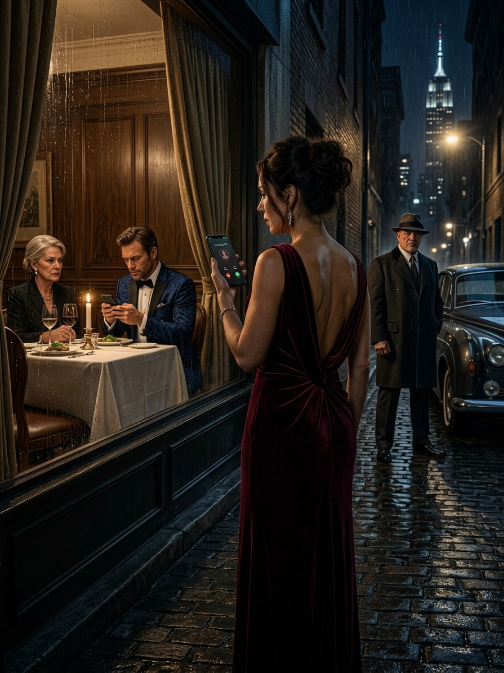
The Mafia Boss Married His Dead Friend’s “Unwanted” Obese Cousin — Then Shocked an Entire City With What She Became

## PART 1
The lobby of the Grand Chicago Hotel held its breath.
Elena Winters stood behind the marble desk in her navy uniform, straightening guest directories that didn’t need straightening, when Jessica Winters swept through the revolving doors like a woman who’d finally located the stage her life deserved.
Elena recognized her sister-in-law immediately. Blonde, polished, expensive in that casual way that required inherited money. Jessica moved with the particular grace of a woman who’d never been told no by anyone who mattered.
She brought two friends. They descended on the lobby like critics at a gallery opening, examining furnishings and fixtures with expressions calculated to find them lacking.
Then Jessica’s eyes landed on Elena.
The smile that followed had edges.
“Oh my God. You’re still doing this?”
Elena kept her professional expression intact, though something inside her—something that had learned to fold itself smaller to survive—contracted further.
“Hello, Jessica.”
Jessica turned to her friends. “Can you believe it? After Michael died, I thought she’d finally go back to school or do something with herself. But no. Still here. Guest services.” She laughed, and it had knives hidden inside it. “It’s like she doesn’t realize she can escape.”
The friends exchanged glances that Elena understood perfectly. This was what it meant to be pitied by people who had never pitied themselves. This was what it meant to be, in every room you inhabited, a cautionary tale.
Elena found her voice. “How can I help you today?”
Jessica leaned against the counter. “Nothing. I just came to watch. It’s genuinely fascinating, how some people just… accept their smallness.”
The lobby seemed to tilt.
Elena’s hands trembled. She gripped the edge of the desk.
Then the revolving doors opened again.
The man who entered moved like violence had learned to walk upright. Black coat. Black eyes that seemed to catalog the room and find it wanting. The entire space recalibrated around his presence. Conversations quieted. Posture straightened.
Elena had seen him only once before—at Michael’s funeral, standing in the back of the church, face carved from something harder than grief.
Marcus Ashford.
He walked directly toward the desk, and Elena felt her heartbeat become something she could no longer ignore.
Jessica paled.
“Marcus,” she said, attempting brightness. “I didn’t realize you were—”
He didn’t acknowledge her. His gaze fixed on Elena with an intensity that made the air between them feel charged.
“We need to talk,” he said quietly. “You, not them.”
Jessica opened her mouth, then shut it. She and her friends retreated with the speed of people who’d suddenly remembered important commitments elsewhere.
When they were gone, Marcus set both hands on the desk and studied Elena with an expression that might have been angry if it hadn’t been so controlled.
“What happened?” he asked.
Elena’s throat closed. “Nothing. It’s fine.”
“Tell me what happened.”
She wanted to lie. Wanted to dissolve. Instead, something in her—something tired of disappearing—finally spoke truth.
“My family doesn’t see me unless they need something to demean. They never have.”
Marcus’s jaw tightened. “And you let them?”
“What choice do I have?”
“Every choice,” he said, and the words landed with the weight of authority. “But first, you need to understand something. Michael asked me to marry you before he died.”
The world went silent.
Elena stared at him. “What?”
—
Three weeks earlier, Michael Hart lay in a hospital bed that couldn’t contain the sharpness of his mind even as the cancer hollowed his body. The machines beeped their relentless rhythm. The afternoon light fell gray and clinical across white sheets.
Michael had been Elena’s only family who remembered her birthdays, who asked her opinion, who treated her like a person instead of a obligation.
Marcus sat beside the bed with his forearms on his knees, the position of a man who’d learned to listen before he learned anything else.
Michael’s fingers, thin as paper, found Marcus’s wrist.
“I need you to do something,” Michael whispered.
“Anything.”
“Marry Elena.”
Marcus had gone absolutely still. “Michael—”
“I know.” Michael coughed, winced, pushed through. “I know it sounds impossible. But she’s alone. She’s been alone since our mother died. Patricia took her in but made sure Elena understood the price. She learned to disappear before she learned to ask for anything.”
Marcus looked away. Michael continued.
“She’s good, Marcus. Better than any of us. She reads books like they’re arguments with the world. She notices things. She remembers kindnesses. And nobody—nobody—has ever bothered to actually look at her.”
Marcus turned back to the man who had once bled on concrete to keep him alive.
“What are you asking me to do?”
“Keep her safe. Give her a name that frightens people, so they think twice before they’re cruel. Give her a roof nobody can take from her. And maybe…” Michael’s voice broke. “Maybe teach her that she’s worth staying for.”
Marcus looked away toward the window and the rain streaking down outside. This man who controlled half of Chicago through whispers and fear, who had killed and ordered killing without hesitation, felt something vast and terrifying open inside him.
“I promise,” he said finally.
Michael died fourteen hours later.
—
At the funeral Mass in St. Stanislaus, Elena sat in the third pew alone.
She had known this would be her place. The family clustered near the front like a portrait of public grief while she occupied the margins, exactly where she’d been positioned her entire life.
Marcus watched from the back.
He saw Jessica lean sideways to whisper something cutting to another cousin. Saw the glance back toward Elena, the exchange of satisfied cruelty. Saw the moment Elena’s face shuttered completely, a door slamming on whatever lived inside.
He recognized that kind of retreat because he’d lived there himself, once.
After the burial, Aunt Patricia and Jessica swept toward their cars without a backward glance toward Elena. Marcus watched her stand alone on the church steps, one hand gripping her purse, shoulders squared against the world.
When she turned toward the bus stop, Marcus followed.
She heard him, stopped, turned with the automatic politeness women learned young.
“Elena Hart?”
“Yes?”
“I’m Marcus Ashford. Michael was my friend.”
Her expression softened. “Michael talked about you.”
“He talked about you too.”
Something flickered across her face—surprise, as if she’d never imagined herself worthy of conversation.
He drove her home to a two-flat in Ravenswood with sagging stairs and a flickering porch light. But on the windowsill above her door sat a pot of basil, stubbornly green against the November cold.
Marcus understood people the way other men understood threats. That plant told him everything. Elena didn’t just survive. She made small, beautiful things persist.
“Whatever Michael asked you for,” she said before stepping out, “you don’t have to do it.”
He watched her climb the stairs until her light came on, and did not start the engine until he was certain she was safe.
Four days later, he asked her to meet him at a restaurant he owned through shells of corporations. Low lighting. Polished wood. The kind of place where money whispered instead of shouted.
Elena arrived in navy and black, hair down, lipstick carefully applied like she’d debated its appropriateness for an hour.
Marcus stood when she reached the table. His grandmother had taught him such things.
He ordered dinner without consulting the menu and let her see that the prices would never matter. Then he told her the truth.
“Michael asked me to marry you.”
Her shock was painful to witness. Pale, then flushed, then looking down as if the tablecloth might offer shelter.
“That’s impossible,” she whispered.
“He thought it was necessary.”
“It isn’t. He had no right—”
“He saved my life once. He had every right.” Marcus held her gaze. “I don’t make promises I intend to break, Elena. And I made him a promise.”
She almost smiled then, sad and tired.
“I’m thirty-two,” she said quietly. “I work guest services. I rent an apartment with crooked floors. Men like you don’t marry women like me.”
Marcus leaned back in his chair, studying her with an intensity that made her throat close. “One legal marriage. One year minimum. You carry my name. You live under my protection. If at the end of that year you want out, you leave with enough security to build any life you want.”
Elena’s eyes searched his face for deception. “Why would you do this?”
“Because Caleb asked. And because…” Marcus paused, choosing words carefully. “Because I recognize something in you. Something worth seeing.”
She took four days to respond. Four days of replaying every cruel thing ever said by people who claimed to love her. When she finally called, her voice was barely audible.
“I’ll do it.”
Their wedding took place in a judge’s chambers on a gray Saturday. Marcus wore charcoal. Elena wore a cream dress bought secondhand, tailored beautifully, refusing spectacle.
When the judge said, “You may kiss the bride,” Marcus saw fear and dignity wrestling behind her eyes.
He kissed her forehead instead.
The relief that crossed her face nearly shattered him.
She moved into his penthouse that afternoon with two suitcases and an apology trembling on her lips. “I’ll stay out of your way,” she said. “I won’t be a burden.”
Marcus turned sharply. “You are not a burden, Elena. Never say that again.”
The first weeks unfolded carefully.
They orbited each other through long hallways and shared dinners, both too disciplined to collide. Elena continued working at the hotel. Marcus left early, returned late.
Yet he began noticing things.
How she washed her mug by hand despite the dishwasher.
The military precision with which she folded blankets.
Her books—Morrison, Baldwin, Woolf, Ellison—their spines cracked from devotion.
The way she stood by the window and stared over Lake Michigan with an expression built from longing and endurance in equal measure.
One night he returned after midnight, knuckles skinned from a meeting that had become less verbal than intended. He found her at the kitchen island in an oversized sweater, reading glasses low on her nose, a mystery novel open beside steaming tea.
She looked up, assessed his hand in one glance, and without asking a question rose to pour another cup.
She set it in front of him and returned to her book.
That silence changed everything.
It wasn’t distance. It was permission to exist without performance. Marcus sat across from her, bruised hand wrapped around warm ceramic, and felt something locked inside him crack open by fractions.
After that, he came home earlier.
Elena began leaving traces of herself. A cardigan over the sofa. A half-finished crossword on the counter. A novel face-down near the window. These small domestic markers unsettled Marcus more than violence ever had. They made the penthouse feel inhabited instead of merely owned.
By December, the space no longer felt like a fortress.
It felt like home.
Her family’s ignorance made it worse, somehow. No visits. No calls. Just the clear message that Elena, even married to Marcus Ashford, remained beneath their consideration.
Until the day Patricia arrived.
## PART 2
Patricia Winters swept into the penthouse with her eyes already roaming, cataloging value instead of beauty. Beside her moved Jessica, visibly offended that someone like Elena had ascended to a penthouse with its own doorman.
Marcus was in his office when the security feed showed him her arrival. He called Elena.
“You have visitors.”
A pause. Then, flatly, “My aunt.”
“Do you want me to come home?”
Elena hesitated. “No. I can handle her.”
He almost believed her until he watched the footage.
Patricia’s smile was sharp as broken glass. Jessica’s questions dripped condescension. And Elena, standing in her own home, began to fold into herself the way she had learned to do before she ever learned to dream.
Marcus left his office immediately.
He arrived at the penthouse to find Patricia mid-sentence, listing all the ways Elena’s marriage was presumably a mistake or an accident.
“I simply cannot fathom how this happened,” Patricia was saying. “Someone of Elena’s background doesn’t typically—”
Marcus stepped into the room, and every conversation halted.
“Aunt Patricia,” he said quietly. “Jessica. You need to leave.”
Patricia’s face flushed. “Excuse me?”
“I’m not asking.” He moved to stand beside Elena, not in front of her as protection, but beside her, claiming her as equal. “You will never speak to my wife that way again. You will never suggest she’s unworthy of anything. And you will not return to this apartment uninvited.”
Jessica’s mouth opened, then shut.
Patricia drew herself up. “Well. I can see that marriage hasn’t improved her position so much as confused his judgment.”
Marcus’s voice became something colder than anger. “Confuse is not what you think. My wife is the finest person I know. Your inability to see that is your failure, not hers.”
He turned to Elena, his expression softening completely. “Get what you need. We’re leaving.”
Outside, snow had begun mixing with December rain. In the car, neither spoke as the city blurred past, red taillights and wet gold streetlamp.
Finally Elena whispered, “Did you mean it?”
Marcus pulled over by the lake, engine idling. He looked at her with an intensity that made the air between them feel charged.
“I made a promise to Michael,” he said. “That’s true. I would have kept it regardless of what happened.” His gaze held steady. “But somewhere between the tea at midnight, the books by the window, and the way you make silence feel like communion, the promise stopped being the reason.”
Her breath caught.
“You became the reason,” he continued, voice rougher. “Everything about you became the reason.”
She reached across the console and took his hand. “I’m not leaving at the end of the year,” she whispered.
Marcus’s fingers closed around hers immediately, almost fiercely. “Say that again.”
“I’m not leaving. I don’t want to leave.”
He brought her hand to his lips and held it there, an old-fashioned gesture made sacred by the surrender it cost him.
## PART 3
From there, the months transformed into an actual life.
Marcus paid Elena’s tuition when she admitted, over whiskey and a literary argument about Hemingway, that she’d once wanted to study English and teach. He did it quietly, not as a favor but as assumption.
“You said you wanted it,” he told her. “So go.”
She enrolled at Northwestern in the spring and thrived.
The apartment changed too. No, that wasn’t precise. Home changed. There were handwritten notes on the refrigerator. Bread cooling on the counter. Her laughter moving through rooms like it had always belonged there.
By April, when she wore a deep emerald gown to a charity gala, the transformation was complete.
The dress was tailored to honor her real body, not disguise it. Men looked. Women looked harder, trying to understand the math of how someone like Elena Winters had become the woman at Marcus Ashford’s side.
On the dance floor, beneath chandeliers and orchestral strings, Elena tipped her head against his chest.
“You’re doing that thing again,” she murmured.
“What thing?”
“Looking at me like I’m the only person in this room.”
Marcus’s hand spread over the small of her back. “You are.”
She laughed softly, then went quiet. When she spoke again, the words were so low they nearly disappeared into the music.
“I think I love you.”
Marcus stopped dancing. Right there, in the center of the ballroom, he lifted her chin with one finger.
“Elena Hart Ashford,” he said, voice rougher than she’d ever heard it, “I have negotiated with men who wanted me dead. I have buried brothers in this city. I have built a life out of choices that decent people would run from.” His thumb brushed her jaw. “But when you smile at me, I forget how to breathe. When you exist in a room, nothing else matters. So yes. I love you. Completely. Irrevocably.”
She kissed him in front of everyone and didn’t care who watched.
That summer, he bought her a ring. Not for the penthouse proposal or the marriage license. A simple gold band that caught the light, uncomplicated and true. He placed it on her finger while they lay in bed at dawn, before the city woke, before the world demanded their armor.
“This is for me,” he whispered. “So everyone knows you’re claimed. And for you. So you know you’re safe.”
The university changed Elena in ways that radiated outward.
She came home with fierce ideas and dog-eared books. She argued with Marcus about Morrison and laughed when she won. She grew in a way that had nothing to do with his protection and everything to do with finally being given space to expand.
One evening, she confessed something quietly. “Patricia called. She wanted to know if we could patch things up.”
Marcus tightened. “What did you tell her?”
“That I was done apologizing for taking up space.” Elena met his eyes. “That you taught me I deserved to.”
Marcus pulled her close and felt pride move through him like something alive.
The first anniversary of their wedding arrived in November, gray and cold, the same season Michael had died.
Marcus came home with a small velvet box. Inside was a gold locket. One side held a tiny photograph of Michael in his twenties, grinning into summer sun. The other held a folded slip of paper.
Elena opened it.
In Marcus’s precise handwriting: YOU WERE ALWAYS WORTHY.
She looked up at him, and in that moment the architecture of her life revealed itself. The lonely girl at every family table. The woman who learned to expect abandonment before affection. The wife who entered marriage convinced she was a duty and discovered she was beloved.
Michael had loved her enough to ask the impossible.
Marcus had loved her enough to make it inevitable.
Tears filled her eyes. She didn’t hide them.
“Thank you,” she whispered.
He drew her into his arms, and she went willingly, resting her head over the steady rhythm of his heart.
Outside, Chicago glittered in its particular way—sharp, ambitious, unforgiving to those it chose to overlook. Inside the penthouse, warmth held.
For years, Elena had believed she was the kind of woman the world overlooked. Too soft, too quiet, too easy for cruel people to practice their cruelty on. But standing in the embrace of a man who had survived by reading danger in every room, she finally understood.
She had never been too much.
She had simply been surrounded by people too small to see her.
And Marcus, who had learned to identify threats in darkness, had looked at her once and recognized not weakness, but worth. Not burden, but home. Not obligation, but love.
He turned her to face him, her eyes still bright with tears.
“You’re mine by choice, sweetheart,” he said, his voice steady and certain. “Every day. Again and again.”
For the first time in her life, Elena believed the words without flinching.
Then she smiled, and the most feared man in Chicago looked at her like the whole world had finally learned to shine properly.
She kissed him, and it tasted like every promise kept. Like every invisible woman finally made visible. Like coming home to a place she’d never known existed.
Outside, snow began to fall on Lake Michigan, and inside the penthouse, two people who had learned to survive alone discovered that the most dangerous choice wasn’t marrying a crime boss.
It was believing you deserved to be loved.
And Marcus Ashford, who had built his empire on the bones of his enemies, had found his only true vulnerability in a woman who’d spent her life learning how to disappear.
He would never let her forget again.
She would never need to hide.
And somewhere in the city below, in the spaces where danger and devotion lived side by side, that promise became the most powerful thing either of them had ever made.
—