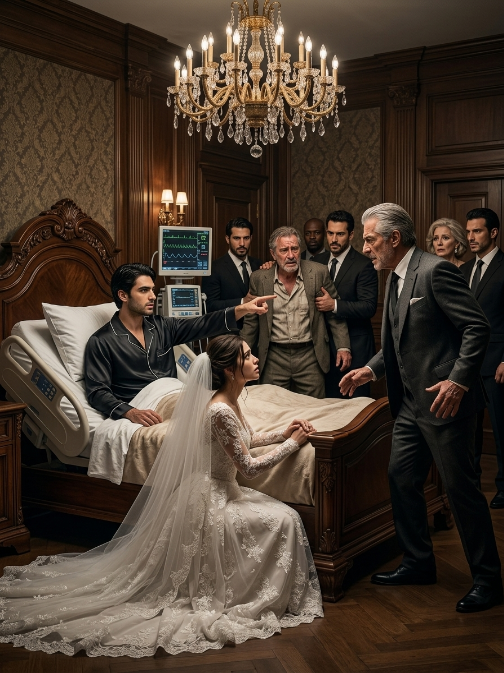
“Don’t Cry, Sir. My Mom Will Save You”—The Boy Comforted the Bleeding Mafia Boss, Then the Truth Came Out

## PART 1
The first thing she noticed about the man in the alley was that he wasn’t asking for help.
That was the tell. Every person Nora Callahan had ever pulled back from the edge — in the ER, on the street, in the specific low-lit disasters that found single mothers working double shifts — had one thing in common. They asked. With their hands or their voices or the way they looked at the ceiling instead of at you. Even unconscious people asked, in the damp rattle of their breathing.
This man was silent. Back against the brick. Both hands pressed to his body. Making himself small in the way that very large, very dangerous people went small when they no longer had a choice. His face was turned up into the rain and his expression was the expression of someone finishing an argument with themselves.
*Not here,* she thought she read in it. *Not like this.*
And then she heard Eli’s voice.
“Sir? Sir, you’re leaking.”
Nora came around the corner of the fire escape and found her five-year-old son crouching in front of a man who had, by her immediate clinical count, at least two gunshot wounds and was losing the argument with blood pressure.
“Eli.” Her voice was quiet. Flat. The voice she used when she needed him to understand that this was not a moment for discussion. “Come to me. Now.”
Eli looked up. His dinosaur rain boots were an inch from a spreading dark pool. His expression was not afraid. It was focused — the focused look he made when he was working on something important, fitting pieces together, trying to get it right.
“He’s crying, Mom,” Eli said.
The man’s jaw moved. “I’m not—”
“You were,” Eli said. Certain. Gentle. Not unkind.
Nora stepped forward and put her body between her son and the stranger, the reflex so practiced she didn’t register doing it. She looked at the man. He looked back.
Late thirties. Dark hair matted to his forehead. His clothes were expensive, which meant the ruin of them meant something. The holster on his hip was empty and the way he held himself — even now, even slumped against a wall bleeding through his shirt — communicated a specific kind of authority. Not the authority of someone who had inherited it. The kind that had been built through years of other people testing it and finding it solid.
She knew the neighborhood. She knew what ran through it and who ran it. She knew what this was.
“I’m calling 911,” she said.
“No.” His voice came out level. She gave him points for that, given what his body was doing. “The men who did this have a radio channel. Ambulance will be two minutes out. Their team will be one minute out.” He held her eyes. “They’ll want to know who helped.”
Eli tugged the back of her scrubs. “Mom. He’s really leaking.”
She looked at the wound on his side. The shoulder. The way his color was going gray at the edges.
She ran the arithmetic the way she always ran it — fast, practical, stripped of everything except what was true. No time. Limited supplies. A child behind her who had already seen too much to unsee.
“What’s your name?”
“Donovan.” A pause. “Donovan Reece.”
“Are there more men coming to this alley right now, Donovan Reece?”
“Not for the next thirty minutes.”
“Are you lying to me?”
Something shifted in his face. Not quite a smile. “I don’t know yet.”
She almost laughed. Shouldn’t have. Didn’t.
“Eli,” she said, “run upstairs and get the blue bag from under the bathroom sink. The heavy one. Don’t stop, don’t talk to anyone, lock the door behind you and wait for my knock.”
“The pattern knock?” Eli said.
“The pattern knock.”
He ran. His boots rang on the fire escape stairs, bright yellow in the dark, and she watched until the door closed before she crouched in front of the man named Donovan Reece and pulled on the gloves she kept in her hoodie pocket because old habits from the ER never fully died.
“I need to know what’s in you and where,” she said. “And I need you to understand something first.”
He looked at her.
“I have one child,” she said. “He just touched your face. That means I’m going to help you, because I’m not going to let the last thing I did for a stranger be nothing.” She held his gaze. “But if anything you’ve brought into this alley follows us upstairs, I will make the call I didn’t make tonight. Are we clear?”
Donovan Reece studied her for a moment with the particular attention of a man who had spent his career reading people quickly.
“Clear,” he said.
Above them, the window opened. Eli’s voice floated down, small and steady in the rain:
“I got it, Mom. I got the bag.”
She pressed her palm to the wound on his side and felt the heat of him bleeding through her glove.
*Don’t die in my alley,* she thought. *I haven’t decided yet if you deserve to.*
—
## PART 2
The apartment above the shuttered coffee shop was three rooms and a fire escape and a refrigerator covered in Eli’s drawings. Rockets. A lopsided dog. A woman in scrubs holding what might have been a sword or might have been a very large spatula — Eli had never fully explained it.
Donovan Reece lay on her couch and did not complain once. She gave him credit for that. She gave him less credit for the way he kept trying to assess the room even through the fever that came on the second night — eyes moving to the windows, tracking sounds in the hallway, the instinct of a man whose body was shutting down but whose habits refused to.
“Stop casing my apartment,” she said.
“I wasn’t.”
“Your eyes were.” She adjusted the compress on his shoulder. “The neighbor on the left works nights. The one above us is eighty-three and sleeps hard. The building has two exits and I know where both are.”
He looked at her with an expression she was starting to recognize. Something recalibrating.
“You always this prepared?” he said.
“I was married to a man who believed in contingency planning,” she said. “Some things survive the divorce.”
On the third morning, a man appeared at the back door — broad, bald, calm, carrying a paper bag and a stuffed tyrannosaurus in a tiny top hat. He looked at Nora the way people looked at puzzles they hadn’t expected to find interesting.
“Gideon,” Donovan said from the couch.
“You look like you lost an argument with a freight elevator,” Gideon said.
“The other guy looks worse.”
Gideon set the bag on the table and turned to Nora. “He told you what he is?”
“Enough,” she said.
“Then I’ll tell you the part he left out.” He reached into the bag and placed a document on the table between them. “Marcus Vane — Donovan’s second-in-command — pulled security footage from the night of the alley. He didn’t get a face. He got a pair of yellow boots.” Gideon’s eyes moved briefly to Eli’s boots drying on the mat by the door. “Vane has been cross-referencing building leases. This address is on his list. He’ll be here by tonight.”
The refrigerator hummed.
Eli, who had been very quiet in the doorway, looked at his boots. Then at his mother. Then at Donovan on the couch.
“Is the bad man coming here because of me?” he asked.
No one answered immediately.
“Yeah,” Donovan said. “He is.” He held Eli’s eyes. “But he’s not going to find what he’s looking for.”
Eli considered this with the seriousness he gave everything that mattered. “Okay,” he said. Then: “Does the dinosaur have a name?”
Gideon looked startled. “He does now,” he said. “What do you want to call him?”
But Nora wasn’t listening anymore. She was looking at the second thing Gideon had pulled from the bag — a folded document, old and handled many times, placed in front of Donovan with the specific gravity of something long-delayed.
Donovan looked at it without touching it.
“Where did you find this?” he said, very quiet.
“The lawyers sealed it when your mother died,” Gideon said. “I had someone pull the summary. The night of her accident, there were two emergency reports filed. The first one said she had a pulse. The second one, filed by the senior responder on scene, said she didn’t.” He paused. “The senior responder was Detective Warren Vane.”
The room went still.
Donovan’s face did not change. That was the most frightening thing about it — not what it showed, but what it held back.
“Marcus Vane’s father,” Nora said.
Gideon looked at her. “Yes.”
She watched Donovan’s hand settle flat on the document. The deliberate stillness of a man who had just been handed a splinter of information that changed the shape of every year that came before it.
“She was alive,” he said.
“She was alive,” Gideon confirmed. “And the first report was filed by a paramedic trainee before the senior overrode it. The trainee’s notes included a partial phrase. Patient attempted speech. Phrase partially transcribed as: *coffee shop wall. Find my son.*”
The only sound was Eli quietly introducing himself to the dinosaur.
Donovan turned his head and looked at Nora. His expression was the expression of a man standing at the edge of something enormous that he had been circling for nineteen years without knowing the shape of it.
“She left something in the wall,” he said.
He looked at the floor.
They were sitting directly above the coffee shop his mother had owned.
—
## PART 3
They went down that night.
Not because the timing was safe — Gideon had made that clear, professionally and at some length. Not because Donovan’s shoulder was in any condition for it, which Nora made clear, briefly and with specifics. They went because Nora looked at the floor and understood, without being told, that nineteen years was already longer than anyone should have to wait for the truth about their mother, and because Eli had fallen asleep on the couch with the top-hat dinosaur under his arm and Gideon had agreed to stay, and because some things didn’t become less true the longer you delayed them. They only became heavier.
The coffee shop smelled like old wood and cold air and something faint and sweet that Nora thought at first was her imagination — flour, or vanilla, or the specific warmth of something that had been made with care in a room and never entirely left it.
“She baked,” Donovan said, as if answering a question she hadn’t asked.
“I know,” Nora said. “I could smell it when I moved in. I thought it was the building.”
“It is the building.” He moved the flashlight across the back wall, slow. “She said the walls remembered things. I thought she was being poetic.”
“Maybe she was being literal.”
The wall gave nothing up easily. They went across it methodically — Nora holding the light, Donovan running his fingers over the mortar joints with the patience of a man who had learned, somewhere, that careful searching beat fast searching every time. Old plaster. A framed photograph of the shop’s opening, two people young and light-struck in front of a hand-lettered sign. A water stain shaped like nothing. A loose section of baseboard behind the service counter that was only a loose baseboard.
Then Nora crouched.
Low, near the floor, below the sight line of anyone standing. One brick with a small mark scratched into the mortar beside it — not a crack, not damage. A crescent. Deliberately made. The kind of mark a person left so they could find something again.
“Here,” she said.
Donovan knelt beside her. His shoulder made the angle difficult and she didn’t comment on it and he didn’t ask for help and then she put her hand over his on the brick and they pulled it together, and it came loose on the third try with a soft grind of old mortar.
Behind it: a metal tin, wrapped in oilcloth, sealed against nineteen years of damp.
He opened it with hands that were not entirely steady. She noticed and said nothing. Some moments deserved their full weight.
Inside: a rosary worn smooth at the cross. A small ledger filled with close handwriting. And a cassette tape labeled in the same hand — careful letters, slightly slanted.
*FOR DONOVAN. WHEN THE TRUTH BECOMES DANGEROUS ENOUGH TO USE.*
Gideon appeared in the doorway the way Gideon always appeared — without announcement, at the moment he was needed. He produced a cassette player from the back office and replaced the batteries from a flashlight and pressed play without making it a ceremony.
Static. A breath. Then a woman’s voice, slightly thinned by age and tape, but clear:
*Donovan. If you’re hearing this, I couldn’t bring it to you myself. I’m sorry. That’s the first thing. The second thing is that some of what you’ve been told about your father, and about me, and about the night everything changed — it was a lie that was built carefully, by people who needed you to stay inside it.*
Donovan sat very still.
Nora looked at the tape player and not at his face, because some grief deserved its privacy even in shared rooms.
*Your father ran things the way men like him ran things — and I won’t pretend that excuses it or that I didn’t know. But the men who helped him and the men who benefited from him are still in this city and some of them have sons who were taught to carry what their fathers started. The ledger has names and dates and specifics. It has enough to dismantle the work of thirty years if someone honest gets hold of it.*
A pause. The old hiss of tape.
*I kept these records because one day you would be in a position to inherit their work, and I wanted you to have something sharper than their weapons. I wanted you to have the truth.*
A longer pause. When she spoke again, her voice was quieter.
*Marcus Vane is not near you by accident. His father was at the scene the night I died. Some inheritances pass down like blood type — without anyone choosing it. Be careful of what Marcus was built to do. Not because you should hate him. Because you should understand him.*
Donovan’s jaw moved.
*One more thing. Power that doesn’t know how to protect anything smaller than itself is just fear with a long reach. I watched you as a boy, and I saw what you were capable of. I also saw what they wanted to train you out of. Whatever softness they called a weakness — it wasn’t. It was the part of you I recognized.*
*Find people who still know how to love something. Let them show you the things I didn’t get to.*
The tape ended.
For a moment nobody moved. The hiss of blank tape filled the room. Then it stopped.
“She knew,” Gideon said quietly.
“She knew everything.” Donovan picked up the ledger. His fingers moved across the cover the way you touched something you had been looking for too long to believe you’d found. “She knew they might come for her before she could give this to me. She left it in the last place they’d look, because men like Vane think memory is sentimentality.”
“And they never search sentimental places,” Nora said.
“No.” He looked up at her. “They don’t.”
She held his gaze in the dark room and the flashlight held steady between them and outside the rain came down and somewhere above them Eli was asleep with a dinosaur in a top hat and none of this was the shape she had expected her Tuesday night to take.
“The ledger has enough?” she said.
“For the right person,” Donovan said. “Someone who’s been waiting for a door to open.”
Nora thought for a moment. “I know a federal prosecutor,” she said. “She was two years ahead of me in nursing school before she changed direction. I’ve called her about patients who were crime victims and didn’t know how to report it. She’s honest. Actually honest — the kind that’s earned, not performed.”
Donovan looked at her steadily. “That’s a significant offer.”
“It’s a phone call,” she said. “What you do with it after that is your problem.”
“It becomes your problem too. If you make that call, you’re in this.”
“Donovan.” She said his name evenly. “I was in this the moment my son touched your face in the rain. I’ve been in this for three days. I’m not under any illusions about that.”
He was quiet for a moment.
“Your ex-husband,” he said. “The one who believed in contingency planning.”
She waited.
“Gideon found something while he was working the accounts,” Donovan said. “Joel Hargrove has been on a shell company payroll for four years. A shell company that traces back to Marcus Vane’s family interests.” He held her eyes. “He put you in this building.”
The room went very still.
Nora processed this with the specific efficiency of a person who had already suspected something without knowing its shape — the way a splinter doesn’t surprise you when it surfaces, even when it hurts.
“He knew you’d come back here,” she said. “When you needed somewhere.”
“Yes.”
“And he wanted someone close to you who would seem accidental.”
“Yes.”
“He placed me here three years ago expecting you might need this address one day.” She looked at the tin in Donovan’s hands. “That’s a very long game.”
“Men like that play long games,” Donovan said. “What they can’t account for is people who don’t run the same calculations.”
She looked at him. “What calculations do I run?”
“Different ones,” he said. And left it at that.
The phone call happened that night, at one-fifteen in the morning, from a burner phone, to a federal prosecutor named Claire Ashworth who picked up on the second ring and listened for six minutes without speaking and then said: *I need the original materials. I need your location. I need you to understand that this doesn’t make anyone clean, and I’m offering it anyway.*
She arrived at three-thirty with two agents and a court order and the expression of a woman who had been waiting for a specific door to open for long enough that she had stopped expecting it.
She took one look at the ledger, the tape, and the documentation Gideon had compiled, and said: *This is everything.*
*Yes,* Donovan said.
*This takes down the Vane family. It takes down half the organized crime infrastructure in this city. It takes down several city officials who you know personally.*
*Yes.*
*And it takes down a significant amount of what you built.*
*Yes,* he said. *That’s the point.*
Claire Ashworth looked at him for a moment. Then at Nora. Then at the tin in its oilcloth on the table.
*Alright,* she said. *Let’s begin.*
Marcus Vane arrived at the building at four-fifteen, twenty minutes after Claire’s team had secured the perimeter, which meant his intelligence was very good but Gideon’s was better. He came with his father’s former detective and two men from the warehouse. He came expecting to find Donovan cornered and without options.
He found federal agents instead.
When they walked him out, he didn’t look at Donovan. He stared straight ahead with the expression of a man who had rehearsed for a different conclusion.
Warren Vane, pulled from his home an hour later based on the first responder records in the ledger, said nothing at all.
The case that followed was long and not clean and produced an outcome that was not justice in the full sense of the word — those outcomes are rarer than movies suggest — but it was the particular narrow corridor between impunity and oblivion that reality sometimes makes available to people who are willing to walk it.
Donovan cooperated completely. The negotiation was difficult and the result was a formal agreement that stripped him of the organizational structure, the accounts, the infrastructure of thirty years, and in exchange did not strip him of his freedom — conditional, monitored, contingent on continued cooperation and on the sustained performance of someone trying to be a different kind of person than the one he had been.
Claire Ashworth, the last time she shook his hand in a formal context, said: *This still doesn’t make you a good man.*
*I know,* he said.
*But it makes you a less dangerous one. I’ll take that.*
Six months after the night in the alley, the coffee shop opened.
Donovan was bad at the coffee at first — an observation Eli made directly, helpfully, and without cruelty on the third morning of operation, sitting on a stool at the counter watching Donovan attempt to calibrate an espresso machine that was older than he was.
“You’re fighting it,” Eli said.
“I’m adjusting it.”
“You’re fighting it. Mom talks to the equipment. She says things work better if you don’t act like they’re already wrong.”
Donovan looked at the espresso machine. Then at Eli.
“Does that work?” he said.
Eli considered this seriously. “For her it does. Maybe it’s a skill.”
“Can you learn it?”
“Probably,” Eli said. “But you have to practice.”
He practiced. He was not good at it yet, which was not the same as not getting better. Nora had installed herself behind the counter with the efficient confidence of someone who had decided this was a reasonable project and was willing to see it through, which Donovan had discovered was her general orientation toward most things: not optimism exactly, but a determined practicality that looked like optimism from the outside.
She still worked at Jefferson three days a week. On the other days she ran the first-aid training program she had designed for the neighborhood — the kind that assumed people would find themselves in emergencies and gave them tools instead of helplessness. Donovan had mentioned that certain funding might be available. She had looked at him with the expression that meant *I know where that money comes from and I know what it would mean to take it,* and he had understood, and the funding had come through Claire Ashworth’s restitution process instead.
The drawings from the apartment upstairs had migrated to the coffee shop wall. Rockets. The lopsided dog. The woman with the sword — or spatula. Beside them, in a small frame that had been Eli’s idea and had not been negotiable, was a single superhero bandage. The blue kind with cartoon figures. Slightly crinkled at the edges from where small fingers had pressed it to a stranger’s arm in the rain.
Eli had presented the framing project with the absolute certainty of a child whose instincts about important things were correct. *It should be here,* he’d said. *So people know what this place is for.*
On a Wednesday evening in November, the rain came back to South Philadelphia. Not the heavy kind. The quiet kind — the kind that turned streetlights into something gentler than they were.
Eli was at the window in yellow boots. He turned from the glass.
“Mom,” he said, “do you remember when I found Donovan?”
Nora was wiping down the counter. Donovan was beside her, marginally better at the bread they had added to the menu two weeks ago on Eli’s insistence that a coffee shop without bread was only half a coffee shop.
“I remember,” she said.
“He was really broken.” Eli looked at Donovan with the frank assessment of someone reviewing completed work. “We fixed him.”
“You fixed me,” Donovan said. “I did the recovery work.”
Eli considered this. “I put on the bandage,” he said. “That’s important. It tells your body what to do.” He looked at the framed bandage on the wall. “Everyone needs that sometimes.”
He turned back to the window.
Donovan looked at the sign above the counter — hand-lettered, repainted six weeks ago in the same color his mother had chosen, because when something is worth keeping you don’t change it, you just make sure it doesn’t fade.
He looked at Eli watching the rain. At the drawings on the wall. At the woman beside him whose hands had known, in the dark and the cold, exactly how to find what was broken and what was worth saving.
Nora’s hand found his on the counter. No announcement. The easy movement of two people who had learned each other’s rhythms the way you learned all the things that mattered — slowly, accidentally, through the accumulation of ordinary days.
“She was right,” Nora said.
“About which part?”
“The sign.” She looked at it. “The color. It’s exactly the right amount of hopeful for this block.”
Outside, the rain came down soft on South Philadelphia.
Inside the coffee shop that had been a shuttered memory and was now a lit window on a wet street, the espresso machine hissed and settled, and a boy in yellow boots watched the rain and named it beautiful, the way children named everything they loved — simply, without apology, without needing to explain why.
Some things get rebuilt wrong the first time. Some things get rebuilt.
The bread rose warm in its bowl on the counter, patient as everything that knew it would eventually be needed.
*— End —*