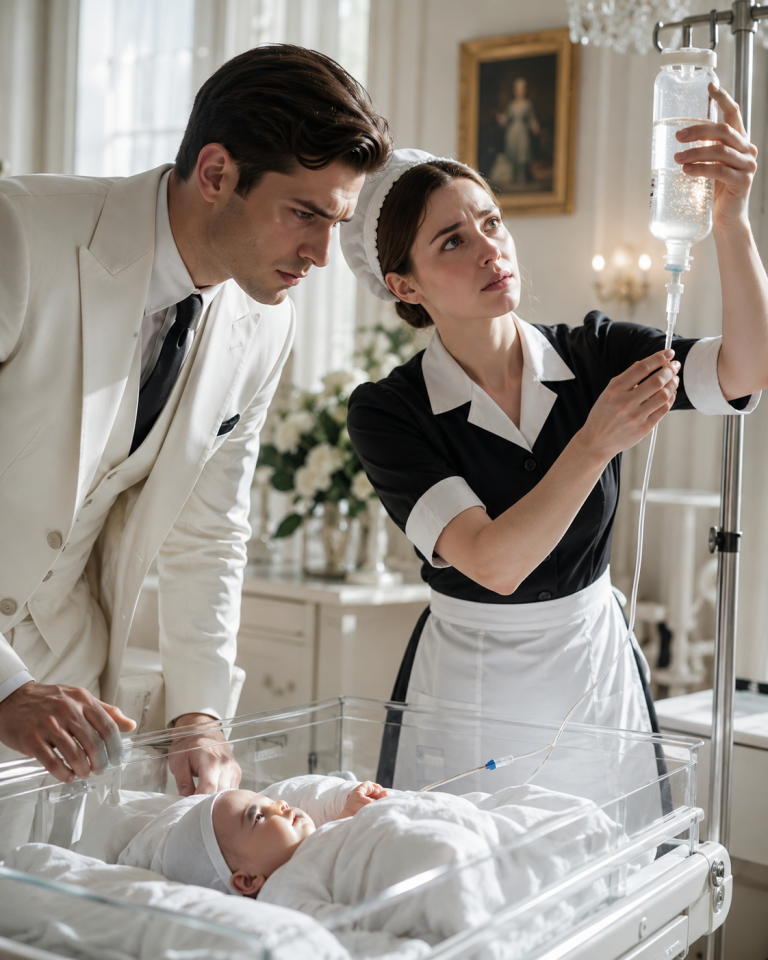
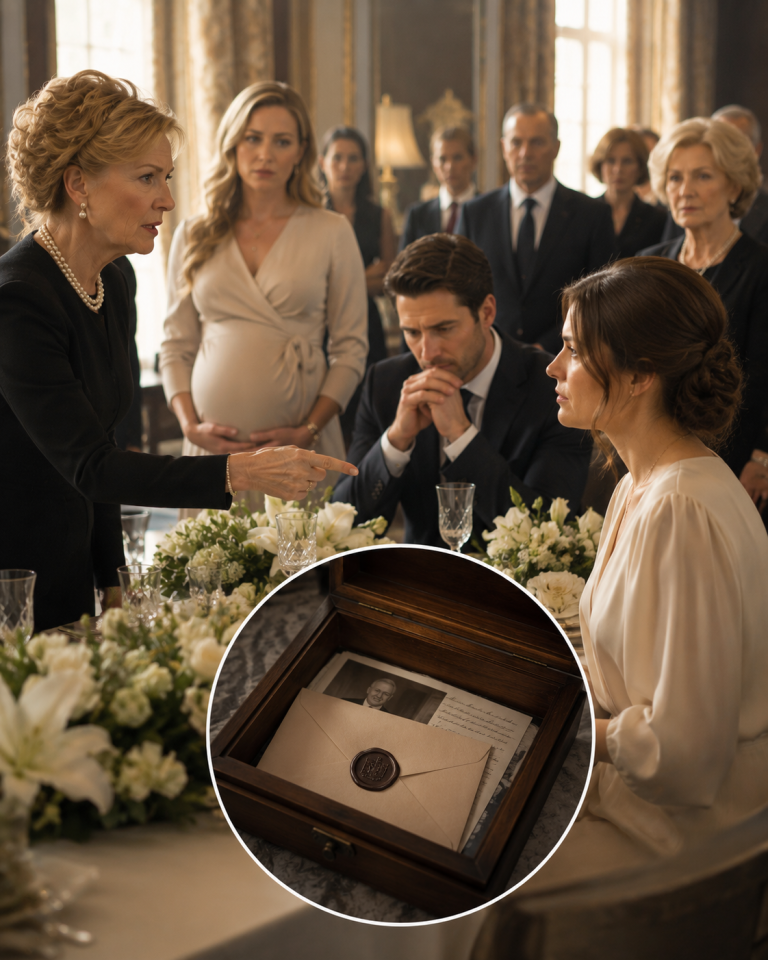
She Took Four Bullets Meant for Chicago’s Most Feared Mafia Mother—Then the Mafia Boss Married Her in the Hospital, Igniting a Dangerous Love

## PART 1
She had always been better at saving other people than herself.
That was what Nora Quinn told herself three weeks later, lying in a hospital bed that cost more per night than her monthly rent, watching winter press against the window in thin grey sheets.
She had been working the morning shift at Carver’s when it happened.
Tuesday. Nine forty-two. The kind of quiet weekday morning where the only customers were retired men nursing coffee and a small, white-haired woman who arrived every other week and always tipped generously and always sat alone at the corner table with a newspaper she never seemed to read.
Nora had liked her. Liked the way she ordered her eggs with the specificity of someone who had strong opinions and wasn’t ashamed of them. Liked the single strand of pearls. The straight posture. The faint accent she could never place.
She had been carrying the woman’s refill when the front door came open wrong.
Not opened. Came open — the particular sound of something forced, the bell above the door ringing too hard against its mounting.
Nora had turned.
Three men.
One of them was already raising his arm.
Later, she would not be able to explain why she moved. It wasn’t calculation. There was no time for calculation. There was only the old woman turning toward the noise with that terrible composure of someone who already knew what sound that was, and Nora’s body making a decision her brain hadn’t finished forming.
She put herself between the gun and the woman.
The first shot hit her left side, below the ribs. The second caught her shoulder. The third punched through low on the right, and she went down hard, the coffee carafe shattering somewhere nearby, the old woman’s hands catching her before she hit the floor fully.
The men ran.
Someone was screaming. More than one someone.
The white-haired woman was not screaming. She was on her knees on the tile, Nora’s head in her lap, pressing both palms flat against Nora’s side with a competence that suggested she had held people together before.
“Stay with me,” she said. “Look at me. Right here.”
Nora looked.
The woman’s pearls were red.
“I’m Marguerite,” the woman said, clear and steady, the way you speak to someone standing on a ledge. “And you are going to be just fine.”
The world contracted to that voice. To the pressure of those elegant hands. To the sound of sirens building somewhere outside.
Then the diner doors opened again.
Not the front — the side entrance, the one the staff used.
The reaction was immediate and physical. Even half-gone, Nora felt it: the change in the air, the way voices died, the way the man behind the counter took a step backward without deciding to.
She turned her head.
She saw dark clothes first. Then height — exceptional height, the kind that dominated a room without effort. Then a face that seemed carved to communicate exactly one thing: that the person wearing it had never once in his life been afraid of anything in this room or any room like it.
He saw his mother’s hands.
The blood.
He crossed the floor in seconds, going down to one knee at Marguerite’s side, and the tenderness with which he checked her face — hands framing it, thumbs moving — was so startling and so completely at odds with his effect on the room that Nora almost forgot she was bleeding.
“It’s not mine,” Marguerite said quickly. “Luca. Look down.”
He looked down.
His eyes found Nora’s.
She had expected dismissal. A stranger on the floor, a complication, someone to be handed off to the paramedics already audible outside. She had not expected the thing that actually crossed his face — a stillness so complete it was almost like grief.
“She pushed me out of the way,” Marguerite said. Her voice fractured on the last word. “She didn’t even hesitate.”
Luca Ferrante said nothing.
He shrugged off his jacket without looking away from Nora’s face and pressed it against the worst of the bleeding with both hands, firm and practiced, like he knew exactly how much pressure was needed.
“Don’t,” he said.
One word.
“Don’t what?” Nora managed.
“Close your eyes.”
“I wasn’t going to.”
“You were.”
She hadn’t realized she was.
His hands were steady. His jaw was tight. His eyes — dark, direct, the kind that didn’t offer comfort so much as an absolute refusal to permit the alternative — held hers with an intensity that was almost anger.
“Stay awake,” he said.
Not a request.
Paramedics arrived. Nora lost the thread of things after that.
—
She woke to a different room. A hospital room in which nothing was standard — not the furniture, not the view, not the quality of the light.
Certainly not the man sitting in the chair beside the bed.
Luca Ferrante was not sleeping. She understood, in the four-second window before he noticed she was awake, that he probably hadn’t been sleeping. He sat with his forearms on his knees and his eyes on the floor, and he looked like a man reviewing a decision.
“Your mother,” Nora said.
“Fine.” He looked up immediately. “She’s at home.”
“Are you sure she’s—”
“I’m sure.”
He said it with the quiet certainty of a man who would not permit uncertainty on this subject.
Nora breathed. The relief was physical, warm, moving through her chest and dissolving something that had been locked tight since the floor of the diner.
She catalogued her body’s condition. Three wounds. Her side felt packed in fire. Her shoulder wouldn’t lift. A dull roar underscored everything.
“How bad?” she asked.
“The chest shot nicked a rib. The shoulder was clean. The lowest wound took longest.” He paused. “You’ll need six to eight weeks.”
“I have a nursing exam in three.”
Something flickered in his expression — not quite amusement, but adjacent to it, surprised into existing.
“Cancel it.”
“I can’t cancel it.”
“You took three bullets.”
“I’m aware.” She tried to shift upright. Pain locked her immediately. “I’m rescheduling it, then.”
He stood and adjusted the pillow behind her without being asked, with the efficiency of someone who had done this before, and said nothing about it, which she found oddly kind.
“I need to tell you something,” he said.
The shift in his tone told her what kind of something before the words arrived.
He explained it carefully. The family his mother belonged to. The other family that had tried to end that. The specific dynamics of what happened to people who disrupted powerful men’s plans.
The specific dynamics of what happened to witnesses.
“They’ll come for me,” Nora said.
“Yes.”
“Because I survived.”
“Because you made them fail publicly. In this world—” He paused in a way that was not hesitation but precision, choosing the right word. “Embarrassment is debt. Debt collects interest.”
Nora looked at the ceiling. She thought about her younger brother Marcus, twenty years old, one semester from finishing the engineering degree their father had been alive just long enough to see him start.
“What are my options?” she asked.
“Protective custody. Official channels.” His tone indicated what he thought of that option. “Or protection through association.”
“Meaning?”
He sat down again. Met her eyes with the directness she was beginning to understand was simply how he operated — no softening, no performance, just the plain shape of the thing.
“My name,” he said. “If you carry it, they’d have to go through the entirety of what my family represents to reach you. Most men won’t do that math and come out in favor of trying.”
Nora was quiet for a long time.
“You’re asking me to marry you,” she said.
“I’m telling you it’s the most complete protection available.”
“Those aren’t the same thing.”
“No. They’re not.” His expression changed slightly. “I’m asking.”
The heart monitor beside her was behaving badly. She ignored it.
“I don’t know you,” she said.
“I know.”
“You don’t know me.”
“I know enough.” His eyes moved over her face. “I know what you did in that diner.”
“That wasn’t—”
“A decision. I know.” He said it without condescension. “That’s what I know about you.”
She thought about Marcus. About the apartment she would not be safe in. About the clinical reality of what happened to women who witnessed gang assassinations and survived long enough to testify.
She thought about the way his hands had been steady on the floor of the diner while he refused to let her look away.
“What do I get?” she asked.
“Safety. Your brother’s tuition, completed. Your own finances cleared.” He paused. “And I’ll be honest with you. That’s more than I offer most people.”
“That’s a low bar.”
“Yes.”
She appreciated that he didn’t argue it.
“I’m not agreeing to disappear,” she said. “I have school. I have a life.”
“I’m not asking you to disappear.”
“If I say no?”
“I’ll protect you anyway. For as long as it’s possible.” His jaw tightened once. “But my capacity isn’t infinite.”
The honesty of that — the admission that he had limits, offered without dressing it up — was more persuasive than any promise would have been.
Nora looked at the window. At the city beyond it, grey and indifferent, full of people who had no idea what was happening in this room.
“All right,” she said.
Luca went still.
Almost like the answer had landed somewhere he hadn’t prepared.
“All right,” she said again, because his silence was unnerving. “I’ll marry you.”
He nodded once.
He made calls. People arrived. A document was prepared and witnessed and signed in a hospital room while armed men stood in the corridor outside, and Nora Quinn became Nora Ferrante with a signature and a pen that ran out halfway through and had to be replaced.
Later, after the room had emptied and Luca had stepped out to speak with someone in the hall, his phone buzzed on the side table. The screen lit briefly with an incoming message from a blocked number.
Nora wasn’t trying to read it.
But the words were visible from where she lay.
*He married the girl. Both of them before morning.*
—
## PART 2
She woke at 2 a.m. to the sound of the window breaking.
Not shattering — breaking, the specific sound of something heavy impacting glass that had been reinforced, the impact followed by the shriek of the alarm before the alarm was cut, and then a sound she had no framework for, low and mechanical and wrong, coming from the corridor outside.
Then gunfire.
Nora understood, in the three seconds between waking and full consciousness, that she was going to die in this hospital room. The understanding was calm and terrible and completely clear.
Then the door came open.
Luca moved through it like someone had turned on a different version of him — the controlled, measured man from her bedside replaced by something faster and more elemental, a gun already in his right hand, his eyes doing a sweep of the room that took less than a second.
“Down,” he said.
She was already trying to move. Pain detonated through her side. He was beside her before she could manage it, one arm around her back, pulling her off the bed and behind the heavy steel-framed bed base as it tipped sideways, positioning himself between her and the door.
The shooting in the corridor intensified.
Someone came through the doorway.
Luca fired twice.
He moved her to the bathroom before the sound had finished echoing. Placed her in the tub with a care that was completely at odds with the violence of the past thirty seconds. His hands on her arms were controlled, deliberate, checking her wounds without stopping.
“Stay here,” he said.
“What’s happening?”
His eyes met hers. Dark and direct and, she realized, furious — not at her, not at the situation, but with the concentrated fury of a man who had been betrayed by someone he trusted.
“There’s someone inside my family,” he said.
Then he was gone.
She sat in the bathtub and listened to the sounds of a man defending a hospital corridor, and thought about nothing useful at all.
He came back twenty minutes later.
He was bloodied — not mortally, she assessed immediately, her nursing brain overriding everything else — bruised along one cheekbone, a cut on his forearm that would need stitches. He stood in the bathroom doorway and looked at her in the bathtub with an expression she had not seen on him yet.
Guilt.
Raw and unguarded and entirely genuine.
“They got past the outer perimeter,” he said. “I should have—”
“Are you injured?”
He blinked. Like the question surprised him.
“The arm.”
“Let me see.”
He crossed to the bathtub and sat on the edge of it, extending his forearm without comment, watching her hands as she examined the cut with the focused economy of someone who had trained for this.
“You need stitches,” she said.
“I know.”
“I could—” She looked around the bathroom. Nothing useful.
“Later,” he said. “Nora.”
She looked up.
“I’m sorry,” he said.
She had not expected that. She had expected command, management, forward motion. She had not expected this — his forearm warm under her hands, his face stripped of its usual control, the words coming out like he wasn’t accustomed to saying them and was saying them anyway.
“You didn’t shoot at me,” she said.
“Someone inside my family tried to kill you.”
“Someone inside your family tried to kill both of us. That’s slightly different.”
He looked at her for a moment. Then something changed in his expression — not quite amusement, but the recognition of it.
“How are you doing this?” he asked.
“Doing what?”
“Being calm.”
“I’m not calm,” she said honestly. “I’m extremely not calm. I’m just trained to function while extremely not calm. It’s different.”
He was quiet.
Outside, she could hear his men moving through the ruined room, voices clipped and purposeful. Someone was being restrained. The sounds of it carried through the wall.
“Your men found someone,” she said.
“Yes.”
“Who told the others you’d married me.”
“Yes.”
His jaw was tight with something that went beyond anger into something older and more interior — the particular wound of being betrayed by someone you fed and trusted and built things with.
“Who is it?” she asked.
He looked at the bathroom wall.
“I don’t know yet,” he said. “But I will.”
Then he took her hand, just briefly, in both of his — careful, warm, deliberate — and said: “I’m taking you home.”
The word *home* sat strangely between them, because they both understood it now meant the same place, and neither of them was ready for what that meant.
—
## PART 3
The Ferrante estate sat at the edge of the city like it had been there before the city and intended to outlast it.
Stone and iron and old glass. Gardens kept with the same disciplined care as everything else in Luca’s world. Staff who moved quietly and quickly and called her *Mrs. Ferrante* in careful, respectful tones that took some getting used to.
Nora had been there three weeks when she started to learn the house.
Not the rooms — the rhythms. The hour Luca left for meetings, the hour he returned. The way he slowed his walk when he was tired without knowing he was doing it. The fact that he read physical books and left them in unexpected places — a thriller on the kitchen counter, a history of siege warfare beside the bathroom sink — as if reading was something he did in the margins of everything else.
She noticed things, because noticing was how she understood the world.
She noticed that he always checked the security reports himself before bed, a thirty-minute ritual that he conducted with the same thoroughness regardless of how late it was. She noticed that he knocked on her bedroom door before opening it and waited for her answer even when the whole household already understood she was confined to her suite during recovery. She noticed that when she couldn’t sleep — which was often; the nightmares had found her somewhere around day four — she would sometimes hear him in the corridor outside her door.
Not pacing. Just present.
She asked him about it on the seventh day.
“You’re outside my door at two in the morning,” she said.
He considered denying it. She watched him consider it and discard it.
“Your heart rate monitor was irregular,” he said. “The medical staff flagged it.”
“I don’t have a heart rate monitor.”
A pause.
“The perimeter sensors picked up movement in your room.”
“Luca.”
He looked at her with that direct, steady gaze that she had stopped flinching away from. “I couldn’t sleep.”
“Okay,” she said.
He seemed uncertain what to do with *okay.*
“The nightmares?” he asked carefully.
“Yes.”
“About the diner.”
“Mostly. Sometimes about the hospital.” She looked at her hands. “Your face, actually. When you came into the diner. The way you looked when you saw the blood and thought it was your mother’s.”
His expression changed.
“I’m not frightened of you,” she said. “In case that’s what you’re thinking. It’s not that. It’s more that—” She paused. “I keep thinking about how you looked before you saw me. Before you knew she was all right. And I keep thinking about how much you love her, and what it would have cost you.”
The room was very quiet.
“It was you,” he said finally. “Who it would have cost.”
“I know. I’m not being morbid. I just—” She met his eyes. “It mattered to me. That you love her that much.”
He sat with that for a while.
The traitor’s name emerged on day nineteen.
Nora heard it from across the room, where she was reviewing her nursing notes — she had refused to cancel the rescheduled exam, just pushed it six weeks — when Luca appeared in the doorway with the contained stillness of a man carrying something that needed to be set down carefully.
“My uncle,” he said.
She looked up.
“Marco Ferrante.” He crossed to the window. Set his hands on the sill. “He managed three of our legitimate companies. My father trusted him completely.”
“Why?”
“Power.” His voice was flat. “He believed I was too focused on protecting family rather than expanding reach. He thought my mother made me sentimental.”
“Was he wrong?”
Luca turned from the window. The question seemed to surprise him.
“About the sentiment,” he said. “No.”
“Then he misread the situation.”
“Explain.”
Nora set down her notes. “He saw the sentiment as a weakness you’d let him exploit. He didn’t understand that the same quality that makes you refuse to let your mother eat lunch alone in a diner is the same quality that made you stay in a hospital chair for four days without sleeping.” She paused. “That’s not weakness. It’s just — differently applied strength.”
Luca was quiet for a long time.
Then he said, “He’s been found.”
Nora understood what he meant.
She also understood what she was about to say, and that she was going to say it anyway.
“What happens now?”
“What happens now is what happens to people who try to kill my wife.”
The word hit her differently every time. *Wife.* Three weeks in, and it still landed with a slight shock, like an unexpected step in a dark stairwell.
“Is there another option?” she asked.
His expression closed. “Not in this world.”
“You keep saying that. *In this world.*” She stood from the chair — carefully, managing the ache in her ribs — and crossed the room. Not close enough to crowd him. Close enough that he couldn’t look at the window instead of her. “But you’re the one running it.”
“It runs by rules I didn’t make.”
“You’re the one enforcing them.”
Something shifted in his face. “Nora—”
“I’m not telling you to do nothing,” she said. “I understand what he did. I understand consequences. I just—” She paused, choosing the words carefully. “I don’t want to be the reason for something I can’t come back from. Either of us.”
He looked at her with that particular expression she had started to recognize as him actually processing, rather than performing consideration.
“You think revenge corrodes people,” he said.
“I think it tends to.” She held his gaze. “I think you already know that.”
The silence stretched.
“He won’t be able to act against the family again,” he said finally.
“Then that’s enough.”
“It isn’t, in my world.”
“Make it enough.” She paused. “Not for his sake.”
Luca studied her for a long time. Then he looked at his phone. Then he made a call that was brief and, to her ears, conclusive — not the call she had feared, but a different kind, and she understood afterward that something had been decided differently than it would have been two months ago.
He didn’t tell her the details. She didn’t ask. There were parts of this life she would learn to navigate with him and parts she would always regard from a distance, and she was beginning to understand that both of them accepting that was its own kind of honesty.
“Thank you,” she said.
“Don’t thank me for not becoming worse.”
“I’m thanking you for listening.”
He was quiet.
“You said something once,” he said slowly. “When you woke up. You asked about my mother before you asked about yourself.”
“I remember.”
“I’ve been thinking about that.” He moved to the window again, the old habit of facing outward. “Every person who comes into contact with my family either wants something from it or is afraid of it. You woke up from surgery and asked about an old woman you’d spoken to twice.”
“She was kind to me.”
“I know.” He turned back. “That’s not what I mean. I mean—” He stopped. Started again. “I’ve spent fifteen years building something that makes people afraid. It works. It’s effective. But you sit in this house and study for an exam and worry about a brother I’ve never met and leave coffee for the household staff in the morning, and I don’t—” He looked at his hands. “I don’t entirely know what to do with that.”
Nora crossed the room.
He watched her come.
She stopped in front of him and reached up and touched the fading bruise at his cheekbone — gently, her thumb tracing the edge of it, the way she might with any patient she was checking.
He went completely still.
“I know you don’t,” she said. “And I think that’s exactly why you need it.”
The room was warm. Very quiet. Outside, the city made its distant, indifferent noise.
Then Luca raised his hand and covered hers, pressing her palm against his jaw, and held it there — not forcefully, not possessively, just with a steadiness that felt like an answer to a question neither of them had said out loud.
“I don’t know how to do this carefully,” he said.
“You’ve been doing it for three weeks.”
“That was—” He paused. “That was different.”
“Was it?”
He looked at her.
What crossed his face then was not the controlled authority she had come to know, and not the grief she had seen in the diner, and not the fury from the hospital — it was something rawer than all of them, the expression of a man discovering he was capable of something he had stopped expecting from himself.
She kissed him first.
It was not a declaration. It was a question, soft and deliberate, with room for either answer. He held still for one breath. Then he kissed her back — and it was careful, unhurried, nothing like the controlled violence she had half-expected from him, just a man paying close attention.
When they broke apart, his forehead came down to hers.
“This wasn’t—” he started.
“I know it wasn’t the plan.”
“I don’t have a plan for this.”
“Neither do I.” She felt him breathe. “We can work from there.”
—
Four months later, Nora sat the nursing exam she had postponed twice.
She passed.
Luca did not make a production of this. He simply left a text when her results came through — *I know* — and arrived home from meetings that evening carrying food from the place she had mentioned once, weeks ago, that she’d loved as a student. He set it on the kitchen counter and left it and said nothing, and she understood this was how he celebrated things, quietly and specifically, and she was beginning to love that about him.
Marcus came to dinner for the first time in March.
He arrived with the cautious energy of a twenty-year-old who had been extensively briefed on who his sister had married, and who was trying very hard to be cool about it, and was not entirely succeeding. He shook Luca’s hand. Luca shook his back with the gravity of a man taking the meeting seriously, which Marcus visibly appreciated.
Over dinner, Marcus asked Luca about the construction work on the estate’s east wing — Marcus was an engineering student, and the load-bearing question was genuine. Luca answered in detail, and then asked a follow-up question, and Nora sat across the table watching her brother and her husband talk about structural load tolerances and thought, somewhat absurdly, that her father would have liked this.
He would have asked a hundred questions and been reassured by none of the answers and liked the man anyway.
She caught Luca looking at her from across the table.
She smiled.
He didn’t quite smile back — he rarely did, not with the full relaxed ease most people meant by smiling. But his eyes changed, the way they always did when he looked at her for real rather than performing looking.
After dinner, she stood at the kitchen window while he walked Marcus to the car.
She could see them from there: Luca with his hands in his pockets, Marcus gesturing with the enthusiasm of a person making a point about something, both of them standing in the light from the gate, and the scene was so ordinary and so completely implausible that she had to press her free hand against her sternum to contain whatever the feeling was.
There was a charity gala in the spring.
Nora hated galas. She had attended three now and found them populated by people performing themselves loudly at other people who were doing the same, all of them slightly afraid of Luca and showing it in different ways.
This one had a woman named Adriana.
Tall, elegant, clearly known to Luca from something Nora didn’t ask about and didn’t need to. She appeared during the cocktail hour with a smile calibrated to communicate a very specific kind of dismissal.
“So this is the one,” she said to Luca, her eyes on Nora with a warmth that was entirely absent. “I heard it was an obligation.”
The table went quiet.
Nora felt the familiar prickle of old insecurities — the ones that knew what they were built from and hadn’t quite finished collapsing. The ones that said *diner waitress* and *nobody* and *outsider* in voices that sounded like other people but were entirely her own.
She didn’t get to finish the thought.
Luca said, “You’re confusing obligation with its opposite.”
Adriana’s expression recalibrated.
“She walked into gunfire for someone she had no reason to protect,” he continued. “She sat a nursing exam six weeks post-surgery. She told me things I needed to hear when it would have been considerably easier to tell me what I wanted to hear.” He looked at Nora, and there it was again — that direct, unguarded gaze that had no performance in it. “I’m not sure what you thought obligation looked like. But it doesn’t look like that.”
The table remained quiet.
Adriana left.
Luca extended his hand across the table, palm up.
Nora took it.
The orchestra was starting, something soft and mid-century, and he led her to the floor and held her in that way he had — protectively, not possessively, with the steady presence of someone committed to being there regardless of what that cost — and she thought: *here.* This is where she lived now. Not in the fear of it, not in the danger, not in the marble hallways and the armed guards and the weight of a name that made rooms go quiet.
In this.
In the way he had knelt on the floor of a diner without hesitation. In the way he knocked before entering. In the fact that he had made a different call than he would have made in another life, because she had asked him to.
“You know you didn’t have to,” she said.
“I know.”
“She wasn’t worth the ammunition.”
Something flickered in his expression — the closest thing to a real smile he’d gotten to all evening. “Agreed.”
“I could have handled it.”
“I know that too.” He adjusted his hold slightly, unhurried, the way he touched everything when he had decided it mattered. “I wanted to.”
She looked up at him.
“You’re going to keep surprising me,” she said.
“That seems likely.”
“I’m going to keep surprising you too.”
“I’m counting on it.”
—
In midsummer, they went back to Carver’s.
It had been renovated, mostly — new flooring, new counters, the structural damage from the shooting absorbed into a general refresh that made the diner look newer than it had before while keeping the quality of light Nora had always liked, the particular early-morning grey of it filtering through the east windows.
Luca had offered to go somewhere else.
She had said no.
They took a booth near the window. The owner, a solid woman named Georgia who had run the place for twenty years, brought their coffee without comment and gave Luca the flat, measuring look of someone deciding whether to be intimidated and concluding that she wasn’t going to bother.
Luca, to his credit, seemed to find this satisfying.
Nora put her hands around her mug.
She could see the corner table from here. The one Marguerite had always taken. The newspaper she never quite read.
“She’s coming Thursday,” she said.
“I know. She told me.” He looked at the corner table. “She says it’s her favorite diner.”
“She comes every other week.”
“I know that too. I used to drive her.”
Nora looked at him.
“And let her walk in alone?” she asked.
Something crossed his face. “She said she needed something that was just hers. I stayed in the car.” A pause. “She was right to want it. I was wrong to let her sit unprotected.”
“She sat unprotected because she was trying to breathe,” Nora said quietly. “And she almost died for it.” She reached across the table and covered his hand. “That’s not the same as you doing something wrong.”
He turned his hand over under hers.
“I know,” he said. “But I let her be unprotected, and a nursing student stepped in front of a bullet, and now—” He stopped. Looked at her directly. “Now I don’t know how to be grateful enough for the second part.”
The morning light came through the east windows.
In the booth at the corner table, two old men were arguing about baseball.
Georgia refilled their coffee without being asked.
Nora looked at the man across from her — this difficult, careful, complicated man who had knelt on a diner floor and refused to let her close her eyes, who knocked before entering and stayed outside her door during nightmares and had, quietly and without announcement, started building something different.
“You’ve been thanking me for four months,” she said.
“I know.”
“You can stop.”
“I know that too.” His thumb moved across the back of her hand. “I probably won’t.”
She looked out the window.
Chicago was doing what it always did — moving, indifferent, large, unconcerned with what happened inside any given diner on any given Tuesday morning. It had no idea that anything had changed.
She had.
Not because of the bullets, or the marriage, or the name she now carried. Those were the circumstances. What had changed was underneath them, quieter and more permanent: she had discovered that the instinct she’d had on the floor of this diner — to put herself between danger and someone who couldn’t survive it — was not a weakness in her. Was not recklessness or poor judgment or the self-destructive impulse her therapist had once gently suggested it might be.
It was simply the truest thing about her.
And she had found, against all reasonable probability, a man who saw that for what it was.
She turned back to him.
“Okay,” she said. “You can keep thanking me.”
He looked at her with those dark, direct eyes, and said nothing, which was sometimes how he said the most important things.
Outside, summer moved through the city in long hot hours.
Inside Carver’s, two people drank their coffee and sat in the quiet that had grown between them — not the silence of people with nothing to say, but the deeper silence of people who had stopped needing to fill the space, who had found in each other something solid enough to rest against.
The kind of quiet you only find when you’ve stopped running from what scared you.
The kind that means you’re home.
—
*THE END*