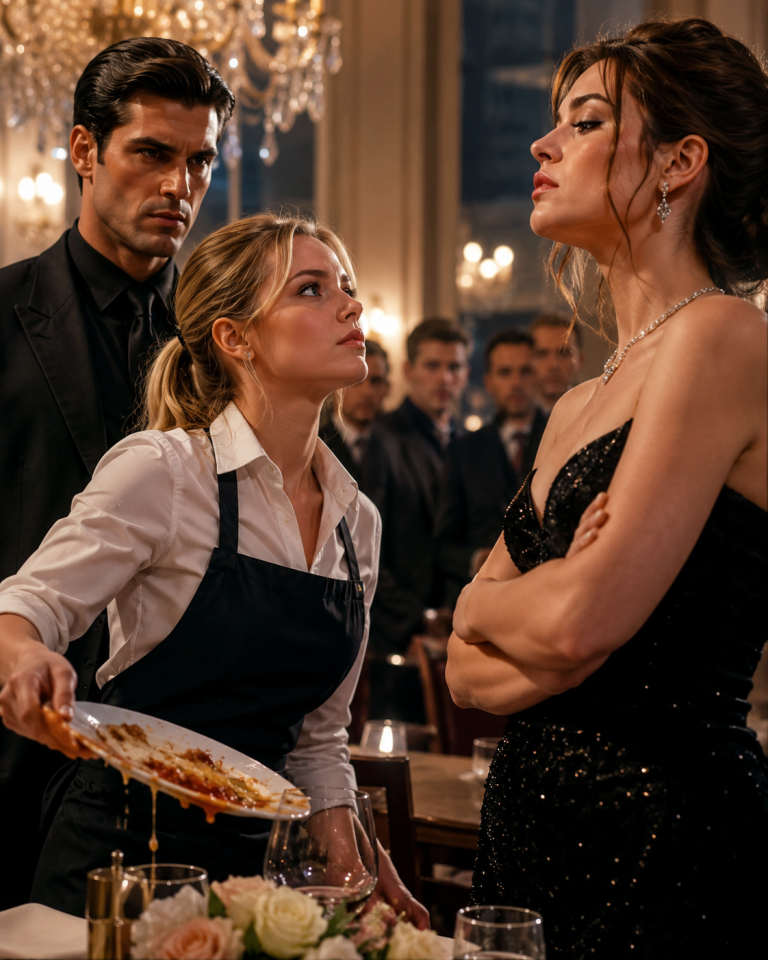
She Loved the Mafia Boss in Silence—Then He Claimed Her in Front of Everyone

## PART 1
The thing about being invisible is that you begin to mistake it for safety.
I had been invisible at Carrera International for exactly seven months, three weeks, and four days — I counted, because counting was something I did, tracking the distance between who I was and the place I had landed, measuring how much longer I needed to hold on before the debt was paid and I could become a different kind of person in a different kind of city.
My name is Clara Whitmore. I am twenty-four years old. I have a degree in business administration that cost more than my parents’ combined annual salary for two of the years they were alive, a debt load that follows me the way weather follows geography, and a job as executive assistant to a man whose name, in certain circles, is spoken the way people speak about things they are afraid of bringing into the room.
Raffael Carrera.
I straightened the contracts on his desk for the second time that morning — he liked them at a specific angle, which I had learned by watching — and tried not to think about the way my back had started aching around the fourth hour of each shift, or the taste of the vending machine coffee that had become the central flavor of my mornings.
The office smelled like leather and something harder to name. Something that made your instincts pay attention even when your rational mind was occupied elsewhere.
The door opened.
I knew who it was before I turned. Mira Fontaine had a specific quality of entry — she moved through doorways the way weather moved through gaps in insulation, filling the space before you had registered the opening.
“Whitmore.”
She said my name the way some people said *inconvenience*.
“Good morning,” I said.
Mira Fontaine was the kind of woman who understood power the way architects understood load-bearing walls — structurally, practically, without sentimentality. She was beautiful in a very deliberate way, the kind of beauty that required maintenance and communicated that the maintenance had been undertaken. She had been at Carrera International for four years and conducted herself, in certain moments, as though the company had been built around her rather than the other way around.
“Raffael will be in the Castellan meeting until six,” she said. “Which means you have the floor to yourself.” Her smile curved slightly. “How thrilling for you.”
I turned back to the contracts.
“Thank you for the update.”
She came further into the office, her perfume arriving before her — something expensive and slightly too present.
“I was looking at the photos from last month’s client dinner last night,” she said. “You were in the background of three of them.” A pause. “No one mentioned it.”
I kept my eyes on the documents.
“No one usually does,” I said.
“No,” she agreed. “That’s the thing about you, Clara. You have become extremely good at occupying space without being in it.” Her voice dropped into something almost affectionate. “It’s a talent, really. Being so thoroughly unremarkable that people’s eyes slide right over you.”
“I have work to do,” I said.
“You always do.” She came to stand beside me, too close, her reflection visible in the window glass beyond the desk. “You know what I find interesting? You’ve been here seven months, and you’re competent — I’ll give you that — but Raffael has never once called you by your first name in front of anyone. You’re always *Miss Whitmore*. Like staff.”
I said nothing.
“Because that’s what you are to him,” she said. “Furniture. Reliable, functional furniture. The kind you stop seeing after the first week.”
The words had the specific quality of things designed to find what was already bruised.
“Mira,” I said.
“Hmm?”
“The Castellan contracts are on the top of the stack. Raffael will want them initialed by the legal contact on page nine before the meeting.” I turned to face her. “Would you like to bring them up, or should I?”
Something shifted in her expression.
“I’ll let you handle that,” she said.
She left.
I stood for a moment in the office that smelled like leather and unnamed danger, and I told myself that the tightening in my chest was nothing, that words from a woman like Mira Fontaine should not carry the weight I was giving them, that I had survived considerably harder things than a beautiful woman’s calculated cruelty.
I was almost convincing.
The private elevator opened at 11:40.
I felt the change in the room before I heard him — the air pressure shift that I had come to associate with Raffael Carrera’s arrival, the specific quality of a space adjusting around someone who moved through it differently than other people moved through things.
He was thirty-seven. Dark hair, the kind of face that had been assembled with intention, dark eyes that processed everything without appearing to hurry. He wore the kind of suit that communicated money so quietly it was louder than ostentation. He had walked into rooms for twenty years the way certain people walked into rooms — as the point around which the room reorganized.
I had spent seven months in his proximity. I knew the microexpressions, the tells, the silences that meant different things depending on what had preceded them.
I did not know what to do with any of that.
“Miss Whitmore,” he said.
“The Castellan contracts are ready. I cross-referenced with the legal notes and flagged the three sections that need your attention before the meeting. There’s also a scheduling conflict on Thursday — I’ve drafted two options for your review.”
He moved past me toward the desk, and for one moment his gaze moved to my face with the quality I had taught myself to file under *professional assessment* and forget immediately.
“Mira was here,” he said.
It was not a question.
“She had an update about the Castellan timing,” I said.
He picked up the contracts.
“What did she say to you?”
I kept my voice even. “Nothing important.”
He was quiet for a moment, reading the first page with the focused attention he brought to everything.
“You’re efficient,” he said.
“Thank you, sir.”
“Not a compliment. An observation.” He turned to the second page. “You’ve flagged the right sections, cross-referenced with the correct addendum, and saved me approximately twenty minutes.” He set the contract down and looked at me directly. “Why did you apply for this position?”
The question arrived sideways.
“The role paid well,” I said honestly.
“And?”
“And I needed the money, and I was qualified, and I have found ways to be useful.”
He studied me.
“Where did you go to school?”
“Hartwell Business. Graduated eighteen months ago.”
“Top of your cohort?”
“Third.” A pause. “I had family obligations that affected the final semester.”
Something in his expression shifted. Almost nothing — the kind of change that required seven months of close observation to detect.
“What obligations?”
“My mother’s medical bills,” I said. “After she died.”
The office was very quiet.
“I’m sorry,” he said.
I had not expected that. Men like Raffael Carrera did not typically acknowledge grief across professional lines.
“Thank you,” I said.
His phone rang.
He answered immediately, the professional mask returning so completely it was as if the conversation had not happened.
“Carrera.” A pause. His jaw tightened. “Which dock?” Another pause, longer. “Who was in the office at that time?”
He looked at me.
The quality of that look was different from any other look he had directed at me in seven months.
Not assessment.
Calculation.
“You’re coming with me to the Castellan meeting,” he said when the call ended.
I blinked. “Sir?”
“You reviewed the contracts personally.”
“Yes.”
“Then I need you there.”
Raffael Carrera did not bring assistants to Castellan meetings. The Castellan meetings were the ones that happened in the penthouse conference room, behind security I had never been cleared for, between people whose names I only knew because they appeared in documents I shredded after reading.
“I understand,” I said.
“Do you?”
He looked at me for a long moment.
“Someone altered one of those contracts,” he said. “And the alteration was subtle enough that only someone who had reviewed the original personally would recognize it on sight.”
My blood ran cold.
“Which contract?”
He showed me the screen of his phone. A photograph of a document page.
I had read that page three days ago.
I read it again now.
The Palermo routing clause was back in. I had removed it. Twice.
“That wasn’t in the approved version,” I said.
“I know.”
“Someone reinserted it after my last review.”
“I know that too.” He held my gaze. “Which is why you’re coming with me.”
He walked toward the elevator.
I followed, carrying the contracts and the specific, spreading cold of understanding that whatever was behind me was not as complicated as what I was walking toward.
—
## PART 2
The Castellan suite occupied the forty-fifth floor.
I had been to the forty-second before. I had never been above it.
The elevator required a separate code — Raffael entered it without comment. The doors opened onto a different atmosphere entirely: darker, quieter, the kind of room that had been designed not for appearances but for function.
Four men sat at the conference table. Two more stood near the far wall. All of them carried themselves with the specific posture of people who did not permit uncertainty in their bearing.
At the head of the table sat a woman.
She was in her sixties, silver-haired, wearing the kind of quiet authority that made Mira Fontaine’s performed power look like amateur theater. She looked at me the moment I entered, the way cats looked at things that had entered their range without warning.
“Interesting,” she said.
“Adriana,” Raffael said.
“You brought her.” Not a question.
“She reviewed the contracts.”
“I can see why.” Adriana Castellan’s eyes did not leave me. “She has her mother’s attention.”
The words landed like something physical.
Raffael’s hand moved — the smallest possible gesture, barely perceptible — to the space between my shoulder and the wall.
“The contract alteration,” he said.
The temperature in the room changed.
Adriana leaned back. “Someone is very interested in the Palermo routing. Interested enough to risk being caught.”
“Who accessed the document server between midnight and four a.m. on Tuesday?” Raffael asked.
One of the men near the wall checked his phone.
“Two logins,” he said. “Your credentials. And—” He stopped.
“And?” Raffael said.
“Miss Fontaine’s.”
The room processed that.
I kept my expression steady.
Mira. At 2 a.m. In the contracts server.
“She said she was preparing legal revisions,” I said.
Raffael looked at me.
“You were with her this morning?”
“She came to your office before you arrived.”
He turned back to the room.
“Where is she now?”
“Downstairs,” someone said. “Waiting for your call.”
Raffael’s jaw tightened.
Then Adriana spoke again.
“The routing wasn’t the only thing she found,” she said.
The room went very still.
Adriana looked at me with an expression I couldn’t entirely read — something between apology and inevitability.
“Did Raffael tell you why he hired you specifically?” she asked.
“He reviewed my application and—”
“He knew your surname,” she said.
I waited.
“Whitmore was your mother’s name,” Adriana continued. “Her birth name was different.”
My pulse stumbled.
“She never mentioned another name.”
“She wouldn’t have,” Adriana said. “She worked very hard not to.”
Raffael had gone very still beside me.
Adriana looked at him. “You knew when you hired her.”
“I suspected,” he said.
“And you didn’t tell her.”
“I was waiting to confirm.”
“Confirm what?” I said.
They both looked at me.
And in the silence before either of them spoke, I understood that whatever they were about to say was going to take apart something I had believed was settled.
“Your mother,” Adriana Castellan said carefully, “was not from New York.”
“She grew up in Queens—”
“She moved to Queens,” Adriana said. “When she was nineteen. After she left Italy.”
The room was too quiet.
“Adriana.” Raffael’s voice had a specific quality I hadn’t heard before. Warning.
“She deserves to know,” Adriana said.
Then Raffael’s phone buzzed.
He looked at the screen.
His expression did something I had never seen it do in seven months.
He turned the phone toward me.
My apartment address. A photograph of my front door. Open.
Spray-painted across the entryway wall in black: *SHE DOESN’T KNOW WHAT SHE IS.*
“We need to move,” Raffael said.
“Tell me—”
“Now, Clara.”
For the first time since I had known him, he used my first name.
And somehow that was what made it real.
—
## PART 3
He took me to a room I had never seen — a secure office behind the conference suite, smaller than I expected, with monitors on two walls and the specific quiet of a space designed for conversations that could not leave it.
He closed the door.
For a moment, neither of us spoke.
I had spent seven months learning Raffael Carrera’s silences. This one was new.
“Start from the beginning,” I said.
He sat down across from me.
“Your mother’s name was Elena Vasari,” he said. “Before she married your father and became Elena Whitmore.”
I waited.
“Vasari was a family name. Old. Connected to the original Castellan organization before the families separated in 1989.”
“Connected how?”
He looked at me steadily.
“Your mother was Adriana Castellan’s niece.”
The word *niece* arranged itself against everything I knew about my life and fit badly.
“My mother was from Queens,” I said. “She worked as a bookkeeper. She watched reality television and made the same pasta every Sunday and worried about money for twenty-two years.”
“Yes,” he said. “Because she chose to.”
“You’re telling me she was connected to organized crime.”
“I’m telling you she was born into a family that operated in those spaces and that she spent her adult life making deliberate choices to keep herself — and you — outside of that world.”
I stared at the monitors on the wall.
“Why would anyone care about me now? She’s been dead for two years.”
Raffael was quiet for a moment.
“Because there are assets. Old ones, tied to the Vasari name. Accounts, properties, and one specific piece of documentation that belonged to your maternal grandfather, who died before he could route it properly.”
“Route it to who?”
“To his heirs,” Raffael said. “Which currently means you.”
I pressed my hands flat on my knees.
“That’s what the Palermo routing was about,” I said.
“Someone wanted access to the channels that move through the Palermo structure before the documentation could be transferred legitimately.”
“And the spray paint in my apartment?”
“A warning. Or an announcement, depending on who sent it.”
I looked at him.
“Who do you think sent it?”
He was quiet for a long moment.
“Mira,” he said. “Enabled by someone who has been watching this situation develop for longer than either of us knew.”
I thought about Mira’s specific, practiced cruelty. The way she had come to the office that morning — not early, but at a specific time. After the server login. Before Raffael arrived.
“She knew who I was,” I said.
“She knew what you represented,” he corrected. “Whether she understood the full picture, I’m less certain.”
“What is the full picture?”
He looked at me.
“The full picture,” he said, “is that whoever wants access to the Vasari documentation has been trying to approach it through you — first through Mira’s intelligence gathering, then through the contract alteration to create a crisis that would require you to be present at the meeting, visible to anyone watching.”
I absorbed this.
“I was supposed to be the problem,” I said.
“You were supposed to be the route.”
The door opened.
One of Raffael’s security staff appeared.
“Fontaine is downstairs,” he said.
Raffael’s expression shifted.
“Bring her up.”
The man left.
Raffael stood. He walked toward the door, then stopped.
“Clara.”
I looked up.
“I should have told you sooner,” he said.
“Why didn’t you?”
“Because I didn’t know how much you knew. And because—” He stopped.
“Because?”
He looked at me with the specific, contained expression of a man who had been managing the distance between what he thought and what he said for a very long time.
“Because you deserved to have a normal job for as long as possible,” he said.
I stared at him.
“That’s an unusual thing for a man in your position to consider.”
“Yes,” he said. “It is.”
He left the room.
I sat with the monitors and the quiet and the weight of a name I had never known — Vasari — and tried to locate myself inside it.
My mother had made pasta every Sunday. She had worried about money. She had, apparently, also made deliberate choices for twenty-two years to protect her daughter from a world she had walked away from.
I thought about the kind of discipline that required.
I thought about the kind of love.
When Raffael returned fifteen minutes later, Mira was not with him.
He closed the door and stood for a moment with his back to me.
“She’s gone,” I said.
“She left the building before we could get to her.”
“Who was she working for?”
He turned.
“My cousin,” he said. “Marco.”
The name was one I recognized from documents. From the way certain conversations stopped when it entered the room. From the specific, careful way Adriana Castellan had never mentioned him by name in my presence.
“He wants the Vasari documentation,” I said.
“He wants what comes with it.”
“Which is?”
Raffael sat down across from me again.
“The documentation includes records of transactions from 1989 to 2003. Cross-border transactions. The kind that, if they entered certain hands, could be used to leverage people in government, in finance, in law enforcement who made specific decisions during that window.”
I looked at him.
“Leverage,” I said.
“Yes.”
“And instead of going to investigators—”
“Your grandfather intended to route it to the Castellan side of the family as a safeguard. A deterrent. The kind of thing that keeps peace because everyone knows it exists.” He looked at me steadily. “He died before he could complete the routing. The documentation has been in limbo for twenty years.”
“And now it transfers to me.”
“When you choose to claim it.”
“Do I have to?”
“No,” he said. “You can do nothing. Decline the inheritance. Walk away from all of this and return to your apartment and your job and your life.”
“And Marco?”
A pause.
“Marco will not stop believing you’re a route to what he wants,” he said. “Declining the inheritance doesn’t change your bloodline.”
I understood what he was telling me.
I understood what he was not saying.
I stood up and walked to the window.
New York moved below us, indifferent and enormous, going about its evening the way cities went about evenings regardless of what happened in the rooms above them.
“My mother spent twenty-two years protecting me from this,” I said.
“Yes.”
“She succeeded.”
“Yes.”
“And now I’m standing in a secure room on the forty-fifth floor of a building owned by a man who knew who I was when he hired me, and I’m being told that the protection ended when she did.”
I heard him stand.
“I hired you because you were qualified,” he said. “Hartwell. Third in your cohort. References that described someone who thought before she spoke and didn’t require supervision. Those were the reasons I hired you.” A pause. “I suspected your identity. I watched to see whether it would matter.”
“Did it?”
He came to stand beside me.
Close enough that the question had a different quality.
“Not in the way I expected,” he said.
I looked at him.
Seven months of studied neutrality between us. Seven months of professional distance maintained with the specific deliberateness of two people who had both decided, separately, not to look at something directly.
“Raffael.”
“Clara.”
“Why did you learn to manage that distance so carefully?”
He was quiet for a long moment.
“Because the people closest to me have a specific statistical outcome,” he said. “And I decided, a long time ago, that the solution was to keep everyone at a distance that reduced the odds.”
“That sounds like a lonely solution.”
“It is an effective one.”
“Until it isn’t,” I said.
He looked at me.
“Until it isn’t,” he agreed.
Before either of us could say anything else, the monitors on the wall flashed.
A security alert. Ground floor. West entrance.
Then the lights went out.
—
The emergency power came on thirty seconds later — red-tinged, operational, wrong.
Raffael was already moving.
“With me,” he said.
We went through the back corridor, past security doors I hadn’t known existed, into a stairwell that smelled like concrete and led to a level I had never accessed. Raffael’s hand was at my back — not possessive, not romantic, the specific pressure of someone moving someone else quickly through a dangerous situation.
“Marco moved early,” he said, low.
“How many?”
“Enough.”
We came out into a room I recognized from photographs but had never entered — the private operations center, where Raffael’s security team managed the building’s systems. Three men were already there, moving with the focused efficiency of professionals.
“Fontaine gave him access codes,” one of them said.
“Lock everything above the thirty-eighth floor,” Raffael said.
“We’ll be locked in.”
“I know.”
He turned to me.
“I need to tell you something,” he said.
“Now?”
“Because after this there may not be a clean moment.”
I looked at him in the red-tinged light.
“Seven months ago,” he said, “I hired you because of your qualifications, and I watched you because of your name, and I spent six of those seven months trying to determine whether the thing I was developing was the kind of thing I was allowed to develop.”
“What thing?”
“The kind,” he said, “that makes a man reassess his statistical solutions.”
I stared at him.
“That’s a very contained way to say something.”
“I have contained it,” he said, “for six months. Precisely.”
An explosion shook the building.
Not large — structural, somewhere below us. Enough to rattle the monitors.
Raffael’s security men were already repositioning.
“She’s here,” one of them said.
“Adriana?” Raffael said.
“No. The other Castellan. Marco’s contact inside the family.”
Raffael’s expression changed.
“Who?”
“Your aunt Sofia.”
The name landed in the room like something dropped from height.
Sofia Carrera. Raffael’s father’s sister. The woman who appeared at family events in photographs I had filed and shredded, who was described in documents as a silent partner in two of the company’s oldest subsidiaries.
“She’s been working with Marco,” he said. Not a question.
“For eighteen months, from what we can tell.”
Raffael was still for one beat.
Then he moved.
“Stay here,” he said to me.
“No.”
He turned.
“Clara—”
“If this is about the Vasari documentation,” I said, “then I’m the person they want. Keeping me here doesn’t reduce the risk. It concentrates it.”
He stared at me.
“You’re right,” he said.
“I know.”
“That’s not reassuring.”
“I didn’t offer it as reassurance.”
For half a second, something moved in his expression — the specific, briefly unguarded look of a man encountering something that surprises him.
Then he nodded.
“Stay behind me until I tell you otherwise.”
We went out.
—
Sofia Carrera was in the main conference room.
She was in her sixties, compact, dressed simply, and she looked at Raffael when he entered with the expression of a woman who had rehearsed this conversation and was not satisfied with any of the versions.
Marco stood behind her.
Younger than I had expected. My age, roughly. He looked like Raffael the way reflections look like the original — the same structure, different quality.
“I wondered,” Marco said, when he saw me, “whether you’d bring her yourself or try to hide her.”
“I don’t hide things,” Raffael said.
“No,” Marco agreed. “You invest in them and wait.”
He looked at me with something I recognized — not malice, exactly. More like a person looking at an object that has complicated their plans.
“Miss Whitmore,” he said. “Or should I say Vasari?”
“You can say what you like,” I said. “It doesn’t change anything legally.”
Sofia made a sound — something between acknowledgment and frustration.
“The documentation,” she said. “All we want is the documentation.”
“The documentation that would give you leverage over seventeen public officials,” I said.
Sofia’s expression shifted.
“Your mother explained things to you.”
“My mother explained nothing,” I said. “I read the contracts I was given and I understood what the Palermo routing was being used for and I was careful enough to flag what didn’t belong and remove it twice.” I held her gaze. “You didn’t account for me being competent.”
Marco looked at Raffael.
“Where is she getting this?”
“She figured it out,” Raffael said.
“In the last twenty minutes?”
“In the last twenty minutes and seven months,” Raffael said. “I told you hiring someone unremarkable would be a mistake.”
Marco’s expression went flat.
“The documentation is ours by family right.”
“The documentation transfers to Vasari heirs,” I said. “Which means it transfers to me. The inheritance mechanism was my grandfather’s design, and it has nothing to do with either family’s preference.”
“You can’t claim something you didn’t know existed.”
“I can now.”
Sofia took one step forward.
Raffael moved between us.
“Sofia,” he said. “Think carefully.”
The room held its tension.
Sofia looked at her nephew with an expression that was older and more tired than her posture had suggested.
“This organization belongs to all of us,” she said. “Not just you.”
“The organization belongs to itself,” Raffael said. “I don’t own it and neither do you.”
“And the girl?”
“Is not a transaction,” he said. “She never was.”
Marco made a sound.
“You’re letting sentiment compromise everything.”
“No,” Raffael said. “I’m letting clarity clarify.”
He pulled his phone from his pocket and held it up.
The screen showed a recording in progress. Time-stamped. With the building’s security system as the registration source.
“Everything said in this room,” he said, “has been going to Adriana Castellan’s legal team for the last eleven minutes.”
Marco went still.
Sofia looked at the phone.
Then at Raffael.
Then, slowly, at me.
“Your mother would have done the same thing,” she said quietly.
“I know,” I said. “She taught me to count carefully.”
It took three hours.
Adriana’s people arrived. Raffael’s security managed the building. Marco left with the specific, suppressed fury of a man who had lost something he had been certain of and could not yet decide what to replace it with.
Sofia remained longer.
Before she left, she came to stand in front of me in the corridor outside the conference room.
“I’m not going to apologize for wanting what I believed was rightfully ours,” she said.
“I’m not asking you to.”
She studied me.
“You handled yourself well,” she said. “For someone who claims not to know this world.”
“I didn’t claim not to know it,” I said. “I claimed I didn’t grow up in it.”
She almost smiled.
“Your mother raised you correctly,” she said.
She left.
—
By eleven o’clock, the building was quiet.
I sat in Raffael’s office with a cup of coffee — vending machine, the only kind available at this hour — and the specific exhaustion of a person who has spent a day being rearranged.
He came in from the corridor.
He looked at me sitting in the chair across from his desk with an expression I was beginning to be able to read.
“You should go home,” he said.
“My apartment has spray paint in it.”
“I’ve arranged somewhere else for tonight.”
“Marco’s people.”
“Secured by this morning,” he said. “They won’t be back.”
I held the coffee cup.
“Raffael.”
“Yes.”
“The thing you were containing for six months.”
He was quiet.
“You said you had been containing it precisely,” I said. “What does that mean?”
He came to sit on the edge of the desk.
Close.
Not professionally close.
The other kind.
“It means,” he said, “that I understand the mathematics of proximity. People who exist near me carry elevated risk as a function of who I am and what I do.” He looked at me directly. “I have managed that by maintaining distances that reduce exposure.”
“And me?”
“You complicated the mathematics,” he said.
“When?”
He thought about it.
“Month two,” he said. “You stayed forty minutes late to redo a filing system that no one had asked you to correct, because you had noticed it was inconsistent and it bothered you. You didn’t tell me. You just fixed it.”
I remembered that evening.
“That’s specific,” I said.
“I notice specific things.”
“About everyone?”
“Not like that,” he said.
I looked at my coffee.
“I’m not the kind of person men like you typically—”
“Clara.”
I stopped.
“I am aware,” he said, “of how I appear to most people. I’m aware of what the stories say and what the reality contains and the distance between them.” His voice was careful. “I’m also aware that you spent seven months treating me like a person rather than a category, and that is, in my experience, rarer than it should be.”
“You treated me like furniture,” I said. “For seven months.”
“I treated you like someone I was trying to protect without knowing how to tell you why.”
The office was very quiet.
“That’s not a great system,” I said.
“No,” he agreed. “It isn’t.”
I set the coffee down.
“I don’t know what I want from this,” I said. “Any of it. The Vasari documentation, the family history, the — whatever this is.”
“You don’t have to decide tonight.”
“I know.” I looked at him. “But I want to say something.”
“Then say it.”
“I came to this job because I needed money and I was desperate and I had no options. And somewhere in the seven months of being invisible and managing your schedule and learning to read your silences and watching the way you ran a room—” I paused. “I stopped being afraid of ending up somewhere unexpected.”
He looked at me.
“What does that mean?”
“It means I’m not running from this,” I said. “The Vasari thing, the Castellan situation, any of it. My mother ran and she was right to and she protected me and I am grateful for every year of ordinary life she gave me.” I met his gaze. “But I don’t think I was built to run.”
Raffael was very still.
“No,” he said quietly. “I don’t think you were either.”
He reached across the desk.
His hand covered mine.
Not possessive. Not a claim.
The specific, careful touch of someone who understood they were handling something that mattered.
“The documentation,” he said. “We’ll deal with it properly. With legal counsel and time and a full understanding of what it contains.”
“And your cousin.”
“Marco will be managed.”
“And your aunt.”
“Sofia will make her choices and live with them.”
“And Mira?”
“Gone,” he said. “And not a concern.”
I looked at our hands.
“And this?” I said.
He was quiet for a long moment.
“This,” he said, “is the thing I spent six months being careful about, and I would like, if you’re willing, to stop being careful.”
I laughed.
It came out real and slightly shaky and more honest than I had intended.
He looked at that laugh the way I had seen him look at problems he was genuinely interested in solving.
“Is that yes?” he said.
“It’s the most honest answer I have right now,” I said.
He turned his hand over and held mine.
Outside, New York continued its indifferent hum — traffic and distance and the ambient noise of a city that did not know or care that one unremarkable executive assistant had just found out she was not who she had believed, and that the man she worked for had been protecting her quietly for seven months and would, she was beginning to understand, be willing to keep doing so.
Not because she needed it.
Because he had decided she was worth the mathematics.
—
Three months later, in a conference room with a view of the harbor, I signed the paperwork that transferred the Vasari documentation to a federally supervised trust with joint oversight from two independent legal bodies and an auditor whose reputation was long enough to be worth something.
Adriana Castellan was present.
So were two federal attorneys.
So was Raffael.
He stood slightly apart from the proceedings, which was his way of being present without dominating — something I had come to understand was a specific and deliberate choice rather than indifference.
When it was done, Adriana looked at me across the table.
“Your mother would have approved,” she said.
“She would have had notes,” I said. “She always had notes.”
Adriana almost laughed.
After the attorneys left, I stood at the window and looked at the harbor.
Raffael came to stand beside me.
“Done?” he said.
“Done with that part,” I said.
“And the rest?”
I looked at him.
Seven months of invisibility. Three months of being very visible, in exactly the ways my mother had worked to prevent, and finding that visible did not mean destroyed.
“The rest,” I said, “I think I can figure out.”
He looked at me with the expression that meant he believed me.
That had become, I realized, one of the things I valued most.
Not protection. Not being managed. Not being kept from the world that existed around me.
Being believed.
“Good,” he said.
The harbor moved below us, unremarkable and enormous, doing what harbors do regardless of what happens in the rooms above them.
I stayed where I was.
That was enough for now.
More than enough.
—
**THE END**