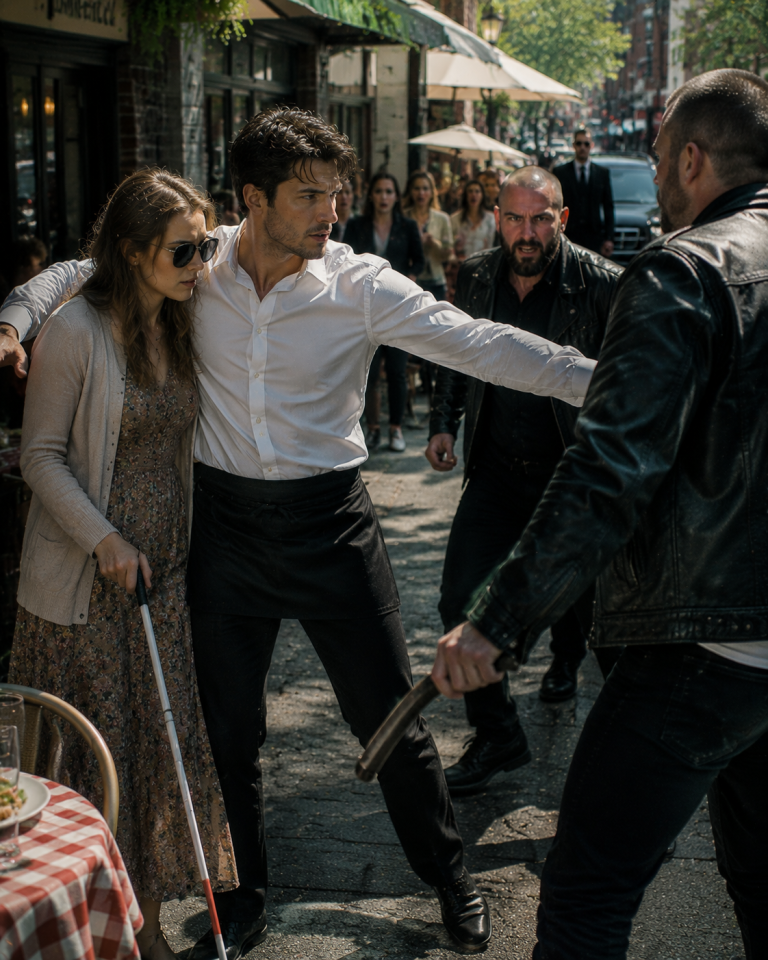
She Couldn’t Speak, So Her Father Sold Her Mafia Boss—Then He Became the First to Truly Listen

## PART 1
The day my father sold me, he wore his best suit.
I noticed this the same way I noticed everything — from a remove, cataloguing details as they arrived, which was the habit I had developed over the thirteen years since the accident stripped my voice away and left me with only observation as a tool for navigating rooms where other people spoke and I did not.
He always wore his best clothes when he was about to do something he needed to look good doing.
Today it was charcoal wool with a pocket square. The cufflinks our mother had given him. He had polished his shoes himself that morning, which he only did when the occasion required a specific kind of performance.
I had watched him perform for most of my life. I had gotten good at reading the staging.
My name is Nora Aldridge. I am twenty-five years old. I teach ASL at a community center in the South End, I prefer my coffee with too much sugar, and I have not spoken a word since I was twelve years old and spent six hours trapped in the wreckage of a car on a January highway while my mother died beside me and I screamed until there was nothing left to scream with.
My father had arranged for me to be in a lawyer’s office at two in the afternoon on a Tuesday in November, in a building in the Financial District that smelled of leather and polished surfaces and the specific stale air of spaces where important things were decided without the consent of everyone they affected.
He had explained it in the car.
Not the full version. The version he had decided I could have.
He had borrowed money from the Barretto family. The Barretto family had connections he had not fully understood when he sought their backing for a development project that had since collapsed. The Barretto family wanted blood, specifically his, and had been specific about the time they were willing to wait before collecting it.
A man named Sandro Ferretti had interceded on my father’s behalf.
In exchange, Sandro Ferretti wanted an alliance. The kind that came with a last name.
My father told me this the way you tell someone the route to a destination, not the reason for the journey.
“It’s the only way to keep your sister safe,” he said. “Mara’s pregnancy makes her vulnerable. You understand that.”
I stared at the passenger window and said nothing. I had been saying nothing for thirteen years. My father had learned to interpret my silences as compliance because it was convenient for him to do so.
The lawyer’s office had two large windows, a desk that cost more than my monthly rent, and three men at the table. My father. A lawyer. And Sandro Ferretti.
I had researched Sandro Ferretti on my phone the night before, after my father told me the plan. What I found was the specific kind of dossier that powerful men accumulate — a presence in certain business circles, a name in property records, a known association with operations that moved through Boston in ways that courts had tried and failed to prosecute. He was thirty-one years old. He was unmarried. He was considered, by the people who considered these things, to be currently ascending.
He was looking at me when I walked in.
Not the way men look at women they have been told to look at. He was watching my face specifically, and the watching had the quality of someone doing actual reading rather than assessment.
The lawyer cleared his throat and began explaining the terms.
My father answered on my behalf before I could reach for my phone.
“She’s capable of her own decisions,” Sandro said.
My father’s expression went careful. “Nora is mute, Mr. Ferretti. I act as her—”
“You act as her when?”
The question was quiet. The kind of quiet that functions as emphasis.
My father blinked.
Sandro reached into his jacket and produced a small notebook and a pen, which he slid down the table until they sat in front of me. Then he looked at me directly.
“I can wait,” he said.
My father started to object.
Sandro looked at him once. One look. My father stopped.
I picked up the pen.
My hands were shaking, which I noted as information. I wrote: *My father is the one who created this situation. Why am I the one signing a contract?*
Sandro read it. Something in his expression shifted. Not surprise. Something that had already been there finding a confirmation.
“That’s a fair question,” he said. “And the honest answer is that your father created a problem he couldn’t solve, and I offered him a solution that happened to involve you.” He held my gaze. “If you want to refuse it, I’ll find another way to manage the Barretto situation that doesn’t require anything from you.”
I wrote: *And my sister?*
“Your sister and her husband would need to leave the city. I can arrange protection for transport. It’s not permanent, but it buys time.”
*Why would you do that for someone who said no to you?*
“Because you didn’t create your father’s mess,” he said. “And the person who didn’t create the mess shouldn’t be the only one paying for it.”
My father had gone still in the way of people who understand they are no longer in control of the room.
The lawyer made a small sound.
I looked at the contract. Then at Sandro. Then at the notebook in front of me.
I wrote: *I need to think. Give me until tomorrow.*
Sandro nodded. “My number.” He wrote it at the bottom of my page. “Not your father’s phone. Yours.”
The drive home was very quiet.
Then my father turned on me in the driveway.
“You embarrassed me,” he said. “That man is offering you a life you have no right to expect. He is offering this family protection we cannot afford to refuse. You will call him tonight. You will tell him yes.”
I typed on my phone and held up the screen.
*You’re right that I don’t have the right to expect protection. Because you built a life that was supposed to protect me, and then you borrowed money from dangerous people without telling us, and now you’re treating your daughters like accounts receivable. So you’ll understand if I take the night.*
My father opened his mouth.
I got out of the car.
In my room, I sat on the floor by the window and thought about Sandro Ferretti’s face when my father tried to answer for me. The specific quality of the silence he had used to stop it. The notebook he had produced without commentary, without explanation, as if preparing for a situation in which someone might need a different mode of communication was simply a sensible thing to do.
I thought about the question I had asked and the answer he had given.
*Because the person who didn’t create the mess shouldn’t be the only one paying for it.*
I turned the notebook paper over in my hands.
At eleven-thirty, I typed the number into my phone.
*This is Nora. I have questions.*
His reply came back in under a minute.
*I have time.*
—
## PART 2
We talked until two in the morning.
He talked. I typed. The rhythm of it was strange and then not strange, the way all communication finds its shape if both people are willing to wait for it.
He told me what the alliance meant practically: his name, his resources, his protection extended to my father’s accounts and my sister’s household. A residence in the Seaport with security that reported to him rather than observed me. Separate arrangements until I decided otherwise.
I typed: *What do you get out of this besides the alliance?*
He called instead of typing back. I answered because I had already started to understand something about how he communicated — that he used calls for the things that required more precision than text could carry.
“The honest version,” he said when I answered.
I made the sound I used to confirm I was listening. He had worked out already that this was what it meant.
“I run operations that have a shelf life,” he said. “That’s the nature of them. I’ve been moving toward legitimate business for three years and I’m not far enough along. The Aldridge name — your family’s history in Boston development — opens doors that my money can’t. That’s the business side.” A pause. “The personal side is that I watched a man speak for his adult daughter in a room full of other people who let him, and I wanted to know what she would say if she had the chance.”
I typed: *And now that you know?*
“Now I know you’re careful, precise, and not afraid of me. Which is useful and also, frankly, a relief.”
*Most people assume silent means afraid.*
“Most people are lazy readers.”
I sat with that for a moment.
Then I typed: *If I say yes, my father loses the ability to speak for me.*
“That’s a condition, not a consequence. I’ll make sure he understands that.”
*And my sister stays protected regardless of what I decide.*
“Done.” No hesitation.
*I need to be honest about something.*
“Good.”
*I don’t know what I’m agreeing to beyond the contract terms. I can’t promise to trust you. I can’t promise this becomes something.*
“I’m not asking for a promise,” he said. “I’m asking for a chance to earn one. There’s a difference.”
The morning came gray and cold, the harbor outside my window the color of old pewter.
I texted him: *Yes. But the wedding is our choice, not my father’s production.*
His reply was immediate: *Agreed. How small?*
*Courthouse. My sister. You and whoever you trust. Done in an hour.*
*Saturday?*
*Saturday.*
My father found out the morning of.
He was in his robe when Sandro rang the doorbell at eight-forty-five, holding white ranunculus that he had apparently chosen himself. My father stood in the foyer in the particular posture of a man realizing he has entirely lost the narrative.
“What is this?” he said.
Sandro handed me the flowers.
“Change of plans,” he said pleasantly. “Nora and I are getting married at the courthouse this morning. You’re welcome to come if she wants you there.”
He looked at me.
I looked at my father — at the man who had taught me to read and taught me to play chess and cried openly at my mother’s funeral and then spent the years after building a life that made him a stranger, a stranger who had finally looked at his silent daughter and seen an asset at a time when he needed liquidity.
I typed on my phone and held up the screen.
*You can come if you want to be present for me. Not for the deal. Not for the optics. If you want to be there for me.*
My father’s face did something complicated.
He came.
He stood in the back of the judge’s chamber and held his hands in front of him and looked, for the first time in years, small.
The judge — a woman named Patricia Holden who looked as if she had seen enough marriages to appreciate the honest ones — read vows that Sandro had apparently rewritten.
“In partnership,” she said. “Not in possession.”
When she asked for my response, I had it typed and ready. I held up my phone.
*I do.*
Judge Holden smiled.
“That,” she said, “is perfectly clear.”
Outside the courthouse, Mara grabbed my arm and pulled me aside while Sandro spoke with the small group who had come for him — two men who carried themselves with the specific readiness of people whose job was to be prepared.
“Are you okay?” Mara said.
I typed: *I think so. I’ll know more in a week.*
“He looked at you the whole ceremony,” she said. “Like he was watching to make sure you were still okay with it.”
I looked over at Sandro.
He was mid-conversation, but when I looked, he looked back.
The same quality of watching from the lawyer’s office.
Not claiming. Reading.
*I’ll call you tonight*, I typed, and took Sandro’s arm, and we went to begin something that neither of us had planned and both of us had chosen.
—
## PART 3
The penthouse was on the eighteenth floor and looked out over the harbor with the specific clarity of a room designed to let light come in unimpeded.
Sandro showed me to a room decorated in soft neutrals — linen and gray and a reading chair by the window that looked like it had been chosen for the specific purpose of reading in.
“I guessed,” he said. “Tell me what’s wrong and we’ll change it.”
*Nothing’s wrong with it*, I typed. *How did you know about the reading chair?*
“Your community center has a reading corner you’ve rearranged three times in the last year,” he said. “I was thorough in my research.”
I stared at him.
“That sounds worse out loud than it was,” he said.
I typed: *It sounds like you paid attention.*
“Yes,” he said. “That’s the more accurate description.”
The first week was an education in calibration.
I learned that Sandro Ferretti ran his operations with a precision that extended to his household — that he was not loud, that he cooked occasionally and badly, that he woke early and worked late and never once entered my room without knocking. I learned that his second, a man named Dante, had known him for fifteen years and had the specific loyalty of someone who had watched a person become something over time and had decided the becoming was worth staying for.
I learned that Sandro learned sign language at speed.
Not perfectly. His hands were built for different work, and the early attempts were clumsy enough to make Dante visibly suppress a smile when he thought no one was watching. But every night he practiced, and every morning he had retained what he had practiced, and within two weeks he could ask me the important things — *are you okay, do you need anything, can I come in* — in a way that required no phone between us.
The first time he signed *are you hungry* correctly across the kitchen, I laughed.
Silent laughter. But visible.
He looked enormously pleased with himself.
“I’ve been practicing that one specifically,” he said. “It felt important.”
I signed back: *Why that one?*
He signed, imperfectly but recognizably: *Because you forget to eat when you’re thinking hard.*
I looked at him.
He had noticed that in two weeks.
We had dinner together that evening without the phone between us for the first time. Mostly sign, with occasional text when I needed more precision than I had the vocabulary for yet. He filled in the gaps with questions. He was good at questions — the specific kind that were actually listening, not prompting.
Three weeks after the courthouse, he came home with blood on his jacket cuff.
I saw it before he made it to his room.
He stopped when he saw me see it.
“Someone in the organization made a comment about you,” he said. “They won’t be making it again.”
I typed: *What kind of comment?*
“The kind that implied your silence was convenient for me.”
I considered this.
*Is it?*
He sat down across from me at the kitchen table.
“No,” he said. “The opposite. You are the least convenient person I have ever met. You communicate in complete sentences. You catch everything I leave out. You ask questions I’d prefer not to answer.” He held my gaze. “You are the least convenient person I’ve ever shared a building with, and I cannot adequately explain how relieved I am about that.”
I put the phone down and signed: *Don’t hurt people on my behalf without telling me.*
He understood every word.
“Agreed,” he said.
Then: “Can I ask you something?”
I nodded.
“Your father,” he said. “He came to the courthouse.”
*Yes.*
“Was that for him or for you?”
I thought about it honestly.
*Both*, I signed. *I wanted to know which one it was. It was mostly for him. But there was something of the father I remember in it.*
“And what will you do with that?”
*Keep the distance. Grieve what he isn’t. Be glad he showed up.*
Sandro looked at me for a long moment.
“You’re very honest about hard things,” he said.
*It’s easier when you don’t have to use your voice.*
He almost smiled.
Then his phone rang.
He looked at the screen and the expression that replaced the almost-smile was the specific face of someone receiving information they had been half-expecting.
“The Barretto family is calling a meeting,” he said. “They’re claiming the alliance terms were conditional on a traditional marriage ceremony. Since we went to the courthouse instead—”
*They’re looking for an excuse to challenge it.*
“Yes.”
*What do we do?*
“We go,” he said. “Both of us. If you’re willing.”
I typed: *I’m willing. But if they speak to you about me the way my father used to speak about me, I respond myself.*
“Understood.”
He stood.
*Wait.*
He waited.
I typed: *Who else was in the room this morning when you took that call?*
He paused. “Dante. Two others.”
*What was the comment. Exactly.*
Something moved across his face.
“That a mute wife was a useful acquisition for a man who preferred not to be questioned.”
I absorbed this.
Then I typed the sentence that, in retrospect, was the first moment I understood something had shifted between us.
*That’s what my father thought too. And look how that worked out for him.*
Sandro looked at the screen.
Then he looked at me.
And something happened in his expression that I had not seen before — not the careful watching, not the controlled management, but something that belonged to the person underneath all of that. Something that looked a great deal like being seen by someone who had been looking.
—
The Barretto meeting took place in a restaurant in the North End that was closed for the evening, a fact that announced the nature of the conversation without requiring announcement.
There were eight men at the table when we arrived. Lorenzo Barretto, who was the family’s current head — sixty years old, silver-haired, the specific stillness of a man accustomed to being the most important presence — looked at me when we entered and did not look away.
I looked back.
He seemed briefly surprised by this.
Sandro pulled out my chair with the specific absence of ceremony that made it feel like a natural action rather than a performance.
“Your arrangement was made without our full approval,” Lorenzo said. “The terms specified a traditional union with appropriate ceremony. What occurred was a courthouse exchange.”
“The terms specified a legal marriage,” Sandro said. “That’s what occurred.”
“The spirit of the agreement—”
“Mr. Barretto.” Sandro’s voice had not changed in register but something in it had become very precise. “The spirit of the agreement was to bind two families. We are bound. If the Barretto family’s objection is to the manner in which we chose to be bound, I’d be interested to understand how that concern relates to your actual interests.”
Lorenzo looked at me.
“What does your wife think?” he said. The phrasing had the quality of a test.
I reached for my phone.
Sandro did not reach for it first. Did not speak. Waited.
I typed and held up the screen.
*My husband speaks for our household in this context, Mr. Barretto. The same way your wife’s interests are presumably represented by you in contexts that don’t require her direct presence. I’m here as his partner, not as a credential he’s displaying.*
Lorenzo read it.
A silence.
Then, slowly, a smile. Genuine, which surprised me.
“Where did she learn to negotiate?” he said.
“She taught herself,” Sandro said.
The terms held. Lorenzo Barretto, it turned out, had no particular investment in whether we had married in a cathedral or a broom closet. The objection had been a test of a different kind — whether Sandro would fold under pressure, and whether I was actually present in the arrangement or decorative. We had answered both.
The drive home was quiet in a different way than most quiet.
“You were excellent,” Sandro said.
*I was honest.*
“That’s what I said.”
I looked at the city passing the window.
*Can I ask you something?*
“Yes.”
*Why are you trying to go legitimate?*
He was quiet for long enough that I thought he might not answer.
“Because I watched my father build something and then watched it require him to become someone he hadn’t planned on being,” he said. “And I made a choice early on that if I was going to be in this world, I would be here on my own terms and not for longer than necessary.” He kept his eyes on the road. “And because there are things I want that this world can’t give me. Not long-term.”
*What things?*
He glanced at me.
“Normal things,” he said. “Mornings without checking for threats. A family that doesn’t need bodyguards. Time.”
I held that.
*That sounds like wanting to be done.*
“It sounds like wanting to be worth something different,” he said.
—
The months that followed were organized around two things: the work of building something legitimate, and the daily practice of learning each other.
Sandro gave me access to everything. Not as a gesture — as a fact. Files. Financial records. Names and histories of everyone in his network who I would need to understand to exist safely in his world. He sat with me for hours going through what each name meant, what each arrangement required, where the pressure points were.
“Why are you telling me this?” I typed, the third evening of this.
“Because I told you I wanted a partner,” he said. “This is what that means. You can’t be my partner if I keep the map from you.”
*Showing me the map means trusting me not to use it against you.*
“Yes.”
*You barely know me.*
He looked at me.
“I know that you took one night to think before agreeing to something significant. I know you asked the right questions when it mattered. I know you’ve spent thirteen years being underestimated and you adapted by becoming extraordinarily precise.” He held my gaze. “I know that when Lorenzo Barretto tested whether you were real, you answered for yourself. I know enough.”
I looked down at the files spread across the table.
*If I learn all of this*, I typed, *and something goes wrong—*
“If something goes wrong,” he said, “you are more protected knowing this than not knowing it.”
*And if you decide you don’t want me anymore?*
He was quiet.
“I’m not offering you a conditional arrangement, Nora.”
I looked at him.
“You said you couldn’t promise to trust me,” he said. “I understood that. I said I’d earn it. I intend to keep saying that until you believe it.”
—
Mara had her daughter in March.
We were at the hospital for eleven hours. Sandro sat in the waiting room with his hands in his lap and the expression of a man for whom hospital waiting rooms represented a specific kind of vulnerability he had no protocols for, which I found unexpectedly endearing.
When the nurse brought the baby out, Mara put her in my arms and said: “Her name is Clara.”
Clara Aldridge, seven pounds, two ounces, with her father’s ears and her mother’s stubborn expression.
I held her and felt something in my chest that had been contracted for years open like a room that’s been closed too long finding air.
Sandro was watching from across the room.
I looked at him and signed: *Come here.*
He came.
He looked at Clara with the expression I had begun to be able to read — the careful controlled version of something that was not controlled at all underneath.
“She’s incredible,” he said.
Mara smiled. “You two should—”
I held up a hand.
Mara laughed. “Okay. Not tonight.”
Sandro’s ears turned red, which I had not previously witnessed and filed immediately as important data.
—
The FBI came four months after the wedding.
Sandro told me before he told anyone else.
He came home at six on a Tuesday, poured water instead of the usual glass of wine, and sat down across from me at the kitchen table.
“Sit down,” he said. “I need to tell you something.”
I was already sitting.
He told me. Federal contact. An offer. Three families currently operating in trafficking and distribution. Immunity for his own prior activity in exchange for documentation and testimony. A clean slate.
“I told them I needed to speak to my wife first,” he said.
I sat with it.
*If you do this*, I typed slowly, *what are the risks?*
“Significant. The families will know eventually. We’ll be in a protected situation for at least a year. It will never be entirely clean.”
*But the organization is done?*
“Yes. Completely. Everything legitimate goes forward and is clean. Everything that isn’t stops.”
I thought about Clara. About Mara. About the community center and the children learning their first signs and the things Sandro had said he wanted — mornings without checking, a family without guards, time.
*What do you want to do?*
“I want to do it,” he said. “I’ve wanted this for three years. But I won’t do it if you say no.”
I typed: *I’m saying yes. We burn it down and build something else.*
He looked at me for a long moment.
Then he did something he had not done before. He reached across the table and took my hand.
Not claiming. Not managing.
Just present.
I turned my hand over and held on.
The year that followed was the hardest and the most clarifying.
Closed hearings. The careful, exhausting work of documentation. A month in a property outside Portland when two families made threats that required distance. Sandro waking at two in the morning to check the door codes. Me waking and finding him there and signing *it’s clear* and watching him choose to believe it.
We became fluent in each other that year. Not the polished version of knowing someone. The useful version — the one where you know which silences mean thinking and which mean distress. Where you know which decisions to make alone and which to bring. Where you’ve run out of politeness and have to get by on honesty.
Sandro became a better cook.
I started learning Italian, because it felt like learning the language of his private thinking.
The day the last indictment was confirmed, Sandro came home with a bottle of wine and two glasses and sat on the kitchen floor, which I had not previously seen him do.
I sat down next to him.
He poured.
“It’s done,” he said.
I took my glass.
*How do you feel?*
“Scared,” he said, which was more honest than I expected. “And — ” He paused. “Like something that’s been wound tight for years just let go.”
*Is that good?*
“I think so. I’ve forgotten what it felt like.”
I signed: *You’ll remember.*
He looked at me.
“With you,” he said. “Yes. I think I will.”
—
The community center opened on a Thursday in September.
It had been Sandro’s idea originally, offered three months into our marriage as a question rather than a plan: *What would you build if you had the resources?* I had answered honestly. ASL instruction. Job training. Legal aid. A room with good light and books for children whose parents were learning to navigate systems that had been designed for someone else.
He had made it possible and then stepped back and let me make it real, which I understood by then was his way of keeping his word.
The first day had fourteen children in the morning ASL class and twenty adults in the evening legal clinic.
I stood at the back of the room and watched small hands making shapes that meant something.
Sandro found me there at the end of the evening.
He signed: *How was it?*
I signed back: *Perfect and exhausting and I want to do it again tomorrow.*
He smiled.
Then he signed, carefully, getting it right on the second try: *You built something.*
*We built something.*
He shook his head.
“You built it,” he said. “I funded it. That’s different.”
*Don’t do that.*
“What?”
*You made it possible. You made most of the things I have possible. Stop pretending that’s nothing.*
He looked at me.
“I’m not pretending it’s nothing,” he said. “I’m saying you are the one who knew what to build.”
I took a breath.
Then I signed, slowly and deliberately, the three signs I had been practicing for two weeks.
*I love you.*
The room was empty. The lights were fluorescent and a little cold. There was nothing romantic about it. He had blood in his past and I had silence in mine, and neither of those things was resolved by the sentence.
But they were true about us, and we had made a practice of truth.
He went still for a moment.
Then he signed back, imperfect but unmistakable.
*I love you too.*
I touched his face.
He leaned into it.
Outside, the city was doing what cities do — continuing, indifferent, enormous, full of people making choices in rooms that wouldn’t make the news. Inside the community center we had built in the space where his old operation had been, two people who had started with a contract and a notebook and a question no one else had asked were standing in the dark after the last class.
Chosen.
Heard.
Present.
—
Five years later, I stood in the back of the same room watching a different class. Our son, Marco, was in the front row, aged three, wearing a small blue shirt and making signs with the focused intensity of a person discovering that their hands could say things. Sandro was beside him, signing along, getting most of it right.
Marco turned to his father and signed: *Wrong.*
Sandro signed: *Show me.*
Marco showed him.
Sandro corrected his hand shape.
Marco considered this, then signed: *Better.*
I had my phone out, recording. This was not for anyone else. This was for the box I kept of the true version of our life — not the dramatic version, not the story other people would tell, but the version that was actually ours.
A man who had built his life on being feared, sitting cross-legged on a community center floor, taking instruction from a three-year-old.
A woman who had spent thirteen years being spoken for, standing in a room she had designed, watching her own family learn the language her voice had given back to her.
Thirteen years ago, a car had gone off the road on a January highway, and I had screamed until there was nothing left.
Nobody had helped me find another way to scream, as Sandro had once put it.
Nobody until him.
He had not given me my voice. That was not what happened. My voice had been in me the entire time, shaped by thirteen years of listening, watching, noticing everything because it was the only currency I had.
What he had done was simpler and harder than giving.
He had decided, on a Tuesday afternoon in a lawyer’s office, that the silent woman in the room was the person he most wanted to hear from.
And then he had listened.
**THE END.**