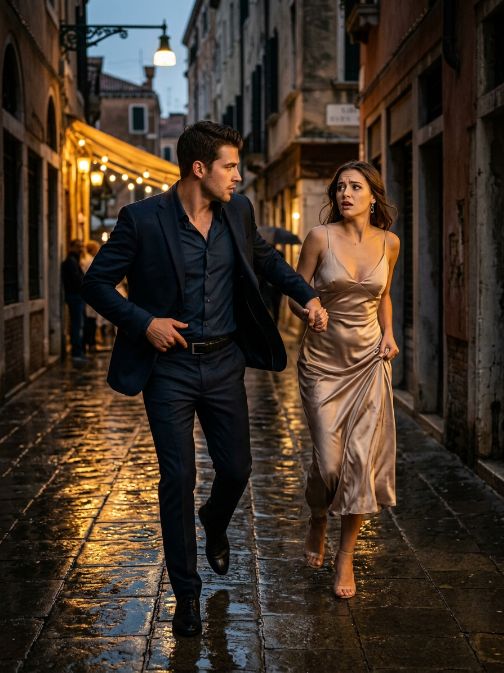
At My Birthday, My Mafia Boss Husband Walked In With His Mistress—Then I Gave Her My Ring, Saying, “He’s Yours”

## PART 1
The things that keep you alive in a dangerous marriage are small and specific.
You learn the weight of a pause before a name. You learn which silences are thinking and which are deciding. You learn the particular temperature of a room that is about to become a room you’ll spend weeks trying to forget.
And you learn, above almost everything else, not to cry in front of witnesses.
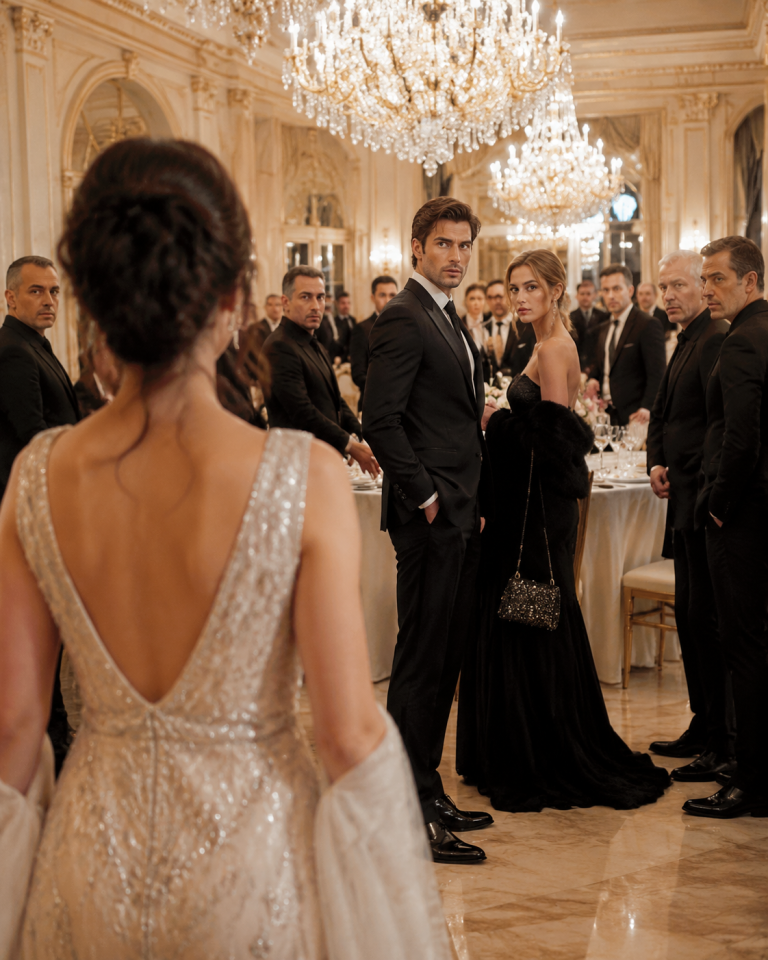
My name is Clara Russo. I had been Mrs. Luca Ferretti for four years, which meant I had been learning these things since I was twenty. On the night of my twenty-fourth birthday, I stood at the center of the Allegro Hotel’s grand ballroom in Chicago — two hundred and sixty guests, four ice sculptures, a string quartet playing something no one was actually listening to — and I watched my husband walk through the doors with another woman on his arm.
He chose a red dress for her.
I noted that.
Not because I was jealous. Because I had learned to read him.
Red was a provocation. Red was deliberate. Red was Luca saying *look* to everyone in the room who owed him money, or favors, or the specific kind of loyalty that looked like friendship until you needed it and found something colder in its place.
Her name was Caterina Bardi. Thirty-one, unmarried, the kind of beautiful that Luca preferred in his women: polished, performative, the sort that could be mistaken for confidence from a distance. I had heard her name once, six months ago, spoken in the careful way his men spoke names they wanted me to miss.
I had not missed it.
Luca brought her to the center of the room.
Two hundred and sixty people watched me.
I felt it the way you felt weather — not a specific thing, but a change in the quality of air. They were waiting for me to fall apart. Not cruelly, most of them. Simply because watching powerful women fall was one of the oldest entertainments the city had to offer, and the Drake gala had been canceled this year.
Luca’s eyes found mine across the ballroom.
He was smiling.
That particular smile — controlled, satisfied, with just enough warmth to be mistaken for affection — had convinced me, at twenty, that I was loved. I had mistaken certainty for safety because I was twenty and grieving and he had arrived in my life three months after my father’s sudden death with that smile and two dozen white roses and a proposal that felt like a door opening rather than closing.
I thought about my father.
I thought about the ring on my finger.
The Ferretti ring. A sapphire, deep blue, surrounded by small diamonds, four generations old, or so Luca had told me the night he slid it onto my hand and said, *now everyone knows.*
He hadn’t meant it as a threat.
That was the worst part.
He had meant it as an explanation.
Luca raised his glass.
“My wife,” he said, his voice carrying the way it always did — not loud, just arranged so that rooms organized themselves around the sound, “has always been gracious. But tonight, Caterina reminds me what it feels like to be with a woman who has never needed to be taught.”
Two hundred and sixty people held very still.
I lifted my left hand.
The light caught the sapphire.
I heard someone inhale.
I worked the ring off my finger — it took a moment longer than it should have, my skin warm from the ballroom heat — and I walked across the marble floor toward Caterina Bardi.
She stared at me.
Up close she was younger than I’d expected. Twenty-two, maybe twenty-three. There was a small tremor at the corner of her mouth that she was working very hard to control, and something in her eyes that looked less like triumph and more like someone who had understood what they had agreed to and was too far in to reconsider.
I had been her.
I recognized her completely.
I placed the ring in her palm.
I said, quietly enough that only she and Luca could hear: “He told me it was tradition.”
Then I raised my voice for the room.
“Keep it. Keep all of it. The name, the house, the men who stand too close to make sure you stay in rooms you don’t remember entering.”
No one moved.
Luca said my name.
“Clara.”
Not shouting. The specific quiet that was worse than shouting.
I had taken five steps toward the exit when Caterina made a sound.
Not a cry.
The particular sound of a body deciding it could no longer continue being upright.
She went down slowly, gracefully almost, which made it worse. The ring hit the floor a half-second before she did. Luca caught her before she struck the marble, and his face was — for the first time in four years — showing me something I had never seen before.
Not anger.
Confusion edged with fear.
I stood watching Caterina Bardi fold against my husband’s arms, her red dress spreading across the marble, the Ferretti ring lying three feet away with the sapphire facing up.
Then a voice said, from very close: “You should leave now.”
I turned.
A man stood near the pillar to my left, close enough that I should have felt him arrive, which meant either he had excellent instincts or I had been watched more carefully than I understood.
Tall. Dark suit. The kind of stillness that belonged to people who had learned early that stillness was its own form of power.
“I don’t know you,” I said.
“My name is Alessandro Vinci.” A pause. “Your mother did.”
The ballroom seemed to rearrange itself.
“My mother is dead,” I said.
“Yes.” His eyes moved to Luca, still holding Caterina, the crowd beginning to press forward. “She left instructions for exactly this moment. The car is outside.”
I looked at Caterina on the floor.
I looked at Luca’s face — afraid, calculating, turning toward me with an expression I had been waiting four years to fully understand.
Then I walked out of my birthday party.
—
## PART 2
The night air was cold enough to matter.
Alessandro Vinci opened the rear door of a black car without ceremony. I stood at the bottom of the hotel steps with no coat, no purse, no ring, looking at a stranger who claimed to know my dead mother, and I did not get in immediately.
“She’s dying,” I said. “Caterina.”
“She collapsed.”
“That’s different from coincidence.”
His expression was careful. “Not entirely.”
“What does that mean.”
“The ring your husband gave you was not family jewelry.”
I looked at my bare left hand. The place where the sapphire had rested for four years had left a faint indentation in my skin.
“Then what was it.”
“A lock,” he said. “And depending on your bloodline, either a key or a weapon.”
Above us on the steps, the hotel doors opened. Luca’s voice reached us — not words, just the particular quality of a man realizing something had escaped him.
“Get in,” Alessandro said.
I got in.
The car pulled away before the door was fully closed.
I did not look through the rear window.
Alessandro sat beside me with the folder on his knees and said nothing for one city block, then two. The Chicago skyline moved past in amber and black.
“Your mother’s name was Ginevra Russo,” he said.
“I know my mother’s name.”
“Her name before she married your father was Ginevra Mancini.”
I turned to look at him.
He met my eyes without flinching.
“The Mancini family,” I said.
“Yes.”
The name arrived in my mouth the way certain things arrived — with the particular weight of something you had heard whispered around corners your whole childhood without ever being given the full sentence.
“My mother was a schoolteacher.”
“Yes. After. By choice. Because your grandparents wanted your parents entirely out, and she loved them enough to agree.”
“And my father?”
Alessandro’s jaw moved.
“Your father tried to stay out. For fifteen years, he succeeded.”
“And then.”
“And then Luca Ferretti decided the Mancini ledger was the most valuable thing no one was looking for anymore.”
The car turned south.
I thought about my father’s death. The official story: cardiac arrest, found in his study on a Tuesday morning, the doctor who attended the scene a man my father had never met. I had been twenty years old and Luca had arrived with white roses three days later.
“He killed my father,” I said.
Alessandro said nothing.
“That was not a question.”
“No,” he said quietly. “It wasn’t.”
A sound left me that was not grief and not rage but some third thing that lived between them.
Alessandro handed me a cream envelope.
My name on the outside in handwriting I would have recognized in a burning building.
My mother’s.
*Clara — when you are finally free.*
My hands shook.
I opened it.
The letter inside was one page. At the bottom was a small brass token, roughly the size of a coin, engraved with a figure I had seen once as a child: a fox carrying a lantern.
I read the letter.
When I finished, I read it again.
Then I said: “She hid the vault inside the lullabies.”
Alessandro’s eyes sharpened.
“You remember them.”
“Every word.”
His phone buzzed.
He looked at the screen.
His expression went somewhere I couldn’t read.
“What,” I said.
He turned the phone.
A photograph. Security camera footage, grainy, timestamped forty minutes ago. A private clinic in the South Loop.
Luca Ferretti stood in a corridor with a man I recognized from my father’s funeral — a doctor who had pressed my shoulder and told me grief was its own kind of illness.
Between them, on a steel tray, lay the Ferretti ring.
The sapphire had been pried from the setting.
Beneath it, a tiny hollow cavity.
Empty.
Not a lock.
A message.
Alessandro was already calling someone.
And somewhere in the city, Luca Ferretti had just discovered that what he had spent four years waiting for was not inside the ring.
It was inside me.
—
## PART 3
The penthouse was nothing like I would have imagined for a man in Alessandro Vinci’s position.
No marble lions. No gold fixtures. No paintings chosen for their price rather than their meaning. Just dark wood, low light, a wall of books that had clearly been read, and windows that showed the river as a long black ribbon below.
A woman waited inside.
Late fifties, silver hair, the posture of someone who had spent decades being the calmest person in difficult rooms.
“Dr. Ferrara,” Alessandro said.
She nodded once at me. “May I see your hand.”
“Why.”
“The ring may have left residue when it activated.”
“You’re saying the ring poisoned Caterina.”
“Not exactly.” She set down her bag and opened it. “The ring contained a compound keyed to respond to specific enzymes in your bloodline. While you wore it, the compound was inert. When it transferred to someone outside your bloodline—”
“It activated,” I said.
“Yes.”
“Is she going to die.”
Dr. Ferrara looked at me directly.
“She’ll have a fever, possibly seizures. If she receives proper treatment, she will recover.”
“And if she receives Luca’s doctors.”
The silence was its own answer.
I sat down.
My mother had given me a letter with a fox-and-lantern token, and the token was meant to locate something, and the ring I had worn for four years had been designed to both protect and threaten depending on whose hand held it, and my husband had murdered my father to gain access to a ledger my mother had hidden in the songs she’d sung me to sleep.
I did this in pieces: first accepting one, then the next, then the one after that. Like stepping across ice.
Alessandro gave me water I didn’t drink.
“The letter,” I said. “She says the vault has three locks. The token finds the first door. My blood opens the second.”
“Yes.”
“And my memory opens the third.”
“Yes.”
“What memory?”
Alessandro met my eyes. “She said you would know it when the door was in front of you.”
I thought about that.
I thought about my mother kneeling in the garden behind our house on the North Shore, turning soil around rose roots, singing under her breath. She used to sing in two languages: Italian for ordinary songs, and something older for the ones she called the *real* songs. I had always assumed she meant *important.* Not *literal.*
The lullabies.
*Beneath the bride, beneath the bone,*
*the fox comes home alone.*
*Three locks and three keys to win—*
*the first is found, the second is blood,*
*the third lives under your skin.*
Under your skin.
Memory.
My skin prickled.
“Alessandro.”
“Yes.”
“My mother is buried at the house on Sheridan Road.”
“Yes.”
“The house Luca took in the divorce settlement she never got to negotiate.”
His jaw flexed.
“Yes.”
“That’s where the first door is.”
A phone rang.
Not Alessandro’s. Mine, which I no longer had — which meant someone had brought it here.
Alessandro reached into his jacket and set it on the table.
The screen showed: LUCA.
I looked at it.
Dr. Ferrara looked at Alessandro.
Alessandro looked at me.
“You don’t have to answer,” he said.
I answered.
I put it on speaker.
The silence on the other end lasted long enough to confirm that Luca had not expected me to pick up.
“Where are you.” Not a question.
“Not at my birthday party,” I said.
He exhaled slowly.
“You don’t understand what you’ve started.”
“I understand what I’ve finished.”
A pause. Longer this time.
“You are with Alessandro Vinci.”
“Yes.”
“He’s using you.”
“Everyone has been using me for four years, Luca. He’s just the first one to explain what for.”
His voice changed. The controlled warmth dropped and what was underneath was cleaner and colder.
“Your mother trusted the wrong people. That was her mistake.”
“My mother built a vault that you have spent four years trying to find. She was not the one who made mistakes.”
“She made one.” His voice softened in the specific way that had always preceded something dangerous. “She trusted her bloodline to remember.”
My blood went cold.
“You already knew about the memory key,” I said.
“I knew about your lullabies, Clara. I have known about them for three years. I have been very patient.”
Alessandro was already moving, typing something on his phone.
“That is why,” Luca continued, “I brought Caterina. I needed the ring off your finger and I needed you frightened enough to run to Vinci. Because Vinci knows where the first door is, and now, so do you. All I have to do is follow.”
I looked at Alessandro.
He had gone completely still.
“He was monitoring my calls,” I said.
Alessandro’s expression answered.
No.
He hadn’t been.
“The penthouse,” Dr. Ferrara said quietly. “He knew about the penthouse.”
“The car,” Alessandro said.
His driver. Someone Luca had reached.
I stood.
“You said the first door is at the house on Sheridan Road.”
“Clara—”
“He’s already headed there. If we don’t reach it first—”
“I know.”
Alessandro pulled the folder from the side table and removed a photograph. He held it toward me.
It was old. 1990s. My mother, young, smiling, standing outside a church in the Italian neighborhood near the North Side. Beside her, also smiling, a man in his late twenties who I had never seen.
On the back, in my mother’s writing: *Alessandro, before he knew what he was getting into. He never did get out of it. But he tried.*
I looked at Alessandro.
He was looking at the photograph with an expression that had nothing to do with tactical assessment.
“You loved her,” I said.
“I owed her,” he said. “There is a difference.”
“Is there.”
His eyes came up.
He didn’t answer.
That was its own kind of answer.
“Tell me what you failed to stop,” I said.
Dr. Ferrara moved quietly toward the window.
Alessandro set down the photograph.
“Your mother was moving the ledger when they found her car,” he said. “I was supposed to be with her. There was an accident on the bridge — a real accident, nothing to do with us — and it backed traffic for forty minutes. When I arrived at the meeting point, she was already gone.”
“Gone as in.”
“She had driven alone. Ahead of schedule. Because she was afraid staying in place would cost her more than moving early.”
“And someone was waiting.”
“Yes.”
“Luca’s father.”
“Yes.”
I thought about my mother’s car. The bridge. The guardrail. The way my father had gone gray in the week that followed and never fully come back.
“She survived it,” I said.
Alessandro looked at me sharply.
“She went into the river,” I said. “And she died. Two men in a boat pulled her out too late.”
“Yes.”
“But the ledger wasn’t in the car.”
His eyes changed.
“No,” he said. “It wasn’t.”
“Because she had already sent it somewhere else.”
Silence.
“She sent it to me,” I said. “Before she drove that night. She sent it to a seven-year-old girl inside the only thing she knew I would always remember. The lullabies.”
The ledger wasn’t hidden in a physical location.
The ledger was a memory palace.
My mother had distributed it across songs, and the fox-and-lantern token, and whatever was buried at the house on Sheridan Road — not a vault full of papers, but a key to reconstruct everything she had carried in her head.
And Luca had known.
For three years, he had been married to the ledger without being able to open it.
I closed my hand around the brass token.
“There is no door at the house,” I said. “There is no door anywhere. She didn’t hide it in a building.”
Alessandro leaned forward.
“She gave me what I needed to reproduce it,” I said. “Luca can search that house for years. He won’t find anything. Because the ledger lives in here.” I pressed two fingers against my temple. “And I’m the only person who can read it.”
Dr. Ferrara made a sound.
Alessandro sat back.
“You’re certain,” he said.
“The lullabies aren’t maps to a location. They’re the document itself.” I thought of my mother singing, her voice low, her hands moving through familiar gestures as if the songs were physical things to be held in a specific order. “She encoded it in the melody structure. Specific intervals. Specific words. Names. Dates. Amounts. Everything she knew, translated into the songs she sang me to sleep with.”
“And the token.”
“Decryption key. So whoever I hand it to can reconstruct the data from what I sing.”
Alessandro stood.
“Then Luca will figure out that the house is a decoy,” he said. “He’ll come back for you.”
“Yes.”
“Tonight.”
“Almost certainly.”
He picked up his phone.
“I need to make calls.”
“I know.”
He paused.
“What did your mother call you when you were little?”
I looked at him.
“She called me *piccola volpe,*” I said. “Little fox.”
His face moved in a way he controlled immediately.
“Of course she did.”
—
The next four hours were the kind that stretched time.
Alessandro’s people relocated us twice — the penthouse, then a building near Wicker Park that belonged to a woman named Ricci who served tea without asking questions and kept a rifle leaning against the pantry wall with the comfortable familiarity of a kitchen tool.
Dr. Ferrara sat with me while I reconstructed what I could from memory.
Not all of it came back at once. Memory was not a hard drive. It was weather. But enough returned — names, numbers, the specific cadence my mother had used for the parts that mattered most — that by three in the morning, Alessandro had three pages of notes and a list of names that made him go very quiet.
“These are Luca’s men,” he said.
“And some that aren’t his.”
He looked up.
“Judges,” I said. “Federal prosecutors. Two aldermen. A state senator.”
“This is why she hid it so carefully.”
“This is why she died.”
Dr. Ferrara refilled my tea.
I thought about the moment in the ballroom. Caterina’s face when I held the ring toward her. The tremor at the corner of her mouth.
“I need to know how Caterina is,” I said.
Alessandro checked his phone.
“She’s awake,” he said. “Fever broke an hour ago. Pierce tried to prevent her from being moved but Vinci’s people were faster.”
Dr. Ferrara nodded in quiet satisfaction.
“She didn’t know,” I said.
“Almost certainly not.”
I thought of being twenty, standing in my father’s unfinished study, and Luca appearing in the doorway with roses and that particular smile. Caterina would have had her own version of that story. Her own moment of feeling chosen.
“She’ll need protection when this is over,” I said.
Alessandro looked at me steadily.
“Yes,” he said. “She will.”
—
At four thirty in the morning, Luca came.
Not to Ricci’s house — he didn’t know about Ricci’s house. He came to the Ferretti family home on Sheridan Road, which he had occupied for the past four years while I lived in the Gold Coast apartment he considered adequate for a wife, and he tore the chapel apart looking for a door that wasn’t there.
His men found the stone floor intact.
The rose garden undisturbed.
The walls solid.
Nothing.
We watched on a security feed Alessandro had accessed with the particular nonchalance of someone who had been accessing other people’s cameras for decades.
Luca stood in the chapel at five in the morning, the space around him in various states of destruction, his face doing the arithmetic that my mother had designed it to do.
He had been wrong.
He had followed the bait.
Which meant I had been right.
Which meant the only thing that mattered was already in motion.
—
The federal arrest warrants arrived in coordination.
Alessandro had spent the night on calls to a prosecutor named Vasquez who had been circling Luca Ferretti’s network for three years without enough to act. What I carried in my memory was not enough by itself — but combined with the records Alessandro had assembled, the accounts he could document, the testimony of Dr. Ferrara who had refused to sign my father’s death certificate and kept her own file, and the specific names and dates I had reconstructed from my mother’s lullabies, it was enough to start a cascade.
Luca was arrested at the house on Sheridan Road at seven fifteen in the morning.
He was photographed being walked to a federal vehicle in the same chapel where he had spent the night looking for a door that did not exist, in a house that had been built on the assumption that power was property.
His expression, in the photographs, was the one I had been waiting four years to see.
Not anger.
Reckoning.
—
Three weeks later, I stood in the rose garden at the house on Sheridan Road.
Luca’s assets had been frozen. The house was in legal limbo. But the roses were nobody’s, at the moment, and I had a key, and it was October.
Alessandro found me there.
He stood at the edge of the garden with his coat collar turned up and said nothing, which I had come to understand was his version of asking whether he was welcome.
“She planted these herself,” I said. “Every spring. She used to say the roses didn’t know who owned the garden. They just grew toward whatever light was available.”
Alessandro looked at the late-season blooms, which were clinging to their final week before frost.
“She was right,” he said.
I turned to look at him.
Four years of Luca Ferretti’s house, and I had forgotten what it felt like to look at a man whose face gave you accurate information.
“You’ve been doing this since she died,” I said.
“Yes.”
“Waiting.”
“Watching. Waiting for you to remove the ring.”
“Eight years.”
“Yes.”
“That’s a long time to owe a debt.”
His expression moved.
“It’s a long time to need to repay one,” he said.
I looked at the roses.
“My mother called you Alessandro before he knew what he was getting into,” I said. “She never specified who he was.”
“No.”
“Are you going to tell me.”
“If you want to know.”
I thought about my mother kneeling in this soil, singing under her breath, pressing seeds into the ground with the patient faith of someone who believed in futures they might not live to see.
She had sent the ledger to a seven-year-old girl in the only form a seven-year-old could carry without knowing.
She had left a letter timed to the exact moment I would finally be free.
She had placed a token in the hands of a man she trusted to wait, and asked him to wait, and he had waited.
“Tell me,” I said.
Alessandro told me.
It took until the roses lost the light.
By the time he finished, the garden was blue with early evening, and I understood three things simultaneously:
My mother had loved my father completely, and the life she had given up for him had been the size of a city.
The man standing beside me had loved her in a way that had never asked for anything back.
And I was the daughter of both of these truths, and neither was shameful, and neither cancelled the other.
“She called me *piccola volpe,*” I said.
Alessandro looked at me.
“Little fox,” he said. “Because foxes learn which routes are safe by watching what happens to things that trust the obvious path.”
I looked at the bare ring finger on my left hand.
The indentation was almost faded.
“I’m going to need somewhere to stay,” I said.
“I know.”
“And I’m going to need lawyers.”
“I have several.”
“Good ones. Not Luca’s.”
“Obviously.”
I almost smiled.
“And eventually,” I said, “I’m going to need someone to tell me who I am when I’m not Mrs. Luca Ferretti.”
Alessandro looked at the garden.
“Clara Russo,” he said. “Who survived four years in the company of a man who believed possession was the same as ownership, and never stopped being herself underneath it.” He paused. “Your mother’s daughter.”
The garden was quiet.
Somewhere above the city, the first stars came out, indifferent to property law and federal indictments and the long slow reckoning of men who had confused power with permanence.
I picked up the brass token from my coat pocket.
The fox and the lantern.
I pressed it once between my palms, the way my mother had pressed it into mine in the rose garden twenty years ago.
Then I put it in my pocket and walked toward the gate.
Alessandro fell into step beside me.
Not ahead.
Not behind.
Beside.
Which was, I was beginning to understand, the only way anyone worth trusting ever walked.
—
*THE END*